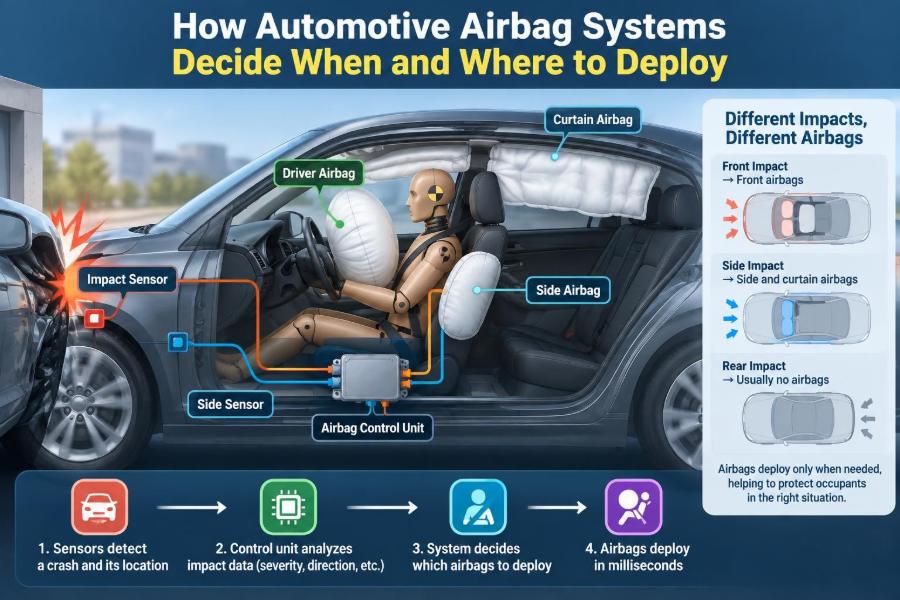

A vehicle is struck hard at an intersection. In a fraction of a second, the restraint system must answer several questions: Is this a crash severe enough to need airbags? Which occupants are at risk? Which airbags can help, and which would add little protection?
The visible event is simple: an airbag inflates. The engineering behind it is not. Sensors, electronic control units, algorithms, seat sensors, pretensioners, and inflators must work together before a driver has time to react.
Airbags are not designed to deploy in every impact. They are supplemental restraints, intended to work with seat belts and vehicle structures to manage occupant motion in particular crash conditions.
Understanding the decision process helps engineers diagnose faults, design safer vehicles, and explain why two apparently similar collisions can produce different airbag outcomes. 🛡️
🚗 1. The Airbag System Has a Narrow Time Window
Crash pulses develop very quickly. From the first contact to significant occupant movement, only milliseconds may be available for sensing, classification, and restraint activation.
The controller therefore does not wait for a collision to finish. It evaluates changing sensor signals continuously and makes a decision while the crash is still developing.
🧩 2. Airbags Are Supplemental Restraint Systems
The common name SRS means Supplemental Restraint System. Seat belts are the primary restraint because they begin controlling occupant motion before contact with an airbag.
An airbag spreads loads over a broader area and helps prevent contact with hard interior surfaces. It cannot reliably provide its intended protection when a person is unbelted, badly positioned, or too close to the module at deployment.
- Seat belts restrain the body early in the crash.
- Pretensioners remove belt slack.
- Load limiters manage belt force after tightening.
- Airbags provide a cushioning surface at the right time.
📡 3. Sensors Measure the Crash, Not Just the Impact
Modern systems do not simply look for a loud bang or a damaged bumper. They measure vehicle motion and, in many designs, use sensors located at more than one point on the vehicle.
The key input is often acceleration, measured along one or more axes. The controller interprets its direction, magnitude, duration, and shape over time.
📉 4. Acceleration and Delta-V Tell Different Parts of the Story
Acceleration describes how rapidly vehicle velocity is changing at a particular instant. A strong deceleration spike can indicate a sharp contact, but its meaning depends on how long it lasts.
When acceleration is evaluated over time, the system can estimate delta-V, the change in velocity associated with the crash. Algorithms use combinations of these signals rather than relying on one simple threshold.
🧠 5. The Airbag Control Unit Is the Decision Maker
The airbag control unit, also called an electronic control unit or restraint control module, receives sensor data and executes calibrated decision logic. It stores diagnostic information and may record event data after a qualifying crash.
Its software is designed to distinguish crash-like signals from ordinary driving events such as potholes, curb strikes, door slams, and braking on rough roads.
⚡ 6. A Crash Pulse Has a Shape
A crash signal is not judged only by its peak value. Engineers analyze the pulse shape: how quickly deceleration rises, how long it persists, and whether its progression resembles a deployable collision.
This matters because a brief, sharp event may not produce the same occupant motion as a lower peak deceleration sustained for longer. The controller evaluates evidence as it accumulates.
🔍 7. Confirmation Sensors Improve Decision Confidence
Many vehicles use a central accelerometer in the control unit and one or more remotely mounted sensors. Front sensors can detect early structural deformation, while side sensors can react closer to the struck area.
Using multiple inputs can improve robustness. A controller may require agreement between signals, or use one sensor to confirm that another signal represents a genuine crash.
↔️ 8. Crash Direction Determines the Initial Strategy
Frontal, side, rear, rollover, and oblique impacts produce different occupant motions. The direction of the crash helps determine which restraint devices can offer useful protection.
A frontal impact commonly drives occupants forward. A side impact can move an occupant toward the door or center of the vehicle much more quickly, leaving less time for sensing and deployment.
💥 9. Frontal Airbags Respond to Forward Occupant Motion
Driver and passenger frontal airbags are generally intended for moderate-to-severe frontal or near-frontal crashes. They help manage forward movement toward the steering wheel, instrument panel, or windshield area.
They may not deploy in a low-severity frontal impact, a rear-end collision, or a narrow object strike that produces limited deceleration. Visible damage alone does not determine the outcome.
🚪 10. Side Airbags Address a Much Shorter Space
In a side collision, there is relatively little crush space between the occupant and the intruding structure. Side airbags can deploy rapidly to protect the thorax, pelvis, or both, depending on the design.
Some are mounted in the seat, while others are in the door or side structure. Their placement is selected to remain effective across seat adjustments and expected occupant positions.
🪟 11. Curtain Airbags Protect the Head Area
Side curtain airbags deploy downward from the roof rail area along the side windows. They are primarily intended to reduce head contact with side structures and, in some situations, help reduce ejection risk.
Because they cover a larger area, curtains may remain inflated longer than frontal airbags. This can be important in rollover events or multi-impact crashes.
🌀 12. Rollover Detection Uses More Than Linear Acceleration
A rollover is defined by vehicle rotation as well as translation. Systems equipped for rollover sensing may use gyroscopes and accelerometers to estimate roll rate, roll angle, and the developing motion of the vehicle.
The controller seeks to identify a credible rollover condition early enough to deploy appropriate restraints, often including curtain airbags and belt pretensioners.
📐 13. Oblique Crashes Are Harder to Classify
Many real collisions are neither purely frontal nor purely side impacts. An oblique crash can combine longitudinal and lateral acceleration, structural rotation, and asymmetric occupant movement.
Modern sensing strategies evaluate multiple axes so the controller can recognize these mixed events. The resulting deployment may involve frontal devices, side devices, or both, according to the vehicle’s calibration.
🧍 14. Occupant Classification Changes Passenger Protection
The front passenger seat may include an occupant classification system. Depending on the vehicle, it can estimate whether the seat is empty, occupied by a small child, or occupied by an adult-sized person.
This information can suppress or modify passenger frontal airbag deployment when deployment could create unnecessary risk. The system must also account for objects placed on the seat and changes in seating condition.
🪑 15. Seat Position Can Influence Deployment Strategy
People sit at different distances from the steering wheel or instrument panel. Some vehicles use seat-track position information as one input for adaptive restraint decisions.
An occupant sitting close to an airbag has less distance over which to slow down. The restraint strategy may therefore differ from that selected for an occupant seated farther back.
📏 16. Out-of-Position Occupants Need Special Consideration
An airbag inflates very quickly and then begins venting. It is designed to cushion an occupant who moves into it after it has deployed, not someone leaning directly against the cover at the instant of deployment.
Children, rear-facing child seats, and occupants leaning forward require particular attention. Vehicle instructions and child-restraint guidance are part of the safety system, not optional details.
🔧 17. Pretensioners Usually Act Before the Airbag Does Its Job
A seat-belt pretensioner rapidly retracts or tightens part of the belt system during a qualifying crash. Its purpose is to remove slack and position the occupant more securely.
Pretensioners and airbags are coordinated, but they are separate devices. A crash may activate pretensioners without deploying every airbag, depending on crash type and severity.
🧯 18. The Inflator Converts a Command into Gas
Once deployment is commanded, electrical current initiates an inflator. The inflator produces gas that fills the folded cushion, forcing it through the module cover and into its designed shape.
Different inflator technologies exist, but the engineering aim is consistent: generate the needed gas in a controlled and repeatable manner while meeting the packaging and performance needs of the vehicle.
🌬️ 19. Airbags Inflate and Vent by Design
An airbag is not a rigid balloon. It contains vents that allow gas to escape as the occupant loads the cushion, helping manage force and reduce rebound.
Most frontal airbags begin deflating soon after inflation. This is why an airbag can cushion the occupant without trapping them in front of the steering wheel or dashboard.
🎛️ 20. Multi-Stage Inflators Allow Different Output Levels
Some frontal airbags use multi-stage inflators. The control unit can command one stage or more than one stage according to crash conditions and the restraint strategy.
Adaptive systems may consider crash severity, belt-use information, occupant classification, and seat position. The exact logic is vehicle-specific and carefully validated rather than universally identical.
🧭 21. Deployment Is a Matrix, Not a Single Switch
There is no universal rule such as “a crash above a certain speed deploys all airbags.” A deployment decision is a combination of crash direction, pulse characteristics, sensor confidence, occupant information, and available restraint devices.
| Crash condition | Likely restraint focus | Why |
|---|---|---|
| Moderate-to-severe frontal event | Belts, pretensioners, frontal airbags | Controls forward movement |
| Severe side intrusion | Side torso and curtain airbags | Provides protection in limited lateral space |
| Rollover condition | Curtains and pretensioners | Helps protect the head area and manage occupancy |
| Low-severity or nonqualifying event | Possibly no airbags | Deployment may offer limited benefit |
The table describes broad design intent, not a prediction for a particular vehicle. Actual behavior depends on model-specific sensing, calibration, and crash circumstances.
🧱 22. Vehicle Structure Is Part of the Sensing Problem
Crash energy is absorbed by structures such as bumper systems, crush rails, cross-members, doors, and pillars. Their deformation affects the sensor signals reaching the control unit.
As a result, the same nominal impact speed can produce different pulses when the striking object, overlap, angle, ride height, or structural compatibility changes.
🚧 23. Why a Damaged Vehicle May Have No Airbag Deployment
Exterior damage can be expensive without creating a crash pulse that warrants airbag deployment. Components near the surface may deform while the passenger compartment and occupant deceleration remain comparatively well managed.
Conversely, some severe events may show damage patterns that are not obvious from one viewing angle. Airbag deployment is not a simple damage gauge.
- A low-speed collision may damage lamps, radiators, and panels.
- A glancing impact may redirect the vehicle rather than create a strong longitudinal pulse.
- A rear impact may not call for frontal airbags.
- A sensor fault can illuminate a warning lamp and requires diagnosis.
⚠️ 24. Why Airbags Can Deploy Without Major Visible Damage
Striking a rigid object, dropping into a severe roadway discontinuity, or contacting an object in a concentrated area can create a sharp acceleration signal. The restraint controller reacts to measured dynamics, not repair cost.
After any deployment, the vehicle should be inspected and repaired using correct procedures. Airbag modules, pretensioners, sensors, trim, wiring, and the control unit may all require attention.
🧪 25. Calibration Requires Extensive Validation
Engineers develop and validate deployment algorithms through simulation, component tests, sled tests, full-vehicle crash tests, and analysis of representative crash conditions. The objective is not merely to trigger quickly, but to trigger appropriately.
Calibration must balance competing risks: deploying too readily in nonbeneficial events, deploying too late in serious crashes, or selecting the wrong restraint combination for occupants and crash direction.
💾 26. Diagnostics Monitor the System Before a Crash
The SRS warning lamp is part of an onboard diagnostic strategy. The control unit checks circuits, connectors, sensor communication, power supply conditions, and other monitored elements.
If the warning lamp remains illuminated, the system may have a fault that needs qualified diagnosis. It is unsafe to assume that airbags will operate normally when an SRS fault is indicated.
🔋 27. Backup Power Preserves Capability During a Crash
A severe impact can damage the main electrical supply or disconnect the battery. Airbag control units commonly include stored electrical energy so that a qualifying deployment can still occur if normal battery power is interrupted.
This reserve is another reason airbag service requires caution. Technicians follow manufacturer procedures, including prescribed waiting periods after disconnecting power.
🛠️ 28. Repairs Can Change Restraint-System Performance
Incorrect repairs after a collision can affect sensor mounting, wiring integrity, structural load paths, seat components, or trim designed to open for an airbag. These changes can compromise system operation.
Using correct replacement parts, repair methods, diagnostic equipment, and calibration procedures is essential. A cleared warning lamp alone is not proof that every repair is structurally and functionally correct.
✅ 29. The Core Principle: Deploy the Right Restraint at the Right Time
Automotive airbag systems make fast decisions by interpreting crash motion, confirming sensor evidence, identifying impact direction, and considering available occupant information. They do not respond to impact speed, noise, or visible damage in isolation.
The best outcome comes from an integrated system: crashworthy structure, correctly worn seat belts, properly positioned occupants, functioning sensors, pretensioners, and airbags selected for the developing crash. Airbags are most effective when the vehicle decides not simply whether to deploy, but which restraint combination can best manage occupant motion. 🛡️🚗⚡