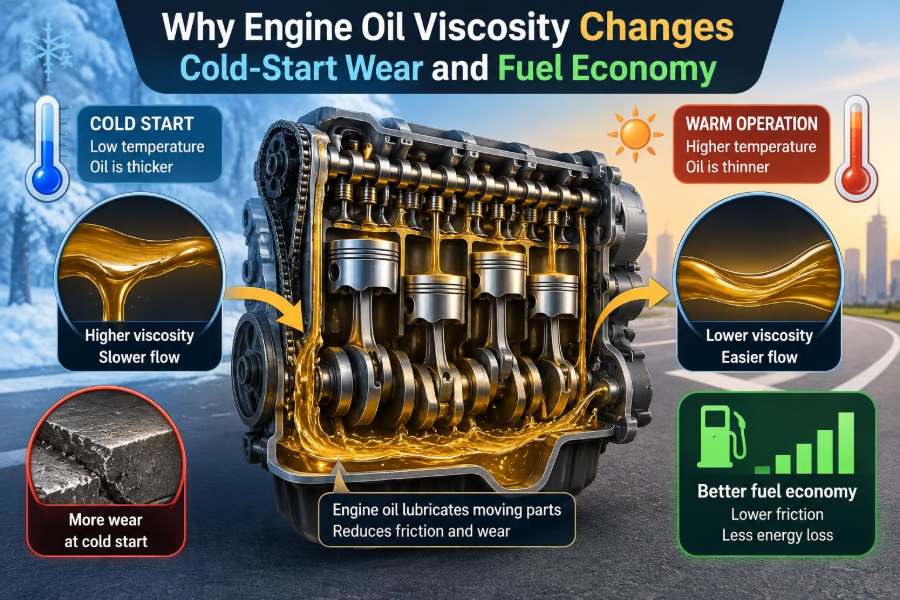

It is a cold morning, the vehicle has stood overnight, and the driver turns the key or presses the start button. The engine fires quickly, but for the first few seconds its moving parts are operating in a condition very different from a fully warmed engine.
Oil has drained away from some surfaces, its flow resistance is higher, and clearances between components have not yet reached their normal operating condition. This short period matters because many critical engine parts begin moving almost immediately.
At the same time, drivers and engineers want low fuel consumption. A thinner oil can reduce internal fluid drag, yet an oil that is too thin for the engine and operating temperature may not maintain the protective film required under load.
Engine oil viscosity is therefore a balancing variable: it affects how fast oil reaches parts during a cold start, how well the oil film separates surfaces, and how much energy the engine spends pumping and shearing oil. Understanding that balance is essential for selecting and managing lubricants correctly.
🛢️ 1. Viscosity Is Oil’s Resistance to Flow
Viscosity describes a fluid’s resistance to flowing or being sheared. Honey has a higher viscosity than water because it flows more slowly under the same conditions.
For engine oil, viscosity influences how readily the lubricant moves through galleries, filters, bearings, and small clearances. It also influences the thickness of the lubricating film that can exist between moving surfaces.
Viscosity is not simply “good” when high and “bad” when low. The useful viscosity is the one that suits the engine design, ambient conditions, operating temperature, and load.
🌡️ 2. Temperature Changes Viscosity Dramatically
All conventional engine oils become more viscous as temperature falls and less viscous as temperature rises. This is why oil that pours easily after a highway journey can seem much thicker after a cold night.
The change is especially important because engines see a wide temperature range: from cold ambient conditions before starting to high temperatures around pistons, turbochargers, and bearings in service.
A lubricant must remain fluid enough at low temperature while retaining sufficient viscosity at operating temperature. Modern multigrade oils are designed specifically to manage this compromise.
🔢 3. Reading a Multigrade Oil Label
A designation such as 5W-30 identifies a multigrade engine oil. The number before the W relates to low-temperature performance, while the number after the W indicates a viscosity grade measured at elevated test temperatures.
The W means winter, not weight. A lower first number generally indicates better low-temperature cranking and pumping behaviour within the classification system.
| Label element | What it broadly indicates | Practical relevance |
|---|---|---|
| 0W, 5W, 10W | Low-temperature cranking and flow capability | Cold starts and cold-climate operation |
| 20, 30, 40 | Viscosity range at high test temperature | Film behaviour when the engine is hot |
| 5W-30 | Combines cold and hot performance requirements | Suitable only if approved for the engine |
These numbers are not a complete description of oil quality. Additive chemistry, volatility, oxidation resistance, deposit control, and manufacturer approvals are equally important.
❄️ 4. What Happens Before a Cold Engine Starts
After shutdown, oil remains on many components as an adsorbed or residual film, while much of the bulk oil returns to the sump. The exact amount retained depends on component shape, surface condition, oil properties, and time spent parked.
As the engine cools, the oil in the sump and passages thickens. A very cold oil may resist movement strongly enough that the lubrication system takes longer to establish normal circulation.
The engine is not completely dry at the next start, but it is not operating under fully warmed, fully stabilised lubrication conditions either.
🔑 5. The First Seconds After Ignition
Once the crankshaft begins rotating, the oil pump must draw oil from the sump, push it through the filter and galleries, and supply bearings and valve-train components. The pump can generate pressure, but pressure alone does not guarantee immediate flow everywhere.
High viscosity increases resistance in the suction path, filter, galleries, and narrow passages. This can delay the establishment of the intended flow rate at remote or highly restricted locations.
Meanwhile, pistons, rings, cam followers, timing components, and bearings are already moving. The quality of lubrication during this transition has a strong influence on wear risk.
🧪 6. Boundary, Mixed, and Hydrodynamic Lubrication
Engine contacts do not all operate in the same lubrication regime. The regime changes with speed, load, temperature, surface finish, and the oil’s viscosity.
- Boundary lubrication: surface asperities carry much of the load, while chemically active additive films reduce friction and damage.
- Mixed lubrication: part of the load is carried by the oil film and part by asperity contact.
- Hydrodynamic or full-film lubrication: a continuous oil film separates surfaces and carries the load.
Cold starts commonly involve more boundary and mixed lubrication than steady hot running. This is why additive performance and rapid oil delivery both matter. ⚙️
🧱 7. Why Cold-Start Wear Is a Real Concern
Wear occurs when surfaces interact under insufficient separation, particularly where load is high or relative motion is repeated. Typical sensitive areas include the piston-ring and cylinder-liner interface, cam and follower contacts, timing-chain components, and some bearing conditions.
Cold oil does not automatically cause damage. However, higher viscosity and slower circulation can extend the period in which lubrication conditions are less favourable.
Repeated short trips can make this issue more relevant because the engine experiences many starts without spending much time at stable oil temperature.
🚿 8. Pumpability Is Not the Same as Pouring
Oil may appear to flow from a container yet still be difficult for an engine oil pump to draw and circulate under severe cold conditions. Pumpability concerns whether the lubricant can move through the pickup system and lubrication circuit in practical operating conditions.
At low temperature, wax structures in mineral-base oils and the overall viscosity of the lubricant can restrict movement. Formulation choices help control this behaviour.
A lower W grade is designed to meet lower-temperature performance requirements than a higher W grade. It should still be selected only where the vehicle manufacturer allows it.
📈 9. Pressure Can Be Misleading
Drivers sometimes assume that high oil pressure means excellent lubrication. In reality, pressure is a response to flow resistance within the system, and thick cold oil can produce elevated pressure quickly.
If a pressure-relief valve opens, part of the pump output may be diverted to control excessive pressure. Some flow paths can still be restricted while the dashboard indication appears normal.
Oil pressure is important, but delivered flow at the correct locations is what sustains lubrication. Engineers design the pump, relief valve, galleries, and oil grade as a system.
🔄 10. Viscosity and Bearing Film Thickness
In journal bearings, the rotating shaft draws oil into a converging clearance and develops a pressure-supporting film. Viscosity contributes to the film’s ability to carry load.
At operating temperature, oil that is too low in viscosity for a particular bearing design and load may produce a thinner film than intended. This can increase the chance of mixed lubrication, especially under high load or high oil temperature.
Conversely, excessive viscosity raises drag and pumping effort. The target is sufficient film thickness without unnecessary fluid resistance.
🏎️ 11. High-Speed Parts Need the Right Oil Film
Camshaft lobes, followers, piston rings, turbocharger bearings, and timing systems face different combinations of speed, load, and oil supply. No single simple rule such as “thicker is safer” describes every component.
For example, a turbocharger may spin at very high speed and depends on correct oil flow and thermal stability. A modern valvetrain may contain compact passages designed around a specific low-viscosity oil.
Using the specified lubricant helps ensure that all these different components receive the balance anticipated by the engine designer.
⛽ 12. Oil Creates Internal Engine Losses
Not all fuel energy reaches the wheels. Some is used to overcome friction and to move fluids inside the powertrain. Engine oil contributes to several of these losses.
- Pumping oil from the sump and through passages requires mechanical work.
- Shearing oil films in bearings and between moving surfaces consumes energy.
- Rotating components must move through oil mist, splash, and windage around the crankcase.
- Cold, viscous oil can increase these losses noticeably during warm-up.
Lower-viscosity oils can reduce some of this resistance, which is one reason they are used in many modern engines.
📉 13. Why Fuel Economy Is Most Affected During Warm-Up
When oil is cold, its viscosity is considerably higher than its normal operating value. The oil pump and moving assemblies therefore encounter greater resistance.
At the same time, a cold engine also has other efficiency penalties: richer fuelling strategies may be used, combustion is less stable, and coolant and metal temperatures are low. Oil viscosity is one contributor within this larger warm-up picture.
On long highway trips, oil reaches a more stable temperature and viscosity. On short trips, a greater proportion of operation occurs in this less efficient phase.
🛞 14. Lower Viscosity Does Not Mean No Protection
Modern low-viscosity oils are engineered using carefully selected base oils and additive systems. Their protection does not rely only on being physically thick.
Anti-wear additives, friction modifiers, detergents, dispersants, antioxidants, and viscosity modifiers each support performance in different ways. The formulation must meet defined performance requirements as a complete product.
A modern 0W-20 or 0W-30 oil approved for an engine is not simply a diluted version of an older, thicker oil. It is designed around the engine’s clearances, materials, emissions hardware, and service demands.
🧬 15. Viscosity Index Helps Explain Multigrade Behaviour
Viscosity index is a measure describing how strongly an oil’s viscosity changes with temperature. A higher viscosity index generally means the viscosity changes less over a specified temperature range.
Multigrade oils use base-stock selection and, in many formulations, polymeric viscosity-index improvers to achieve useful cold-flow and hot-viscosity characteristics together.
These polymers change their effective shape with temperature. Their behaviour helps the oil avoid becoming excessively thin at high temperature while remaining more manageable at low temperature.
🧵 16. Shear Stability Matters in Service
Viscosity-index improvers can be exposed to mechanical shearing in high-stress regions such as bearings, gears, and pumps. If an oil loses viscosity through permanent shear, its high-temperature protection margin may be reduced.
Engine-oil formulations are tested and designed for their intended duty, but harsh operation, extended drain intervals, contamination, and high temperatures all increase the importance of using the correct approved product.
Fresh oil viscosity alone is not the whole story; viscosity retention throughout the drain interval also matters.
🧊 17. The Meaning of Cold-Cranking Performance
A starter motor must overcome engine compression, mechanical friction, and the resistance caused by cold lubricant. Thick oil increases drag at the crankshaft, bearings, valvetrain, and other moving parts.
Low-temperature cranking classifications help indicate whether an oil can permit acceptable cranking at specified cold conditions. They do not guarantee that every vehicle will start in every situation.
Battery condition, starter health, fuel quality, ignition or injection performance, and ambient temperature remain important. Still, choosing an appropriate W grade reduces one major cold-start burden.
🔍 18. The Oil Filter Adds Useful Resistance
An oil filter protects the engine by capturing harmful particles, but it also creates a pressure drop as oil flows through its media. When oil is cold and viscous, that pressure drop can increase.
Many systems include a bypass valve to maintain oil supply if the pressure difference across the filter becomes excessive. Bypass flow is a protective measure, not a preferred normal operating condition, because filtration may be reduced while it is active.
Correct filters and timely replacement are therefore part of the lubrication system’s cold-start performance.
🧯 19. Fuel Dilution Can Alter Viscosity
Fuel can enter crankcase oil through processes such as incomplete combustion, cold running, repeated short journeys, injector faults, or particular operating strategies. The effect depends on the engine and conditions.
Fuel dilution often lowers oil viscosity, which can weaken high-temperature film strength. It can also affect volatility and the oil’s ability to protect components over the intended drain interval.
Drivers who notice a rising oil level, persistent fuel smell in the oil, or warnings should investigate according to the vehicle manufacturer’s guidance rather than assuming the oil is still suitable.
💧 20. Water and Soot Change Lubrication Too
Short trips may allow moisture to accumulate when the oil does not stay hot long enough to evaporate water vapour. Contamination can promote corrosion and interfere with the lubricant’s condition.
In some diesel engines, soot loading is also an important consideration. Dispersant additives keep soot particles suspended, but excessive contamination can raise viscosity and increase abrasive wear risk.
Viscosity is thus affected not only by temperature but also by ageing, oxidation, fuel dilution, soot, and other contaminants.
🚗 21. City Driving Is a Severe Lubrication Duty
Urban use commonly combines repeated starts, low average speeds, stop-start operation, idling, and short journeys. These conditions can keep oil below its ideal stabilised temperature for much of the trip.
Frequent thermal cycling also challenges the lubricant with condensation, fuel dilution risk, and oxidation over time. The engine may accumulate relatively little distance while experiencing many start events.
For this reason, maintenance schedules often distinguish between normal and severe service. Owners should use the schedule and oil specification applicable to their actual usage pattern.
🛣️ 22. Highway Driving Creates Different Demands
Steady driving usually gives the oil more time to warm up and circulate under stable conditions. Pumping losses from cold viscosity become less dominant once the lubricant reaches normal operating temperature.
However, sustained high speed, heavy load, hot weather, towing, or mountain driving can raise oil temperature. Under these conditions, the hot-viscosity grade and oxidation resistance become especially relevant.
The same vehicle can therefore place very different demands on its oil in winter city commuting and summer loaded highway travel.
📘 23. Manufacturer Approval Comes Before Grade Alone
Two oils with the same SAE viscosity designation can have different additive packages and different performance approvals. One may be suitable for a particular engine while the other is not.
Manufacturer specifications can address issues such as wear protection, deposit control, turbocharger cleanliness, fuel-economy performance, compatibility with after-treatment systems, and drain interval capability.
Always begin with the owner’s manual or service information: select an oil carrying the required approval, then choose among permitted viscosity grades for the expected climate and use.
⚠️ 24. Why “Thicker for Protection” Can Be the Wrong Decision
A thicker oil may seem reassuring because it can produce a thicker film under some conditions. Yet if the engine was designed for a lower viscosity, moving to a much thicker grade can impair cold flow, increase pumping losses, and alter the operation of hydraulic components.
Variable valve timing actuators, hydraulic lash adjusters, chain tensioners, and narrow oil-fed passages may be particularly sensitive to oil-flow characteristics. A non-approved grade can create problems even if oil pressure appears high.
Extra viscosity should not be used as a substitute for diagnosing oil consumption, low pressure, wear, overheating, or mechanical faults.
✅ 25. Why “Thinner for Economy” Can Also Be Wrong
Using oil thinner than the manufacturer permits may improve flow and reduce drag in theory, but it can reduce the oil-film margin at high temperature and load. It may also fail to meet the engine’s required approval.
Older engines, engines with high mileage, and engines used in demanding service do not automatically require thicker oil. Their condition should be assessed against the manufacturer’s permitted grades and professional diagnostic evidence.
The right decision is not based on a universal preference for thin or thick oil. It is based on the intended operating window.
🧰 26. Practical Steps for Drivers and Technicians
Good lubrication practice begins with correct selection and continues with proper maintenance. Small routine decisions can reduce cold-start stress and preserve fuel economy.
- Use the specified oil approval and an allowed viscosity grade.
- Consider expected ambient temperatures when choosing among permitted grades.
- Maintain the oil level between the recommended marks; both low and excessive levels can cause problems.
- Use a suitable, quality filter and replace it at the scheduled interval.
- Avoid unnecessary hard acceleration immediately after a cold start.
- Investigate warning lamps, unusual valvetrain noise, oil consumption, or changes in oil level promptly.
Long idling is generally not an efficient method of warming an engine. Gentle driving after a brief stabilisation period usually warms the powertrain more effectively, subject to the vehicle manufacturer’s instructions.
🧑🔧 27. A Technician’s Diagnostic View
When an engine shows cold-start noise, slow pressure build-up, poor fuel economy, or abnormal wear, oil viscosity is only one possible factor. Diagnosis should consider the entire lubrication and engine-management system.
Useful checks include
- Verifying the exact oil grade, approval, level, condition, and service history.
- Checking for incorrect filters, blocked pickup screens, leaks, or pressure-control faults.
- Assessing battery, cranking speed, coolant-temperature readings, and cold-start fuelling behaviour.
- Looking for contamination, fuel dilution, overheating history, or excessive sludge.
Changing to a different viscosity without finding the cause may hide symptoms temporarily while allowing the real fault to continue.
🎯 28. The Core Principle: Fast Flow, Strong Film, Low Losses
Engine oil must flow quickly enough during cold starting, maintain an adequate lubricating film when the engine is hot and loaded, and avoid creating unnecessary pumping and shearing losses. These requirements naturally compete with one another.
Multigrade oils and modern additive technology make this balance possible, but only within the limits for which an oil and engine were designed. Cold-start wear and fuel economy are both strongly influenced by viscosity because viscosity controls the movement and behaviour of the lubricant itself.
The best engine oil is not the thickest or the thinnest oil; it is the approved oil whose viscosity matches the engine’s design, climate, and duty cycle. Choosing it correctly protects components during vulnerable starts while helping the engine operate efficiently once on the road. 🛢️⚙️🌡️