
A dashboard reminder appears just as you are rushing to work. The car feels normal, but you cannot remember whether the last oil change was six months ago or closer to a year. The glovebox may contain a receipt, an old inspection report, and a service booklet—none of them easy to use when you need an answer quickly.
That uncertainty is familiar because vehicle maintenance is usually a collection of small jobs rather than one dramatic event. Tyres wear gradually, fluids decline slowly, and filters become restricted over time. Without a simple record, routine care turns into guesswork.
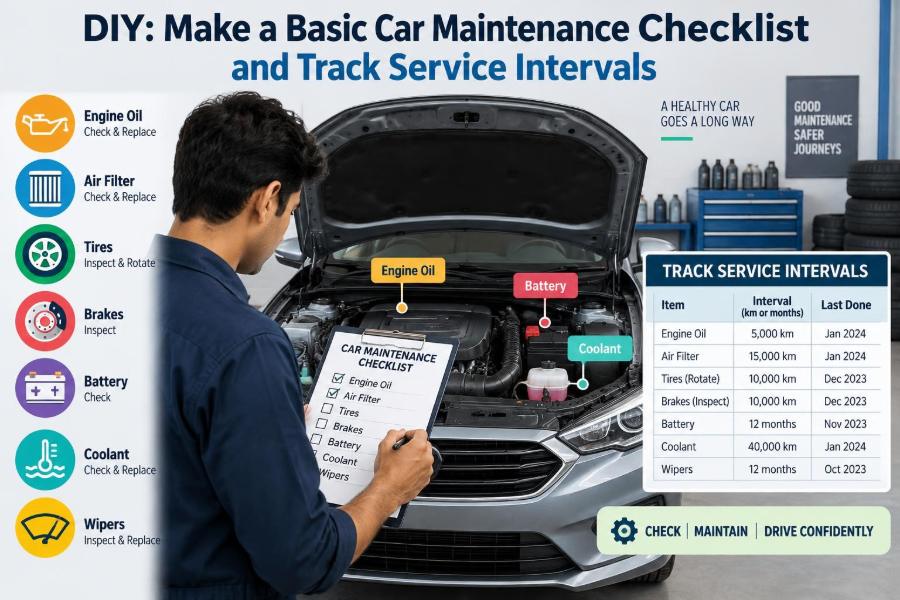
A basic maintenance checklist gives each task a place, a trigger, and a history. It does not turn every driver into a technician, nor does it replace the vehicle manufacturer’s maintenance schedule. It helps you notice what is due, ask better questions at a workshop, and avoid overlooking the straightforward work that protects safety and reliability.
The useful goal is not to service parts unnecessarily. It is to track the right items by time, distance, condition, and operating conditions, then act before a small maintenance need becomes a roadside problem.
🧰 What a maintenance checklist actually does
A car maintenance checklist is a structured list of inspections, replacements, and service actions, with space to record when each was completed. Its value comes from converting vague intentions such as “check the tyres sometime” into a repeatable routine.
Each line should answer four questions: what is checked or replaced, when it was last done, what triggers the next action, and what was found. This creates a usable maintenance history rather than a pile of invoices.
📘 Start with the owner’s manual
The owner’s manual is the primary source for your specific model. It identifies fluid specifications, warning-light meanings, capacities, tyre pressures, approved service intervals, and procedures that differ between engines, transmissions, hybrid systems, and markets.
Use a checklist to organize the manual’s requirements, not to override them. If a generic list says to replace an item at one interval but your manual specifies another, follow the manual or seek advice from a qualified technician.
🧭 Understand the four service triggers
Most maintenance tasks are governed by one or more triggers. A good tracker records the trigger type instead of relying on a single calendar date.
- Distance: used for wear-related items such as engine oil, filters, and tyre rotation.
- Time: used when fluids, rubber, or chemical additives age even with low mileage.
- Condition: used for tyre tread, brake-pad thickness, wiper performance, and battery health.
- Warning or symptom: used when a lamp, noise, leak, vibration, or change in driving behaviour requires prompt diagnosis.
For many tasks, the earliest applicable trigger matters. An oil service described as “distance or time, whichever comes first” is not optional for low-mileage cars.
🗂️ Choose a tracking format you will maintain
The best format is the one you will update immediately after a service. A paper page in a folder works well for owners who keep printed receipts. A spreadsheet can calculate upcoming mileage, while a notes app is convenient when the car is away from home.
Some drivers use a calendar reminder plus a digital log. This combination is practical: the calendar prompts action, and the log preserves the details. Avoid relying only on a dashboard sticker, which may disappear after a windscreen replacement or only cover one service item.
🧾 Build the core service-record fields
Keep the record simple enough to update in less than a minute. At minimum, note the date, odometer reading, task, next due point, and receipt or invoice reference.
| Field | Why it helps | Example |
|---|---|---|
| Date and odometer | Creates a verifiable service point | 12 March; 48,250 km |
| Task and parts used | Shows exactly what was done | Oil and filter replaced; specified oil grade |
| Next trigger | Makes planning straightforward | At manual interval or specified date |
| Condition notes | Captures developing issues | Front pads wearing evenly; tyres rotated |
| Receipt reference | Supports warranty and resale records | Invoice saved in vehicle folder |
Do not record only “service done.” That phrase cannot tell a future owner, technician, or even you which fluids and filters were actually changed.
🛢️ Track engine oil and the oil filter
Engine oil reduces friction, carries heat away from moving parts, and suspends contaminants for the filter to capture. Over time, thermal stress, contamination, and additive depletion reduce its ability to do this work.
Record the oil grade, quantity if known, filter replacement, date, and mileage. Many modern vehicles calculate oil life from operating conditions, but that monitor still needs to be reset correctly after service and does not remove the need to observe time limits in the manual.
Check the level only using the method specified for the vehicle, on suitable level ground. Overfilling can be harmful too, so “more oil” is not automatically safer.
💧 Check coolant carefully
Coolant transfers heat from the engine and protects internal passages against freezing, boiling, and corrosion. Its concentration and chemical formulation matter; mixing incompatible coolants can reduce corrosion protection or create deposits.
Inspect the reservoir level when the engine is cold and look for obvious staining, wet hoses, or a sweet smell around the cooling system. A slowly falling level is not a normal maintenance item to ignore—it can indicate a leak that needs diagnosis.
Never remove a pressurized cooling-system cap when the engine is hot. Hot coolant can escape forcefully and cause serious burns.
🛑 Give brake checks a fixed place
Brakes deserve condition-based checks because pad wear depends greatly on traffic, hills, vehicle load, and driving style. A visual inspection may reveal pad thickness, rotor condition, flexible-hose damage, and signs of fluid leakage, but some components are not easily visible without removing wheels.
Brake fluid absorbs moisture over time in many conventional systems. The manual will specify inspection or replacement guidance. Record fluid service separately from pad or rotor replacement; they are related systems, but they are not the same task.
A soft pedal, pulling under braking, grinding noise, brake warning light, or sudden change in braking performance calls for professional assessment rather than waiting for a planned checklist date.
🛞 Make tyre care a monthly habit
Tyres are the vehicle’s only contact with the road. Pressure affects load carrying, steering response, braking, wear pattern, and heat generation, while tread depth affects the tyre’s ability to clear water.
Check pressure when tyres are cold, using the vehicle manufacturer’s placard pressure rather than the maximum pressure printed on the tyre sidewall. Include the spare tyre if the vehicle has one that requires inflation.
- Look for cuts, bulges, embedded objects, and uneven wear.
- Measure tread with an appropriate gauge and comply with local legal minimums.
- Record rotations, alignments, puncture repairs, and replacements.
- Investigate repeated pressure loss instead of continually adding air.
🔄 Record tyre rotation and wheel alignment separately
Tyre rotation moves tyres between positions to distribute wear according to the approved pattern for the vehicle and tyre type. It does not correct alignment. Wheel alignment refers to suspension geometry, including angles that influence straight-line stability and wear.
Feathered tread, a steering wheel that is off-centre, or a vehicle that consistently drifts on a level road can justify an alignment inspection. Record the reason for the check as well as the result, because a recurring alignment issue may point to worn suspension or impact damage.
🔋 Watch the battery before it fails
A conventional 12-volt battery can weaken gradually, especially after short trips, long parking periods, extreme temperatures, or repeated accessory use with the engine off. Slow cranking, dimming lights, and electrical warnings can be clues, though they may also arise from charging-system faults.
Inspect terminals for looseness and corrosion, and keep the hold-down secure. A battery test reports condition at that moment; it cannot perfectly predict the future. Record test dates, battery installation date if known, and any charging or replacement work.
Hybrid and electric vehicles also have a low-voltage battery, but their high-voltage systems require model-specific procedures. Do not attempt high-voltage repairs without suitable training and equipment.
💡 Test lights, signals, and visibility equipment
Exterior lights are safety equipment and communication tools. Test headlights, tail lamps, brake lamps, indicators, reverse lights, hazard lights, and number-plate illumination where fitted. A helper makes brake-light testing easier, or use a safe reflective surface where appropriate.
Also inspect mirrors, windscreen washers, and demisters. Poor visibility can develop quietly: a weak washer jet or hazed lamp lens may be noticed only in rain or darkness, when it matters most.
🌧️ Replace wipers based on performance
Wiper blades do not have one universal replacement interval. Sun exposure, freezing conditions, dust, and infrequent use all affect the rubber edge. Streaking, skipping, chattering, or an unclean sweep are more useful replacement triggers than a guess based on age.
Top up washer fluid with a product suitable for the local climate and the vehicle’s system. In freezing weather, plain water can freeze in the reservoir or on the glass. Clean the windscreen regularly, because grit can damage both the glass and the blade edge.
🌬️ Separate the engine air filter from the cabin filter
The engine air filter protects the intake system from dust. A heavily loaded filter can affect airflow, but replacement should follow the manufacturer’s interval or inspection guidance rather than assuming every dirty-looking filter is overdue.
The cabin air filter serves a different purpose: it filters air entering the passenger compartment through the heating, ventilation, and air-conditioning system. A restricted cabin filter may reduce airflow or contribute to musty odours. Record these filters as separate lines in the checklist.
⚙️ Do not forget transmission and driveline fluids
Transmission, transfer-case, and differential fluids lubricate gears, bearings, clutches, or hydraulic components, depending on the design. Their service requirements vary substantially. Some vehicles have accessible checks; others require a specific temperature, scan tool, or procedure.
Terms such as “lifetime fluid” should be read alongside the exact manual conditions and local service guidance. Severe operating conditions—such as towing, repeated short trips, high ambient heat, or mountain driving—can change service requirements. Never substitute fluid by colour or a generic description alone.
🧪 Include steering, suspension, and underbody observations
Steering and suspension components keep the tyres positioned correctly and help the vehicle respond predictably. During a basic walk-around, listen for clunks, observe uneven tyre wear, and note leaks from dampers or struts.
Underbody checks can also identify damaged shields, corrosion, fluid drips, and loose exhaust components. These are observations, not a substitute for safe lifting and inspection. Never crawl under a vehicle supported only by a jack; use approved support equipment or have a workshop inspect it.
🔍 Learn the difference between a warning and a reminder
A maintenance reminder generally tells you that a scheduled service is due. A warning light may indicate a system fault, an unsafe condition, or a need for immediate attention. The symbols vary by vehicle, so the manual matters.
A flashing engine-management light, low oil-pressure warning, overheating indication, brake-system warning, or battery charging warning should not be treated as an ordinary to-do item. Follow the manufacturer’s instructions and stop safely if advised. Continuing to drive can turn a manageable fault into major damage or a safety hazard.
📏 Use baseline readings to spot change
A single observation is less informative than a pattern. If you periodically note tyre pressures, oil level, coolant level, and any unusual noise, you gain a baseline for what is normal for your vehicle.
For example, a small oil-level change may be difficult to interpret after one journey. A documented downward trend checked in consistent conditions is more useful when discussing the issue with a technician. Record facts rather than assumptions: “oil level moved from upper mark to mid-range over several checks” is better than “engine is damaged.”
📅 Create monthly, seasonal, and annual routines
Grouping tasks by cadence makes the checklist easier to use. Monthly checks are quick observations. Seasonal checks prepare the vehicle for temperature or weather changes. Annual review is a good time to reconcile records and plan manufacturer-scheduled work.
Practical routine structure
- Monthly: tyre pressure and condition, exterior lights, washer fluid, visible leaks, and dashboard warnings.
- Before long trips: tyres, fluids, wipers, lights, spare tyre or mobility kit, and emergency equipment.
- Seasonally: battery condition, coolant protection where relevant, wiper performance, climate-control operation, and tyre choice for local conditions.
- Annually: review the manual schedule, service records, recalls or manufacturer notices where applicable, and professional inspection needs.
🚚 Define what “severe service” means for your car
“Severe” does not necessarily mean dramatic off-road use. Many ordinary driving patterns can be demanding: frequent short trips before the engine fully warms, sustained stop-start traffic, dusty roads, towing, carrying heavy loads, prolonged idling, or steep terrain.
These conditions may increase heat cycles, contamination, braking demand, and load on lubricants. Check the manual’s severe-service definition instead of assuming that low annual mileage equals easy use.
🧮 Calculate the next due point without false precision
For distance-based tasks, add the manufacturer-specified interval to the recorded odometer reading. For example, if a hypothetical manual calls for an inspection every 10,000 km and it was completed at 48,250 km, the next target is 58,250 km.
Do not treat that number as a cliff edge. It is a planning point, not permission to ignore a warning, leak, or poor performance until the exact mileage arrives. Add a reminder slightly ahead of the due point so you can book service conveniently.
🧷 Keep receipts and part details with the log
A checklist records the overview; receipts provide supporting detail. Save workshop invoices, parts receipts, tyre reports, inspection reports, and warranty paperwork together. Photographing a paper receipt is sensible because thermal paper can fade.
For DIY work, record the part number or specification, fluid type, quantity, and any torque-sensitive procedure performed according to reliable vehicle information. This helps prevent accidental mixing of incompatible products at the next service.
🔧 Decide which jobs are suitable for DIY
Basic checks—such as tyre-pressure measurement, washer-fluid top-up, lamp inspection, and visual fluid-level checks—are within reach for many owners. Even then, use the correct tools, keep hands clear of moving parts, and follow the vehicle instructions.
Jobs involving lifting the car, brakes, pressurized systems, airbag components, fuel, high-voltage equipment, or complex electronic resets have higher risk. The boundary is not a matter of pride. If you lack information, equipment, confidence, or a safe workspace, professional service is the appropriate decision.
🧤 Prepare a small, useful inspection kit
A compact kit removes excuses for skipping simple checks. It need not be expensive or elaborate.
- Accurate tyre-pressure gauge and a way to inflate tyres
- Tread-depth gauge
- Clean cloths and disposable gloves
- Correct washer fluid and a small funnel
- Notebook or phone-based checklist
- Flashlight for looking around wheel arches and under the bonnet
Keep chemicals sealed and labelled. Do not store loose tools where they can become projectiles in a sudden stop.
🧠 Avoid the most common tracking mistakes
The first mistake is making the system too complicated. A sprawling spreadsheet with dozens of rarely relevant fields is less useful than a concise log updated consistently. Start with manufacturer-required tasks and basic safety checks.
Another mistake is resetting a service reminder without completing the service, or assuming a workshop completed every item during a generic “full service.” Read the invoice and ask what was inspected, measured, replaced, and deferred.
Finally, avoid treating appearance as diagnosis. Fresh-looking fluid, quiet brakes, or a clean engine bay do not prove every system is healthy.
🧾 Use workshop visits more effectively
Bring your record to a workshop and describe symptoms with dates, mileage, and conditions. “A vibration appears at motorway speed after tyre rotation” is far more useful than “the car feels strange.” It gives the technician a focused starting point.
Ask for measured findings when appropriate: pad thickness, tyre tread readings, battery-test result, or the reason an item was recommended. This is not distrust; it helps you keep an accurate service history and prioritize work intelligently.
🏷️ Plan for warranty, inspection, and resale
Service documentation may be relevant to warranty conditions, inspection requirements, and resale value, but requirements vary by location, manufacturer, and contract. Keep records clear and retain evidence of both dealer and independent-workshop services.
A well-documented vehicle is easier to assess because its maintenance story is visible. That does not guarantee its condition, but it gives a buyer or technician useful context and shows whether scheduled items were considered.
🗣️ Make a checklist that fits your vehicle
A compact starter checklist might include oil service, tyres, brakes, coolant, battery, lights, wipers, filters, and the specific driveline fluids named in your manual. Add model-specific items such as timing-belt replacement, spark plugs, diesel emissions-system maintenance, or hybrid cooling checks only where the manufacturer requires them.
Personalize the log with your driving pattern. A city commuter, a vehicle that tows a trailer, and a lightly used weekend car need the same disciplined recordkeeping, but their likely service triggers may not be identical.
✅ The core principle: observe, record, and respond
Effective maintenance is not about replacing every part early or reacting anxiously to every sound. It is a cycle: inspect simple items safely, record what was done and what changed, follow the manufacturer schedule, and respond promptly to warnings or abnormal conditions.
That cycle protects the parts of motoring that matter most—safe stopping, clear visibility, dependable starting, predictable handling, and fewer avoidable surprises. A checklist is valuable because it makes routine care visible before memory fades.
Build a small checklist, update it every time the car is serviced, and let the manufacturer’s schedule guide every major decision. A few clear records can make car ownership calmer, safer, and much easier to manage. 🚗🧰📅