
You may have noticed a small family car wearing a 1.0-litre or 1.5-litre badge while producing power once expected from a much larger engine. Press the accelerator, and it can pull confidently onto a motorway, climb a hill with passengers aboard, or overtake without feeling underpowered.
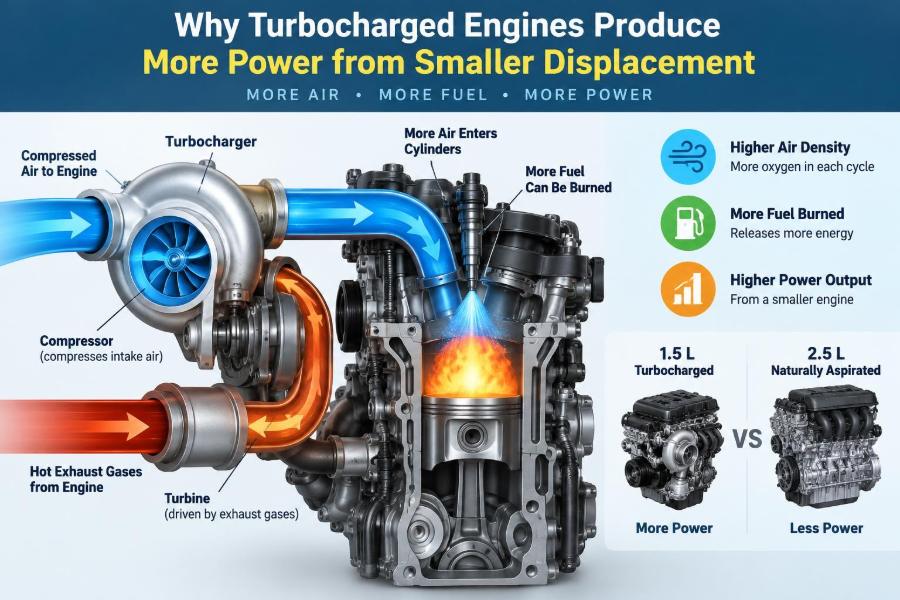
That result often comes from a turbocharger. Rather than making an engine physically larger, a turbo uses energy in the exhaust stream to force more air into the cylinders. More air allows more fuel to be burned safely, so a small engine can release more energy on every combustion cycle.
This matters far beyond impressive specification-sheet numbers. Turbocharging shapes vehicle packaging, fuel economy strategies, emissions control, engine durability, driving feel, and maintenance requirements. It is one of the defining technologies behind modern gasoline and diesel powertrains.
The basic idea is simple, but the engineering behind it is not. Understanding why turbocharged engines make more power from less displacement requires following the path of air, fuel, heat, pressure, and control systems through the engine.
🚗 Displacement Sets the Engine’s Natural Air Capacity
Engine displacement is the combined swept volume of all cylinders. A 2.0-litre four-cylinder engine, for example, can draw in roughly twice the cylinder volume per intake stroke as a naturally aspirated 1.0-litre engine operating under comparable conditions.
In a naturally aspirated engine, atmospheric pressure pushes air into the cylinders as the piston moves downward. The engine can only fill the available cylinder volume with air at approximately ambient pressure, minus restrictions caused by the intake system, throttle, valves, and airflow dynamics.
More displacement therefore usually means more air per cycle, more fuel that can be mixed with that air, and potentially more torque. A turbocharger changes this relationship by increasing the mass of air packed into a given cylinder volume.
🌬️ Power Begins with Air Mass, Not Just Engine Size
An engine does not make power simply because its cylinders are large. It makes power by burning fuel, and fuel combustion requires oxygen. The useful question is not merely, “How many litres is the engine?” but “How much oxygen reaches the cylinders each cycle?”
Air density matters because a cylinder full of cool, dense air contains more oxygen molecules than the same cylinder volume filled with hot, thin air. If the engine management system adds the correct amount of fuel, that denser charge can release more energy during combustion.
A turbocharged 1.5-litre engine can therefore ingest an air mass comparable to that of a larger naturally aspirated engine at high load. It has not gained physical cylinder volume; it has increased the density of the charge inside the volume it already has.
🌀 The Turbocharger’s Two Connected Wheels
A conventional turbocharger contains two small turbines mounted on a common shaft inside separate housings. Exhaust gas drives the turbine wheel on one side. The shaft then spins the compressor wheel on the intake side.
The compressor draws fresh air through the air filter and accelerates it outward. Its shaped housing converts much of that velocity into pressure before the air travels toward the engine intake.
This arrangement is clever because it uses energy that would otherwise leave through the exhaust pipe as heat and gas motion. A turbocharger does create some exhaust restriction, so the energy is not completely “free,” but it can recover useful energy without a belt-driven connection to the crankshaft.
🔥 Exhaust Gas Provides the Turbine’s Driving Energy
After combustion, exhaust gases leave the cylinder at high temperature and pressure. Their energy is sufficient to spin a turbine at extremely high rotational speeds. The turbine’s speed varies with exhaust flow, exhaust temperature, turbine design, and wastegate control.
When the driver requests more torque, the engine injects more fuel and produces more exhaust energy. The turbine accelerates, the compressor supplies more pressurized intake air, and the system can support increased fueling. This is the basic feedback path behind boost production.
At low engine speed, exhaust energy is limited. That is why a turbo cannot always provide maximum boost instantly, especially with a relatively large turbine. The delay between opening the throttle and receiving strong boost is commonly called turbo lag.
📈 Boost Pressure Raises Cylinder Charge Density
Boost is intake pressure above atmospheric pressure. When compressed intake air enters the cylinder, its increased density means the cylinder holds more oxygen than it would under natural aspiration.
Imagine two identical bottles. One holds air at ordinary room pressure; the other is filled with compressed air. Both have the same physical volume, but the compressed bottle contains more air molecules. Boost works similarly, although the real engine process is affected by heat, valve timing, pressure losses, and cylinder filling behavior.
Higher boost can support higher torque, but pressure alone does not tell the complete story. Intake temperature, fuel quality, combustion timing, exhaust backpressure, and component limits all determine how much useful power the engine can produce reliably.
⚖️ Torque Is the Immediate Result Drivers Feel
Power is related to torque and engine speed. In practical driving, a turbocharged engine’s noticeable advantage is often its torque at modest rpm rather than only its peak power figure.
Because boost can build in the middle of the rev range, a small turbo engine may deliver strong pulling force without needing very high rpm. This suits everyday acceleration, hills, loaded vehicles, and relaxed cruising.
For example, a hypothetical 1.4-litre turbo engine may feel stronger in normal traffic than a larger naturally aspirated engine that needs several thousand more rpm to approach its best torque. The comparison depends on gearing and calibration, but the driving impression is common.
🔄 Why Power Depends on Torque and Engine Speed
Torque describes the twisting force available at the crankshaft. Power describes how quickly the engine can do work. An engine can produce substantial torque at low rpm, but maximum power usually arrives later because the crankshaft is turning faster.
Turbocharging helps increase the torque available per combustion event by allowing more air and fuel into each cylinder. If that torque remains available across a broad speed range, the engine can produce useful power without excessive displacement.
This is why manufacturers often publish torque curves alongside maximum power. A single peak-power value cannot show whether a vehicle will feel responsive in the rev range used most often.
🧪 The Air-Fuel Ratio Must Stay Under Control
Extra air is only helpful when the engine delivers an appropriate amount of fuel. The engine control unit, or ECU, uses sensors and programmed maps to calculate fueling, ignition timing, throttle position, boost targets, and other operating decisions.
For gasoline engines, the mixture may be controlled near the chemically ideal ratio during many conditions so the catalytic converter can work effectively. Under high load, some engines use different mixture strategies to manage combustion temperature and protect components, depending on their design and emissions system.
Diesel engines generally operate with excess air and regulate output primarily through fuel quantity. Turbocharging is especially valuable for diesel engines because it supplies the oxygen needed to burn more fuel cleanly and reduce visible soot formation under load.
❄️ Compression Heats the Intake Charge
Compressing air raises its temperature. This is a fundamental limitation of turbocharging: the compressor increases pressure, but it also creates heat. Hot intake air is less dense than cool intake air at the same pressure and increases the likelihood of unwanted combustion behavior in gasoline engines.
Compressor efficiency describes how effectively a compressor raises pressure without adding unnecessary heat. No real compressor is perfect, so every boosted engine must account for the temperature increase.
On a warm day, after repeated acceleration, or while towing uphill, intake temperatures can rise significantly. A well-designed turbo system must still manage power, combustion safety, and component temperatures under these demanding conditions.
🧊 An Intercooler Restores Density and Protects Combustion
An intercooler, also called a charge-air cooler, removes heat from compressed intake air before it enters the engine. Cooler air is denser, allowing a greater oxygen mass to reach the cylinders at a given boost pressure.
Most road vehicles use an air-to-air intercooler mounted where outside airflow can pass through it. Some use air-to-water charge cooling, which can package more easily in certain engine bays and may respond differently to transient heat loads.
Intercooling also gives the combustion system a wider safety margin. Cooler charge air helps reduce knock tendency in gasoline engines and can reduce thermal stress. It is not an optional cosmetic component; it is central to sustained turbocharged performance.
💥 Knock Limits Gasoline Turbo Engines
In a spark-ignition gasoline engine, combustion should begin at the spark plug and progress smoothly through the mixture. Knock occurs when part of the unburned mixture auto-ignites in an uncontrolled manner, creating rapid pressure waves.
Severe or persistent knock can damage pistons, rings, bearings, and other components. Turbocharging raises cylinder pressure and temperature, which can make knock more likely if the engine is not carefully designed and calibrated.
Knock sensors listen for characteristic vibration patterns. If they detect knock, the ECU can retard ignition timing, reduce boost, alter fueling where applicable, or take other protective actions. This is one reason real-world output can vary with fuel quality, ambient temperature, and operating conditions.
🧱 Stronger Parts Carry Higher Cylinder Loads
More air and fuel create higher combustion pressure. The crankshaft, connecting rods, pistons, piston pins, bearings, head gasket, cylinder block, and cylinder head all experience greater loads as boost and torque increase.
A turbocharged engine is not simply a naturally aspirated engine with a compressor attached. Production turbo engines are engineered as systems, with component strength, cooling passages, lubrication capacity, combustion chamber geometry, and control calibration chosen for their intended duty.
That does not mean every turbocharged engine is equally robust. Design targets differ between a small commuter car, a heavy towing vehicle, and a high-performance model. Safe output always depends on the limits of the particular engine and drivetrain.
🛢️ Oil Keeps the Turbocharger Alive
The turbocharger shaft runs at exceptionally high speed and is exposed to intense heat from the turbine side. Most automotive turbochargers rely on a continuous supply of clean engine oil to lubricate and cool their bearing system.
Oil quality, correct viscosity, timely oil changes, and proper oil level therefore matter greatly. Sludge, contaminated oil, a blocked oil feed, or extended operation with low oil pressure can damage turbo bearings and seals.
After hard driving, modern water-cooled turbo systems and post-shutdown cooling strategies often help manage retained heat. Even so, drivers should avoid immediately demanding maximum load from a cold engine, because oil flow and oil temperature may not yet be suitable for severe service.
🌡️ Cooling Systems Manage More Than Coolant Temperature
Turbocharging adds heat to several parts of the vehicle: intake air, exhaust gas, engine oil, coolant, and under-bonnet components. The radiator, oil cooler where fitted, intercooler, electric fans, coolant circuits, and heat shields work together to manage it.
A dashboard temperature gauge may not reveal every thermal challenge. Intake-air temperature, exhaust-gas temperature, oil temperature, and local turbine housing temperature can all influence how the ECU protects the powertrain.
When temperature limits are approached, the engine may reduce boost or alter ignition timing. Drivers may interpret this as lost power, but controlled derating can prevent damage during high ambient temperatures, long climbs, repeated acceleration, or heavy towing.
🚪 The Wastegate Prevents Excessive Boost
Without control, rising exhaust flow could spin the turbine faster and create more boost than the engine can safely use. A wastegate regulates turbine energy by allowing some exhaust gas to bypass the turbine wheel.
An actuator opens or closes the wastegate based on commands from the ECU or a pressure-control system. Keeping it more closed directs more exhaust through the turbine and increases boost response. Opening it limits turbine speed and stabilizes boost pressure.
Wastegate problems can cause weak performance, overboost faults, unstable boost, or limp-home operation. Because the turbo system depends on accurate pressure control, small actuator or hose faults can produce noticeable drivability symptoms.
🧭 Variable-Geometry Turbos Improve the Operating Range
A fixed turbine housing is always a compromise. A small turbine responds quickly at low rpm but may restrict exhaust flow at high rpm. A larger turbine can flow well at high power but may feel slow to respond at low engine speed.
Variable-geometry turbochargers use adjustable vanes around the turbine. At low exhaust flow, the vanes can guide gas more aggressively onto the turbine wheel, increasing response. At higher flow, they open to avoid excessive backpressure.
This technology is common in many diesel applications and appears in some gasoline engines using suitable high-temperature materials. It broadens the useful operating range, but adds mechanical complexity and requires careful control.
⏳ Turbo Lag Is a Response Issue, Not a Lack of Boost
Turbo lag is the time required for exhaust energy, turbine speed, compressor flow, and intake pressure to rise after the driver requests acceleration. It is most noticeable when the engine is at low rpm and the turbo is rotating slowly.
Engineers reduce lag through smaller or twin-scroll turbines, low-inertia wheels, optimized exhaust manifolds, variable geometry, electronic boost control, appropriate gearing, and hybrid assistance in some newer systems.
Drivers can also influence perceived lag. Selecting a lower gear raises engine speed and exhaust flow, helping the turbo operate nearer its responsive zone. This is not a cure for poor calibration, but it explains why the same vehicle can feel different in different gears.
🛣️ Downspeeding Uses Torque Instead of High RPM
Turbocharged engines often support downspeeding: using a smaller engine at lower rpm while relying on boost-generated torque when needed. Longer gearing can reduce cruising engine speed, noise, and friction losses.
At a steady motorway speed, a small turbocharged engine may operate with a relatively open throttle and moderate boost demand. When the driver asks for acceleration, boost can rise to provide additional torque without requiring a large naturally aspirated engine to run at high rpm.
Downspeeding is beneficial only within sensible operating conditions. Asking for heavy torque at very low rpm in a high gear can raise cylinder pressure and thermal load, so modern calibrations and transmissions often intervene to protect the engine.
⛽ Why Real Fuel Economy Varies So Much
Small turbocharged engines can use less fuel than larger naturally aspirated alternatives when operating lightly loaded, especially if the vehicle benefits from lower mass and lower cruising rpm. However, a turbocharger does not make fuel consumption disappear.
Under strong acceleration, high speed, towing, or steep climbing, the engine needs more air and fuel to make more power. A small boosted engine working near full load may consume fuel at a high rate because it is producing substantial output from limited displacement.
This explains why laboratory-style economy expectations and everyday results can differ. Route, speed, traffic, cargo, ambient temperature, driving style, transmission behavior, and how often the engine enters boost all matter.
🏙️ Direct Injection Supports Modern Boosted Designs
Many modern gasoline turbo engines use direct fuel injection, which sprays fuel directly into the combustion chamber rather than into the intake port. Fuel evaporation can cool the intake charge inside the cylinder, helping reduce knock tendency under load.
This cooling effect can allow useful combinations of compression ratio, boost, and ignition timing. Direct injection also enables precise fuel delivery across a wide range of operating conditions.
It brings trade-offs. Intake valves may not receive the washing effect of fuel flowing over them, so deposit management depends on engine design, oil control, crankcase ventilation, fuel quality, and operating conditions. The technology is valuable, but it is not a complete solution by itself.
🧯 Emissions Control Is Part of the Turbo System
Turbocharging and emissions performance are closely connected. Better air management can support more complete combustion and enable engine sizing strategies that reduce fuel use in some conditions. Yet higher combustion temperatures and pressures can also affect pollutant formation.
Gasoline engines may use catalytic converters and, in some applications, particulate filters. Diesel engines commonly combine turbocharging with exhaust gas recirculation, oxidation catalysts, particulate filters, and nitrogen-oxide control systems.
The calibration must balance power, fuel consumption, component temperature, and emissions across cold starts, urban driving, highway operation, and high-load events. A turbocharger is therefore part of a larger emissions-controlled powertrain, not an isolated performance device.
🚚 Diesel Engines Benefit Differently from Boost
Diesel engines do not use a throttle plate to control normal power output in the same way as conventional gasoline engines. They usually take in plentiful air and vary injected fuel quantity to change torque.
A turbocharger supplies additional oxygen so the diesel can burn more fuel with less smoke under load. It also helps compensate for the lower specific power a naturally aspirated diesel might otherwise produce from a given displacement.
Diesel turbo systems must handle high torque, soot exposure, and demanding exhaust aftertreatment requirements. Their strong low-rpm pulling ability is one reason turbocharged diesels have been widely used in commercial vehicles and towing applications.
⚙️ Transmission Calibration Shapes the Driving Experience
The engine is only one part of the acceleration system. A well-matched manual, automatic, dual-clutch, or continuously variable transmission keeps the turbo engine within a speed range where it can produce responsive torque.
An automatic transmission may downshift before a hill or during overtaking, allowing the engine to build boost rapidly. A manual driver makes the same choice by selecting a lower gear. Gear ratios can make a modestly sized turbo engine feel eager or, if poorly matched, hesitant.
Torque limits are also often programmed into lower gears to protect the clutch, gearbox, driveshafts, and tires. A flat torque curve on paper may therefore be intentionally shaped in real driving.
🔧 Common Modifications Can Overlook System Limits
Increasing boost pressure is often described as an easy route to more power. In reality, safe calibration must consider compressor efficiency, turbine flow, air-fuel control, knock margin, injector capacity, fuel pump capacity, exhaust temperature, intercooler effectiveness, clutch or transmission capacity, and engine strength.
A modification that produces a strong short test pull may still create excessive heat or pressure during repeated use. Factory protection strategies can also be altered or bypassed by poorly developed software, removing safeguards rather than improving engineering.
For road vehicles, modifications can affect emissions compliance, insurance, warranty, reliability, and legal status. Any calibration change should be approached as a system-level engineering decision, not a simple boost-number adjustment.
🧰 Maintenance Habits That Support Turbo Reliability
Turbocharged engines reward ordinary but disciplined maintenance. Following the manufacturer’s specified oil grade and service interval is especially important because the turbocharger depends on oil under high thermal and mechanical stress.
- Check engine oil level regularly and investigate repeated oil loss.
- Use the specified fuel grade where the manufacturer requires or recommends it.
- Allow the engine to warm through normal gentle driving rather than aggressive acceleration from cold.
- Replace air filters on schedule and inspect intake ducting for leaks or loose connections.
- Address warning lights, unusual smoke, whistling, rattling, or sudden power loss promptly.
These practices cannot eliminate every failure, but they reduce avoidable stress and make developing faults easier to catch before they affect the turbo or engine.
🔍 Diagnosing Low-Boost and High-Boost Symptoms
A loss of turbo performance does not automatically mean the turbocharger itself has failed. Split charge pipes, leaking intercoolers, stuck wastegates, faulty boost-control solenoids, blocked filters, sensor faults, exhaust leaks, or fueling issues can create similar symptoms.
Common signs include reduced acceleration, a check-engine light, limp-home mode, unusual noises, smoke, or boost pressure readings outside the expected range. These signs require diagnosis with suitable tools rather than assumptions.
Likewise, oil in an intake tract is not by itself proof of a failed turbo seal; small amounts can arise from crankcase ventilation. A competent diagnosis considers pressure tests, fault codes, shaft condition, oil supply, intake leaks, and the engine’s overall condition.
⚠️ The Main Trade-Offs of Engine Downsizing
Downsizing with turbocharging can reduce package size and improve efficiency in favorable operating conditions, but it also increases system complexity. A naturally aspirated engine may have fewer boost-control and charge-air components, though it may need more displacement to deliver similar peak torque.
Turbo engines face demanding heat management and can be more sensitive to neglected lubrication or incorrect calibration. Their real-world fuel advantage can shrink when drivers repeatedly use high boost.
The best choice depends on the vehicle’s mass, expected load, terrain, duty cycle, maintenance quality, and performance target. There is no universal rule that one architecture is always superior.
📊 Turbocharged and Naturally Aspirated Engines Compared
| Characteristic | Turbocharged smaller engine | Similar-output naturally aspirated engine |
|---|---|---|
| Air supply | Compressed intake air increases oxygen mass | Primarily limited by atmospheric filling |
| Low- to mid-range torque | Often strong once boost is available | Often builds more progressively with rpm |
| Response | May show lag or boost transitions | Usually immediate and linear |
| Heat and controls | Higher complexity: turbo, intercooler, boost control | Generally simpler intake and exhaust arrangement |
| Efficiency potential | Good during light-load downsized operation | Can be competitive, especially under sustained high load |
🏁 Motorsports Demonstrate Both Potential and Limits
Motorsport has long shown that forced induction can extract remarkable output from compact engines. Racing applications use highly specialized materials, cooling systems, fuels, calibration, and maintenance practices, so their outputs should not be treated as direct targets for road engines.
The lasting lesson is engineering rather than spectacle: power rises when more oxygen and fuel can be processed efficiently, but heat, detonation, mechanical stress, and airflow limits rise with it.
Road-car turbocharging applies the same physical principles with different priorities. It aims to deliver usable torque, acceptable emissions, durability over many operating hours, quietness, and reasonable maintenance rather than maximum short-duration output.
🔋 Electrified Turbos and Hybrid Assistance Address Lag
Newer powertrains increasingly use electric assistance to improve turbo response. An electric motor can accelerate a turbo shaft or an electrically driven compressor can supply air before exhaust flow is sufficient to spin a conventional turbine strongly.
Hybrid systems can also fill the torque gap with an electric motor while the engine and turbocharger build output. This allows engineers to use turbocharger sizing that favors high-load efficiency without making low-speed response feel as delayed.
These approaches add cost, controls, cooling needs, and electrical-system demands. They do not change the underlying need for air, fuel, and thermal management, but they give designers more tools to manage the compromise.
🧠 The Core Principle: More Oxygen Per Cycle Means More Potential Power
The fundamental reason a turbocharged engine can make more power from smaller displacement is straightforward: the turbocharger raises the mass of air entering each cylinder. With more oxygen available, the engine can burn more fuel and produce greater cylinder pressure and torque.
The real achievement lies in managing the consequences. Intercooling limits charge temperature, the wastegate controls boost, the ECU protects combustion, lubrication supports the turbo, cooling manages heat, and stronger components withstand higher loads.
Turbocharging is therefore not magic and not merely an add-on. It is a carefully controlled method of making a small engine behave, at selected operating points, like a larger air-processing machine.
A turbocharged engine produces more power from less displacement because it packs more oxygen into each cylinder, then manages the added heat, pressure, fuel, and mechanical load with coordinated engineering. That is why the technology can deliver both practical everyday torque and compact, efficient powertrain packaging when it is properly designed and maintained. 🚗🌀🔧