
You pull into a fuel station, notice one tyre looks slightly softer than the others, and decide it can wait until the weekend. The car still drives, the warning light is not on, and the tyre does not look flat. It seems like a small issue.
Yet tyre pressure is one of the few maintenance details that changes how a vehicle rolls, steers, brakes, rides, and uses fuel every time it moves. A difference of only a few psi can alter the shape of the tyre where it meets the road.
That contact patch is the vehicle’s only physical connection with the road surface. Engine power, braking force, and steering input all pass through four relatively small areas of rubber.
Understanding tyre pressure is therefore useful far beyond passing a maintenance check. It helps drivers make better decisions about fuel economy, tyre life, stability, load carrying, and day-to-day safety.
🛞 Tyre Pressure Is More Than Air in a Rubber Shell
Tyre pressure is the force exerted by compressed air inside a tyre, commonly stated in psi, bar, or kilopascals. The air supports most of the vehicle’s weight while the tyre’s structure holds that pressure in shape.
A pneumatic tyre works like a flexible pressure vessel. Its sidewalls and tread are designed to deflect, but only within a controlled range. Too little or too much pressure changes that designed behaviour.
📐 The Contact Patch Connects Vehicle to Road
The contact patch is the portion of tread touching the road at any instant. It may look small, but it must transmit acceleration, braking, cornering, and vertical load simultaneously.
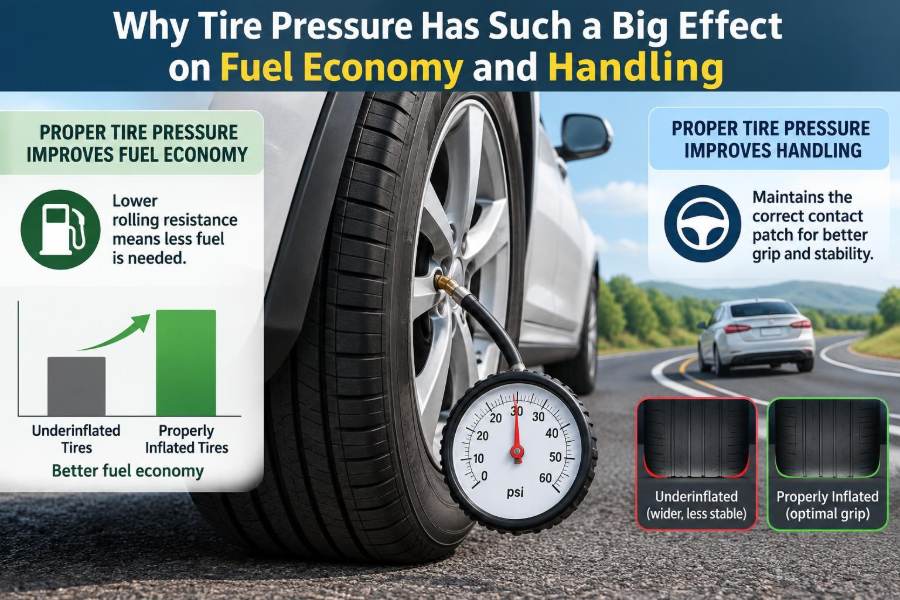
Pressure affects the patch’s size and, just as importantly, its shape. An underinflated tyre tends to spread and flex more; an overinflated tyre tends to become rounder and concentrate load nearer the tread centre.
⚙️ Why Rolling Resistance Uses Fuel
As a tyre rolls, rubber repeatedly deforms as it enters the contact patch and recovers as it leaves. Rubber does not return all of the deformation energy perfectly. Some becomes heat through a phenomenon called hysteresis.
This energy loss is rolling resistance. The engine must supply extra energy to overcome it, particularly during urban driving where speeds are lower and aerodynamic drag is less dominant.
📉 Underinflation Raises Rolling Resistance
An underinflated tyre has a larger, more distorted footprint and bends more through every revolution. Greater sidewall and tread deflection generally means more hysteresis and more heat generation.
The result is higher rolling resistance, so the engine or electric motor must work harder to maintain the same speed. The exact fuel-economy change depends on the vehicle, tyre construction, road, temperature, driving speed, and degree of underinflation.
🔋 Why Electric Vehicles Feel the Effect Too
Electric vehicles do not burn fuel, but tyre pressure still matters to their energy consumption and range. At lower and moderate speeds, rolling resistance can be a substantial part of the force the motor must overcome.
EVs are often heavier than comparable combustion vehicles because of their battery packs. This makes correct load-rated tyres and recommended cold pressures especially relevant, not merely useful for maximizing displayed range.
🌬️ Aerodynamic Drag Does Not Cancel the Problem
At highway speed, aerodynamic drag grows rapidly and often becomes the dominant resistance. That does not mean tyre pressure stops mattering; it means its contribution is one part of a larger energy balance.
Think of it as carrying a slightly heavier backpack on a windy day. The wind may be the largest challenge, but the extra load still requires effort. Correct pressure helps avoid an unnecessary loss in every driving condition.
🔥 Flexing Turns Energy into Heat
Heat is the most serious engineering consequence of substantial underinflation. Every rotation bends the sidewall, casing plies, belts, and tread, and repeated flexing raises internal temperature.
Heat can accelerate material ageing and weaken the bond between tyre components. At sustained speed, with a heavy load or hot ambient conditions, an underinflated tyre has less margin for safe operation than it may appear to have during a short, slow trip.
🧭 Steering Response Depends on Sidewall Support
When the steering wheel is turned, the tyre needs to develop lateral force before the vehicle changes direction. A properly inflated tyre supports its sidewall so this force builds predictably.
With low pressure, the sidewall deflects more before the tread responds fully. Drivers may describe the result as vague steering, delay on turn-in, or a vehicle that feels less precise when changing lanes.
↪️ Cornering Balance Can Shift
Front and rear tyres have different roles, and a pressure mismatch can change the car’s cornering balance. For example, a noticeably low front tyre can reduce the front axle’s lateral capability and encourage earlier understeer.
A low rear tyre can affect rear stability differently. The outcome is not identical for every vehicle because suspension geometry, tyre design, load distribution, and electronic stability control also matter. The practical lesson is to keep all tyres at their specified pressures.
🛑 Braking Relies on a Stable Tread Surface
Braking performance is not determined by contact-patch area alone. Tyre compound, tread design, road texture, load transfer, ABS calibration, and temperature all influence available grip.
However, incorrect pressure can prevent the tread from working in its intended shape. Excessive deformation and heat from underinflation can reduce consistency, while significant overinflation may make the tyre less compliant over small road irregularities.
🌧️ Wet-Road Behaviour Has Less Tolerance
On wet pavement, tread grooves must channel water away so rubber can contact the road rather than ride on a water film. This task becomes more demanding with speed, standing water, worn tread, and incorrect inflation.
Underinflation does not automatically cause aquaplaning, but it can worsen tyre deformation and water evacuation conditions. A tyre with inadequate tread depth or poor pressure has less reserve when the road surface changes suddenly.
⚖️ Load Distribution Changes Pressure Needs
Manufacturers specify pressures for a normal vehicle load and often provide a separate setting for full passengers, luggage, towing, or sustained higher-speed operation. These values account for the load each tyre is expected to carry.
Adding cargo without considering pressure increases sidewall deflection. A family holiday trip, a work van carrying tools, or a vehicle towing a trailer should be treated differently from an empty solo commute.
📋 Read the Vehicle Placard, Not the Tyre Sidewall
The most reliable everyday reference is the vehicle’s tyre-information placard, commonly located on the driver’s door frame, door edge, glovebox area, or fuel-filler flap. The owner’s manual provides further detail.
The number moulded into a tyre sidewall is typically its maximum permissible inflation pressure, not the manufacturer’s recommended operating pressure for your particular vehicle. Confusing these two values is a common and potentially costly mistake.
❄️ Pressure Must Be Checked Cold
Tyres heat up in normal driving, and warming the air inside raises the measured pressure. For a meaningful comparison with the placard value, check tyres when they are cold: ideally before driving or after the vehicle has been parked long enough to cool.
Checking immediately after a motorway journey may show a higher number that reflects operating temperature, not overinflation. Do not bleed air from hot tyres simply because the reading exceeds the cold recommendation.
🌡️ Seasonal Temperature Changes Are Real
Pressure also changes with ambient temperature. A tyre checked on a warm afternoon can read lower on a cold morning, even when it has no puncture or leak.
This is why pressure checks should become more frequent around seasonal weather changes. The goal is not to chase every small daily variation, but to identify a sustained cold-pressure reading below the vehicle specification.
🧪 Gauge Accuracy Matters More Than Perfection
Portable gauges vary in accuracy, particularly inexpensive or damaged units. A consistently used gauge is often more useful than switching between several tools and worrying about small differences.
Use a gauge that is in good condition, press it firmly onto the valve, and listen for prolonged leaking air. If a reading seems surprising, repeat the measurement or compare with a reliable workshop gauge.
🔎 A Slow Leak Rarely Announces Itself Clearly
Tyres naturally lose a small amount of air over time, but a recurring drop deserves investigation. Causes include a puncture, valve-core leakage, a damaged valve stem, corrosion around the wheel bead, or impact damage.
A tyre pressure monitoring system can provide an alert, but it is not a substitute for inspection. By the time some systems warn the driver, the pressure may already be well below the preferred cold setting.
📡 TPMS Is a Warning System, Not a Maintenance Plan
Direct TPMS uses pressure sensors in the wheels; indirect systems infer a difference from wheel-speed data. Both can help identify a significant loss, but neither necessarily confirms that every tyre is at the placard value.
Check manually after a warning, correct the cause rather than repeatedly topping up, and follow the vehicle procedure for resetting or recalibrating the system. A warning light should never be ignored because the car still feels normal.
📊 Recognizing Uneven Tyre Wear Patterns
Wear patterns can reveal a pressure issue, though alignment, suspension faults, rotation practices, and driving style can create similar symptoms. Inspecting the entire tread is more informative than looking only at the outer shoulder.
| Observed tread wear | Possible contributor | Useful next step |
|---|---|---|
| Both shoulders wear faster | Persistent underinflation or hard cornering | Check cold pressure and inspect alignment |
| Centre wears faster | Persistent overinflation | Compare with the vehicle placard |
| One-sided wear | Alignment or suspension issue | Arrange a professional inspection |
| Cupping or scalloping | Possible damping, balance, or suspension concern | Inspect tyres and suspension components |
These are diagnostic clues, not final diagnoses. A technician should assess a tyre with unusual wear, visible damage, vibration, or repeated pressure loss.
⬆️ More Pressure Is Not a Universal Efficiency Trick
Some drivers add pressure above the placard value hoping to reduce rolling resistance. While increased pressure can reduce deformation in some conditions, it also changes ride quality, tread loading, grip behaviour, and impact vulnerability.
Vehicle recommendations are a system-level compromise involving comfort, handling, braking, durability, load capacity, and tyre wear. For ordinary road use, following the manufacturer’s specified cold pressure is the sound baseline.
🧱 Overinflation Changes the Ride and Impact Response
An overinflated tyre is stiffer and absorbs less of a pothole or sharp road edge. More of that impact is transmitted to the wheel, suspension, and occupants.
It may also make the car feel nervous on uneven surfaces because the tyre conforms less readily to road texture. The objective is not the hardest tyre possible; it is the pressure that lets the tyre operate as its designers intended.
🚙 Different Tyres May Need Different Pressures
Many vehicles specify different front and rear pressures because axle loads differ. Front-engine cars, for example, commonly carry more static weight at the front, while a loaded rear cargo area can substantially increase rear-axle load.
Temporary spare tyres, compact spares, and some run-flat tyres may have special pressure requirements. Their instructions should be followed exactly, especially because temporary spares often have speed and distance limitations.
🏁 Performance Driving Is a Separate Case
Track driving creates tyre temperatures and forces far beyond normal road conditions. Performance drivers may adjust pressures to reach an intended hot operating range, using tyre temperatures and vehicle behaviour as feedback.
That practice should not be copied casually on public roads. Road-car placard pressures are for cold tyres in approved tyre sizes and ordinary operating conditions; track guidance depends on the specific tyre, vehicle, circuit, and load.
🔧 A Practical Monthly Checking Routine
A simple routine prevents most pressure-related problems. Check at least monthly, before long trips, after major temperature changes, and whenever a tyre looks low or the steering feel changes.
- Park on level ground and let the tyres become cold.
- Read the correct front and rear values from the placard.
- Measure all four road tyres and the spare if fitted.
- Add air in small increments, then recheck the gauge.
- Replace valve caps and inspect tread, sidewalls, and valve stems.
- Record repeated losses rather than assuming they are normal.
This process usually takes only a few minutes and offers a useful opportunity to spot nails, cracks, bulges, or abnormal wear.
🧰 When Professional Help Is the Better Choice
Seek tyre-service advice if one tyre repeatedly loses pressure, if a sidewall has a bulge or cut, if the wheel is damaged, or if there is vibration after an impact. Do not attempt to repair a damaged sidewall or drive indefinitely on a tyre that must be reinflated often.
Professional inspection is also sensible after fitting different tyre sizes, changing wheel types, or modifying vehicle loading. Tyre pressure is only one part of a wider wheel-and-suspension system.
🧠 The Core Principle: Pressure Controls Tyre Behaviour
Tyre pressure affects fuel economy because it influences rolling resistance and heat generation. It affects handling because it controls how the tyre supports load, forms its contact patch, and develops steering and braking forces.
The best answer is rarely “as high as possible” or “whatever feels comfortable.” The correct cold pressure is the vehicle manufacturer’s specified value for the tyre size and load condition, checked with a reliable gauge and maintained consistently.
That small quantity of air helps the tyre roll efficiently, carry its intended load, respond predictably, and wear more evenly. It is one of the simplest maintenance checks with consequences that can be felt in every journey.
Correct tyre pressure is not a minor detail; it is a foundation for efficient, predictable, and safer vehicle behaviour. Check it cold, use the placard as the reference, and treat unexplained pressure loss as a fault to investigate. 🚗🛞🌧️