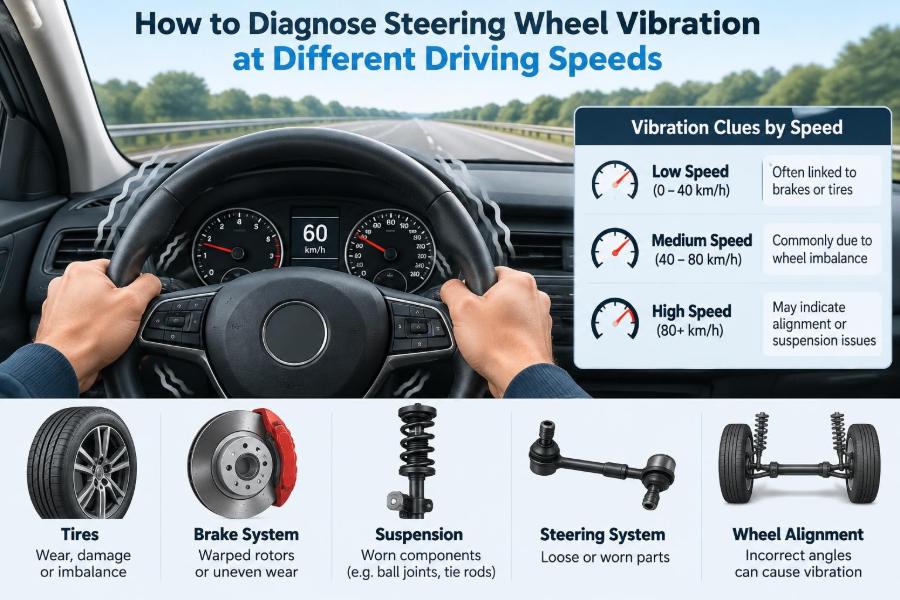

A steering wheel that begins to tremble on an otherwise familiar road can be surprisingly distracting. Perhaps it appears only at 60 mph, fades when the car slows, and returns every time the vehicle reaches the same highway speed.
That pattern is not random. Vehicle speed, braking, steering angle, road surface, and load all change the forces acting through the tyres, wheels, suspension, and steering system. The conditions under which vibration appears are often the best clues to its source.
For drivers, a correct diagnosis can prevent wasted money on parts that were never faulty. For engineering students and technicians, it is a useful lesson in rotating mass, resonance, friction, compliance, and force transmission.
Some vibrations are minor comfort issues, while others point to a condition that needs prompt inspection. The aim is not to guess from one symptom, but to observe the vibration carefully and test the vehicle safely.
🧭 Start With the Vibration Pattern
Before inspecting components, describe exactly what happens. Note the speed at which the vibration starts, where it is felt, whether it is continuous or intermittent, and what makes it worse or better.
A shake felt mainly through the steering wheel usually has a strong connection to the front wheels, front brakes, steering linkage, or front suspension. A vibration felt mostly in the seat or floor may originate farther rearward, although vehicle structure can transmit forces in unexpected ways.
- Does it occur only while accelerating?
- Does it appear while braking, coasting, or at a steady speed?
- Does it change when turning?
- Did it begin after a pothole strike, tyre replacement, or brake service?
📏 Why Vehicle Speed Is Such a Powerful Clue
A tyre and wheel assembly rotates faster as road speed rises. A small mass imbalance, slight runout, or tread irregularity therefore creates a repeating force more frequently at higher speed.
Speed also changes aerodynamic loading, driveline torque, and the response of flexible rubber bushes. A fault may exist at all speeds but become noticeable only when its forcing frequency approaches a natural frequency of the steering or suspension system.
This is why a vehicle can feel smooth at 40 mph, shake strongly at 65 mph, then feel less severe at 75 mph. The defect has not necessarily disappeared; the system has moved away from its most responsive range.
🔄 Understand Rotational Frequency and Resonance
Every rotating assembly produces a frequency related to its rotational speed. A wheel with a larger rolling circumference turns fewer times per mile than a smaller one, but both create increasingly frequent disturbances as speed rises.
Resonance occurs when a repeated input excites a component near its preferred vibration frequency. Think of pushing a playground swing: small pushes can create a large motion when timed correctly.
In a car, compliant tyre sidewalls, control-arm bushes, steering columns, and the steering wheel itself can amplify a modest input. This explains why the steering wheel may shake far more visibly than the original wheel defect seems to justify.
🛑 Separate Moving Vibration From Brake-Only Vibration
The first major branch in diagnosis is simple: does the vibration happen without touching the brake pedal? If it occurs at cruising speed, investigate rotating wheels, tyres, suspension, and driveline systems first.
If the steering wheel shudders chiefly during braking, the brake discs, hubs, calipers, and their mounting conditions become much more likely suspects. Brake-related vibration can sometimes be felt through the pedal as well, but pedal feel alone does not prove the cause.
A vehicle may have more than one fault. For example, a poorly balanced wheel can produce a highway-speed tremor while disc thickness variation causes a separate shake during braking.
🛞 Wheel Imbalance at Highway Speeds
Wheel imbalance is a common cause of steering vibration that emerges within a relatively narrow highway-speed band. It occurs when the mass around the rotating wheel-and-tyre assembly is not distributed evenly around its axis.
As the wheel rotates, the heavier area produces an outward force. Wheel balancing machines identify where correction weights should be fitted to reduce that force.
Symptoms often include a steering-wheel shimmy that begins progressively, peaks over a particular speed range, and reduces when the driver slows. Missing adhesive weights, damaged clip-on weights, or mud packed inside a wheel can all create a similar effect.
⚖️ Static Balance and Dynamic Balance Are Different
A wheel can be balanced in one plane yet still create a wobbling couple across its width. This is why modern balancing commonly considers both the inner and outer correction planes of the wheel.
Static imbalance tends to make one point of the assembly heavier. Dynamic imbalance involves unequal mass distribution across the wheel width, which can encourage a side-to-side wobble as it rotates.
Wide wheels and low-profile tyres may make dynamic balance quality more noticeable. The correct balancing method and clean mounting of the wheel on the balancer matter as much as adding a weight.
🧱 Tyre Defects That Mimic Imbalance
Not every speed-sensitive shake is fixed by balancing. Tyres can develop force variation or shape irregularities that a conventional balance machine may not fully reveal.
A separated belt, distorted carcass, flat-spotted tread, or locally stiff section can cause the tyre to push upward or sideways once per revolution. The wheel may show correct mass balance while the vehicle still shakes.
Inspect for bulges, exposed cords, deep cuts, uneven tread blocks, and obvious out-of-round movement. A bulge or suspected internal separation is a safety concern: do not continue high-speed driving while waiting for a convenient inspection.
📐 Radial Runout and Lateral Runout
Runout describes how much a rotating part deviates from a perfectly true path. Radial runout is an up-and-down variation, while lateral runout is a side-to-side wobble.
A bent wheel, damaged tyre bead, corrosion between the hub and wheel, or a distorted tyre can contribute to runout. Even a small irregularity can be felt if it coincides with a responsive speed range.
Technicians measure runout with a dial indicator or suitable equipment rather than relying only on visual judgement. Seeing a tyre move slightly in a workshop does not by itself identify whether the tyre, wheel, hub, or mounting surface is responsible.
🧼 Check Wheel Mounting and Hub Cleanliness
A wheel must sit flat and concentric on the hub mounting face. Rust scale, dirt, paint buildup, trapped stones, or a damaged mating surface can prevent correct seating.
Incorrect wheel nuts, unsuitable wheel-seat profiles, and uneven tightening can also create trouble. Wheel fasteners should be tightened in the specified sequence and to the vehicle manufacturer’s torque requirement, using an appropriate torque wrench.
Do not apply grease to wheel studs or nut seats unless the vehicle manufacturer specifically directs it. Lubrication changes the relationship between tightening torque and clamping force, which can lead to inaccurate fastening.
🕳️ Pothole Damage and Bent Wheels
A pothole impact can bend a wheel flange, damage a tyre internally, shift alignment, or loosen an already worn suspension joint. The driver may notice the problem immediately, but some damage becomes apparent only at speed.
Alloy wheels can crack as well as bend, while steel wheels may deform at the rim edge. A visual check should include both inner and outer wheel flanges, because damage on the inside is easy to miss.
After a sharp impact, inspect tyre pressure, sidewalls, wheels, and steering behaviour before assuming that balancing alone will solve the vibration.
🌡️ Tyre Pressure Changes the Feel
Incorrect tyre pressure does not usually create a precise, repeatable steering shake by itself, but it can worsen the symptoms of other faults. Pressure changes the tyre’s stiffness, contact patch, and ability to absorb road disturbances.
An underinflated tyre can feel vague and may overheat in service. An overinflated tyre can transmit sharper road inputs and reduce the size of the contact patch.
Check pressures when tyres are cold and use the vehicle placard recommendation rather than the maximum pressure printed on the tyre sidewall. Then re-evaluate the vibration under the same road conditions.
🧩 Uneven Tread Wear Tells a Story
Tread wear patterns often reveal the forces a tyre has experienced. Feathering, cupping, one-sided wear, and localized patches are not merely cosmetic; they can affect ride and steering smoothness.
- Feathered edges commonly suggest a toe-related alignment issue.
- Cupping or scalloping can be associated with worn dampers, imbalance, or suspension looseness.
- Wear on one shoulder may indicate alignment concerns, sustained pressure error, or hard cornering patterns.
These patterns are clues, not automatic diagnoses. A careful inspection of the tyre, alignment angles, and suspension condition is needed before assigning a single cause.
↔️ Alignment Can Cause Pulling, Not Usually a Pure Shimmy
Wheel alignment sets angles such as toe, camber, and caster. Incorrect settings often produce drifting, pulling, off-centre steering, or accelerated tyre wear more directly than a classic speed-specific steering-wheel vibration.
However, poor alignment can wear tyres irregularly, and those tyres may later create vibration. Alignment should therefore be checked when tread wear supports the suspicion or after an impact that may have displaced a component.
Replacing tyres without correcting the underlying alignment problem can make the ride feel better temporarily while allowing the same damaging wear pattern to return.
🔩 Loose Steering Linkage Requires Attention
Track-rod ends, inner tie rods, ball joints, steering-rack mounts, and related joints guide wheel direction under load. Wear creates clearance, allowing a wheel to move slightly instead of following the driver’s input precisely.
This may cause wandering, a clunk over bumps, or steering-wheel shake that becomes more obvious on rough roads. It can also amplify a tyre or wheel disturbance that would otherwise be mild.
Because steering joints are safety-critical, inspection should be performed with the correct lifting method and manufacturer procedure. Do not place hands near moving components while another person turns the steering wheel.
🪛 Suspension Bushes and Dampers Control Motion
Rubber bushes isolate noise and allow controlled suspension movement. When badly worn, cracked, or separated, they can allow unwanted changes in wheel position during braking, cornering, or travel over bumps.
Shock absorbers and struts do not carry the vehicle’s weight alone; their primary role is damping, meaning they control repeated spring motion. Weak damping can contribute to tyre cupping and an unsettled response after bumps.
A bounce test can offer a rough impression, but it is not a complete diagnosis. Modern suspension designs and internal damper faults require closer inspection and, when needed, professional testing.
🛑 Brake Disc Vibration During Deceleration
If the steering wheel pulses or shakes chiefly when braking from medium or high speed, investigate the front brake system. Drivers often call this “warped discs,” but the practical mechanism can be more complicated.
Disc thickness variation, uneven friction deposits, disc runout, seized caliper hardware, or dirt trapped between the disc and hub can create varying brake torque as the wheel turns. That changing torque travels through the suspension and steering system.
The symptom is usually proportional to brake application: it becomes clearer with a light-to-moderate pedal input and may change with speed. A safe brake inspection should include pad condition, caliper slide movement, disc surface, and hub cleanliness.
🔥 Avoid Misdiagnosing Every Disc as Warped
A brake disc may have runout or thickness variation without looking dramatically bent. Thermal stress, improper wheel fastening, corrosion at the hub face, and uneven pad transfer can all contribute to brake judder.
Replacing discs without cleaning and checking the hub face may allow a new set to develop the same problem. Likewise, fitting new pads onto a poorly functioning caliper does not address a sticking slide or piston.
The correct repair depends on measurements and component condition. Disc machining, replacement, hub cleaning, caliper repair, or a combination may be appropriate depending on the vehicle and manufacturer limits.
🚀 Vibration Only Under Acceleration
A vibration that appears mainly when the engine is applying torque points away from simple wheel imbalance. On front-wheel-drive and many all-wheel-drive vehicles, inner constant-velocity joints, driveshafts, engine mounts, and transmission mounts become relevant.
An inner CV joint with wear can create a shudder during acceleration that reduces when the driver lifts off the throttle. A damaged driveshaft or incorrect shaft geometry after suspension modification can have similar symptoms.
Diagnose this condition cautiously. Road testing is useful, but driveline inspection should include checking for damaged boots, grease loss, excessive play, bent shafts, and loose mounting hardware.
🌀 Vibration While Turning Has Its Own Clues
Noise or vibration that changes strongly during a turn may involve wheel bearings, CV joints, tyres, or steering components. A worn outer CV joint more often clicks during tight powered turns than it causes a straight-ahead highway shimmy.
A wheel bearing can produce a humming or growling sound that changes as vehicle weight transfers from one side to the other. It may also permit movement that affects wheel control, though noise alone cannot identify the exact side with certainty.
Tyre scrub on full lock can be normal on some surfaces and vehicles. Distinguish this low-speed sensation from a fault before replacing parts.
🏁 Low-Speed Shake Is Not the Same Problem
A steering wheel that moves at parking speeds may be responding to rough pavement, tyre tread pattern, steering-system effort, or a fault that is not related to high-speed balance. The context matters.
On vehicles with hydraulic power steering, low fluid level, air in the system, a weak pump, or belt problems may cause groan and inconsistent assistance. Electric power steering systems have different diagnostic procedures and may store fault codes.
Do not confuse steering-wheel movement caused by turning over coarse ground with a high-speed shimmy. Reproducing the symptom in the right condition is the foundation of accurate testing.
🎛️ Use a Speed-and-Symptom Reference
This reference is a starting point, not a substitute for inspection. More than one fault can produce the same sensation, and the vehicle’s design affects how forces reach the driver.
| Observed condition | More likely areas to inspect | Useful next check |
|---|---|---|
| Shake at a narrow highway-speed range | Wheel balance, tyre condition, wheel runout | Inspect weights, tread, and wheel mounting |
| Shake mainly under braking | Discs, hubs, calipers, front suspension | Check disc runout, thickness, and slide movement |
| Shudder only under power | Inner CV joints, driveshafts, mounts | Compare acceleration and coast behaviour |
| Vibration after pothole impact | Tyres, wheels, alignment, suspension joints | Inspect inner wheel rim and tyre sidewall |
| Vibration plus wandering or clunking | Steering linkage, bushes, ball joints | Perform a safe play inspection |
🔁 Rotate Wheels to Isolate the Source
When tyre and wheel condition is suspected, moving wheels between axles can be a useful diagnostic step if the tyre sizes, directional markings, and vehicle recommendations permit it.
If a steering-wheel vibration changes to a seat or body vibration after rotating wheels, the suspect assembly may have moved from the front to the rear. This does not prove whether the tyre or wheel is defective, but it narrows the search.
Observe correct rotation direction and asymmetric tyre mounting requirements. Vehicles with staggered wheel sizes may not allow front-to-rear rotation at all.
🧪 Ask for the Right Tyre-Shop Checks
A basic wheel balance is a reasonable first step for a highway-speed vibration, but communicate the symptom clearly. Mention the approximate speed range, whether it is in the steering wheel, and whether it began after an impact or tyre work.
If ordinary balancing does not help, ask whether the shop can check wheel and tyre runout or assess road-force variation. Road-force equipment applies a load to the rotating tyre to identify variations in how the assembly behaves under load.
This service can help identify a difficult tyre issue, but it does not replace inspection of loose steering, brake, or suspension parts. Diagnostic tools are most useful when interpreted alongside the vehicle’s symptoms.
🔍 A Safe Inspection Sequence at Home
Drivers can perform several useful visual checks without dismantling safety-critical components. Park on level ground, apply the parking brake, and use proper lifting equipment if wheels must be removed.
- Check cold tyre pressures and compare them with the vehicle placard.
- Look for missing balance weights, packed mud, cuts, bulges, and uneven tread.
- Inspect visible wheel rims for impact damage and cracks.
- Check that wheel fasteners appear present and have been tightened correctly.
- Record the exact speeds and driving conditions that reproduce the symptom.
Do not crawl beneath a vehicle supported only by a jack. If there is any uncertainty about lifting, wheel fastening, brake condition, or joint play, arrange a qualified inspection.
🧰 What a Professional Diagnosis Adds
A workshop can use a lift, dial indicator, wheel balancer, alignment equipment, brake measuring tools, and manufacturer service information. These tools allow technicians to measure rather than infer.
A sound diagnostic process usually begins with road-test confirmation, followed by tyre and wheel inspection, checks for play, and targeted measurement based on the observed pattern. Replacing parts in a random sequence is expensive and can conceal the real cause.
Give the technician a concise symptom description: “The steering wheel shakes between roughly 60 and 70 mph, including while coasting, but not during braking.” That is far more useful than simply saying the car “vibrates.”
⚠️ Know When Not to Keep Driving
Stop and seek assistance if vibration is sudden and severe, a tyre has a bulge or exposed cords, a wheel appears loose, steering response changes dramatically, or there is a strong burning smell from a brake.
Also treat repeated clunks, significant pulling under braking, visible fluid leaks near steering or suspension components, and a vibration following a major impact as reasons for prompt assessment. Continuing to drive can worsen damage or reduce control.
A mild, familiar highway-speed tremor may allow a cautious trip to a repair facility, but the appropriate decision depends on severity and visible condition. When in doubt, choose inspection over experimentation.
❌ Common Diagnostic Mistakes
The most common error is assuming every steering vibration is a balance problem. Balancing is often appropriate, but it cannot correct a separated tyre belt, a bent hub surface, worn ball joint, or brake-torque variation.
Another mistake is changing several variables at once. New tyres, alignment, brake work, and suspension parts installed together may cure the symptom, but they make it difficult to learn which defect caused it.
- Ignoring the difference between braking and cruising symptoms.
- Using visual appearance alone instead of measurement where runout is suspected.
- Overtightening wheel nuts with an impact wrench.
- Fitting used parts without checking their condition and compatibility.
📝 Build a Repeatable Road-Test Routine
Choose a legal, smooth, low-traffic route where speed can be varied safely. Bring the vehicle gradually through the suspected range and observe steering-wheel movement, seat vibration, noise, and pedal behaviour.
Repeat under light acceleration, steady throttle, and gentle coast where conditions allow. Then, if braking is safe, apply a controlled moderate brake input rather than a harsh emergency stop solely for diagnosis.
Keep notes rather than relying on memory. A repeatable pattern turns a vague complaint into evidence that can guide the next inspection step.
📚 The Engineering Lesson Behind the Shake
Steering vibration is a practical example of a dynamic system. Tyres generate forces at the road, wheels rotate, suspension links transmit loads, bushes filter them, and the steering mechanism communicates some of that motion to the driver.
The same defect can feel different between vehicle models because mass, stiffness, damping, geometry, tyre construction, and steering design differ. This is why symptom-based diagnosis is probabilistic rather than perfectly certain.
Good troubleshooting follows the physics: identify the input frequency, identify the condition that activates it, then inspect the components capable of generating or amplifying that force.
✅ The Core Principle: Diagnose Conditions, Not Just Parts
The most reliable clue is the condition that creates the vibration. Highway-only shake directs attention toward rotating assemblies and resonance; brake-only shake directs attention toward braking force variation; acceleration-only shudder directs attention toward torque-loaded driveline components.
Begin with simple, high-probability checks such as tyre condition, pressure, wheel mounting, and balance. Move next to measurements and safety-critical inspections rather than repeatedly replacing parts based on assumptions.
A smooth steering wheel is not merely a comfort feature. It is evidence that tyres, wheels, brakes, suspension, and steering components are working together with controlled forces and predictable motion.
When steering vibration is diagnosed by its speed and driving condition, the repair becomes more accurate, safer, and far less wasteful. Observe carefully, inspect methodically, and let the symptom pattern lead the investigation. 🚗🛠️📍