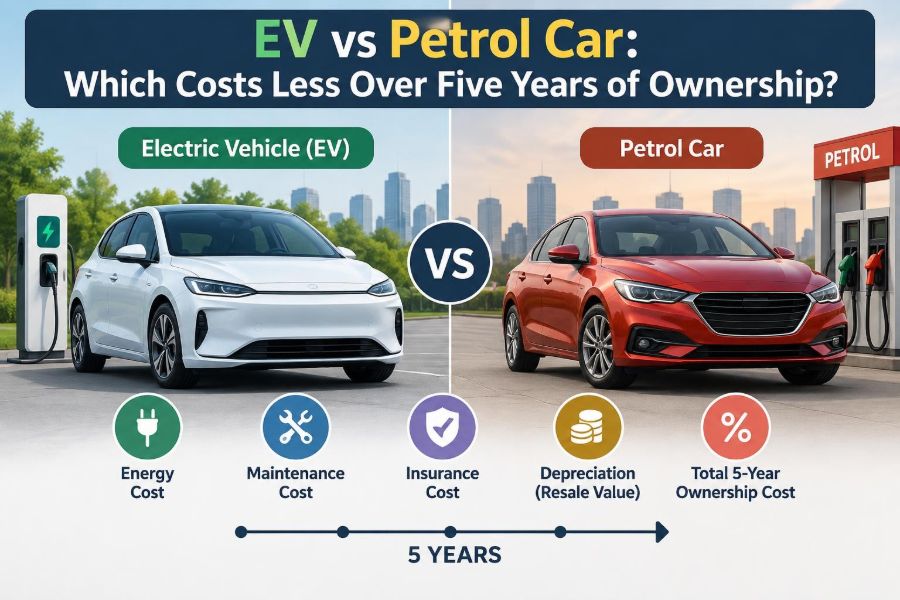

A car buyer standing in a showroom often sees the same dilemma: a petrol car with a lower sticker price, or an electric vehicle with a higher upfront cost but a much smaller fuel bill. The monthly payment may be visible, but many of the real expenses arrive later.
Over five years, the answer can change with driving distance, electricity tariff, fuel price, home-charging access, insurance, and even where the vehicle is parked. A cheap-to-buy car is not automatically cheap to own.
This matters to students entering the automotive field as much as it does to commuters choosing their next car. Engineers, fleet managers, and buyers all need to separate purchase price from total cost of ownership.
The useful question is not simply “Are EVs cheaper?” It is: which vehicle costs less for this driver, in this location, over this period?
🧾 Start with total cost of ownership
Total cost of ownership, often shortened to TCO, is the combined cost of buying, operating, maintaining, insuring, and eventually selling a vehicle. It gives a more realistic five-year comparison than the showroom price alone.
A practical five-year calculation includes the initial price, financing cost where applicable, energy, servicing, tyres, insurance, taxes or fees, charging equipment, and resale value. Some costs are predictable; others need sensible assumptions.
🔍 Why the purchase price can mislead
An EV may cost more at purchase because its traction battery is expensive to manufacture. A comparable petrol vehicle may therefore look like the better bargain on day one.
However, the purchase price is a one-time expense, while petrol and electricity costs repeat every time the car is used. For a high-mileage driver, recurring energy savings can gradually offset a higher initial price.
📏 Set a fair five-year comparison
A fair comparison uses vehicles of similar size, performance, equipment, and intended use. Comparing a compact EV with a large petrol SUV can produce a misleading result, even if both have similar prices.
Choose the same ownership period, estimate the same annual distance, and state all assumptions. The result is a scenario, not a universal verdict.
🚘 Choose comparable vehicle classes
Compare hatchbacks with hatchbacks, family crossovers with family crossovers, and work vans with work vans. Vehicle mass, tyre size, power output, cabin space, and feature level all affect cost.
An EV’s quiet acceleration can make it feel more powerful than a petrol equivalent, but performance should not be the only matching criterion. Practical range, cargo space, towing needs, and passenger capacity also matter.
🛣️ Annual distance changes the result
Distance travelled is usually the biggest reason two owners reach different conclusions. A car driven 8,000 km per year consumes far less energy than one driven 25,000 km per year.
Because an EV commonly has lower energy cost per kilometre, its financial advantage generally becomes stronger as annual mileage rises. Conversely, a low-mileage driver may take longer to recover a higher purchase price.
⛽ Understand petrol cost per kilometre
Petrol cost depends on the vehicle’s real-world fuel consumption and the local price of petrol. A simple estimate is fuel consumption in litres per 100 km multiplied by fuel price, then divided by 100.
For example, a hypothetical car using 7 L/100 km at a petrol price of 1.50 currency units per litre costs about 0.105 units per kilometre in fuel. Actual consumption rises in congestion, cold starts, steep terrain, and aggressive driving.
⚡ Calculate EV electricity cost per kilometre
For an EV, use energy drawn from the grid, not only the consumption displayed by the car. Charging loses some energy as heat in cables, electronics, and the battery-management process.
If an EV requires 18 kWh/100 km from the wall and electricity costs 0.20 currency units per kWh, its energy cost is about 0.036 units per kilometre. This is only an example; tariffs and consumption vary widely.
🏠 Home charging is often the cost anchor
Home charging is commonly the most convenient and potentially lowest-cost way to run an EV, especially when charging can occur during lower-tariff periods. The vehicle is parked for many hours, so high charging power is not always necessary.
But home charging is not free. Include the electricity tariff, installation work, any charger purchase, and possible electrical-panel upgrades. A basic socket may be unsuitable or unsafe for continuous high-current charging unless the installation is assessed properly.
🔌 Public charging changes the equation
Public chargers can be essential for apartment residents, long-distance travellers, and drivers without private parking. Their pricing may be based on energy, time, connection fees, or a combination.
Fast-charging networks are valuable for journey time, but they may cost substantially more than home electricity. A driver who depends almost entirely on public rapid charging should calculate with those actual rates rather than assuming domestic electricity prices.
🌡️ Real-world EV consumption is not fixed
EV energy use changes with speed, weather, heating or air conditioning, tyre pressure, payload, road gradient, and driving style. Highway travel at sustained speed often uses more energy than mixed urban driving.
Cold weather can reduce available battery energy and increase cabin-heating demand. These effects do not make EVs unsuitable, but they should be included when estimating winter range and annual electricity use.
🚦 City driving often favours an EV
In stop-start traffic, a petrol engine spends time idling and repeatedly accelerating a vehicle from rest. Its efficiency is often poorer in these conditions than during steady travel.
An EV does not consume energy while stationary, and regenerative braking can recover part of the vehicle’s kinetic energy during deceleration. Regeneration is not free energy; it simply reduces some energy that would otherwise be lost as brake heat.
🛤️ Highway driving narrows the gap
At motorway or highway speed, aerodynamic drag rises rapidly. Both petrol cars and EVs need more energy to push through the air, but the EV may lose some of its city-use advantage.
A petrol car can also be relatively efficient at steady speed. For frequent long journeys, assess fuel economy, fast-charging cost, charging stops, and route coverage—not just official range figures.
🔧 Routine maintenance usually differs
Battery-electric vehicles have fewer routine service items in the powertrain. They do not need engine oil, oil filters, spark plugs, exhaust-system maintenance, or many of the fluids associated with an internal-combustion engine.
They still require inspections, cabin filters, brake-fluid checks, coolant-system attention where specified, suspension work, tyres, wipers, and software-related service. Lower maintenance is not the same as maintenance-free.
🛑 Brakes last differently with regeneration
Regenerative braking allows the motor to act as a generator during deceleration. This can reduce use of the friction brakes and may extend pad and disc life in normal driving.
Less brake use can also create a maintenance consideration: in wet or salty environments, rarely used brake components may corrode. Periodic inspection and occasional proper friction-brake use, following the manufacturer’s guidance, remain sensible.
🛞 Tyres are a shared but variable expense
Tyres are a major ownership cost for both vehicle types. EVs can be heavier because of their battery packs, and instant motor torque can accelerate tyre wear if the driver frequently uses hard acceleration.
On the other hand, a calm driver using suitable low-rolling-resistance tyres may see reasonable tyre life. Do not assume EV tyres always wear faster; vehicle mass, alignment, road surface, tyre compound, and driving behaviour matter more.
🛡️ Insurance can reverse small savings
Insurance premiums depend on driver profile, location, repair history, theft risk, vehicle value, and insurer experience. An EV may cost more to insure in some markets because battery-related repairs, specialist training, or parts availability can affect claim costs.
In other cases, the difference may be modest. Obtain quotes for the exact models before deciding, because a large insurance difference can outweigh a small energy-cost advantage.
🏛️ Taxes, fees, and local rules matter
Registration charges, annual road taxes, congestion charges, parking rules, and emissions-zone policies differ by country and city. Some places offer EV incentives or reduced fees, while others are gradually revising policies as EV adoption grows.
These rules can change during a five-year ownership period. Treat them as location-specific inputs, not permanent benefits, and check the current terms before signing a purchase agreement.
💳 Financing is part of the purchase cost
If a vehicle is financed, compare the total amount repaid rather than only the monthly instalment. A higher-priced EV may create more interest expense even when its operating costs are lower.
Deposit size, loan duration, interest rate, balloon payments, and lease conditions can all alter the result. A low monthly payment may simply move a large amount of cost to the end of the agreement.
📉 Depreciation is often the largest hidden cost
Depreciation is the loss in vehicle value over time. It is not paid as a bill each month, but it becomes very real when the car is sold, traded in, or returned at lease end.
Used-car values depend on supply, demand, new-vehicle pricing, model updates, condition, mileage, and market confidence. EV resale values can be affected by rapid technology changes, while petrol values can be affected by fuel costs and policy shifts. Neither outcome is easy to forecast precisely.
🔋 Battery health needs perspective
EV batteries degrade gradually with age, use, temperature exposure, and charging patterns. Battery management systems protect the pack by controlling temperature and limiting access to the absolute top and bottom of its chemical capacity.
A battery warranty can reduce ownership risk, but buyers should read its duration, mileage limit, capacity-retention condition, and exclusions. Battery replacement is expensive, yet it is not a routine five-year expense for most owners.
🔥 Fast charging is convenient, not automatically harmful
Modern EVs are designed to use DC fast charging within their specified limits. The vehicle actively manages charging power and battery temperature to reduce stress.
Still, frequent high-power charging can be less efficient and may expose the battery to more heat than slower charging. When time allows, regular home or workplace charging is often cheaper and gentler, while fast charging remains a practical travel tool.
🏢 Apartment living needs a different plan
For drivers in apartments, the key question is not whether chargers exist somewhere nearby. It is whether charging fits the normal weekly routine without repeated detours, waiting, or expensive rapid-charging sessions.
Shared residential charging may involve permission, metering, billing arrangements, and future capacity planning. A petrol car can be simpler in this situation, although reliable workplace or neighbourhood charging can make EV ownership entirely workable.
🧳 Long trips have a time cost too
A five-year money calculation should not ignore time and convenience. Petrol refuelling is generally quick, while EV road trips require planned charging stops whose duration depends on charger power, battery condition, route demand, and the vehicle’s charging curve.
For many drivers, planned breaks fit naturally into a long journey. For drivers making time-critical trips, towing regularly, or travelling through sparse charging regions, this operational difference can carry genuine value.
📊 A hypothetical five-year worksheet
The following structure shows how to compare two similarly sized vehicles. The figures should be replaced with local prices, actual quotes, and realistic driving assumptions.
| Cost item | EV calculation | Petrol car calculation |
|---|---|---|
| Purchase and finance | Price + interest − incentives | Price + interest |
| Energy over five years | km × kWh/100 km × electricity price | km × L/100 km × petrol price |
| Maintenance | Scheduled service + tyres + repairs | Scheduled service + tyres + repairs |
| Other running costs | Insurance + taxes + charger costs | Insurance + taxes + fees |
| End value | Subtract estimated resale value | Subtract estimated resale value |
Keep assumptions visible. A spreadsheet is useful because changing annual distance or energy price immediately shows how sensitive the decision is.
🧮 Find the break-even distance
The break-even distance is the point at which an EV’s higher initial cost has been recovered through lower running costs. It is an estimate, not a promise, because maintenance, resale value, and energy prices can change.
Conceptually, divide the EV’s extra upfront cost by the expected saving per kilometre. If the EV does not have a higher upfront cost after incentives and financing, this particular calculation may not be needed.
⚠️ Avoid the most common comparison mistakes
- Using laboratory consumption figures as if they guarantee real-world results.
- Pricing every EV kilometre at cheap home-electricity rates when public charging will be frequent.
- Ignoring home-charger installation and electrical work.
- Comparing cars with very different size, safety, or equipment levels.
- Forgetting finance interest, insurance quotes, and expected resale value.
- Assuming any incentive, tax rule, or fuel price will remain unchanged for five years.
A robust estimate is usually a range: optimistic, typical, and higher-cost cases.
🧭 Identify the driver who benefits most
An EV is often financially attractive for a driver who covers substantial annual distance, can charge regularly at home or work, and mainly uses the car for commuting, urban travel, or predictable regional trips.
A petrol car may make more financial or practical sense for a low-mileage owner, a driver without dependable charging, or someone whose routine requires frequent long-distance travel in areas with limited infrastructure. These are patterns, not strict rules.
🌍 Consider emissions separately from cost
Operating cost and environmental impact are related but not identical questions. An EV has no tailpipe emissions while driving, but its overall emissions depend on electricity generation, vehicle manufacturing, battery production, and lifetime use.
A petrol vehicle emits exhaust gases during operation and relies on fuel extraction, refining, and transport. For a purchase decision, assess environmental priorities alongside cost rather than claiming that one financial result settles every issue.
🧰 What automotive engineers should notice
This comparison shows why vehicle engineering is a systems problem. Battery capacity affects range and mass; mass affects tyres and energy use; charging speed affects travel convenience; thermal management affects performance, durability, and cost.
For engineers, the goal is not simply to maximise a single specification. Good vehicle design balances efficiency, safety, durability, manufacturability, repairability, and the customer’s actual operating pattern.
✅ Make the decision with your own data
Collect five inputs before choosing: annual distance, typical routes, petrol price, electricity price by charging location, and insurance quotes for the exact vehicles. Then add service plans, taxes, charger costs, finance terms, and a cautious resale estimate.
Run more than one case. If the EV only wins under perfect home-charging conditions, the decision is more fragile than an EV that remains competitive even with some public charging and higher electricity prices.
🏁 The five-year ownership takeaway
There is no single winner because ownership cost is shaped by use. The strongest EV case combines regular low-cost charging, enough annual mileage to capture energy savings, and a vehicle that fits the driver’s range and space needs.
Petrol cars retain advantages in lower initial cost for some models, fast refuelling, and uncomplicated operation where charging is unavailable. A careful comparison turns a broad technology debate into a practical personal calculation.
Over five years, the cheaper car is usually the one whose purchase price, energy source, driving pattern, and resale risk best match the owner—not simply the one with the lower price tag or newer technology. 🚗⚡📋