
A vehicle rarely fails without leaving clues. The first sign may be a faint squeal on a cold morning, a steering wheel that no longer sits straight, or an oil warning light that disappears after a few seconds. It is easy to postpone attention when the car still starts and moves.
That delay can be expensive. A small fluid leak can lower lubrication where it is needed; an underinflated tyre can run hot and wear at the shoulders; a neglected cooling system can turn a routine journey into overheating damage.
Long vehicle life is not mainly about finding one miracle product or driving with extreme caution. It comes from understanding which systems wear, checking them at sensible intervals, and responding early when operating conditions change.
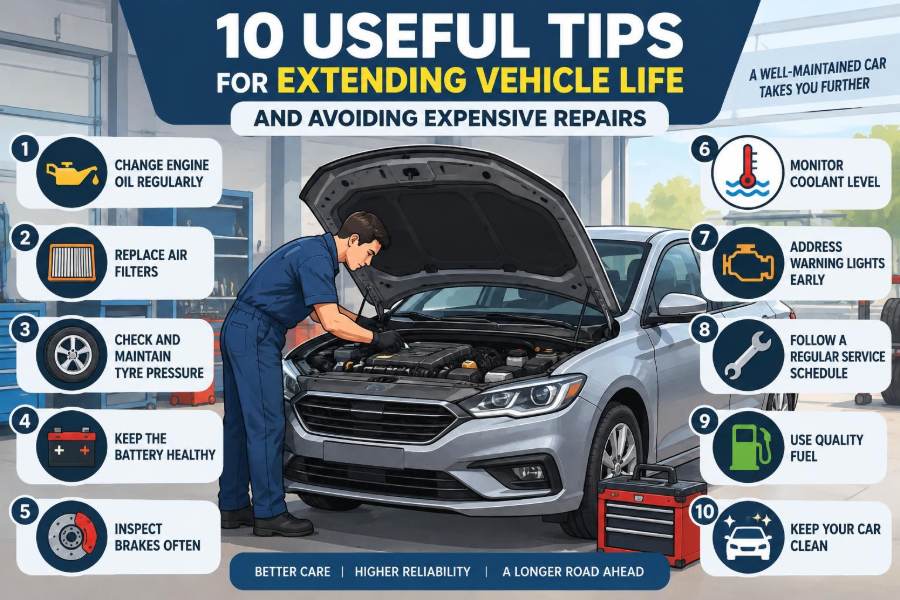
The ten habits below apply to most petrol, diesel, hybrid, and electric vehicles, although the exact maintenance intervals and fluids must always come from the manufacturer’s handbook. They help students, new drivers, and experienced owners make decisions before a minor defect becomes a major repair.
🧭 Start with a maintenance mindset
A car is a group of connected systems rather than a collection of independent parts. Engine oil affects lubrication, cooling and cleanliness; tyre condition affects braking, steering, suspension loading, and fuel use. Looking after basics protects several components at once.
Think of maintenance as managing wear, not merely responding to breakdowns. Some wear is expected, but its rate changes sharply with driving style, road conditions, temperature, load, and missed servicing.
📘 Use the handbook as the primary schedule
The service schedule in the owner’s handbook is the correct starting point because it reflects the engine, gearbox, brakes, and equipment fitted to that particular model. Generic advice can be useful, but it should not override specified fluid grades, inspection intervals, or warning-light instructions.
Many schedules include a more demanding category often called severe use. Repeated short trips, dusty roads, heavy towing, long idling, very hot or cold climates, and frequent stop-start driving may justify shorter intervals.
🗓️ Tip 1: Build a realistic service record
Record dates, mileage, work performed, fluid specifications, tyre changes, and recurring observations. A paper folder, phone note, or spreadsheet all work. The record makes it easier to spot patterns, such as coolant needing repeated top-ups or one tyre losing pressure.
A good history also helps a technician diagnose a fault without guessing what has already been replaced. For a future buyer, it demonstrates that the vehicle was maintained rather than simply repaired when something failed.
- Keep invoices and inspection reports.
- Note the brand-independent specification of oils and fluids used.
- Set reminders before, not after, a due date.
- Record warning lights and the conditions under which they appeared.
🛢️ Understand what engine oil actually does
Engine oil forms a thin film between moving surfaces, reducing direct metal contact. It also carries heat away from some components, suspends contaminants for the filter to capture, and helps operate systems such as variable valve timing in many engines.
Oil degrades through heat cycles, combustion by-products, moisture, and shear forces. A vehicle that makes very short trips may not run long enough to evaporate accumulated moisture, even if its mileage is low.
🔧 Tip 2: Check oil level and use the correct grade
Check the level on level ground using the method specified for the vehicle. Some engines should be checked after a short wait following shutdown; others have electronic level measurements. Do not overfill: excess oil can be aerated by the crankshaft or create problems for emission-control equipment.
The correct viscosity and approval matter. A number such as 0W-20 or 5W-30 describes viscosity behaviour, but it does not by itself confirm suitability. Use the manufacturer-required specification, particularly where turbochargers, particulate filters, or long service intervals are involved.
⚠️ Treat oil pressure warnings as urgent
An oil-pressure warning is different from a routine service reminder. It can indicate that oil is not reaching bearings and other components adequately. Continuing to run the engine may cause severe damage in a short time.
Safely stop as soon as practical, switch off the engine, and consult the handbook or qualified assistance. Checking the oil level is sensible only after the vehicle is safely parked; adding oil does not solve every low-pressure cause.
🌡️ Learn the purpose of the cooling system
The cooling system transfers excess engine heat to the radiator, where airflow carries it away. Coolant is not simply coloured water: a correctly specified mixture provides freeze protection, corrosion inhibition, and a controlled boiling point.
Hoses, clamps, radiators, water pumps, thermostats, fans, and pressure caps all contribute. A fault in one part can upset the system’s pressure, flow, or heat rejection.
💧 Tip 3: Protect coolant and investigate losses
Check the coolant reservoir only when the engine is cool and follow the marked minimum and maximum levels. Never remove a pressurised cap from a hot engine; hot coolant can escape forcefully.
A gradual drop in coolant is not a normal “use-up” item in a sealed system. It may come from an external seep, a failing cap, or an internal issue. Topping up repeatedly can hide the evidence while the underlying problem progresses.
🔥 Respond calmly to overheating
If the temperature gauge rises abnormally, a temperature warning appears, or steam is visible, reduce load where safe and stop as soon as conditions allow. Continuing uphill with air conditioning on, for example, may add heat load at the moment the system is struggling.
Do not pour cold water onto a hot engine or open the cooling system immediately. Allow it to cool and arrange diagnosis. The cause could range from a fan fault to low coolant or restricted circulation, and each needs a different repair.
🛞 Tip 4: Make tyres a monthly inspection item
Tyres are the vehicle’s only intended contact with the road. Their pressure, tread, age, damage, and alignment condition influence grip, ride, braking stability, and the stress transmitted into suspension components.
Check pressures when tyres are cold, using the vehicle’s recommended values for its load condition. The number moulded on a tyre sidewall is generally a tyre limit, not the vehicle’s normal operating pressure.
📏 Read tyre wear patterns
Tread depth alone does not tell the whole story. Uneven wear is useful diagnostic information because it often points to pressure, alignment, balance, suspension, or driving-condition issues.
| Wear pattern | Possible contributing cause | Useful next step |
|---|---|---|
| Both shoulders worn | Persistent underinflation | Check pressure, leaks, and loading habits |
| Centre worn | Persistent overinflation | Confirm cold pressure against handbook |
| One edge worn | Alignment or suspension issue | Arrange alignment and component inspection |
| Cupping or scallops | Balance, damping, or suspension concern | Inspect tyres, wheels, and suspension |
These patterns are clues, not final diagnoses. A technician should inspect the whole system before parts are replaced.
🧱 Do not ignore tyre age or sidewall damage
Tyres can deteriorate even when tread remains. Cracks, bulges, cuts, exposed cords, and repeated pressure loss deserve prompt professional assessment. A sidewall bulge may indicate internal cord damage and is not a cosmetic defect.
When replacing tyres, match the approved size, load index, and speed rating. Mixing significantly different tyre designs or tread depths can affect vehicle behaviour, especially on all-wheel-drive vehicles where rolling-diameter differences may matter.
🛑 Tip 5: Preserve brakes with inspection and anticipation
Brake pads and discs are designed to wear, but their life depends heavily on heat. Hard repeated braking, heavy loads, downhill driving, seized caliper slides, or corroded hardware can raise temperatures and accelerate wear.
Looking farther ahead and easing off the accelerator earlier reduces unnecessary braking. This is not about coasting out of control; it is about creating time and space so speed changes are smooth and deliberate.
👂 Know normal and abnormal brake symptoms
A brief noise after rain may be surface corrosion clearing from discs. Persistent squealing, grinding, pulling to one side, vibration through the pedal, a soft pedal, or a warning light needs investigation.
Grinding can mean friction material is worn far enough that metal is contacting the disc. Waiting can transform a pad replacement into discs, caliper work, or more extensive repair.
🧪 Respect brake fluid and hydraulic service
Brake fluid transmits pedal force hydraulically. Many common brake fluids absorb moisture over time, which can lower their boiling performance and contribute to internal corrosion. Follow the stated replacement interval rather than assuming the reservoir level reveals fluid condition.
Brake work is safety-critical. If pedal feel changes suddenly or the brake warning light appears, avoid treating it as ordinary maintenance and seek qualified assessment.
⚙️ Tip 6: Be gentle with the transmission and drivetrain
Engines and transmissions last longer when high loads are applied after fluids have warmed and when shifts are not forced. Automatic, manual, dual-clutch, continuously variable, and electric drivetrains all have different service needs.
Use the approved transmission fluid and interval where service is specified. A fluid that looks similar may have different friction characteristics, which can affect shift quality and clutch operation.
🅿️ Avoid common parking and shifting mistakes
Come to a complete stop before selecting reverse or drive. On an incline, apply the parking brake according to the vehicle’s instructions so the transmission’s parking mechanism is not carrying the full vehicle load.
For manual transmissions, avoid resting a foot on the clutch pedal and do not hold the vehicle on a hill with clutch slip. Both habits generate heat and wear friction surfaces unnecessarily.
🔋 Tip 7: Keep the battery and charging system healthy
The battery starts conventional engines and stabilises electrical supply; even hybrids and EVs usually retain a low-voltage battery for control systems. Repeated short journeys, loose terminals, parasitic electrical loads, and age can weaken it.
Clean, secure terminals and a properly fitted battery reduce intermittent electrical faults. If starting becomes slower, dashboard lights flicker, or electrical functions behave unpredictably, test both the battery and charging system rather than replacing parts at random.
💡 Use jump-starting with care
Incorrect jump-start connections can damage electronics or create sparks near a battery. Follow the vehicle-specific procedure, use suitable leads or a compatible jump pack, and never assume every vehicle has identical connection points.
If a battery repeatedly goes flat, the issue may be battery deterioration, an alternator or DC-DC charging issue, or an electrical draw while parked. Recharging alone does not identify which one is responsible.
🧹 Tip 8: Keep air, fuel, and filters clean
Filters protect systems from contaminants. The engine air filter limits abrasive dust intake, the cabin filter supports HVAC airflow, the oil filter captures particles, and fuel filtration is especially important on some diesel systems.
Replace filters at recommended intervals, but avoid the opposite mistake of changing components purely because they look slightly dusty. A technician can inspect for blockage, damage, and correct installation; a poorly seated air filter can allow unfiltered air past it.
⛽ Choose fuel and refuelling habits carefully
Use the fuel grade specified by the manufacturer. A higher octane rating is not automatically better for an engine that does not require it, while using unsuitable fuel can affect performance or protection.
Avoid running regularly with a nearly empty fuel tank when practical. Fuel in the tank helps manage fuel-pump operating conditions in many designs, and low levels leave little margin if a journey takes longer than expected. For diesel vehicles, contamination and water management are particularly important.
🚦 Tip 9: Drive in a way that limits wear
Smooth driving protects more than fuel economy. Rapid acceleration, abrupt steering, pothole impacts, harsh braking, and repeated high-speed cold operation load tyres, mounts, suspension joints, brakes, and drivetrain components.
This does not mean a vehicle must be driven timidly. It means matching inputs to conditions: allow the engine and transmission to warm through normal driving, slow for rough roads, and avoid sudden demands when traction is poor.
🏙️ Adapt maintenance to short-trip driving
Short urban journeys are hard on many vehicles because the engine, oil, exhaust after-treatment system, and battery may not reach stable operating conditions. Condensation can remain in the oil and exhaust, while the battery gives up starting energy without enough time to recover it.
Where appropriate and safe, occasional longer drives can help systems reach normal temperature. However, this does not replace scheduled service, and drivers should not take unnecessary journeys solely to “fix” a warning light.
🕳️ Protect suspension and steering from impacts
Suspension absorbs road irregularities while keeping tyres in contact with the road. A sharp pothole or kerb strike can bend a wheel, damage a tyre, disturb alignment, or stress ball joints, bushings, and dampers.
After a substantial impact, look for vibration, pulling, a changed steering-wheel position, noise, or a new tyre bulge. Early inspection can prevent uneven tyre wear from continuing for thousands of kilometres.
🔍 Tip 10: Inspect small problems before they multiply
A regular walk-around takes only a few minutes. Look beneath the vehicle for fresh drips, inspect lights, notice cracked wiper blades, and listen for new sounds on startup and during turns.
Small defects interact. For example, a leaking shock absorber can reduce damping, contributing to irregular tyre wear; worn tyres then reduce wet-road grip. Repairing the first fault is often cheaper than waiting for the chain of effects.
🧼 Keep the exterior and underside clean
Dirt alone does not destroy a car, but road salt, mud, moisture, and debris can retain water against paint, seams, brake lines, and underbody components. Regular washing is particularly useful after winter road treatment or off-road use.
Clear leaves and debris from drainage channels where the handbook permits. Blocked drains can allow water into areas designed to stay dry, potentially affecting interiors, wiring, or corrosion-prone panels.
🌧️ Protect visibility systems
Wipers, washers, mirrors, lights, and the windscreen are maintenance items because they determine what the driver can see. Replace damaged wiper blades before they scratch glass or leave unsafe unwiped areas.
Use washer fluid suitable for local temperatures. Plain water may freeze, promote microbial growth, or provide poor cleaning performance in oily road grime.
🧠 Learn the difference between reminders and warnings
A service reminder generally indicates a planned maintenance interval. A warning light may indicate an active condition needing attention, but colours, symbols, and urgency vary by manufacturer.
Read the handbook rather than relying on a generic online image. A flashing engine-management light, red oil or temperature warning, brake warning, or significant handling change should be treated more seriously than a routine maintenance message.
📟 Use diagnostic codes as clues, not verdicts
On-board diagnostics can store fault codes when a system sees an abnormal signal or operating condition. A code often identifies the affected circuit or symptom, not the part that must be replaced.
For example, an oxygen-sensor-related code may arise from wiring, an exhaust leak, fuel control, or the sensor itself. Good diagnosis combines codes with live data, inspection, and symptoms.
🧰 Choose repair work by risk and competence
Owners can often handle low-risk checks such as tyre pressures, washer fluid, visual inspections, and handbook-guided lamp replacement. Brakes, high-voltage hybrid or EV components, airbags, fuel systems, and major suspension work require suitable tools, training, and safety procedures.
Saving money by attempting unfamiliar safety-critical work can produce a more expensive and dangerous outcome. A reputable workshop should explain the finding, the recommended action, and whether the repair is urgent or can be planned.
📋 Ask better questions at the workshop
Clear communication improves maintenance decisions. Describe when a noise occurs, whether the engine is hot or cold, the road speed, warning lights, and any recent work. “It makes a noise” is less useful than “a click occurs during slow right turns after rain.”
- What fault was confirmed, rather than merely suspected?
- Is the repair safety-critical or likely to cause secondary damage if delayed?
- Which parts and fluid specifications will be used?
- Can worn parts be shown or explained after replacement?
💰 Distinguish preventive maintenance from unnecessary replacement
Preventive maintenance follows known service needs before failure. Unnecessary replacement means changing parts without a schedule, test result, inspection finding, or credible symptom. The goal is not to replace everything early; it is to replace the right item at the right time.
Be cautious with broad “flush” or additive recommendations that are not supported by the vehicle maker’s schedule or a diagnosed condition. Some services are appropriate in particular circumstances, but their value depends on the vehicle and the actual problem.
🔄 Plan for seasonal and usage changes
A vehicle’s needs shift with the calendar. Cold weather affects battery performance, tyre pressure, visibility, and fluid behaviour. Hot weather places more demand on cooling, air conditioning, and tyres. Towing or carrying heavy loads adds stress to brakes, tyres, and driveline components.
Before a long trip, inspect tyre condition and pressures, fluid levels as specified, lights, wipers, and any known minor issue. This is a practical check, not a guarantee against every roadside problem.
✅ The core principle: intervene early and accurately
The most useful maintenance habit is neither obsessive checking nor waiting for a breakdown. It is early, evidence-based attention: follow the correct schedule, observe changes, verify causes, and act according to safety and urgency.
Oil, coolant, tyres, brakes, batteries, filters, and driving habits are not separate chores. Together, they determine how much heat, friction, contamination, corrosion, and impact the vehicle must tolerate over its life.
Maintain the systems you can control, investigate changes while they are still small, and let the manufacturer’s guidance—not guesswork—set the baseline for care. That approach will not eliminate every repair, but it gives a vehicle its best practical chance of a long, reliable service life. 🚗🔧🛣️