
Picture a weekday morning: a parent is calculating school-drop-off time, a delivery driver is watching battery range, and a commuter is deciding whether a delayed bus still makes sense. None of them is thinking about suspension geometry or traction control. Yet vehicle engineering shapes each decision.
A better vehicle is not simply one with more power, a larger screen, or a newer badge. It is one that moves people and goods safely, efficiently, comfortably, and predictably within the real constraints of roads, weather, cost, energy, and human behavior.
That makes everyday mobility an engineering problem as much as a transport problem. The design of a brake pedal, battery pack, driver-assistance warning, cargo floor, or wheelchair-accessible entry can change whether a journey is practical for a particular person.
Progress therefore means looking beyond the vehicle in isolation. Better mobility emerges when vehicles, drivers, infrastructure, energy systems, and public transport work together.
🛣️ Everyday Mobility Is a System, Not Just a Car
Mobility is the ability to reach work, education, healthcare, shops, and social connections. A vehicle contributes to that ability, but it operates inside a wider system of streets, parking, charging or fueling, traffic rules, repair services, and transit networks.
A highly capable car offers little benefit if its owner cannot park near home, recharge reliably, afford maintenance, or use it safely on damaged roads. Conversely, a modest vehicle can serve extremely well when routes are short, services are nearby, and other travel options fill the gaps.
For engineers, this system view changes the design question from “How can this vehicle do more?” to “What journey problem should this vehicle solve?”
🎯 Designing Around Real Trips
Vehicle requirements should begin with actual duty cycles: the repeated pattern of distance, payload, road type, stops, temperature, and parking time. A city delivery van, rural family vehicle, airport shuttle, and construction pickup may all need four wheels, but their engineering priorities differ sharply.
For example, frequent stop-start driving rewards efficient low-speed operation and regenerative braking. Long highway travel places greater emphasis on aerodynamic drag, seat comfort, stability, and sustained thermal performance.
- Short urban trips may prioritize compact dimensions and easy entry.
- Rural routes may require ground clearance, robust tires, and dependable range.
- Commercial fleets need uptime, service access, and predictable operating costs.
- Accessible transport needs secure restraints, clear controls, and low physical effort.
⚖️ Better Means Balancing Competing Requirements
Engineering rarely provides a perfect solution with no trade-offs. A larger battery may extend electric driving range, but it adds mass, cost, packaging difficulty, and material demand. Softer suspension can improve ride comfort but may reduce body-control precision unless carefully tuned.
The task is to select compromises that fit the intended use. A vehicle optimized for rapid acceleration may not be the most economical commuter, while an ultra-light city vehicle may not offer the crash protection or highway capability required by every buyer.
Good engineering makes these compromises deliberate, visible, and appropriate rather than accidental.
🧱 Platform Engineering Creates Useful Flexibility
A vehicle platform is the underlying architecture that defines major hard points, structural paths, suspension locations, and packaging zones. Modern platforms can support several body styles or powertrains, reducing duplicated development work.
This approach can make safety features and efficient manufacturing available across a broader range of vehicles. It also allows engineers to tailor wheelbase, cargo layout, or battery capacity without beginning from an entirely blank design.
But shared platforms have limits. A component that suits a compact passenger car may not satisfy the cooling, towing, or durability requirements of a heavy commercial application. Commonality should support fit-for-purpose design, not force every use into the same compromise.
🛡️ Safety Begins Before a Crash
Crashworthy structures, airbags, and seat belts are essential, but the safest collision is the one avoided. Active safety includes braking, steering, tires, visibility, warning systems, and electronic controls that help a driver maintain control.
Anti-lock braking systems, for instance, help prevent wheel lock under hard braking so the driver can retain steering capability. Electronic stability control can detect a developing skid and selectively brake individual wheels to help correct the vehicle’s path.
These systems assist rather than repeal physics. Speed, tire grip, road condition, and driver attention remain decisive.
👀 Visibility Is an Engineering and Human-Factors Issue
A driver can respond only to what they can detect and interpret in time. Windshield pillars, mirror placement, camera views, lighting performance, dashboard reflections, and pedestrian sightlines all affect visibility.
High seating can improve the view ahead but may create blind zones directly in front of the vehicle. Camera systems can reveal some hidden areas, yet dirty lenses, glare, screen delay, and overreliance can reduce their usefulness.
Designing for visibility means considering people outside the vehicle too. Clear lighting signatures, manageable vehicle front geometry, and effective mirrors can reduce uncertainty in crowded streets.
🧠 Driver Assistance Needs Honest Communication
Advanced driver-assistance systems may provide lane support, adaptive cruise control, emergency braking, parking assistance, or blind-spot alerts. Their value depends on accurate sensing, sensible control behavior, and interfaces that communicate what the system is doing.
A frequent design risk is confusion about capability. If a system appears more autonomous than it is, a driver may look away or delay intervention. Alerts that sound too often can also train users to ignore them.
Useful assistance is calibrated: it explains its limits, requests takeover early enough, and avoids abrupt behavior that surprises surrounding road users.
🧍 Occupant Protection Requires Many Layers
Passive safety manages crash energy when prevention has failed. The passenger compartment must preserve survival space, while crumple zones deform in controlled ways to absorb energy before it reaches occupants.
Seat belts, pretensioners, load limiters, airbags, head restraints, and child-restraint anchorages work as a system. An airbag alone is not a substitute for proper belt use; its timing and cushioning are designed around a restrained occupant.
Protection also varies with seating position, body size, posture, and crash direction. This is why robust vehicle safety engineering involves structural design, restraint design, sensing, and testing rather than a single component.
🛞 Tires Translate Every Command to the Road
Tires are the vehicle’s contact patches with the road. Acceleration, braking, cornering, and many safety systems all depend on available grip, which changes with tread depth, rubber compound, inflation pressure, load, temperature, and surface condition.
Even sophisticated traction or stability control cannot create grip where a worn or unsuitable tire provides very little. A vehicle’s engineering potential is therefore limited by routine tire condition.
For everyday mobility, selecting tires suitable for local climate and checking pressure when tires are cold are simple practices with meaningful effects on handling, wear, and energy consumption.
🔋 Electrification Changes the Packaging Problem
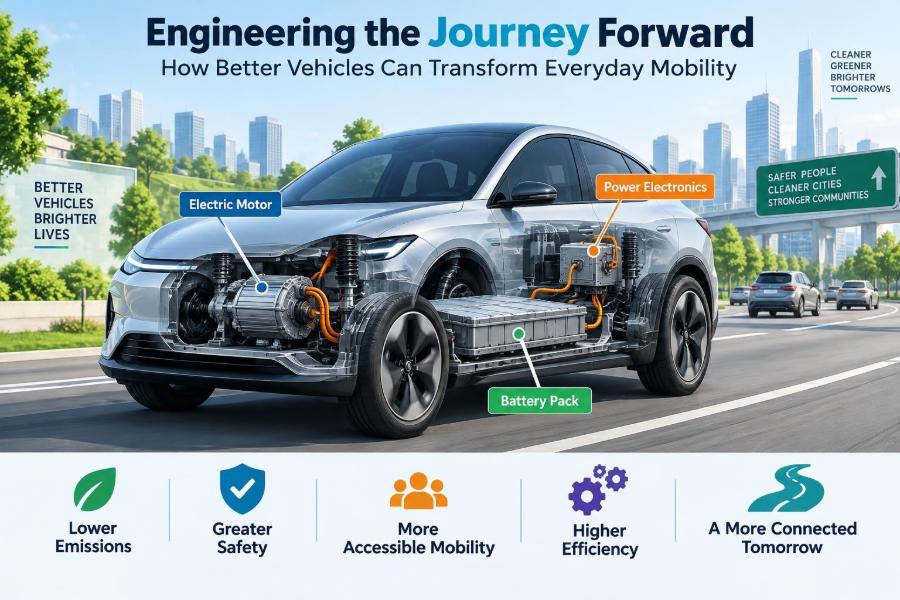
Electric vehicles replace the engine, fuel tank, exhaust system, and transmission arrangement of many conventional designs with a battery, electric motor, power electronics, and high-voltage wiring. This rearrangement can free cabin space and lower the center of gravity when the battery is placed under the floor.
It also introduces new constraints. Battery packs require protection from impact, water intrusion, vibration, and excessive temperature. Their mass influences suspension tuning, braking calibration, tire loading, and structural design.
Electrification is not a single vehicle formula. Battery-electric, hybrid, plug-in hybrid, and fuel-cell concepts each bring different infrastructure needs and operating characteristics.
🌡️ Thermal Management Protects Performance
Thermal management controls heat in engines, motors, batteries, inverters, brakes, and cabins. It becomes especially visible in very hot or cold weather, when occupants want heating or cooling while the propulsion system also needs energy and temperature control.
A battery usually performs best within an intended temperature range. Heating or cooling it can consume energy, but neglecting temperature control can limit power, charging rate, durability, or safety margins.
Efficient heat pumps, insulation, coolant circuits, and intelligent control strategies can improve real-world usability. The precise outcome still depends on climate, route, speed, load, and vehicle design.
⚡ Charging Must Fit Daily Routines
Electric mobility works best when charging matches dwell time: the periods when a vehicle is already parked. Home, workplace, depot, and destination charging can turn inactive time into energy replenishment.
Fast charging is valuable on longer journeys and for high-utilization fleets, but it is not the only measure of a practical system. Access, reliability, payment simplicity, clear information, and convenient locations often matter just as much.
For an apartment resident without assigned parking, charging access may be the central barrier. For a depot-based van fleet, planned overnight charging may be far more workable than frequent public fast charging.
⛽ Combustion Powertrains Still Need Better Engineering
Internal-combustion vehicles remain part of many transport systems, particularly where refueling infrastructure, towing needs, long distances, or vehicle affordability shape decisions. Improving them still matters while fleets transition.
Efficiency can be improved through combustion control, reduced friction, optimized gearing, stop-start operation, lower aerodynamic drag, and lighter components. Emissions control systems also require correct operating conditions and maintenance to function as intended.
There is no engineering value in treating vehicle technologies as moral labels. The relevant question is how a particular powertrain performs over its actual use, including energy supply, maintenance, and lifecycle constraints.
🌬️ Aerodynamics Saves Energy at Speed
Aerodynamic drag rises rapidly as vehicle speed increases, which makes body shape especially influential during highway travel. Smooth underbodies, carefully shaped mirrors, controlled airflow around wheels, and well-designed rear surfaces can reduce the energy needed to maintain speed.
The goal is not necessarily to make every vehicle look identical. It is to manage airflow without compromising necessary cooling, visibility, cargo access, repairability, or pedestrian considerations.
Roof boxes, open windows, and external accessories can also alter drag. Their impact depends on the vehicle and operating speed, but the principle is straightforward: pushing air aside requires energy.
⚙️ Reducing Mass Has Benefits and Boundaries
Lower mass can reduce the energy needed for acceleration and climbing, and it may allow smaller powertrain components. It can also reduce loads on tires, brakes, and suspension components.
However, lightweighting must not undermine crash performance, durability, affordability, or repairability. Advanced materials may save mass but create joining, recycling, and repair challenges.
The best strategy is often targeted mass reduction: remove material where it contributes little value, retain it where structural strength or protection is needed, and use systems engineering to avoid adding unnecessary features elsewhere.
🔄 Regenerative Braking Recovers Part of Motion
In many electrified vehicles, the traction motor can operate as a generator during deceleration. Instead of converting all motion into brake heat, it sends some energy back to the battery. This is called regenerative braking.
It is particularly useful in urban traffic with repeated slowing and starting. It cannot recover all energy, because losses occur in tires, air resistance, electronics, and the battery itself, and friction brakes remain necessary for stronger stops and low-speed holding.
Well-calibrated blending between regenerative and friction braking should feel natural to the driver. A change in pedal feel during transitions can reduce confidence if not engineered carefully.
🏙️ Compact Vehicles Can Improve Dense Cities
Large vehicles occupy more road space, parking space, and visual space, especially in dense urban areas. Compact cars, micro-mobility vehicles, small delivery machines, and shared shuttles can sometimes move people or goods with fewer spatial demands.
Smaller is not automatically safer or more sustainable. It must still provide adequate crash protection, weather protection, range, and comfort for its role. But matching vehicle size to trip size can make streets easier to use.
A single occupant commuting a few kilometers usually does not require the same machine as a family traveling with luggage or a tradesperson carrying tools.
♿ Inclusive Design Expands Independence
Mobility design often assumes a healthy, average-sized adult with full strength, vision, hearing, and dexterity. Real users include older adults, children, people with temporary injuries, wheelchair users, and passengers who need assistance.
Inclusive features can include low step-in heights, wide door openings, grab handles, high-contrast controls, voice and tactile feedback, easy-to-reach storage, and accessible restraint systems. These are not niche details; they can make a vehicle easier for nearly everyone to use.
Accessibility also depends on the trip chain. A wheelchair-accessible van is less useful if curb ramps, pickup zones, or destination entrances fail to support the journey.
📦 Commercial Vehicles Multiply Design Decisions
A design improvement on a commercial vehicle can affect many trips each day. Ergonomic loading height may reduce worker strain; a better turning circle may shorten time on narrow streets; reliable telematics may help maintenance teams address faults before a breakdown.
Fleet engineering should consider driver fatigue, cargo security, route conditions, depot operations, and repair downtime. A vehicle that is slightly cheaper to buy but repeatedly unavailable can be expensive to operate.
Commercial operators also need useful data, not simply more data. Information should support actions such as scheduling service, coaching efficient driving, or identifying charging bottlenecks.
🔧 Reliability Is a Mobility Feature
A vehicle that performs brilliantly when new but fails unpredictably does not deliver dependable mobility. Reliability comes from component design, manufacturing quality, corrosion protection, software validation, diagnostic capability, and realistic durability testing.
For users, reliability includes how a fault is handled. Clear warnings, safe fallback modes, available spare parts, competent service technicians, and understandable repair information reduce disruption.
Engineering for reliability means anticipating heat cycles, vibration, water exposure, misuse, aging seals, cable wear, and imperfect maintenance—not just ideal laboratory operation.
🧰 Repairability Extends Useful Vehicle Life
Vehicles are long-lived products operating in harsh conditions. Designing components for access, diagnosis, replacement, and recalibration can reduce downtime and avoid prematurely discarding otherwise serviceable vehicles.
Repairability sometimes conflicts with compact packaging or sealed modules. The compromise should be evaluated honestly: a design that saves a small amount of assembly space may create disproportionate cost and waste after a minor collision or component fault.
Training and tooling matter too. A repairable design still needs safe procedures, especially around high-voltage systems, airbags, and sensor calibration.
🧭 Software Now Shapes the Driving Experience
Software coordinates power delivery, battery behavior, braking, driver displays, connectivity, and assistance features. It can improve a vehicle after sale through updates, but it can also introduce new failure modes if changes are poorly tested.
Automotive software must handle unusual situations gracefully: a faulty sensor, weak network connection, interrupted update, low battery state, or conflicting driver request. Safe degradation is often more valuable than a clever feature that works only under perfect conditions.
Cybersecurity is part of this responsibility. Connected vehicles need protection against unauthorized access while still allowing legitimate diagnosis and maintenance.
🔒 Data Should Serve the User, Not Confuse Them
Connected vehicles can generate information about location, energy use, component health, driving patterns, and cabin settings. This can help users plan journeys and help fleets maintain vehicles, but it raises privacy and control questions.
Drivers should be able to understand what is collected, why it is collected, and how it is shared. Consent screens buried in complex menus do not create meaningful understanding.
From an engineering standpoint, collecting only useful data, securing it well, and designing transparent controls are often better than treating data volume as a goal.
🚦 Vehicles Must Cooperate With Streets
No vehicle design can fully compensate for unsafe road geometry, missing crossings, poor lighting, or inconsistent lane markings. Safer and more efficient mobility requires vehicles to be considered alongside street design and traffic management.
For example, automatic emergency braking may reduce some collision risk, but lower speeds near schools, protected crossings, and clear sightlines reduce exposure in the first place. Technology works best when it reinforces a forgiving transport environment.
This principle applies to charging as well. Cables, bays, signage, and grid connections need to be designed around real parking behavior and accessibility needs.
🚌 Better Vehicles Should Support Public Transport
Private vehicles and public transport are often presented as opposites, but many journeys combine them. A person may walk, cycle, drive to a station, take a train, and use a small shuttle for the last segment.
Vehicles can strengthen this network through reliable feeder buses, accessible taxis, safe bicycle transport, park-and-ride services, and shared vehicles for trips that do not justify ownership. The best option depends on local density and service quality.
Engineering should avoid the assumption that every mobility problem requires a privately owned, full-size vehicle. Sometimes the better vehicle is the one that makes a transfer easier.
🌱 Lifecycle Thinking Prevents Burden Shifting
A vehicle’s environmental impact is not limited to what leaves its tailpipe, or to the electricity it consumes while driving. Materials extraction, manufacturing, maintenance, tire wear, energy production, and end-of-life treatment all matter.
Lifecycle assessment is a structured way to consider these stages. Its results depend on assumptions about vehicle lifetime, electricity sources, manufacturing processes, usage, and recycling, so comparisons should be interpreted carefully rather than reduced to slogans.
Durability, efficient operation, smaller right-sized vehicles, cleaner energy, and material recovery can all contribute. No single design choice removes every impact.
🧪 Testing Must Reflect Messy Reality
Laboratory tests are essential because they provide repeatable conditions for comparing designs. Yet real use adds uneven roads, traffic, aggressive weather, different loads, aging components, and varied driving habits.
Strong development programs combine simulation, bench testing, proving-ground work, controlled road evaluation, and field feedback. Each method catches different problems.
A stated range, energy-use figure, or assistance feature description should therefore be understood as condition-dependent. Engineers and users alike should ask which conditions the result represents.
📋 Buying or Specifying for the Actual Job
Whether choosing a personal vehicle or writing a fleet specification, start with use rather than marketing categories. Consider the journeys made most often, then identify the difficult but legitimate cases that the vehicle must handle.
- How many people and how much cargo must it carry regularly?
- Where will it park, refuel, or charge?
- What weather, gradients, road surfaces, and trip lengths are normal?
- Which safety and accessibility needs are non-negotiable?
- Can local workshops maintain the technology?
This approach prevents both under-specification and expensive over-specification.
⚠️ Common Mistakes in Mobility Innovation
One mistake is treating a new technology as the solution before defining the problem. Adding automation, connectivity, or battery capacity can create cost and complexity without improving the journey that matters.
Another is optimizing a single metric. Maximum range, peak power, screen size, or cargo volume tells only one part of the story. A well-rounded design considers safety, usability, serviceability, and total resource demand.
Finally, engineers must not design only for ideal users. Real people make mistakes, carry awkward loads, wear gloves, drive in rain, and operate vehicles while tired. Robust design expects this reality.
🤝 Engineers Need Cross-Disciplinary Thinking
Mechanical, electrical, software, materials, manufacturing, and safety engineers must work together because decisions cross boundaries. A battery packaging change can affect crash structure; a new sensor can alter styling, wiring, software, calibration, and repair procedures.
Useful mobility solutions also benefit from input by urban planners, accessibility specialists, technicians, fleet operators, and end users. The person who loads parcels all day may identify an ergonomic failure that is invisible in a design review.
For students, this is a reminder that technical depth and systems thinking are complementary skills, not competing ones.
🔭 The Next Step Is Appropriate Innovation
Future vehicles may use improved batteries, lower-carbon materials, more capable sensing, bidirectional energy functions, automated fleet operations, and new ownership models. Some developments will be highly valuable in particular contexts and less useful in others.
The question is not whether technology is advanced. It is whether it makes travel safer, more accessible, less resource-intensive, and more dependable without transferring unreasonable costs or risks elsewhere.
Appropriate innovation is often quietly effective: a safer door latch, clearer warning, longer-lasting component, better bus ramp, or charging point placed where people actually stop.
🌍 The Core Principle: Engineer the Whole Journey
Better vehicles transform everyday mobility when they are designed around people’s complete journeys rather than isolated specifications. That includes entering the vehicle, carrying what is needed, navigating safely, obtaining energy, recovering from faults, and arriving without creating unnecessary burden for others.
Safety, efficiency, inclusion, reliability, and lifecycle responsibility are not optional extras added at the end of development. They are connected design requirements that must be considered from the first concept sketch.
For the automobile engineer, the most useful measure of progress is simple: does this design help more people make necessary journeys with greater confidence and fewer resources?
The journey forward is not defined by vehicles that merely travel farther or faster, but by vehicles that make everyday movement safer, fairer, more reliable, and better matched to the world around them. 🚗⚡🌍