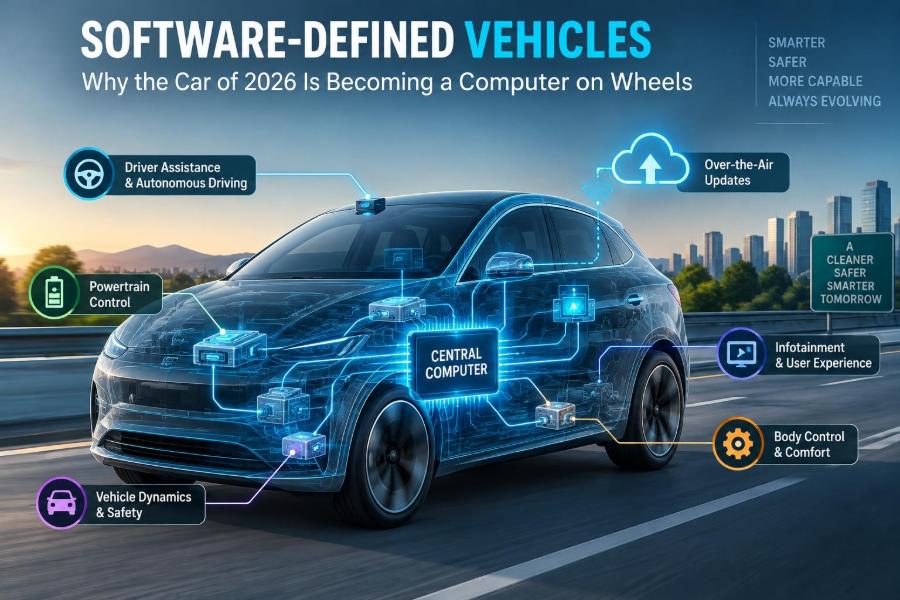

A driver buys a new car partly for its reversing camera, route guidance, driver-assistance features, and smartphone integration. A few months later, a software update changes the dashboard layout, improves charging-route planning, or fixes a fault without a visit to a workshop.
That experience once belonged mainly to phones and laptops. It is becoming normal in automobiles, where code now influences everything from door locks and infotainment to battery control and braking support.
This shift matters to engineering students because vehicle design is no longer separated neatly into mechanical, electrical, and software work. It matters to working professionals because the tools, supply chains, safety cases, and service models around the vehicle are changing with it.
The car of 2026 will still need tyres, crash structures, motors or engines, bearings, and reliable wiring. But its capabilities will increasingly be shaped by software that can be updated, monitored, and improved over the vehicle’s life.
🧠 What “Software-Defined Vehicle” Actually Means
A software-defined vehicle (SDV) is a vehicle in which many features and functions are controlled, coordinated, or changed primarily through software rather than being fixed entirely by dedicated hardware.
It does not mean that a car is simply a large smartphone, nor that mechanics become irrelevant. It means the hardware platform is designed to support adaptable software functions, including functions that may be added or refined after production.
For example, one electronic control unit may receive sensor data, while software decides how to present warnings, manage energy use, or coordinate several subsystems. The value increasingly comes from how these elements work together.
🚘 Why This Change Is Happening Now
Vehicles have contained electronic control units, or ECUs, for decades. What has changed is the scale of connectivity, computing power, sensor data, electrification, and customer expectation for digital features.
Electric vehicles particularly benefit from software-intensive control because battery temperature, charging, torque delivery, and energy recovery must be managed continuously. Advanced driver-assistance systems also require rapid processing of camera, radar, and other sensor inputs.
Manufacturers are therefore moving from many isolated electronic functions toward more integrated computing platforms.
🧩 From Separate ECUs to a Coordinated Platform
A conventional vehicle may contain numerous ECUs, each supplied for a narrow purpose: engine management, anti-lock braking, airbag control, windows, seats, lighting, or infotainment. These units often use different software, networks, and update procedures.
This arrangement evolved sensibly over time, but it can create duplication and complexity. Adding a cross-vehicle feature may require changes across several controllers and suppliers.
An SDV approach seeks greater coordination. It does not eliminate every ECU, especially in safety-critical areas, but it aims to reduce unnecessary fragmentation.
🏗️ Understanding Vehicle Electrical and Electronic Architecture
The electrical/electronic architecture, often shortened to E/E architecture, is the organized arrangement of a vehicle’s computers, networks, sensors, actuators, power supply, and software interfaces.
Think of it as the vehicle’s nervous system. Sensors detect conditions, networks carry messages, controllers make decisions, and actuators create physical outcomes such as steering assistance, brake pressure, cooling flow, or lamp operation.
A good architecture makes these interactions understandable, testable, and resilient. A poor one can make even simple changes slow, expensive, and risky.
🗂️ Domain Controllers and Their Limits
One intermediate design groups related functions into domains. A body domain may handle locks, lighting, and windows; a powertrain domain may handle propulsion; and a cockpit domain may manage displays and media.
Domain controllers can reduce the number of separate modules and simplify communication within their area. They are a practical step away from a fully distributed ECU landscape.
However, functions such as automated parking or energy-aware route planning cross domain boundaries. This is why many newer designs are moving further toward centralized and zonal architectures.
📍 Zonal Architecture Explained
In a zonal architecture, controllers are organized partly by physical location in the vehicle rather than solely by function. A controller near the front-left area, for instance, may collect signals from nearby lamps, sensors, and actuators.
Those local controllers connect to high-performance central computers. This can shorten wiring runs, reduce harness weight, and make the vehicle easier to scale across models.
The exact benefit depends on design choices; zonal architecture is not automatically simpler. It requires robust power distribution, network design, diagnostics, and clear responsibility boundaries.
🖥️ Central Computers and High-Performance Compute
A central vehicle computer can run demanding functions that would be impractical on many small controllers. Examples include sensor fusion, advanced visualization, connected services, and fleet-level diagnostic logic.
Sensor fusion combines information from several sensors to build a more useful interpretation than a single sensor could provide. A camera may identify lane markings while radar supplies distance and relative-speed information.
Centralization does not mean a single computer should control every safety function. Local controllers may still need authority to respond quickly and safely if communication is disrupted.
🔌 Networks: The Car’s Data Highways
Vehicle networks carry messages between modules. CAN remains widely used because it is robust and well suited to many control tasks. LIN is common for simpler, lower-speed body functions, while Ethernet is increasingly used where large data flows are needed.
High-resolution cameras and central computing place much greater demand on bandwidth than a traditional switch signal. Network design must also address timing, message priority, redundancy, electromagnetic compatibility, and fault isolation.
A fast network alone is not enough. Engineers must specify which information is trustworthy, who may send it, and what happens when it arrives late or not at all.
⚙️ Software Layers Separate Hardware from Features
A useful SDV design separates low-level hardware interaction from higher-level vehicle applications. This is often described as abstraction: software can use a stable interface without needing to know every detail of the underlying device.
For example, a climate-control application should request a cabin temperature target rather than directly managing every electrical detail of a blower motor. The lower layer translates the request into hardware action within defined limits.
This separation can make software more portable across vehicle variants. It also demands disciplined interface design; vague or unstable interfaces create difficult integration problems.
🧱 Middleware Makes Integration Possible
Middleware is software that helps applications communicate with operating systems, hardware, networks, and one another. It can provide messaging, timing services, security functions, diagnostics, and standardized interfaces.
In a vehicle, middleware is valuable because many teams and suppliers must integrate their work. Without agreed interfaces, every new connection can become a one-off engineering exercise.
Standardization helps, but it is not a substitute for system engineering. Engineers still need to define performance budgets, failure behavior, ownership, and verification methods.
🔄 Over-the-Air Updates Change the Vehicle Lifecycle
An over-the-air, or OTA, update delivers approved software to a vehicle through a wireless connection. It can correct software defects, improve a user interface, update maps, or revise certain control calibrations.
The key change is lifecycle thinking. Instead of treating software as frozen at vehicle delivery, manufacturers can maintain it through controlled releases.
Not every update should be performed in the same way. Safety-relevant changes need careful validation, secure installation, clear conditions for use, and recovery procedures if an update fails.
🛡️ Why Cybersecurity Is a Core Engineering Requirement
Connectivity creates useful services, but it also creates possible entry points for attack. A compromised infotainment system, mobile application, diagnostic interface, or cloud account must not become a route to critical vehicle functions.
Cybersecurity involves secure design from the beginning: authentication, encryption where appropriate, access control, key management, secure boot, monitoring, and timely vulnerability response.
It is also a lifecycle responsibility. A vehicle may remain on the road for many years, so security support cannot be treated as a short-term launch task.
🔐 Secure Boot, Signing, and Trusted Updates
Secure boot checks that authorized software is loaded when a controller starts. Digital signatures help the system verify that an update came from an approved source and has not been altered.
These measures do not guarantee that software is free of defects. They reduce the risk of unauthorized software running in the vehicle.
Update systems also need rollback or recovery strategies. A vehicle must not be left unusable because an interrupted download or installation corrupted essential software.
🧯 Functional Safety Still Comes First
Functional safety addresses hazards caused by malfunctions in electrical or electronic systems. In automotive engineering, the concern is not merely whether code works under normal conditions, but what the vehicle does when hardware, software, sensors, or communication fail.
A braking-related function, for example, needs defined fault detection and a safe response. Depending on the function, that response might be a warning, limited operation, fallback control, or a carefully managed shutdown.
More software does not remove safety engineering; it expands the number of interactions that must be analyzed.
🧭 Safety of the Intended Functionality
Some risks occur even when components have not technically failed. A camera-based assistance system may function as designed but struggle with glare, obscured lane markings, unusual road layouts, or poor weather.
This is often discussed under safety of the intended functionality. Engineers must consider performance limitations, user understanding, environmental conditions, and foreseeable misuse.
A clear driver warning is not a complete solution. The system’s operational boundaries must be designed, communicated, tested, and monitored realistically.
👀 Driver Assistance Is Not the Same as Autonomy
Features such as adaptive cruise control, lane centering, emergency braking, and parking assistance can reduce workload in specific conditions. They do not automatically make a vehicle capable of driving everywhere without supervision.
Terminology can confuse users when marketing language is stronger than the actual capability. The practical question is simple: who is responsible for monitoring the road and taking control when conditions change?
For many systems available in ordinary passenger vehicles, the driver remains responsible. Engineers should design handover behavior and human-machine interfaces around that reality.
🔋 Battery Software Is Central to Electric Vehicles
The battery-management system estimates battery state, protects cells from unsuitable operating conditions, coordinates charging, and supports thermal management. It is one of the most consequential software-controlled systems in an electric vehicle.
Battery state of charge is not measured as directly as a fuel gauge reading. It is estimated using current, voltage, temperature, operating history, and battery models, with unavoidable uncertainty under changing conditions.
Good battery software balances range, performance, charging speed, cell longevity, and safety. These goals can conflict, especially in very hot or cold weather.
🌡️ Thermal Management Depends on Smart Control
Modern vehicles must manage heat from batteries, motors, power electronics, cabins, and computing hardware. In electric vehicles, thermal control can influence charging behavior, available power, range, and component durability.
Software coordinates pumps, valves, fans, compressors, and heat exchangers according to sensors and predicted needs. Preparing a battery for a rapid-charge stop is one example of predictive control.
The challenge is not just to cool or heat aggressively. Efficient control uses energy carefully while keeping components within suitable operating ranges.
📱 The Digital Cockpit Changes the User Interface
Screens, voice control, connected navigation, and customizable displays give manufacturers more flexibility than fixed buttons alone. Software can adapt layouts, add functions, and integrate external services.
But a screen is not automatically a better interface. Frequently used controls, such as demisting or hazard lights, must remain easy to locate and operate without unnecessary visual distraction.
Good cockpit design respects human attention. The engineering problem includes response time, readability, touch accuracy, accessibility, and behavior during a system restart.
☁️ Cloud Services Extend the Vehicle Beyond Its Cabin
Connected vehicles can exchange data with cloud services for navigation, remote status checks, service scheduling, software delivery, and fleet management. Commercial fleets may use this information to plan maintenance and reduce avoidable downtime.
Data should be collected for a clear purpose, protected appropriately, and handled transparently. A technically possible data stream is not automatically necessary or acceptable to retain.
Connectivity also requires graceful degradation. Core driving functions should not depend on a perfect mobile-data connection.
🔧 Diagnostics Become More Proactive
Traditional diagnostics often begin after a warning lamp appears or a driver reports a problem. Connected software can support earlier detection of patterns, such as repeated communication errors or abnormal temperature behavior.
This does not mean every anomaly identifies a definite failure. Sensor noise, changing conditions, and incomplete data can produce false alerts.
The best diagnostic systems give technicians useful evidence: fault context, event timing, software version, relevant measurements, and recommended checks. They should assist judgment rather than replace it.
🧰 Workshops Need New Skills, Not Less Skill
Mechanical fundamentals remain essential. Tyres wear, suspension parts loosen, coolant leaks, and crash damage needs careful repair. Yet technicians increasingly need competence in high-voltage safety, network diagnostics, calibration, software configuration, and cybersecurity-aware procedures.
A repair may involve replacing a component and then pairing, coding, calibrating, or updating it. Skipping the digital step can leave a vehicle with warnings, reduced functionality, or unsafe operation.
For students, the valuable combination is practical workshop discipline plus confidence reading data, wiring diagrams, network traces, and service documentation.
🏭 Manufacturing Must Manage Software Configuration
A vehicle leaving the factory may contain many software versions across different controllers. Manufacturing must ensure that the installed hardware and software combination matches the intended specification.
Configuration management tracks exactly what is fitted and what code is approved for it. This becomes especially important when similar-looking vehicles have different sensors, battery capacities, market requirements, or optional features.
Without configuration control, a correct update for one variant could be unsuitable for another. Software traceability is therefore a quality issue, not merely an IT task.
🤝 Suppliers and Automakers Are Redefining Responsibilities
Vehicle development has long relied on specialist suppliers. In an SDV, integration becomes more demanding because functions cross traditional component boundaries and software may be updated after sale.
Automakers may develop more software internally, while suppliers provide platforms, controllers, operating systems, sensors, and specialized applications. Neither model is universally superior.
The vital requirement is clear responsibility: who owns the interface, validates changes, handles cybersecurity issues, maintains documentation, and supports the function throughout its service life?
💸 Feature-on-Demand Has Benefits and Boundaries
Some vehicles can activate eligible features after purchase through software. This may let an owner add a service when it becomes useful, rather than paying for every option at delivery.
However, customers reasonably question subscriptions for features tied to hardware already installed in the vehicle. The distinction between a continuing connected service and a permanently fitted capability affects perceived fairness.
Engineers and product teams should also avoid designing essential safety or compliance functions around confusing payment conditions.
⚠️ The Risks of Software Complexity
Greater flexibility can create greater complexity. A feature that crosses cloud systems, mobile apps, central computers, networks, sensors, and actuators has many possible failure points.
Common problems include poorly defined interfaces, insufficient test coverage, incompatible versions, unexpected latency, unclear warning messages, and updates that solve one issue while affecting another.
The answer is not to reject software. It is to manage complexity through architecture, modularity, simulation, testing, traceability, staged releases, and a willingness to limit features that cannot be supported safely.
🧪 Testing Cannot End at the Prototype Stage
SDV development uses several levels of testing. Software can be tested in simulation; controllers can be evaluated with simulated inputs; and complete vehicles can be tested on roads and proving grounds.
Hardware-in-the-loop testing is one useful approach. Real control hardware operates while a test system simulates parts of the vehicle and environment, allowing unusual or hazardous scenarios to be repeated safely.
Testing must include degraded conditions: low voltage, lost messages, sensor disagreement, interrupted updates, poor connectivity, and unexpected user actions. Normal operation alone is not enough.
📏 Measuring Value Beyond Screen Size
A larger display or more downloadable features does not by itself indicate a better software-defined vehicle. Useful measures include predictable behavior, fast and understandable diagnostics, robust cybersecurity, maintainability, and a low burden on driver attention.
Consider a simple comparison: a system that adds a flashy menu but causes frequent delays has limited engineering value. A quieter improvement that makes battery preconditioning reliable or reduces false warnings may matter far more in daily use.
| Question | Useful engineering focus |
|---|---|
| Can the feature be updated? | Compatibility, validation, recovery, and version control |
| Can it fail safely? | Fault detection, fallback behavior, and driver communication |
| Can it be serviced? | Diagnostics, documentation, calibration, and technician access |
| Can users understand it? | Clear interface design and realistic operating limits |
🎓 What Students Should Learn for This Field
Students do not need to become experts in every discipline at once. They do need a systems mindset: understand how a mechanical outcome depends on electronics, software, energy, communications, and human use.
- Build foundations in vehicle dynamics, powertrain or electric-drive systems, and basic electronics.
- Learn programming concepts, version control, debugging, and structured testing.
- Read network diagrams and understand sensors, actuators, signals, and timing.
- Study functional safety, cybersecurity principles, and high-voltage working practices.
- Practice explaining technical limits clearly to non-specialists.
A small project such as logging CAN data on a training rig, simulating a battery estimator, or designing a fault-warning interface can develop more useful understanding than memorizing buzzwords.
🧑🔧 Practical Questions for Working Professionals
Professionals evaluating SDV projects should ask practical questions early. What function is being changed, which systems depend on it, and what is the safe behavior if a connection or update fails?
They should also ask whether service teams have the tools, permissions, training, and documentation needed to support the design. A feature that cannot be diagnosed efficiently becomes expensive for owners and workshops.
Finally, measure operational outcomes rather than only delivery speed. Reliable releases, shorter repair times, fewer confusing warnings, and well-managed security response are meaningful indicators of maturity.
🛣️ What the Car of 2026 Will—and Will Not—Be
By 2026, many new vehicles will offer more centralized computing, connected services, software updates, digital displays, and software-managed electric-drive functions than cars from earlier generations. The pace will vary by market, price segment, regulation, and manufacturer.
They will not all be fully autonomous, permanently connected, or free from mechanical maintenance. Nor will every software feature be useful simply because it can be deployed.
The most successful vehicles will combine digital adaptability with the traditional automotive virtues of durability, safety, repairability, and predictable operation.
🚀 The Core Principle: Software Must Serve the Vehicle
The defining idea of the software-defined vehicle is not that code replaces automotive engineering. It is that software becomes a major means of delivering, coordinating, improving, and maintaining vehicle functions.
That creates opportunities for better energy management, diagnostics, safety support, and personalization. It also imposes serious obligations in architecture, verification, cybersecurity, serviceability, and honest communication about system limits.
For future engineers, the advantage will come from connecting disciplines rather than choosing only one. The best decisions will treat software, hardware, people, and the real operating environment as one engineering system.
The car of 2026 is becoming a computer on wheels, but it succeeds only when its software makes the physical vehicle safer, clearer, more reliable, and easier to live with. 🚗💻🔧