
You press the accelerator to merge into traffic, and an electric vehicle moves away with almost no pause. There is no rising engine speed, no familiar gear change, and often very little sound. Yet a large amount of energy is being measured, converted, controlled, and delivered in milliseconds.
That smooth response can make an EV seem mechanically simple. It is simpler than a conventional car in some ways, but its powertrain is a tightly coordinated electrical system. The battery, inverter, motor, cooling circuits, software, and reduction gears must all work together.
Understanding that chain helps students connect electrical theory with vehicle behaviour. It also helps drivers make better sense of range, rapid acceleration, regenerative braking, charging limits, and the warning messages that can appear on an instrument display.
The central idea is straightforward: stored chemical energy becomes electrical energy, electrical energy becomes controlled magnetic force, and magnetic force becomes wheel torque. The engineering lies in making every conversion efficient, safe, responsive, and durable.
🔋 The EV Powertrain at a Glance
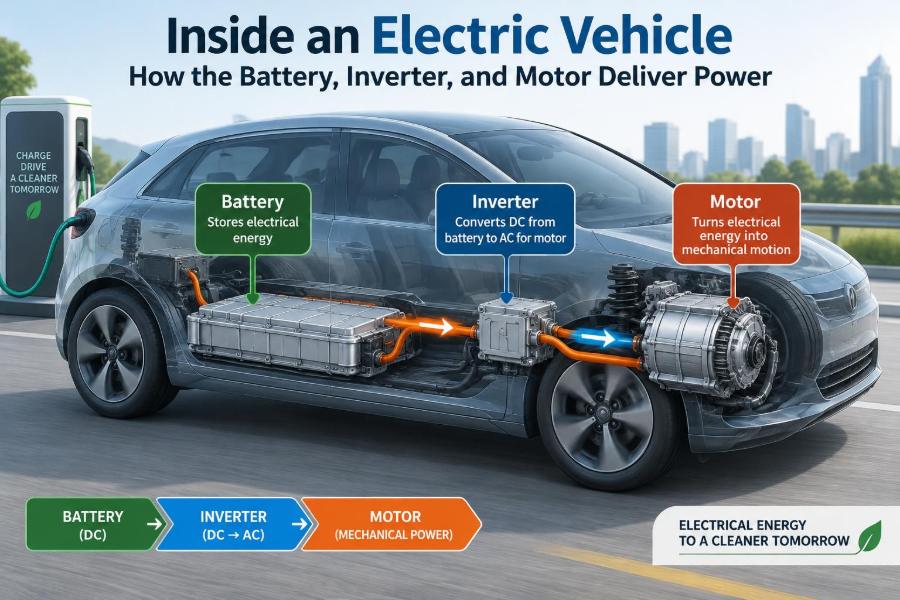
An EV powertrain transfers energy along a clear path: the high-voltage battery supplies direct current, or DC; the inverter changes and controls that electricity; the traction motor produces rotation; and reduction gears send torque to the wheels.
This is not a one-way path. During deceleration, many EVs reverse the flow, using the motor as a generator to return some energy to the battery. That bidirectional capability is one reason an EV can feel both quick and controlled in urban driving.
⚡ Why Voltage Matters So Much
Power is the product of voltage and current. For a given power demand, raising voltage allows the system to use less current. Lower current can reduce resistive heating in cables, connectors, and switching devices.
That is why traction batteries operate at far higher voltages than the familiar 12-volt electrical system. The exact voltage varies by vehicle and battery state, but it is high enough that specially designed insulation, connectors, service procedures, and safety monitoring are essential.
🧪 The Battery Is an Energy Store, Not a Fuel Tank
A lithium-ion traction battery stores energy through reversible electrochemical reactions. It contains many individual cells arranged into modules and then into a sealed pack. The pack includes far more than cells: it also has sensors, electrical contactors, fuses, cooling hardware, and structural protection.
A fuel tank mainly holds energy. A battery must also manage the conditions under which energy enters and leaves. Temperature, cell voltage, current, age, and charge level all affect what the pack can safely deliver or accept.
🧱 Cells, Modules, and Packs
The cell is the smallest energy-storage unit. Manufacturers use several physical formats, including cylindrical, prismatic, and pouch cells. Each format creates different trade-offs in packaging, cooling, assembly, repairability, and mechanical support.
Cells are connected in series to increase voltage and in parallel to increase current capability and total capacity. Modules group cells into manageable sections, while the pack integrates modules into a protected vehicle-level assembly.
- Series connections add voltage.
- Parallel connections increase available current and energy capacity.
- Pack architecture determines how the battery fits the vehicle floor or body structure.
📏 Energy Capacity and Power Capability Are Different
Battery energy capacity is commonly expressed in kilowatt-hours, or kWh. It describes how much energy the pack can store and is closely related to potential driving range, although speed, weather, terrain, tyres, and driving style also matter.
Power capability describes how quickly the battery can provide or absorb energy. A pack may have substantial energy capacity but limited peak power when it is cold, nearly empty, too hot, or aged. This distinction explains why full acceleration or strong regeneration may sometimes be temporarily reduced.
🧠 The Battery Management System Watches Every Cell
The battery management system, usually called the BMS, monitors battery voltage, current, and temperature. It estimates state of charge, manages balancing between cells, and communicates operating limits to other controllers.
State of charge is an estimate, not a direct view into the battery. The BMS combines measurements and models because a cell’s usable charge depends on temperature, load, and its recent history. Its calculations help prevent overcharging, over-discharging, and operation outside intended limits.
⚖️ Cell Balancing Protects the Whole Pack
Cells do not remain perfectly identical throughout their lives. Small manufacturing differences, temperature variation, and aging can cause some cells to reach high or low voltage limits before others.
Balancing reduces the mismatch, often by carefully bleeding a small amount of energy from relatively fuller cells. This process does not create extra energy; it helps the pack use its cells more evenly and prevents one limiting cell from unnecessarily restricting the whole battery.
🌡️ Temperature Changes Battery Behaviour
Cold cells have higher internal resistance and accept charge less readily. In cold conditions, an EV may limit available power, reduce regenerative braking, or use energy to warm the battery before fast charging.
High temperatures also require control. Heat accelerates unwanted aging processes and can reduce performance. A vehicle’s thermal system therefore works throughout driving, charging, and sometimes after the vehicle has been parked.
❄️ Cooling and Heating Are Part of Performance
Many modern EVs use liquid coolant plates, channels, or refrigerant-based systems to control battery temperature. Some use heat pumps to move heat efficiently between the cabin, battery, motor, and power electronics under suitable conditions.
Thermal management is not merely a comfort feature. It influences charging speed, sustained acceleration, regeneration, battery life, and the consistency of vehicle behaviour. The best system is one that maintains suitable temperatures with minimal energy use.
🔒 Contactors Connect High Voltage Safely
When an EV is switched off, high-voltage contactors inside the battery pack are normally open, isolating much of the high-voltage system. When the vehicle starts, the control system checks conditions before closing them.
A pre-charge circuit usually charges the inverter’s capacitors gradually before the main contactors close. Without this step, a sudden inrush of current could stress components and cause arcing. This is a practical example of how electrical safety shapes powertrain design.
🧯 Fuses, Isolation, and Fault Detection
High-voltage batteries include protective devices that interrupt current during certain faults. The vehicle also monitors insulation resistance between the high-voltage circuit and the vehicle body, helping detect unwanted leakage paths.
These protections do not make high-voltage components safe for untrained handling. Orange cables and marked enclosures identify high-voltage circuits, but correct isolation procedures, approved tools, and manufacturer information remain necessary for service work.
🔄 DC Must Become Controlled AC
The battery supplies DC, meaning its polarity remains in one direction. Most traction motors require carefully controlled alternating current, or AC, to create a rotating magnetic field. The inverter performs this conversion.
It does more than simply alternate current. The inverter controls voltage, frequency, phase, and current waveform many thousands of times per second. Those decisions determine motor speed, torque, efficiency, and smoothness.
🧩 Inside the Traction Inverter
At the heart of an inverter are fast semiconductor switches, commonly based on silicon or silicon carbide. By switching the battery voltage on and off in a precisely timed pattern, the inverter synthesizes the three-phase AC supplied to the motor.
Silicon carbide devices can switch efficiently at high voltages and temperatures, which can help reduce losses or cooling demand in some designs. Their benefits depend on the complete system design; the semiconductor choice alone does not determine vehicle efficiency.
🎼 Pulse-Width Modulation Shapes Motor Power
Pulse-width modulation, or PWM, is a common control technique. Rather than delivering a perfectly smooth analogue voltage directly, the inverter creates rapid pulses whose timing and width produce the required average electrical effect.
A useful analogy is a fast-acting tap: it opens and closes so quickly that the average flow can be controlled precisely. In an EV, the result is a rotating magnetic field that the motor can follow with remarkable accuracy.
🧭 Motor Control Determines Torque
The accelerator pedal does not directly command battery current. It sends a request to vehicle control software, which considers traction, temperature, battery limits, gear position, and stability-control interventions before requesting motor torque.
Modern systems commonly use field-oriented control, which treats magnetic fields as controllable components. This allows the inverter to produce requested torque smoothly while managing efficiency and protecting the motor and battery.
🧲 The Motor Turns Magnetic Fields into Motion
A traction motor has a stationary part called the stator and a rotating part called the rotor. The inverter energizes stator windings in sequence to create a rotating magnetic field. The rotor responds to that field, producing torque at the output shaft.
Unlike an internal-combustion engine, an electric motor can generate useful torque from very low speed. That is why an EV can launch strongly without a conventional multi-ratio gearbox.
🌀 Common EV Motor Types
Permanent-magnet synchronous motors use magnets in the rotor and are widely used because they can offer high power density and strong efficiency over much of their operating range. Their material supply and magnet use are design considerations.
Induction motors create rotor magnetism electrically rather than relying on permanent magnets. Electrically excited synchronous motors are another option, using a controlled rotor field. Manufacturers select motor types according to cost, efficiency, material strategy, packaging, and desired driving characteristics.
📈 Torque, Speed, and Power Do Not Rise Together Forever
At lower motor speeds, the system can often provide near-constant torque, limited by current and thermal capability. As speed rises, available voltage becomes a stronger constraint, and the motor usually moves into a region where power is more nearly constant.
This relationship explains a familiar sensation: hard initial acceleration that gradually becomes less forceful at higher road speeds. It is a physical consequence of motor speed, voltage limits, and aerodynamic drag, not simply a software choice.
⚙️ The Reduction Gear Multiplies Wheel Torque
Most EVs use a fixed reduction gear between the motor and differential. The motor spins much faster than the wheels, and the gearset reduces speed while increasing torque at the axle.
Using one main ratio removes many of the clutches, shift mechanisms, and calibration demands found in conventional transmissions. It does not remove the need for careful gear design: tooth strength, lubrication, noise, and efficiency still matter.
🚘 The Differential Lets Wheels Turn at Different Speeds
When a vehicle takes a corner, the outer wheel travels farther than the inner wheel. A differential allows those wheels to rotate at different speeds while receiving drive torque.
Some EVs use one motor per axle and a conventional differential. Others use separate motors for left and right wheels, allowing software to vary torque independently. That can improve response and traction, but it increases control complexity.
🦶 From Pedal Input to Wheel Force
Imagine a driver asking for moderate acceleration on a dry road. The vehicle controller interprets pedal position as a torque request, checks battery and motor limits, and commands the inverter. The inverter then supplies the motor with the required three-phase current.
The motor shaft turns, the reduction gear multiplies torque, and the tyres push backward against the road. The road pushes the vehicle forward. If tyre grip is limited, traction control can reduce or redistribute torque before wheelspin becomes excessive.
🌧️ Traction Is the Final Limitation
Motor torque is only useful if the tyres can transmit it. On wet leaves, snow, gravel, or worn road surfaces, a powerful EV can exceed available grip very quickly, especially because torque arrives with little delay.
Wheel-speed sensors, stability control, and motor control cooperate to manage this. Fast electric torque adjustment can be an advantage, but it cannot defeat the basic friction limit between tyre and road.
♻️ Regenerative Braking Reverses the Energy Flow
When the driver lifts off the accelerator or presses the brake pedal, the controller can command negative motor torque. The wheels then drive the motor, turning it into a generator. The inverter converts the generated AC into DC for the battery.
Regeneration recovers part of the vehicle’s kinetic energy that would otherwise become heat in friction brakes. It is especially useful in stop-start traffic and on descents, where repeated slowing creates frequent opportunities to recover energy.
🛑 Why Friction Brakes Still Matter
Regenerative braking has limits. A full or cold battery may accept little charging power, and low-speed regeneration often fades because the motor is turning slowly. Emergency braking may also require more braking force than regeneration alone can provide.
Hydraulic friction brakes remain essential for strong stops, holding the vehicle, backup capability, and operation when regenerative limits are reached. Well-designed brake blending makes the transition between regenerative and friction braking feel natural to the driver.
🔌 Charging Takes a Different Route
During AC charging, electricity from the grid enters the vehicle’s onboard charger, which converts AC to the DC needed by the battery. The traction inverter is generally not the main device used for this conversion in a typical onboard AC charging arrangement.
During DC fast charging, an external charger supplies controlled DC directly to the battery through the vehicle’s high-voltage charge path. The BMS communicates allowed voltage and current, while thermal management helps keep the pack within suitable conditions.
⏱️ Why Fast-Charging Speed Changes During a Session
Fast charging is not normally a constant-power process from empty to full. As battery state of charge rises, the BMS commonly reduces charging current to avoid pushing cell voltages beyond their intended limits. This is often called charge tapering.
Pack temperature, charger capability, cell condition, and the vehicle’s charging strategy also affect the rate. For a driver, the practical lesson is simple: a brief charging stop in a lower-to-middle charge range may add energy faster than waiting for a very high state of charge.
🔋 The 12-Volt System Still Has a Job
Even a high-voltage EV retains a low-voltage electrical system for controllers, lighting, locks, displays, safety systems, and other conventional loads. A DC-DC converter steps high-voltage battery energy down to maintain the low-voltage battery.
This smaller battery is still important. If it is weak or disconnected, the vehicle may be unable to start its control systems and close the high-voltage contactors, even when the traction battery contains ample energy.
📉 Where Energy Is Lost Along the Way
No powertrain conversion is perfectly efficient. Battery internal resistance creates heat; inverter switches and conductors lose energy; the motor has copper, iron, and mechanical losses; and gears, bearings, and tyres add further losses.
At road speed, aerodynamic drag becomes a major demand and rises rapidly with speed. This is why two identical trips can use very different amounts of battery energy when one is driven at a much higher average speed.
🧊 Cabin Comfort Competes for Energy
Heating, air conditioning, window demisting, seat heating, and battery conditioning all draw energy. Their effect on range is most noticeable on shorter journeys, where the vehicle spends a larger share of the trip warming or cooling itself.
Preconditioning while connected to a charger can be helpful where the vehicle supports it. It may bring the cabin and battery closer to suitable temperatures before departure, reducing the immediate demand on stored battery energy.
🛠️ Service Requires a Different Mindset
EV maintenance still includes tyres, suspension, brakes, coolant in applicable systems, cabin filters, and exterior lighting. Reduced mechanical complexity does not mean zero maintenance, particularly because vehicle mass and instant torque can increase tyre wear in some driving conditions.
High-voltage diagnosis should never be approached as ordinary wiring work. A technician needs vehicle-specific procedures, appropriate personal protective equipment, isolation verification, and an understanding that capacitors can retain energy after shutdown.
🚫 Common Misunderstandings About EV Power
One common mistake is assuming that a larger battery automatically means faster acceleration. Acceleration depends on the battery’s power capability, inverter and motor ratings, thermal condition, traction, vehicle mass, and control strategy—not capacity alone.
Another is treating regenerative braking as free energy. It recovers energy that the vehicle already used to accelerate, but conversion losses remain. The most efficient driving still avoids unnecessary acceleration and braking whenever traffic conditions permit.
🧭 Reading Real-World EV Behaviour
A reduced power message after repeated hard acceleration, mountain driving, or very fast charging may reflect thermal protection rather than a fault. Likewise, weaker regenerative braking on a cold morning can be a normal battery-protection response.
However, warning lights, damaged orange cables, coolant leaks, unusual burning smells, or collision damage near the battery area require professional assessment. Normal operating limits and a potential electrical fault are not the same thing.
🏁 The Core Principle: Control Energy at Every Step
An EV is best understood as an energy-management system. The battery determines what energy is available, the BMS defines safe limits, the inverter turns DC into precisely controlled AC, the motor creates torque, and the driveline delivers that torque to the tyres.
Performance, range, charging behaviour, and regeneration all emerge from the same connected system. When one part is cold, hot, full, low, or traction-limited, the controllers adjust another part to protect components while maintaining predictable vehicle behaviour.
Electric vehicles deliver power by managing energy—not just storing it—through a coordinated chain from battery chemistry to tyre contact patch. Once that chain is clear, the quiet, immediate response of an EV becomes an understandable engineering achievement. ⚡🔋🚗