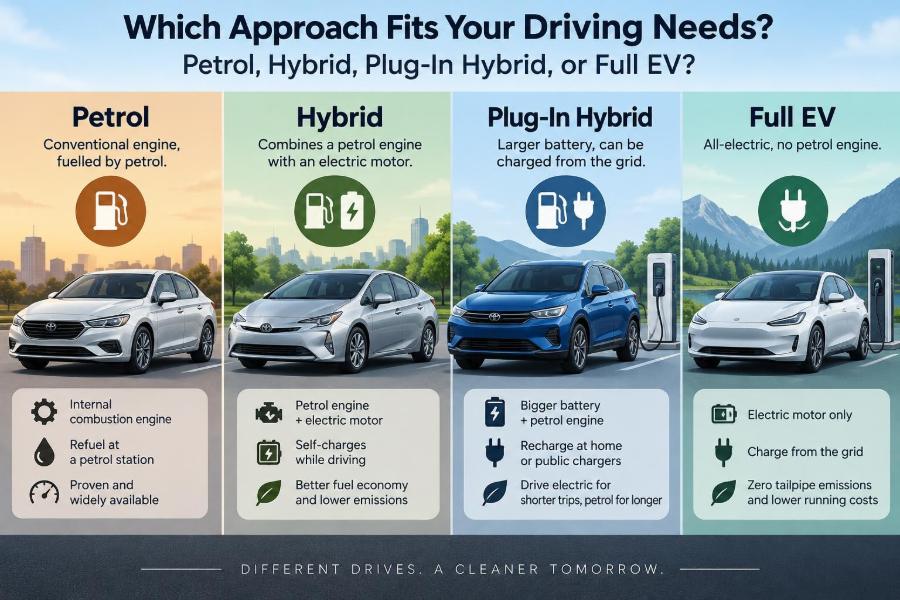

You are replacing a car, and four models on the shortlist all appear to solve the same problem: getting you to work, carrying the family, and handling the occasional long trip. Yet their powertrains—petrol, hybrid, plug-in hybrid, and battery-electric—ask very different things from their owners.
A vehicle that feels ideal during a short test drive can be a poor fit after six months of commuting, charging, servicing, and paying for energy. The right choice depends less on labels and more on where, how far, and how predictably you drive.
For example, a driver with home charging and a regular 30-kilometre commute faces a different decision from someone who travels long distances across areas with sparse charging. A hybrid may be highly efficient for one person and unnecessarily complex for another.
Understanding the engineering behind each option makes the comparison clearer. It also helps separate realistic benefits from assumptions based on brochure fuel-consumption figures or advertised electric range.
🧭 Start With the Job Your Car Must Do
Before comparing technologies, describe your normal driving week. Focus on actual trips rather than the most memorable annual journey: daily distance, parking location, road type, passenger load, and whether the vehicle can be charged where it rests.
A powertrain is not inherently “best.” It is a system designed around particular operating conditions. Internal-combustion vehicles are flexible when refuelling must be quick; electric vehicles are especially convenient when charging can happen while parked.
- How many kilometres do you drive on a typical weekday?
- Can you charge safely at home or reliably at work?
- How often do you make long, time-sensitive journeys?
- Do you mainly drive in congested city traffic, on highways, or on mixed routes?
- Will one vehicle need to serve several drivers with different routines?
⛽ Petrol Vehicles: The Conventional Baseline
A petrol vehicle uses an internal-combustion engine that burns fuel in cylinders to produce mechanical power. A transmission then matches engine speed and torque to the wheels. It remains the simplest choice operationally because refuelling infrastructure is widespread and stops are short.
Modern petrol cars can be efficient for their class, especially on steady highway runs. However, engine efficiency falls during idling, stop-start driving, cold operation, and repeated acceleration—conditions common in urban use.
Petrol is often practical for drivers without dependable charging, those who regularly travel through remote areas, or buyers seeking a lower purchase price. Its weaknesses are ongoing fuel use, tailpipe emissions, and a larger servicing burden than a purely electric drivetrain.
🔧 What Petrol Ownership Usually Involves
An engine car contains many heat- and wear-related systems: engine oil, filters, spark plugs, cooling circuits, exhaust components, and often a multi-speed gearbox. Maintenance intervals vary by manufacturer, but these systems create more routine service items than an EV has.
That does not make petrol cars unreliable by definition. It means ownership depends more heavily on correct maintenance, fuel quality, and attention to warning lights. Short, infrequent journeys can also be hard on an engine because it may not reach normal operating temperature.
For used-car buyers, service history matters particularly because neglected oil changes or cooling problems can turn an initially cheap vehicle into an expensive one.
🔋 Hybrid Vehicles: Electric Assistance Without Plugging In
A conventional hybrid, often called a full hybrid or self-charging hybrid, combines a petrol engine, an electric motor, and a relatively small battery. It cannot normally be plugged into an external charger; instead, it recovers some energy while braking and uses the engine to maintain battery charge.
The electric motor can move the car at low speeds for short periods, assist during acceleration, and allow the engine to switch off when power demand is low. The battery is not intended to provide long all-electric travel.
The term “self-charging” deserves care. A hybrid does recover braking energy, but it does not create free energy. Fuel ultimately supplies much of the energy used, especially on longer or faster trips.
♻️ Why Hybrids Work Well in Stop-Start Traffic
Braking converts a moving vehicle’s energy into heat at the brake discs and pads. A hybrid can use regenerative braking to run its motor as a generator, sending part of that otherwise lost energy back into the battery.
In town, where a vehicle frequently slows and accelerates, this recovery can be valuable. The electric motor also supplies strong torque from very low speed, reducing the need for the petrol engine to work inefficiently during initial acceleration.
On a long motorway journey at a steady speed, there are fewer braking opportunities and the engine supplies most of the energy. This is why a hybrid’s advantage is commonly greater in urban and mixed driving than in uninterrupted high-speed cruising.
⚙️ Hybrid System Designs Are Not All Identical
Hybrid architecture affects how the engine and motor share work. In a series hybrid, the engine mainly generates electricity while an electric motor drives the wheels. In a parallel hybrid, engine and motor can both provide wheel torque. Many production systems blend these approaches.
Some hybrids use a power-split transmission to continuously balance engine and motor operation. Others use a conventional automatic transmission with an integrated electric motor. The driver may notice different engine sounds and responses, but the core purpose is the same: use electrical energy where it reduces fuel consumption.
When comparing models, judge the complete vehicle rather than assuming all hybrids will behave or consume fuel alike.
🔌 Plug-In Hybrids: Two Energy Sources, One Compromise
A plug-in hybrid electric vehicle, or PHEV, has a larger battery than a conventional hybrid and can be charged from an external electricity supply. It can usually travel a meaningful distance on battery power before the petrol engine is needed.
In principle, a PHEV can cover regular short trips electrically while retaining an engine for longer journeys. That flexibility is attractive for households with one car that must handle both commuting and occasional holiday travel.
Its compromise is complexity. A PHEV carries an engine, fuel tank, electric motor, battery, charging hardware, and related control systems. It may be heavier than both a comparable petrol car and a dedicated EV.
🏠 Plug-In Hybrids Depend on Plugging In
The central question is straightforward: will the car be charged routinely? A PHEV that is plugged in after most short trips can use a high share of electric driving. One that is rarely charged effectively becomes a heavy hybrid carrying a depleted battery.
Advertised fuel-consumption figures for PHEVs often assume a particular mixture of charged electric travel and engine travel. If your routine differs, your result can differ sharply. The official number is not a promise for every driver.
A useful thought experiment is to imagine the charging cable as part of the daily parking routine, like locking the car. If that habit is unlikely to form, a conventional hybrid may be the more honest and efficient option.
🛣️ Understanding Electric-Only Range in a PHEV
PHEV electric range changes with speed, temperature, hills, cabin heating or cooling, tyre choice, and load. High-speed driving uses more energy because aerodynamic drag rises rapidly as speed increases.
Do not select a plug-in hybrid solely because its quoted electric range narrowly matches your commute. Leave a practical margin for winter conditions, detours, battery ageing, and the fact that battery charging targets may not always be reached.
For a hypothetical 40-kilometre daily return commute, a PHEV with substantially more real-world usable electric range offers resilience. One with barely enough range may start the engine regularly, particularly in cold weather.
⚡ Full EVs: A Different Drivetrain Layout
A full electric vehicle, usually called a battery-electric vehicle or BEV, stores energy in a large traction battery and uses one or more electric motors to drive the wheels. It has no petrol engine, fuel tank, exhaust system, or tailpipe.
Electric motors deliver torque immediately and operate efficiently across a broad speed range. Most EVs therefore use a simple fixed reduction gear instead of the multi-speed transmission found in many combustion vehicles.
An EV converts electrical energy to motion directly, but its overall environmental impact still depends on factors including battery production, vehicle size, electricity generation, and how long the vehicle remains in use. Tailpipe-free does not mean impact-free.
🔄 Regeneration Changes the Driving Feel
When an EV driver releases the accelerator, the motor can slow the car while generating electricity. The strength of this regenerative braking is often adjustable. In some settings, the vehicle slows enough for much of city driving to be controlled with the accelerator alone.
Regeneration can reduce brake wear, but friction brakes are still essential for hard stops, emergencies, very low speeds, and situations where the battery cannot accept much energy. A cold or fully charged battery may limit regenerative braking temporarily.
The change in pedal feel takes adjustment, especially for drivers accustomed to coasting. It is not automatically safer or more efficient in every situation; smooth anticipation remains the key skill.
🌡️ Temperature, Weather, and Real-World EV Range
Battery performance is sensitive to temperature. Cold weather increases the energy needed to heat the cabin and can reduce the battery’s ability to deliver or accept energy efficiently. Very hot weather can also require energy for cooling and battery thermal management.
Rain, snow, headwinds, steep gradients, roof boxes, heavy cargo, and high speeds all affect range. These are physical effects, not necessarily faults in the vehicle.
Range planning should therefore use a buffer. On an unfamiliar long journey, avoid treating the displayed maximum range as a distance you must fully consume before charging.
🏡 Home Charging Is Often the Deciding Advantage
For many EV and PHEV owners, charging at home is more valuable than the ability to use the fastest public charger. The car can replenish energy while it is parked overnight, turning daily refuelling into a background task.
A dedicated charging unit can provide controlled, convenient charging where suitable, but installation should be assessed by a qualified electrician. Electrical capacity, cable routing, local requirements, and shared parking arrangements all matter.
A standard domestic outlet may be acceptable in some circumstances, depending on the equipment and local guidance, but it is generally slower and should not be treated casually as a permanent high-load solution without proper assessment.
🏢 Workplace and Apartment Charging Need Realistic Checks
Not everyone has a driveway. Apartment residents may depend on shared chargers, street charging, workplace facilities, or public networks. The practical question is not whether a charger exists somewhere nearby, but whether it is available when you need it.
Shared charging introduces queueing, payment access, parking time limits, and the need to move the vehicle when charging is complete. These are manageable for some routines and frustrating for others.
If reliable charging is uncertain, a hybrid can remove that dependency. A full EV can still work, but only after mapping actual charging options around home, work, and regular destinations.
🚀 Public Fast Charging Makes Long EV Trips Possible
Direct-current fast chargers can add energy much faster than typical home equipment, making long-distance EV travel practical on suitable routes. However, charging speed is not fixed. It depends on the charger, the car’s maximum charging capability, battery temperature, and state of charge.
Most EVs charge fastest through part of the battery range and slow down as the battery approaches full. This is why route planning commonly involves shorter charging stops rather than repeatedly charging to 100 percent.
Fast charging is a travel tool, not necessarily the cheapest or most convenient everyday energy source. Check route coverage and backup locations before relying on it for frequent journeys.
🧾 Compare Energy Costs by Your Own Routine
Fuel and electricity prices vary widely by location and tariff, so broad claims about “cheap running” can mislead. The useful comparison is cost per kilometre based on your expected consumption and where you will obtain energy.
For an EV, estimate charging losses as well as the energy shown on the dashboard. For a PHEV, calculate both electric and petrol operation. For petrol and hybrid vehicles, use realistic fuel economy rather than the best figure from a single ideal trip.
Also distinguish between public rapid charging and home or workplace charging. They can have very different prices and convenience profiles.
📉 Purchase Price Is Only One Part of Cost
Total cost of ownership includes purchase or finance cost, insurance, energy, maintenance, tyres, parking, taxes or incentives where applicable, and expected resale value. Some of these are uncertain, particularly future energy prices and used-vehicle values.
An EV may have fewer routine mechanical service items, while a PHEV combines aspects of EV and engine maintenance. Petrol cars may cost less to buy in some markets but can have higher fuel spending over time.
Compare vehicles over the period you expect to own them. A low monthly payment can hide a larger upfront deposit, mileage condition, or final payment in a finance agreement.
🛠️ Maintenance Differences Are Real but Not Magical
EVs do not need engine oil, spark plugs, exhaust repairs, or many transmission services. Yet they still need tyres, brake inspection, suspension work, cabin filters, coolant checks where specified, and repairs to ordinary vehicle systems.
Hybrids and PHEVs add electric components to a petrol vehicle, but regenerative braking can reduce wear on friction brakes. Because brake discs may be used less often, inspection remains important; corrosion can develop in damp climates.
Follow the manufacturer’s service schedule rather than assuming any technology is maintenance-free. Software updates and battery-system inspections may also be relevant.
🧠 Battery Health Requires Context, Not Panic
Traction batteries gradually lose some usable capacity with age and use. The rate depends on chemistry, thermal management, climate, charging behaviour, and operating conditions. A lower displayed range does not automatically mean a failed battery.
Battery warranties vary by market and model, so read their duration, mileage limit, capacity conditions, and exclusions. For a used EV or PHEV, a battery health report can be helpful, but it should be interpreted alongside vehicle history and real-world range.
Frequent high-power charging and prolonged exposure to extreme heat may add stress, but practical use should not become anxious micromanagement. Use the vehicle as intended and follow manufacturer guidance.
🏎️ Performance, Towing, and Payload Can Shift the Answer
Electric motors provide quick response, which can make an EV feel strong in city traffic and during overtaking. The battery’s mass, however, can make the vehicle heavier. Tyres may wear differently because of weight and immediate torque.
Towing, carrying heavy loads, climbing long grades, and driving quickly increase energy consumption for every powertrain. In an EV, these demands can reduce range noticeably, so towing drivers should check real towing capability and charging access along intended routes.
A PHEV or hybrid can also face payload constraints because the battery and electric hardware take space and mass. Never assume that a similarly sized model has the same towing or carrying limits.
🌍 Emissions Depend on Use, Not Just the Badge
Petrol vehicles produce tailpipe emissions whenever the engine runs. Hybrids can reduce fuel use in suitable conditions, while PHEVs can reduce local tailpipe emissions substantially on trips completed electrically.
An EV has no tailpipe emissions while driving, which improves local air quality at the point of use. Its wider emissions profile depends partly on the electricity source and the impacts of manufacturing, especially battery production.
Vehicle size matters. A smaller, efficient car of any type generally requires less energy to move than a larger, heavier vehicle driven in the same way. Choosing only by powertrain ignores this basic engineering reality.
📏 Official Figures Are Comparison Tools, Not Personal Forecasts
Standardised test procedures allow buyers to compare cars under the same conditions. They are useful for identifying relative efficiency, electric range, and emissions, but they cannot fully replicate every climate, route, driving style, or accessory load.
Be particularly careful with PHEV economy figures, because the outcome changes dramatically with charging frequency. An advertised value may assume a level of electric driving that does not match your life.
Use official data as a starting point, then seek independent road tests, owner experiences from similar climates, and a realistic assessment of your own trips.
🧮 A Practical Powertrain Comparison
| Powertrain | Best matched to | Main strength | Main limitation |
|---|---|---|---|
| Petrol | Drivers without reliable charging or with varied remote travel | Fast, widely available refuelling | Fuel use and more engine-related maintenance |
| Hybrid | Urban and mixed driving without charging access | Efficient stop-start operation | Limited electric-only driving |
| Plug-in hybrid | Regular short trips with dependable charging and occasional long travel | Electric commuting plus engine backup | Benefits fall sharply if not charged |
| Full EV | Drivers with reliable charging and predictable route planning | Electric driving and simpler mechanical drivetrain | Charging access and journey planning matter more |
👨👩👧 Match the Choice to Household Reality
A household with two vehicles can make a different decision from a one-car household. For example, an EV may cover everyday use while another vehicle handles rare long towing trips. A single shared car may need the broadest possible flexibility.
Consider who actually drives it. A confident EV owner may be comfortable planning charging stops, while another driver may value the familiarity of fuel stations. Neither preference is technically wrong; convenience is part of vehicle suitability.
Also consider future changes: a new job, relocation, loss of workplace charging, or a growing family can alter the answer more than a small difference in efficiency.
🧪 Test Drive Beyond the Showroom Route
Ask for a test drive that resembles your life. Include a faster road if possible, low-speed traffic, parking, and the type of route where you spend most time. Pay attention to visibility, ride, controls, rear-seat space, and cargo access as well as acceleration.
For an EV or PHEV, inspect the charging port location, cable storage, charge scheduling controls, navigation, and range display. For a hybrid, notice how smoothly the engine starts and how the braking system feels.
A familiar route often reveals practical details that specifications cannot: whether a tall boot lip is awkward, whether road noise is tiring, or whether the vehicle fits your parking space.
⚠️ Common Buying Mistakes to Avoid
- Choosing a PHEV without a charging plan: this can leave you carrying battery mass while using petrol for most trips.
- Assuming all public chargers are equally reliable or accessible: check the locations you would genuinely use.
- Buying an EV based only on maximum claimed range: account for winter, speed, load, and charging buffers.
- Comparing only purchase price: include energy, servicing, insurance, and likely ownership period.
- Ignoring vehicle size: an oversized vehicle can undermine efficiency regardless of powertrain.
- Treating a test drive as enough research: charging and long-trip planning require separate investigation.
🗺️ Build a Simple Decision Path
First, establish whether dependable charging exists where the car normally parks. If it does not, a petrol vehicle or conventional hybrid may be the most straightforward choice, unless public charging genuinely fits your routine.
Next, compare your regular daily distance with realistic electric range, not an optimistic headline figure. Frequent short trips with charging favour an EV or PHEV; regular long-distance driving may favour an EV with proven fast-charging performance, a PHEV that is consistently charged, or a hybrid depending on the route.
Finally, calculate likely costs and test the actual models. The answer should emerge from constraints and habits rather than loyalty to a technology.
✅ The Core Principle: Fit the Powertrain to the Pattern
Petrol, hybrid, plug-in hybrid, and full EV systems each solve the same transport problem through different energy pathways. Their strengths appear only when those pathways match the driver’s routine.
A conventional hybrid is often a sensible bridge for drivers who want improved urban efficiency without charging dependence. A PHEV makes the most sense when regular plugging in is realistic. A full EV is especially compelling when routine charging is convenient and journeys can be planned around its range and charging network.
Petrol remains a practical choice where charging is unavailable or driving requirements are unusually variable. The most responsible decision is not the one with the newest label; it is the one you can operate efficiently, affordably, and conveniently every day.
Choose the powertrain that fits your real parking, charging, distance, and driving pattern—not the one that sounds best in isolation. 🚗⚡🌍