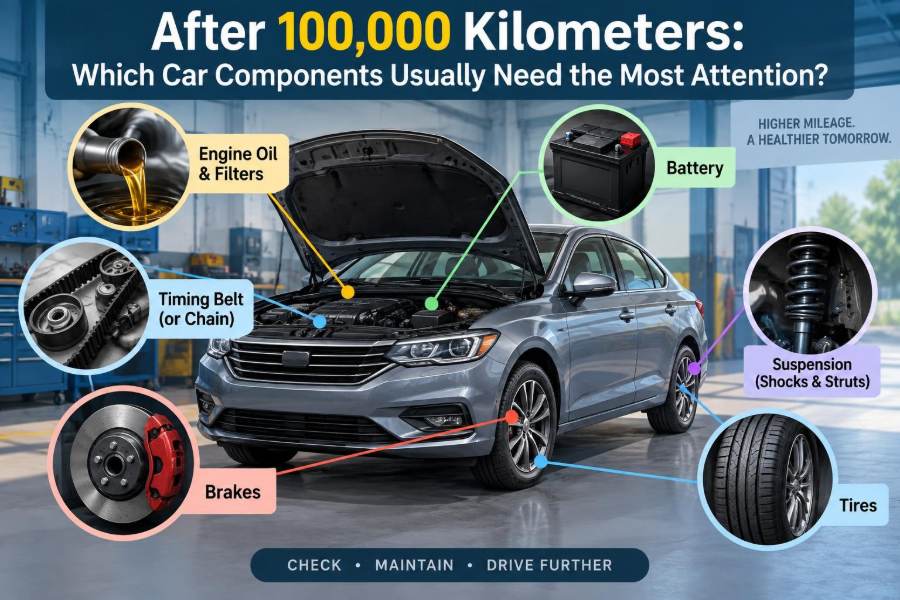

A car that has crossed 100,000 kilometres often still feels familiar: the engine starts, the doors close, and the daily commute continues. Yet this is also the point where small changes become easier to notice—a faint vibration at highway speed, longer braking distances, a battery that hesitates on cold mornings, or a suspension that no longer feels composed over potholes.
The number itself is not a failure line. A carefully maintained vehicle can remain dependable far beyond it, while a neglected low-mileage car can need substantial work earlier. What changes after 100,000 kilometres is the likelihood that several wear-related systems begin asking for attention at roughly the same time.
For students of automobile engineering, this is a useful real-world view of vehicle durability. Components do not wear in isolation: heat, friction, load cycles, contaminants, road conditions, and maintenance quality interact over thousands of operating hours.
For owners and technicians, the practical question is not “what will definitely fail?” but “what should be inspected first, and why?” A condition-based approach prevents both missed safety faults and unnecessary part replacement.
🧭 Why 100,000 Kilometres Is a Meaningful Checkpoint
At this mileage, many consumables have completed several service cycles, while rubber parts, fluids, bearings, and electrical connections have experienced years of thermal cycling. Thermal cycling means repeated heating and cooling, which can harden seals, weaken plastics, and loosen electrical contact quality.
It is a planning checkpoint rather than a universal service interval. The owner’s manual, service history, vehicle age, engine type, and operating environment remain more useful than mileage alone.
📚 Start With the Service History
A complete history often tells more than an odometer reading. It shows whether oil was changed at suitable intervals, whether brake fluid and coolant were renewed, and whether timing-belt work has already been completed.
When history is incomplete, assume less rather than more. A technician can inspect condition, but some items—such as the age of a timing belt or last brake-fluid change—cannot be confirmed reliably by appearance.
🔍 Use Inspection Before Replacement
Good maintenance is not simply replacing every visible component. It combines a visual inspection, road test, diagnostic scan where relevant, fluid checks, measurements, and the manufacturer’s schedule.
Brake pad thickness, tyre tread, battery test results, belt condition, and suspension play can be measured. This evidence-based process distinguishes a worn item from one that merely looks old.
🛢️ Engine Oil and Filter Quality
Engine oil forms a thin lubricating film between moving parts such as crankshaft bearings, camshafts, and piston rings. Over time it collects contaminants and its additive package is depleted, reducing its ability to manage deposits, corrosion, and heat.
At high mileage, correct oil specification matters especially. Using a thicker or thinner oil simply to “help an old engine” can create problems if it conflicts with the engine’s design and manufacturer approval.
💧 Oil Leaks, Seals, and Gaskets
Minor seepage around a valve cover or oil pan is common as gaskets age. A leak becomes more urgent when oil reaches the exhaust, contaminates rubber mounts, lowers the oil level, or drips where it can create a fire or road hazard.
Do not confuse a leak repair with an engine rebuild. A hardened gasket may be the entire fault, but the source should be identified carefully because oil can travel along surfaces before it becomes visible.
🌡️ Cooling System Hoses and Coolant
The cooling system controls metal temperatures and prevents local hot spots in the cylinder head. Coolant also contains corrosion inhibitors, so replacing it at the prescribed interval is about more than freeze protection.
Inspect hoses for swelling, cracks, softness, abrasion, and oil contamination. Check the radiator, expansion tank, cap, water pump area, and hose joints for dried residue, which can indicate a slow leak.
⚙️ Timing Belt, Timing Chain, and Accessory Drive
A timing belt synchronizes crankshaft and camshaft rotation. On engines designed with interference geometry, belt failure can allow pistons and valves to collide, causing major internal damage. Follow the specified time and distance interval, whichever arrives first.
Timing chains are generally durable but are not maintenance-free. Chain noise on start-up, fault codes related to cam timing, or poor oil-change history deserve professional diagnosis. Accessory belts, tensioners, and idler pulleys also need inspection for cracking, noise, and bearing roughness.
🔥 Spark Plugs and Ignition Coils
Many modern engines use long-life spark plugs, but their replacement interval may fall near or beyond 100,000 kilometres. Worn electrodes increase the voltage required to create a spark, which can strain ignition coils and contribute to misfires.
A misfire may feel like hesitation, rough idle, reduced power, or flashing malfunction warning light. Continuing to drive with an active misfire can overheat and damage the catalytic converter because unburned fuel reaches the exhaust.
🌬️ Engine Air Filter and Intake Leaks
A clogged engine air filter can restrict airflow, while a damaged air box or intake hose can admit unfiltered air. Dust entering the intake accelerates wear in cylinders and turbocharger components.
Cracked intake ducting and vacuum leaks can also disrupt the measured air flow used by the engine control unit. The result may be unstable idle, mixture-related fault codes, or reduced fuel economy.
⛽ Fuel Filter and Fuel Delivery
Fuel-filter requirements vary widely. Some vehicles have a replaceable external filter; others use a filter integrated with the fuel pump module. The maintenance plan for the specific model should decide the interval.
Restricted fuel flow can appear as hesitation under load, difficult starting, or lack of high-speed power, but these symptoms have several possible causes. Pressure testing is more useful than replacing expensive fuel-system parts by guesswork.
🧪 Transmission Fluid and Shift Quality
Automatic-transmission fluid lubricates, cools, and provides hydraulic control. Manual gearbox oil and differential oil also age, particularly under towing, stop-start operation, high temperatures, or frequent heavy loads.
Some manufacturers describe certain fluids as long-life, but that does not mean they last unchanged under every use pattern. A specialist should use the exact approved fluid and filling procedure; incorrect level or fluid chemistry can harm an automatic transmission.
🧱 Clutch Wear in Manual Cars
A clutch friction disc gradually wears each time it is engaged. A high engagement point, slipping under acceleration, judder, or difficulty selecting gears can signal a clutch, hydraulic, mount, or gearbox-related issue.
Holding the car on an incline with the clutch pedal instead of the brake creates unnecessary heat. This everyday habit can shorten clutch life far more quickly than normal cruising mileage.
🛑 Brake Pads, Discs, and Calipers
Brakes deserve priority because wear is expected and directly affects safety. Pads lose friction material, discs wear thinner, and caliper slides can seize if their protective boots fail or lubrication is neglected.
Listen for grinding, investigate pulling under braking, and do not ignore a soft pedal or warning lamp. Brake inspection should include pad thickness, disc condition, flexible hoses, caliper movement, parking brake operation, and leaks—not pads alone.
🫧 Brake Fluid and Hydraulic Health
Brake fluid absorbs moisture from the atmosphere over time. Excess moisture can lower its boiling resistance and promote internal corrosion in hydraulic components, especially in demanding braking conditions.
The fluid should be changed according to the manufacturer’s time-based recommendation. A fluid flush is different from simply topping up the reservoir; topping up does not remove aged fluid from lines and calipers.
🛞 Tyres: More Than Remaining Tread
Tread depth matters for water evacuation, but tyre age, sidewall damage, uneven wear, and pressure matter too. Rubber hardens with time, potentially reducing wet-weather grip even when the tread appears acceptable.
Uneven inner-edge wear may be hidden until the wheel is turned or lifted. Check all tyre surfaces, including the spare where fitted, and set pressures when tyres are cold using the vehicle placard guidance.
📐 Wheel Alignment and Balancing
Alignment refers to wheel angles such as toe and camber. Incorrect alignment can wear tyres rapidly, make the car wander, and leave the steering wheel off-centre. It may follow pothole damage, kerb impacts, or worn suspension joints.
Balancing addresses mass distribution around the rotating wheel and tyre. A vibration concentrated at a particular speed often points to wheel balance, although damaged tyres, bent wheels, or worn components can produce similar symptoms.
🪜 Shock Absorbers, Struts, and Springs
Shock absorbers control spring movement; they do not hold the vehicle up. When damping weakens, the body can continue bouncing after a bump, tyres may lose consistent road contact, and braking stability can deteriorate on rough surfaces.
Look for fluid leakage, broken springs, clunks, excessive body motion, and uneven tyre wear. A vehicle may feel normal because deterioration is gradual, which is why comparison during inspection is valuable.
🔩 Bushings, Ball Joints, and Wheel Bearings
Suspension bushings isolate noise and allow controlled movement. Ball joints provide pivoting motion, while wheel bearings support rotating hubs. Their deterioration can cause clunks, vague steering, tyre wear, humming noise, or vibration.
These items should be checked for play with the vehicle safely lifted using proper equipment. A loose ball joint or severely worn bearing is not a “monitor later” defect because it can affect steering control.
🧭 Steering System and Power Assistance
Inspect tie-rod ends, steering rack boots, joints, and power-steering lines where applicable. Torn boots admit water and grit, accelerating wear in joints that would otherwise remain protected.
Electric power steering avoids hydraulic fluid but still relies on sensors, wiring, and mechanical linkages. Heavy steering, warning lamps, or inconsistent assistance require diagnosis rather than assumptions about a simple alignment issue.
🔋 Battery, Alternator, and Grounds
A battery can start an engine yet have limited reserve capacity. Age, heat, repeated short trips, and parasitic electrical drain can reduce its performance. A proper battery test assesses more than open-circuit voltage.
Also inspect terminals, cables, chassis grounds, and alternator charging voltage. Corrosion adds electrical resistance, much like a partially blocked pipe restricts water flow, and can create intermittent faults that imitate more serious electronic failures.
💡 Lighting, Wipers, and Driver Visibility
Visibility components are easy to postpone because they are inexpensive, but they have a direct effect on safe driving. Check all exterior lamps, headlamp aim, washer jets, wiper blades, rear wiper where fitted, and windscreen condition.
Streaking blades may seem minor until night rain or low sun makes the windscreen difficult to see through. Replace damaged blades and use washer fluid suited to local temperatures.
🌫️ Cabin Filter and Climate-Control Operation
The cabin air filter traps dust, pollen, and debris before air enters the ventilation system. A blocked filter can reduce airflow and contribute to window fogging, which drivers sometimes mistake for an air-conditioning failure.
Run the air conditioner periodically, including in cooler months, to assess cooling and help circulate lubricant in the system. Weak cooling, unusual compressor noise, or repeated loss of refrigerant calls for a leak-aware professional inspection.
🧯 Exhaust System and Emissions Hardware
Exhaust hangers, joints, heat shields, and pipes corrode according to climate and trip pattern. Short trips can leave moisture in the exhaust for longer, while road salt accelerates external corrosion.
For petrol vehicles, catalytic converters and oxygen sensors influence emissions control. Diesel vehicles may add particulate filters and other emissions systems. Warning lights or regeneration-related symptoms need accurate diagnosis; removing or bypassing emissions equipment is unsafe and may be unlawful.
🧠 Diagnostic Trouble Codes Need Context
An onboard diagnostic code identifies a system or operating condition, not necessarily the failed part. For example, an oxygen-sensor-related code may result from wiring damage, an exhaust leak, fuel-mixture trouble, or the sensor itself.
Use scan data with basic mechanical checks and symptom history. Replacing the component named most clearly by a generic scanner is a common and costly mistake.
🚪 Body Seals, Drain Paths, and Corrosion
At this age and mileage, inspect door seals, sunroof drains if equipped, wheel arches, underbody seams, brake lines, and subframes. Trapped water can cause corrosion where it remains hidden until structural or electrical damage develops.
Clear drainage paths carefully and investigate damp carpets promptly. Water inside the cabin can corrode connectors, affect control modules, and create persistent odours long before a major symptom appears.
📋 A Practical 100,000-Kilometre Inspection Plan
A useful visit groups work by safety, reliability, and scheduled maintenance. This helps an owner make sensible decisions when several jobs are due together.
| Priority | Typical focus | Reason |
|---|---|---|
| Immediate safety | Tyres, brakes, steering, suspension play, lights | These affect control, stopping, and visibility. |
| Scheduled reliability | Oil, filters, belts, fluids, spark plugs | These prevent predictable wear and breakdown risk. |
| Condition monitoring | Seals, mounts, minor seepage, cosmetic corrosion | Repair timing depends on severity and progression. |
Ask for measured findings where possible: pad thickness, tyre tread, battery result, fluid condition, fault codes, and photos of leaks or worn parts. This makes prioritisation clearer.
⚠️ Common High-Mileage Maintenance Mistakes
- Ignoring time-based intervals: belts, brake fluid, and coolant may age even on low-mileage cars.
- Replacing parts from symptoms alone: vibration, warning lamps, and poor starting have multiple possible causes.
- Using unapproved fluids: transmission, coolant, and engine-oil specifications are functional requirements, not branding preferences.
- Delaying small leaks indefinitely: a minor leak may contaminate belts, wiring, rubber, or the environment.
- Focusing only on the engine: tyres, brakes, steering, and suspension often deserve earlier attention.
🧾 Budgeting Without Cutting the Wrong Corners
Not every recommendation has equal urgency. Separate repairs into “unsafe now,” “due by schedule,” “likely needed soon,” and “monitor at the next service.” A trustworthy workshop should be able to explain the reason for each category.
Cheapest parts are not always economical on labour-intensive jobs. For example, replacing a timing-belt tensioner or water pump at the same time as a scheduled belt service may reduce duplicated labour, but the correct scope depends on the vehicle design.
🧑🔧 When Professional Diagnosis Is Essential
Seek qualified help for brake hydraulic faults, steering play, airbag warnings, transmission problems, overheating, active engine warning lights, fuel leaks, and high-voltage systems in hybrid or electric vehicles. These systems can have serious safety consequences.
DIY checks still have value: fluid levels, tyre condition, lights, visible leaks, and service records help catch problems early. The key is knowing where observation should end and measured diagnosis should begin.
✅ The Core Principle After 100,000 Kilometres
The best high-mileage strategy is not to replace everything pre-emptively. It is to follow scheduled items rigorously, inspect wear-prone systems systematically, and repair confirmed safety or reliability defects before they affect other components.
Mileage is only one part of a vehicle’s condition. A car driven gently on long trips may age very differently from one used for short urban journeys, heavy loads, rough roads, or extreme temperatures.
After 100,000 kilometres, dependable motoring comes from evidence-led maintenance: inspect the whole vehicle, respect the manufacturer’s intervals, and act early on faults that affect safety or cause secondary damage. 🚗🔧🛞