
You leave home with a comfortably high battery charge, take the usual route to work, and arrive with less range remaining than expected. Nothing is necessarily wrong with the vehicle. The journey may simply have included a cold morning, fast traffic, a steep flyover, cabin heating, and several hard accelerations.
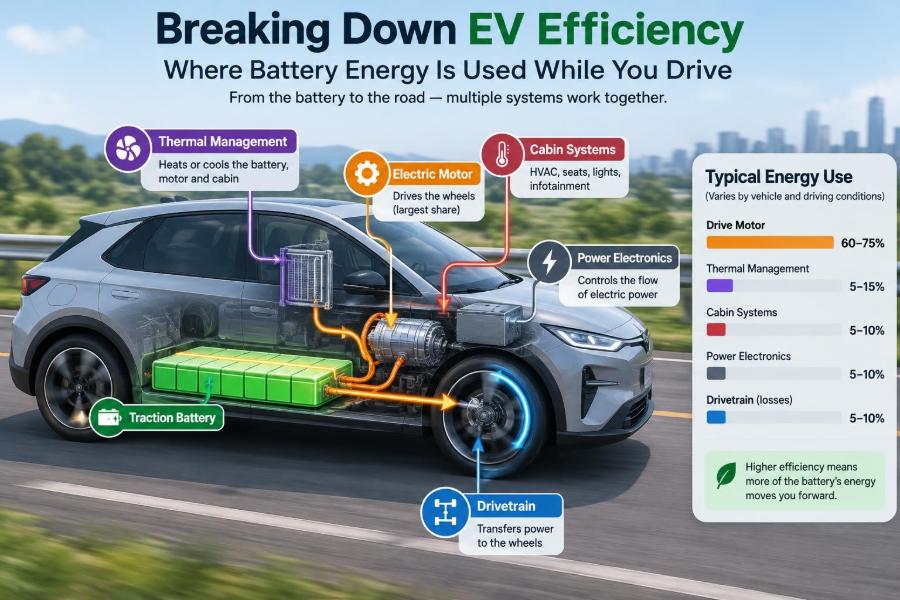
An electric vehicle does not use battery energy only to turn its wheels. It also powers computers, pumps, lights, climate control, battery conditioning, and many smaller electrical loads that are barely noticeable from the driver’s seat.
That is why the dashboard range estimate changes as driving conditions change. It is responding to the energy the car is using now, not making a fixed promise based only on battery size.
Understanding where the energy goes helps drivers plan trips more realistically and helps engineering students connect vehicle design choices with real-world efficiency.
🔋 Battery energy is stored energy, not guaranteed driving distance
An EV battery stores electrical energy, usually stated in kilowatt-hours (kWh). A kilowatt-hour is an amount of energy: using one kilowatt continuously for one hour consumes one kWh.
Range depends on how many kilometres the vehicle can travel per kWh. A larger battery can usually provide more range, but it does not eliminate the effect of speed, temperature, road gradient, payload, or auxiliary electrical use.
Battery capacity quoted by a manufacturer may include a portion that is not fully available to the driver. This controlled buffer helps protect the battery from stressful operating extremes, so usable energy is the more relevant figure for analysing real driving range.
📏 The basic efficiency relationship
At its simplest, EV energy use can be expressed as energy per distance, such as Wh/km or kWh/100 km. Lower consumption means the vehicle needs less battery energy to cover the same distance.
A useful engineering relationship is:
Energy used = traction energy + auxiliary energy + conversion and mechanical lossesTraction energy moves the vehicle. Auxiliary energy runs systems such as climate control and electronics. The remaining category includes unavoidable losses in components that convert, transmit, or dissipate energy.
⚡ The battery pack and its operating window
The pack is made from many cells arranged into modules and connected to produce the voltage and energy required by the vehicle. The battery management system monitors cell voltages, temperatures, current, and state of charge.
It does not simply allow unrestricted energy flow. It may limit charging or power output when the battery is very cold, very hot, nearly empty, or highly charged. These limits protect durability and safety, but they can affect available performance and regeneration.
🧠 The battery management system uses a little energy too
The battery management system, or BMS, is the pack’s electronic supervisor. It measures conditions, calculates state of charge, identifies faults, and communicates with the vehicle control units.
Its own electrical demand is small compared with propulsion during normal driving, yet it illustrates a broader point: an EV has many continuous background loads. Over long parking periods, monitoring and connected functions can also contribute to gradual charge loss.
🔄 From DC battery power to AC motor power
The battery supplies direct current (DC), while many EV traction motors use alternating current (AC). An inverter rapidly switches the battery DC to create controlled AC currents for the motor.
The inverter also controls motor torque. When the driver asks for acceleration, it regulates the electrical input needed to produce it. During regenerative braking, it changes its role and directs generated electrical energy back toward the battery.
No power conversion is perfectly lossless. Some energy becomes heat in semiconductor switches, cables, and other electrical components.
🌀 The traction motor turns electrical energy into torque
The traction motor creates torque at the wheels through electromagnetic interaction. Unlike an internal-combustion engine, it can provide strong torque from very low speed without needing a conventional multi-ratio gearbox.
Motor efficiency varies with speed and torque. It is generally not a single fixed percentage. A vehicle cruising gently may operate in a different efficiency region from one climbing a hill at high load or accelerating forcefully onto a motorway.
⚙️ The reduction gear and differential still have losses
Most EVs use a fixed reduction gear to reduce the motor’s high rotational speed and multiply torque at the wheels. A differential allows the driven wheels to rotate at different speeds while cornering.
Gears, bearings, and lubricants create friction and fluid-churning losses. These are typically modest compared with the energy required to push the car through air at high speed, but they are real and engineers work to reduce them through gearing, lubrication, bearing design, and manufacturing accuracy.
🛞 Tyres consume energy through rolling resistance
Tyres flex as they roll. Their rubber and internal structure do not return all of that deformation energy, so part is dissipated as heat. This is called rolling resistance.
Tyre pressure, compound, construction, temperature, load, and road surface all influence it. Underinflated tyres generally increase rolling resistance, reduce range, and can worsen tyre wear.
Low-rolling-resistance tyres can improve efficiency, but engineers must balance this against wet grip, noise, ride quality, durability, and handling requirements.
🌬️ Aerodynamic drag dominates at higher speeds
Air resistance rises rapidly with speed. The force required to overcome aerodynamic drag increases approximately with the square of speed, while the power needed to overcome it increases approximately with the cube of speed.
That is why a moderate speed increase can have a surprisingly large range penalty on an open road. At urban speeds, stopping and starting may matter more; at motorway speeds, the air becomes one of the vehicle’s largest energy demands.
Frontal area, drag coefficient, wheel design, underbody panels, mirrors, roof accessories, and open windows can all affect airflow.
🏔️ Climbing stores energy as gravitational potential energy
When an EV climbs a hill, it must lift its mass against gravity. That energy is not a mysterious loss; it is stored as gravitational potential energy because the vehicle is now at a higher elevation.
Descending can recover some of it through regeneration, but not all. Motor, inverter, battery, tyre, and drivetrain losses remain, and the battery may not be able to accept full regenerative power if it is cold or close to full charge.
🛑 Braking turns motion into heat unless regeneration captures it
A moving vehicle has kinetic energy. Conventional friction brakes convert that energy into heat at the pads and discs. Regenerative braking uses the traction motor as a generator, converting some vehicle motion back into electrical energy.
Regeneration is especially valuable in traffic with frequent deceleration. It reduces wasted kinetic energy and can reduce friction-brake use, although friction brakes are still essential for strong braking, emergency braking, low-speed stopping, and conditions where available regeneration is limited.
♻️ Regeneration is recovery, not free energy
A common mistake is to treat regenerative braking as energy creation. It only recovers part of energy that the battery previously supplied to accelerate the vehicle or that gravity supplied during a descent.
Every stage has losses. The wheels drive the motor, the motor generates electricity, the inverter manages it, and the battery accepts it chemically. Efficient driving still means avoiding unnecessary acceleration and braking in the first place.
🚦 Urban driving can be efficient, but conditions matter
City travel avoids prolonged high aerodynamic drag and provides opportunities for regenerative braking. These features can make an EV very efficient in stop-start traffic.
However, urban driving is not automatically economical. Repeated hard acceleration, short journeys with cabin conditioning, rough roads, congestion, and long waits with the climate system running can raise energy consumption substantially.
🛣️ Steady motorway driving has a different energy profile
At constant motorway speed, the vehicle spends less energy repeatedly accelerating its mass. The trade-off is sustained aerodynamic demand.
Aerodynamic drag does not disappear because the road is smooth or traffic is flowing. This is why a vehicle that delivers excellent urban efficiency may show noticeably higher kWh/100 km during fast, long-distance travel.
❄️ Cold weather changes several systems at once
Cold conditions can reduce available battery power and slow charging because cell chemistry becomes less favourable. The vehicle may use energy to warm the battery before or during driving, especially when high power or rapid charging is expected.
Cabin heating is another major load. An internal-combustion vehicle has abundant waste engine heat; an EV does not. A resistive heater converts electricity directly to heat, while a heat pump can move heat more efficiently in suitable conditions.
Cold tyres, denser air, wet roads, and slower warm-up of lubricants can add smaller penalties as well.
☀️ Hot weather brings cooling loads
High ambient temperatures increase cabin air-conditioning demand, particularly after a vehicle has been parked in direct sun. Battery cooling may also operate to keep cell temperatures within a preferred range.
Thermal management is not wasted design complexity. Excessive temperature can affect performance, charging capability, durability, and safety margins. The engineering task is to control temperature while using as little energy as practical.
🌡️ Battery thermal management protects performance and life
Modern EVs may use liquid cooling, refrigerant-based systems, heating elements, valves, pumps, and heat exchangers to manage battery temperature. The exact architecture differs by vehicle.
These systems consume energy, but their value must be judged over the whole operating life of the vehicle. Allowing a battery to operate at unsuitable temperatures may save a small amount of energy temporarily while increasing other limitations or long-term stress.
🪟 Cabin comfort can be a large short-trip load
On a long journey, climate-control energy is spread across many kilometres. On a short trip, the same initial heating or cooling demand is spread across far fewer kilometres, so the displayed consumption can look much worse.
Features such as seat heaters and heated steering wheels often warm the occupant more directly than raising the temperature of the entire cabin. Used sensibly, they can support comfort with less energy than relying only on high cabin-air heating.
💡 Auxiliary loads are individually small but collectively real
Lights, wipers, infotainment, instrument displays, cameras, power steering, brake vacuum or electro-hydraulic systems, pumps, fans, sensors, connectivity hardware, and control units all need electrical power.
Most are not major range consumers by themselves. Their significance rises when propulsion demand is low, such as slow traffic, idling in a parked vehicle, or very short trips.
| Energy user | When it tends to matter most | Main reason |
|---|---|---|
| Traction motor | Acceleration, climbing, high speed | Moving vehicle mass and overcoming resistance |
| Aerodynamic drag | Fast open-road driving | Airflow resistance rises sharply with speed |
| Cabin heating or cooling | Extreme weather and short trips | Comfort demand is large relative to distance travelled |
| Battery conditioning | Cold or hot conditions, charging preparation | Cells need a suitable temperature range |
| Tyres and drivetrain | All driving conditions | Rolling, friction, and mechanical losses |
📊 Dashboard consumption figures need context
A trip computer may show recent consumption, long-term average consumption, predicted range, or energy recovered through regeneration. These values are useful, but they answer different questions.
A very low figure after a downhill section does not represent the energy needed for the whole route. Likewise, a high figure after warming a cold cabin on a short trip should not be assumed to represent a full-day journey.
Compare similar routes, speeds, weather conditions, and payloads before drawing conclusions about vehicle efficiency.
🧭 Route planning is energy planning
Two routes of similar distance can require different energy. A route with high speeds, strong headwinds, steep climbs, poor surfaces, or heavy traffic may use more energy than a slightly longer but gentler alternative.
Navigation systems that consider elevation, traffic, and charging locations can improve planning, but their predictions remain estimates. Weather changes and driving style can move the actual result away from the forecast.
💨 Wind and rain affect range more than many drivers expect
A headwind increases the vehicle’s speed relative to the air, even if road speed is unchanged. Because aerodynamic demand rises strongly with airspeed, a sustained headwind can increase consumption noticeably.
Rain can increase tyre rolling resistance and may require wipers, lights, demisting, and cabin heating. Deep standing water also creates additional resistance and should be approached cautiously for safety, not merely efficiency.
👨👩👧 Payload, passengers, and roof equipment add demand
Extra passengers and luggage increase mass, which matters most during acceleration and climbing. On level roads at steady speed, added mass has less influence than aerodynamic drag, though tyre loading still changes rolling losses.
Roof boxes, bike carriers, and poorly streamlined external accessories can have a much larger effect at higher speeds because they disturb airflow. Removing equipment when it is not needed is a practical efficiency measure.
🎯 Driving style shapes the energy budget
Efficient EV driving is not about crawling along or obstructing traffic. It means anticipating conditions, accelerating smoothly where appropriate, maintaining a sensible speed, and avoiding late braking that throws away momentum.
- Look ahead and ease off early when traffic is slowing.
- Use a steady accelerator input rather than repeated surges.
- Choose speeds appropriate to road, weather, and legal limits.
- Use regenerative settings in a way that supports smooth control, not abrupt driving.
- Keep tyres at the manufacturer’s recommended pressures for the operating condition.
⚠️ Common range mistakes to avoid
One mistake is assuming rated range will be repeated on every journey. Standardised test values are useful for comparison, but they cannot represent every temperature, route, speed, load, and driving pattern.
Another is relying on regeneration to cancel aggressive driving. Regeneration recovers only a portion of energy. A third is ignoring tyres, roof accessories, or climate settings because each change seems minor; several small demands can combine.
🔧 Vehicle maintenance still supports EV efficiency
EVs have fewer routine powertrain maintenance items than many combustion vehicles, but efficiency still depends on basic condition. Tyres need inspection and correct inflation, wheel alignment should be checked if the vehicle pulls or tyres wear unevenly, and brakes require periodic attention.
Brake discs can see less frequent use because of regeneration. In wet or salty environments, following the manufacturer’s maintenance guidance is particularly sensible to help keep mechanical braking components in good condition.
🏭 Design trade-offs engineers must manage
Engineers cannot optimise one efficiency factor in isolation. A larger battery may increase range but also adds mass, cost, material demand, and packaging challenges. A highly aerodynamic body may affect styling, interior space, cooling airflow, or repair complexity.
Similarly, a powerful thermal system may improve performance in difficult weather but consumes energy and adds components. Good EV engineering is therefore system optimisation: finding the best compromise for intended use rather than pursuing one headline number.
🔌 Charging losses are separate from driving consumption
Energy drawn from the grid is not identical to energy later delivered from the battery to the wheels. Charging equipment, battery cooling or heating, and the battery’s electrochemical process all involve losses.
For a clear efficiency discussion, distinguish between wall-to-battery energy and battery-to-wheel energy. A home electricity meter measures energy supplied to the vehicle or charger, while the trip computer may report energy used from the battery during driving.
🧪 Why real-world efficiency is variable, not defective
Variation in consumption is a normal result of physics and vehicle operation. A cold, fast, uphill trip with a headwind and cabin heating has a fundamentally different energy requirement from a mild, slow, level trip.
Drivers should investigate sudden, unexplained changes, especially if warning messages appear or tyre pressures are low. But day-to-day changes that align with weather, speed, route, and auxiliary loads are usually expected behaviour.
🧩 A practical way to analyse an EV journey
When consumption seems unusual, separate the trip into causes instead of blaming the battery immediately. Ask what changed compared with a familiar journey.
- Check average speed, especially time spent at high speed.
- Consider elevation: was the route mostly uphill?
- Check temperature, wind, rain, and cabin-conditioning use.
- Inspect tyre pressures when tyres are cold and follow vehicle guidance.
- Note passengers, cargo, roof equipment, and traffic conditions.
- Compare several similar trips rather than one isolated result.
This approach is useful for drivers and technicians because it turns a vague range concern into a structured energy-balance question.
🎓 The core lesson: every kilometre has an energy budget
Battery energy is divided among propulsion, resistance forces, climate control, thermal management, electronics, and conversion losses. Which item dominates changes with the journey.
At low speeds, repeated acceleration and auxiliary loads can be prominent. At high speeds, aerodynamic drag becomes increasingly influential. In cold weather, heating and battery conditioning may become a meaningful part of the budget.
EV efficiency is best understood not as one fixed number, but as a changing energy balance shaped by vehicle design, environment, route, and driving choices.
Once that balance is visible, range estimates become easier to interpret, efficient habits become more practical, and the engineering behind electric mobility becomes far more tangible. 🚗🔋🌱