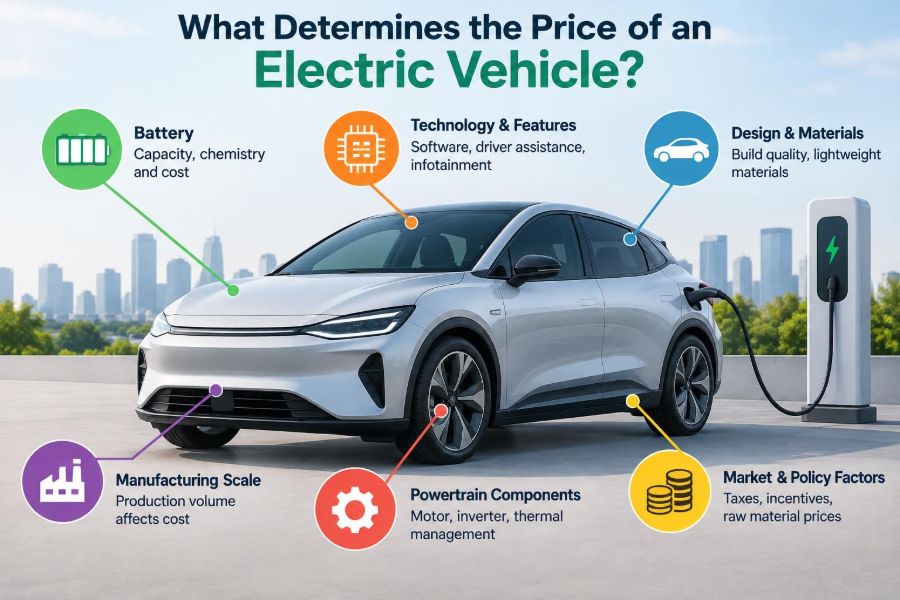

A buyer walks into a showroom, compares two electric cars of similar size, and finds a surprisingly wide gap between their prices. Both have four wheels, a battery, a motor, and a screen. So why might one cost much more than the other?
The answer is not simply that one is “better.” An electric vehicle’s price is shaped by chemistry, engineering, manufacturing scale, regulations, software, supply chains, and the choices made about performance and comfort.
For students of automobile engineering, EV pricing reveals how technical decisions become commercial decisions. For drivers and fleet operators, it helps separate a higher upfront price from a genuinely higher-value vehicle.
Understanding these factors also makes it easier to evaluate claims about affordable EVs, premium models, and the likely direction of the market.
⚡ The Starting Point: What an EV Price Includes
The displayed price of an electric vehicle combines far more than the visible body and cabin. It must recover the cost of design, testing, parts, assembly, distribution, warranty coverage, and the manufacturer’s operating margin.
Taxes, registration charges, delivery fees, and local incentives can also change what a customer finally pays. Therefore, the manufacturer’s cost, list price, and on-road price are related but different figures.
🔋 The Battery Pack Is Usually the Largest Cost Driver
In many EVs, the traction battery is the most expensive single system. It stores the energy that replaces petrol or diesel, but it also contains sophisticated monitoring, cooling, structural protection, and high-voltage safety hardware.
A battery pack is not just a box of cells. Its final cost includes cells, modules or cell-to-pack architecture, busbars, contactors, sensors, battery-management software, enclosure materials, assembly, and validation.
🧪 Cell Chemistry Changes Cost and Capability
Battery chemistry determines which materials are needed, how much energy a cell can store, its expected cycle life, thermal behaviour, and its cost. Common families include lithium iron phosphate (LFP) and nickel-based chemistries such as NMC or NCA.
LFP cells can reduce dependence on some costly materials and are often used where robust life and moderate cost are priorities. Nickel-rich cells can offer higher energy density, which may help range or reduce pack mass, but their material and thermal-management requirements can differ.
Neither chemistry is universally superior. The appropriate choice depends on vehicle size, target range, charging strategy, climate, cost target, and desired performance.
📏 Battery Capacity Raises Both Range and Price
Battery capacity is commonly expressed in kilowatt-hours (kWh). A larger pack can usually store more usable energy and extend driving range, but it requires more cells and often stronger supporting structures.
Consider two hypothetical versions of the same crossover: one designed mainly for city travel and one intended for frequent highway journeys. The long-range version may need a substantially larger battery, increasing material cost, weight, cooling demand, and sometimes suspension requirements.
More capacity is therefore not automatically better value. A driver who can charge regularly may benefit more from an efficient, reasonably sized pack than from paying for range that is rarely used.
🏭 Cell Manufacturing Scale Matters
Cell cost depends heavily on production volume, factory utilization, process yield, and purchasing scale. A high-output plant that consistently produces cells within specification can spread fixed equipment and development costs across many units.
New factories face a learning period. Scrap rates, quality checks, worker training, and process adjustments can keep costs elevated until production becomes stable. This is one reason a technically promising battery may not immediately produce a low-cost vehicle.
⛏️ Raw Materials Create Price Volatility
Lithium, nickel, graphite, copper, aluminium, and other materials enter EV batteries and electrical systems. Their prices can move with mining output, processing capacity, transport disruptions, trade rules, and demand from multiple industries.
A manufacturer may use long-term supply contracts, recycling, chemistry changes, or alternative suppliers to reduce exposure. Even so, raw-material volatility can influence vehicle pricing, margins, and the timing of product launches.
🧊 Thermal Management Adds Engineering Value
Battery cells work best within an appropriate temperature range. Liquid cooling, refrigerant-based systems, pumps, valves, heat exchangers, sensors, and control software help manage heat during driving, rapid charging, and extreme weather.
A basic system may cost less, while a more capable system can improve repeatable charging performance and protect battery life under demanding use. The difference may not be obvious in a showroom, but it can materially affect vehicle cost and ownership experience.
🛡️ Battery Safety Requires More Than Strong Cells
High-voltage batteries must be protected in a crash, isolated during faults, and monitored for abnormal temperatures or electrical conditions. The pack enclosure, mounting points, fuses, contactors, venting paths, crash testing, and diagnostic logic all contribute to safety.
These measures add mass and cost, but removing them is not a meaningful economy. A well-engineered battery system must manage both normal operation and rare fault scenarios.
⚙️ Motors and Power Electronics Set Performance
An EV powertrain includes the electric motor, inverter, reduction gear, high-voltage cables, and control systems. The inverter converts the battery’s direct current into the alternating current used by many traction motors.
A compact city EV may use a modest motor and simple drivetrain. A performance-oriented vehicle may use multiple motors, high-current inverters, upgraded cooling, and stronger gears. Faster acceleration and higher sustained output generally require more expensive hardware.
🧲 Motor Material Choices Affect Supply Risk
Some permanent-magnet motors use rare-earth materials that provide high torque and compact packaging. Their supply chains and prices can be sensitive to processing capacity and geopolitical conditions.
Other designs, including induction and certain electrically excited motors, can reduce or avoid some rare-earth dependence. However, they bring their own trade-offs in efficiency, size, control complexity, and manufacturing. Engineers select a motor architecture for the whole vehicle, not for one material alone.
🚘 Vehicle Size and Mass Multiply Costs
A larger vehicle needs more body material, larger tyres, a stronger structure, and often a larger battery to achieve comparable range. Added mass also increases demands on brakes, suspension, and crash-energy management.
This explains why making a small urban EV affordable is technically different from making a large electric SUV affordable. The second vehicle carries more material and needs more energy simply to move its greater mass.
🏗️ Platform Design Determines What Can Be Shared
A dedicated EV platform can place the battery low in the floor, optimize occupant space, and integrate high-voltage components from the beginning. It may support efficient assembly once volumes are high.
Adapting an existing internal-combustion platform can reduce initial development time and use familiar production assets. But compromises in packaging, structural layout, or assembly steps may remain. The lower-cost route depends on production scale and the manufacturer’s starting point.
🏭 Factory Investment Must Be Recovered
Developing an EV requires investment in tooling, software, testing facilities, battery assembly, safety procedures, and worker training. New production lines may also need high-voltage equipment and different material-handling systems.
Those fixed costs are spread across vehicles sold. A low-volume niche EV may carry a higher cost per unit than a model built in large numbers, even if the two share similar battery capacity.
📈 Production Volume Creates Economies of Scale
Economies of scale mean that average cost can fall as output rises because fixed expenses are divided across more units and suppliers can manufacture components more efficiently. Shared motors, inverters, controllers, and pack modules can reinforce this effect.
Scale has limits. Expanding too quickly can create quality problems, supply shortages, or costly factory downtime. The goal is not maximum volume at any price, but stable volume with reliable processes.
🔗 Supplier Networks and Vertical Integration
Some manufacturers buy cells, motors, electronics, and software services from specialist suppliers. Others make selected components internally or work through closely integrated partnerships.
Vertical integration can give greater control over design and supply, but it requires capital, expertise, and accountability for manufacturing quality. Outsourcing can reduce direct investment, yet it may expose a company to supplier pricing and availability constraints.
🚢 Logistics and Factory Location Influence Cost
Battery packs are heavy, and moving vehicles or components across long distances adds transport, handling, insurance, and inventory costs. Customs duties and local-content requirements can further affect final price.
Building near major markets may reduce some logistics costs, but labour, energy, land, and supplier availability also matter. There is no single “best” factory location for every EV programme.
💻 Software Is a Real Product Cost
Modern EVs rely on software for battery management, motor control, charging communication, thermal operation, displays, driver assistance, diagnostics, and cybersecurity. Developing and maintaining that software requires engineering effort long after production begins.
Over-the-air updates can correct issues or add features without a workshop visit. They also create continuing obligations: secure servers, testing, version control, customer support, and compliance management.
📡 Electronics and Semiconductor Availability
Controllers, sensors, displays, communication modules, and power semiconductors are central to an EV. A shortage of one specialised electronic component can delay production of an otherwise complete vehicle.
Automakers may redesign modules, qualify alternative parts, or hold more inventory to reduce risk. Each response has a cost, which can eventually appear in pricing or equipment changes.
🔌 Charging Hardware Shapes Everyday Convenience
The onboard charger converts grid AC power to battery-compatible DC power during many home and workplace charging sessions. Its rating, charging connectors, communication equipment, and safety hardware influence both cost and convenience.
Support for high-power DC charging may require more capable pack cooling, charging controls, and electrical architecture. A buyer should distinguish between a car’s peak charging claim and its ability to sustain useful charging rates across a real charging session.
🌡️ Climate Capability Can Raise the Specification
Cold weather reduces available battery power and can increase energy used for cabin heating. Very hot conditions can increase cooling demand. Features such as heat pumps, battery preconditioning, insulated components, and stronger thermal systems may improve operation in demanding climates.
They add cost, but the value depends on where and how the vehicle will be used. A feature that is essential for a cold-region commuter may be less relevant in a consistently mild climate.
🪑 Interior Equipment and Brand Positioning
Not every price difference comes from the electric powertrain. Panoramic roofs, premium audio, larger displays, advanced seats, glass treatments, upscale trim, and complex lighting all affect material and assembly cost.
Brand positioning also influences price. A manufacturer may price a vehicle to reflect service experience, design reputation, exclusivity, warranty support, or a performance image. This is a commercial decision, not proof that every component is more expensive.
🧪 Testing, Certification, and Compliance
Before sale, vehicles must meet applicable safety, electromagnetic compatibility, environmental, and battery-transport requirements. Manufacturers conduct engineering validation for crashes, durability, water ingress, high-voltage isolation, braking, software behaviour, and more.
Testing is expensive because prototypes, facilities, instrumentation, and specialist labour are required. It is also essential: reliable results help prevent costly recalls and unsafe field failures.
🧾 Warranty and Service Provisions Are Built In
A vehicle price partly reflects the manufacturer’s expected warranty obligations. Battery coverage is particularly significant because diagnosis, repair, and replacement can be costly.
Designing for serviceability can reduce lifetime repair costs, but replacing a failed cell or module is not always straightforward. Pack construction, sealing, access, parts availability, and technician training influence the practical service burden.
♻️ Recycling and Second-Life Planning
At the end of a battery’s automotive life, materials may be recovered through recycling, while suitable packs or modules may sometimes be repurposed for stationary energy storage. The technical and economic feasibility depends on battery condition, design, transport rules, and local infrastructure.
Designing for traceability and safe dismantling can add planning and hardware cost now, while potentially supporting material recovery later. The financial benefit is not identical in every region or chemistry.
🏛️ Taxes, Incentives, and Local Policy
Governments may influence EV transaction prices through purchase incentives, tax treatment, registration fees, import duties, or local manufacturing policies. These measures vary by country and can change over time.
A consumer should treat an incentive as a policy-dependent part of the purchase calculation, not as an inherent reduction in vehicle engineering cost. Eligibility conditions, income limits, vehicle caps, and application procedures may apply.
💰 List Price Is Not the Same as Ownership Cost
A lower purchase price does not automatically mean lower overall cost, and a higher price does not automatically mean better economics. Energy prices, charging access, insurance, depreciation, tyres, maintenance, financing, and resale value all matter.
For a fleet, downtime and route suitability can be as important as the invoice price. For a household, the availability of convenient home charging may have a major effect on whether an EV’s operating advantages are realised.
📊 A Practical Way to Compare Two EVs
Compare vehicles by the job they must do rather than by headline range or screen size. Start with usable range in your conditions, then examine charging capability, warranty terms, vehicle efficiency, cargo or passenger needs, and local service support.
| Comparison question | Why it affects value |
|---|---|
| How much usable range is needed? | A larger battery costs more and may be unnecessary for predictable daily trips. |
| Where will charging happen? | Home, workplace, and public charging access change convenience and operating cost. |
| Is rapid charging frequent? | Frequent long trips place greater value on thermal management and charge-rate consistency. |
| What does the warranty cover? | Battery and high-voltage coverage can alter long-term risk. |
| Which features will actually be used? | Comfort and software options can add cost without improving the core mission. |
⚠️ Common Mistakes When Judging EV Prices
One mistake is comparing battery capacity alone. A smaller pack in an efficient vehicle can deliver similar real-world usefulness to a larger pack in a heavier, less efficient one.
Another is treating advertised range as a fixed outcome. Speed, weather, terrain, payload, tyres, driving style, and cabin climate control change energy consumption. Buyers should also avoid assuming that every public charger delivers the vehicle’s maximum charging power.
- Do not compare prices before accounting for taxes, incentives, and required fees.
- Do not ignore insurance and charging-installation costs.
- Do not pay for a range or performance level that does not match actual travel patterns.
🔮 Why EV Prices May Change Over Time
Battery manufacturing improvements, simpler pack structures, better cell yields, larger production volumes, and more efficient electrical architectures can reduce costs. At the same time, commodity prices, regulations, exchange rates, and demand can move in the opposite direction.
Price evolution is therefore unlikely to be perfectly smooth. A new generation may become cheaper, but a particular market can still experience temporary increases caused by supply-chain or policy changes.
🎯 The Core Principle Behind an EV’s Price
An EV is priced through a chain of connected choices: how much energy it stores, how quickly it charges, how safely it operates, how much performance it delivers, where it is built, and how many units share its development cost.
The most useful question is not “Why is this EV expensive?” but “Which engineering capabilities, manufacturing costs, and ownership benefits am I paying for?” That question reveals whether a price difference reflects a meaningful requirement, a desirable option, or simply market positioning.
The price of an electric vehicle is ultimately the visible result of technical design choices and the industrial system required to deliver them reliably. A good buying decision matches those choices to real driving needs rather than to the longest specification sheet. ⚡🚗🔋