
A car that hesitates at a junction, shakes at idle, or flashes its check-engine light can turn an ordinary trip into a diagnostic puzzle. The symptom may feel dramatic, but the underlying fault is often a single cylinder failing to do its share of the work.
That failure is called a misfire. It can be caused by a weak spark, the wrong amount of fuel, unmetered air, poor compression, or a control-system fault that changes the timing of those events.
For students, misfire diagnosis is an excellent lesson in systems thinking. For technicians and experienced drivers, it is a reminder not to replace parts based on a code alone.
The most reliable approach is to understand what combustion needs, observe when the fault occurs, and test one system at a time. That turns “the engine runs badly” into evidence that can lead to a defensible repair.
🔥 What an Engine Misfire Actually Means
In a spark-ignition engine, each cylinder should draw in air, receive the appropriate amount of fuel, compress the mixture, ignite it near the correct crankshaft position, and release useful energy during the power stroke. A misfire occurs when that cylinder produces little or no expected combustion torque.
Misfire does not always mean there was no flame at all. Combustion may be late, incomplete, weak, or inconsistent. The crankshaft slows slightly after that cylinder’s firing event, and the engine control module may detect this speed variation through the crankshaft position sensor.
⚙️ Why One Weak Cylinder Affects the Whole Vehicle
A multi-cylinder engine smooths torque by distributing power strokes through a full crankshaft rotation. When one cylinder contributes less than the others, the result is uneven torque, felt as vibration through the steering wheel, seat, gear lever, or body structure.
At idle, the effect is especially noticeable because there is little rotational inertia and no driveline load to mask it. Under acceleration, a misfire can feel like a flat spot, bucking, poor response, or a sudden loss of power.
🚨 When a Misfire Needs Immediate Attention
A steady malfunction indicator lamp can indicate a stored emissions-related fault, but a flashing check-engine light commonly warns that active misfire may be severe enough to overheat the catalytic converter. Unburned fuel entering the exhaust can burn in the converter rather than in the cylinder.
Reduce load immediately. Avoid hard acceleration, towing, or sustained high-speed operation, and arrange diagnosis. Stop driving if the engine runs extremely roughly, smells strongly of fuel, loses power dangerously, overheats, or has abnormal mechanical noise.
🧩 The Five Requirements for Combustion
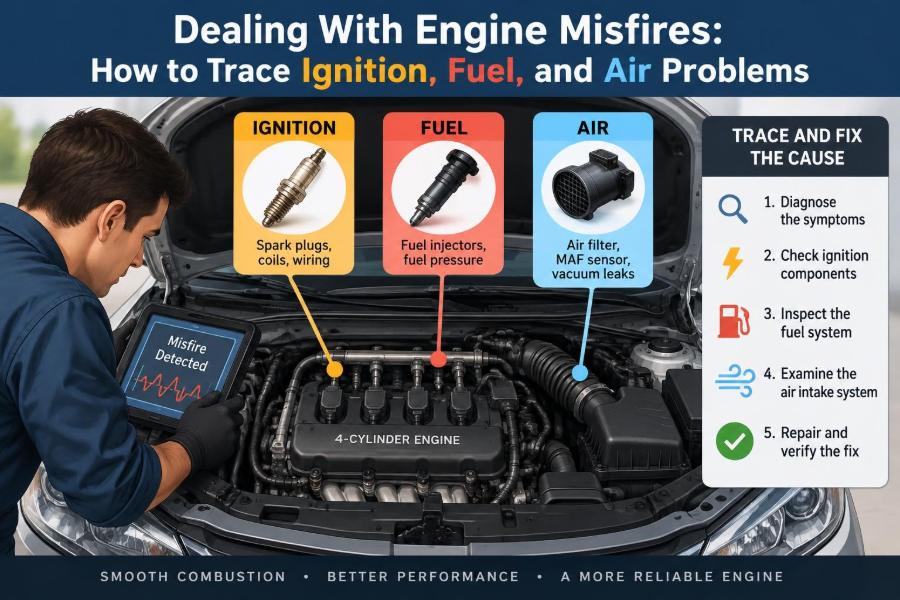
A useful diagnostic model begins with five conditions: adequate air, correctly delivered fuel, a capable ignition source, sufficient compression, and correct timing or control. A fault in any one can create similar driver symptoms.
- Air: enough clean, measured air must enter the cylinder.
- Fuel: the injector must deliver fuel in the right quantity and pattern.
- Spark: ignition must occur with enough energy at the intended time.
- Compression: the charge must be compressed and contained.
- Timing: valve, crankshaft, camshaft, and ignition events must be coordinated.
This model prevents the common mistake of treating every misfire as a spark-plug problem.
📍 Identifying the Pattern Before Touching Parts
Ask when the misfire occurs. A cold-only misfire, hot-only misfire, idle-only misfire, and wide-open-throttle misfire point toward different conditions and tests.
For example, a weak ignition coil may break down when cylinder pressure rises during acceleration. A vacuum leak often has a larger influence at idle, when airflow through the throttle is low. An injector with poor spray quality may show up most clearly on cold starts or under light load.
🖥️ Reading Diagnostic Trouble Codes Correctly
Generic OBD diagnostic trouble codes in the P0300 range are commonly associated with misfire detection. P0300 generally indicates random or multiple-cylinder misfire, while codes such as P0301 through P0308 commonly identify a particular cylinder number, depending on engine configuration.
A code is a starting point, not a part-replacement instruction. A cylinder-specific code tells you where the engine-control system observed the crankshaft-speed effect. It does not prove whether the cause is a plug, coil, injector, valve, wiring fault, or mechanical defect.
📸 Freeze-Frame Data Gives the Fault Context
When a code is stored, the control module may save freeze-frame information: engine speed, coolant temperature, calculated load, vehicle speed, fuel-trim values, and other operating conditions. This information can recreate the moment the fault crossed the module’s threshold.
Suppose a fault was recorded at low rpm, warm coolant temperature, and closed throttle. That supports checking idle airflow, vacuum leaks, and idle fuel control before assuming the fault appears under heavy load. Live data and manufacturer-specific misfire counters can add useful detail where scan-tool access permits.
👀 Start With a Careful Visual Inspection
Before advanced testing, inspect what can be seen safely. Look for disconnected intake ducts, split hoses, loose electrical connectors, damaged coil boots, oil in plug wells, rodent-damaged wiring, and signs of coolant or fuel leaks.
Also check whether recent work disturbed the fault area. A coil connector not fully latched after service, an incorrectly routed vacuum hose, or a trapped injector wire can create a problem that appears far more complicated than it is.
🔌 Spark Plugs: Small Parts With Major Diagnostic Value
A spark plug must fire across a gap under high cylinder pressure. Wear enlarges the gap and increases the voltage required to jump it. Deposits, cracks in the ceramic insulator, incorrect heat range, wrong gap, or incorrect plug specification can all contribute to misfire.
Remove plugs only on a cool engine and inspect each cylinder separately. Compare them rather than judging one plug in isolation. A plug from a healthy cylinder can provide a useful visual reference.
| Plug observation | Possible direction for diagnosis |
|---|---|
| Dry, sooty black deposits | Rich running, weak ignition, restricted air, or excessive short-trip operation |
| Wet fuel smell | Fuel is present but ignition or compression may be inadequate |
| Oily deposits | Oil entering the chamber through rings, guides, seals, or ventilation issues |
| Very clean or pale appearance | Possible coolant entry, lean operation, or abnormal combustion; confirm with tests |
Plug appearance is evidence, not a final diagnosis. Modern fuels and operating conditions can make deposits ambiguous.
⚡ Testing Coils, Leads, and Ignition Boots
Coil-on-plug systems place an individual coil directly over each spark plug. Older systems may use coil packs, high-tension leads, or a distributor. In every arrangement, insulation breakdown and poor connections can leak high voltage before it reaches the plug.
On engines with interchangeable coils, swapping the suspected coil with a known-good cylinder can be a powerful controlled test. If the misfire code moves with the coil, the coil or its boot becomes a strong suspect. Confirm connector condition and wiring supply before condemning the component.
🧪 Why Spark Testing Must Be Done Safely
Ignition systems generate high voltage. Improvised tests involving a removed plug, exposed metal, or a hand-held wire can cause shock, ignite fuel vapour, or damage electronics. Use appropriate insulated tools and follow vehicle-specific procedures.
An adjustable spark tester can show whether a coil can produce a visible discharge under a controlled gap, but it does not perfectly reproduce combustion-chamber pressure. A coil that sparks in open air may still fail under load, so test results must be interpreted with the driving symptoms.
⛽ Fuel Delivery Begins Before the Injector
A misfire blamed on one injector can sometimes originate upstream: low fuel level, a restricted pickup, weak pump, blocked filter where fitted, poor pump wiring, or a faulty pressure-control system. These faults often affect multiple cylinders, especially when fuel demand rises.
Verify fuel pressure and, where relevant, fuel volume using the manufacturer’s procedure. Pressure specification alone is not universal; direct-injection and port-injection systems operate very differently. Fuel work requires fire precautions, proper depressurization, and suitable equipment.
💉 Injector Faults and Cylinder-to-Cylinder Differences
An injector can fail electrically, stick mechanically, clog partially, leak, or produce a distorted spray pattern. A restricted injector may create a lean cylinder; a leaking injector can create an overly rich cylinder, fuel-wet plug, hard restart, and oil dilution in serious cases.
Useful tests include checking connector integrity, measuring injector circuit behavior with suitable equipment, listening for consistent injector operation, and performing a professional injector balance or flow test. A clicking injector is not automatically a flowing injector; the sound only suggests that its actuator is moving.
🌬️ Airflow Measurement and the Correct Air-Fuel Ratio
The engine control module calculates fuel delivery from sensor inputs, commonly including mass airflow, manifold absolute pressure, intake-air temperature, throttle position, oxygen-sensor feedback, and engine speed. Incorrect sensor information can result in the wrong fuel quantity even when the injector hardware is sound.
For a conventional gasoline engine operating in closed loop, the control module continuously adjusts mixture using exhaust oxygen-sensor feedback. A faulty sensor can contribute to poor control, but sensor codes and fuel trims must be interpreted in context rather than treated as automatic proof of a failed sensor.
🕳️ Vacuum Leaks and Unmetered Air
A vacuum leak allows air into the intake after the airflow has been measured, or through a path the control system does not expect. Common locations include intake manifold gaskets, PCV hoses, brake-booster hoses, throttle-body seals, and cracked plastic intake components.
At idle, unmetered air represents a larger share of total airflow, so idle quality often suffers most. The control module may add fuel in response, producing positive fuel-trim values. A smoke machine is generally safer and more conclusive than spraying flammable aerosol near a running engine.
📈 Using Fuel Trims as Directional Clues
Short-term fuel trim is the controller’s immediate correction; long-term fuel trim is its learned correction over time. Positive values generally mean the module is adding fuel in response to a perceived lean condition, while negative values mean it is subtracting fuel.
Compare trims at warm idle and at a steady elevated rpm. Strongly positive correction at idle that improves with rpm can support a vacuum-leak theory. Positive correction across operating ranges may suggest inadequate fuel delivery or incorrect airflow measurement. These are patterns, not verdicts.
🧹 Intake Restrictions and Throttle-Body Deposits
Not every air-related fault is a leak. A severely restricted air filter, collapsed intake hose, contaminated airflow sensor, or carbon deposits around an electronic throttle body can alter airflow and idle control.
Cleaning should be deliberate, not aggressive. Some airflow sensors are easily damaged by touching the sensing element or using unsuitable chemicals. Electronic throttle systems may require a relearn procedure after cleaning, depending on the vehicle design.
🫧 Exhaust Leaks Can Mislead Sensor Feedback
An exhaust leak ahead of an upstream oxygen sensor can draw fresh air into the exhaust stream during pressure pulses. The sensor may then report apparent excess oxygen, and the control module may enrich the mixture unnecessarily.
Look for ticking sounds on cold start, black soot around joints, damaged flex sections, or loose manifold hardware. Exhaust leaks farther downstream can also create noise and emissions concerns, but their effect on mixture control depends on sensor location and system design.
🧱 Compression: The Mechanical Side of Misfire Diagnosis
Ignition and fuel checks can be perfect while a cylinder still cannot burn the charge effectively. Low compression can result from worn piston rings, burned or bent valves, valve-seat damage, a failed head gasket, cylinder-wall damage, or incorrect valve timing.
A compression test compares the cylinder’s ability to build pressure during cranking. Test conditions matter: battery condition, throttle position, fuel and ignition disablement, gauge quality, and procedure can all affect results. Compare cylinders and consult the engine manufacturer’s acceptable limits.
🔍 Leak-Down Testing Finds Where Compression Escapes
A cylinder leak-down test introduces regulated compressed air into a cylinder positioned near top dead center on the compression stroke. The technician listens and observes where air escapes.
- Air at the intake suggests an intake-valve sealing issue.
- Air at the tailpipe suggests an exhaust-valve sealing issue.
- Air at the oil filler or crankcase suggests ring or piston leakage.
- Bubbles in coolant or air from an adjacent cylinder can indicate a head-gasket or crack concern.
The piston must be held correctly at top dead center. Otherwise, air pressure can rotate the crankshaft unexpectedly.
🕰️ Camshaft and Crankshaft Timing Problems
Valve timing determines when cylinders breathe. A stretched timing chain, slipped belt, failed tensioner, damaged timing component, or variable valve timing fault can change this relationship and cause misfires, poor power, abnormal starting, and correlation codes.
Some timing faults affect every cylinder; others influence a bank or operating range. Do not assume a camshaft correlation code proves a sensor failure. The sensor may accurately report a mechanical timing error.
🌡️ Temperature Changes Reveal Intermittent Faults
Heat changes electrical resistance, material expansion, fuel vaporization, and sensor behavior. A coil may fail only after heat soak, an injector connection may lose contact when hot, and a marginal valve may seal differently after the engine reaches operating temperature.
Record whether the fault occurs cold, warm, after a short stop, during rain, or only after a long drive. This simple history is often more useful than a vague description such as “it happens sometimes.”
🏁 Load Testing Separates Weak Components From Dead Ones
Engine load increases cylinder pressure, which raises the voltage needed for spark to jump the plug gap. That is why a coil or plug that appears acceptable at idle may misfire during uphill acceleration or high-gear passing.
Conversely, a vacuum leak may become less obvious once the throttle opens. A safe road test with scan data, or a controlled workshop load test, helps reproduce the exact condition. Do not conduct distracting tests on public roads without proper safety arrangements.
🔄 The Component-Swap Method, Used Carefully
Swapping identical components between cylinders is a practical way to test a hypothesis. Coils are common candidates; in some engines, plugs and injectors can also be moved when procedures allow.
Document the original cylinder, clear or record codes as appropriate, and repeat the same operating conditions. If the fault moves, the swapped part is implicated. If it stays, investigate the cylinder’s wiring, injector control, air leak, compression, or mechanical condition rather than continuing to swap parts blindly.
🧭 A Sensible Diagnostic Sequence
A structured workflow reduces both cost and diagnostic error. The exact order changes with symptoms, but the following sequence works for many gasoline-engine misfires:
- Confirm the complaint and determine whether driving should stop.
- Scan for codes, freeze-frame data, pending faults, and live data.
- Inspect intake, ignition, wiring, fluid leaks, and recent repair areas.
- Identify whether the pattern is cylinder-specific, random, idle-related, load-related, cold, or hot.
- Test the most likely system with evidence-based checks.
- Verify the repair under the conditions that originally produced the fault.
Verification matters. A smooth idle after replacing a part does not prove success if the original misfire occurred only on a warm, loaded climb.
🛑 Common Diagnosis Mistakes to Avoid
The costliest mistakes usually come from assumptions. Replacing plugs, coils, injectors, sensors, and fuel pumps in sequence may eventually find the fault, but it teaches little and can introduce new problems.
- Assuming a cylinder code identifies the failed component.
- Ignoring oil or coolant contamination in plug wells.
- Testing only at idle when the fault occurs under load.
- Reading fuel trims without comparing idle and elevated-rpm behavior.
- Overlooking mechanical tests after ignition parts appear normal.
- Clearing codes before recording freeze-frame data.
Good diagnosis narrows uncertainty before parts are ordered.
🧰 Repair Quality Matters as Much as Fault Finding
A correct diagnosis can still lead to repeat trouble if installation is poor. Use the correct plug type and gap, torque plugs to specification, route wiring away from heat and sharp edges, seat connectors fully, and replace damaged seals or boots rather than reusing them out of convenience.
For fuel-system, timing-system, and internal-engine repairs, manufacturer procedures are essential. These jobs can involve high pressure, precise timing relationships, torque-angle fasteners, and safety risks beyond ordinary home servicing.
🚙 Modern Engines Add Useful Data—and New Complexity
Turbocharging, gasoline direct injection, variable valve timing, cylinder deactivation, start-stop systems, and wideband oxygen sensors provide efficient operation but expand the list of possible misfire influences. Carbon accumulation, high-pressure fuel control, boost leaks, and actuator faults may require specialized test methods.
The core principle remains unchanged: verify air, fuel, spark, compression, and timing. Advanced systems change how evidence is gathered, not the physical requirements for combustion.
📚 Building a Repeatable Technician Mindset
Students should practice connecting symptoms to conditions rather than memorizing a fixed parts list. Keep notes on code data, cylinder numbering, test setup, readings, swaps, and the final confirmation. Clear records make it easier to explain why a repair was justified.
Working professionals benefit from the same discipline when time pressure is high. A ten-minute inspection and data review can prevent hours of unnecessary component replacement and improve customer confidence in the repair process.
✅ The Core Principle: Prove the Cause, Then Repair It
An engine misfire is best treated as a controlled investigation. Determine which cylinder or operating condition is involved, gather scan and visual evidence, then test the systems that can realistically create that pattern.
Ignition faults are common, but fuel delivery, airflow errors, exhaust leaks, compression loss, and timing defects can produce deceptively similar symptoms. The strongest diagnosis is the one in which a test result explains the complaint and the repair removes it under the same conditions.
Trace a misfire by following evidence through spark, fuel, air, compression, and timing—not by guessing which part is most likely to fail. That approach protects the engine, the catalytic converter, and the repair budget while building real diagnostic skill. 🔧🚗