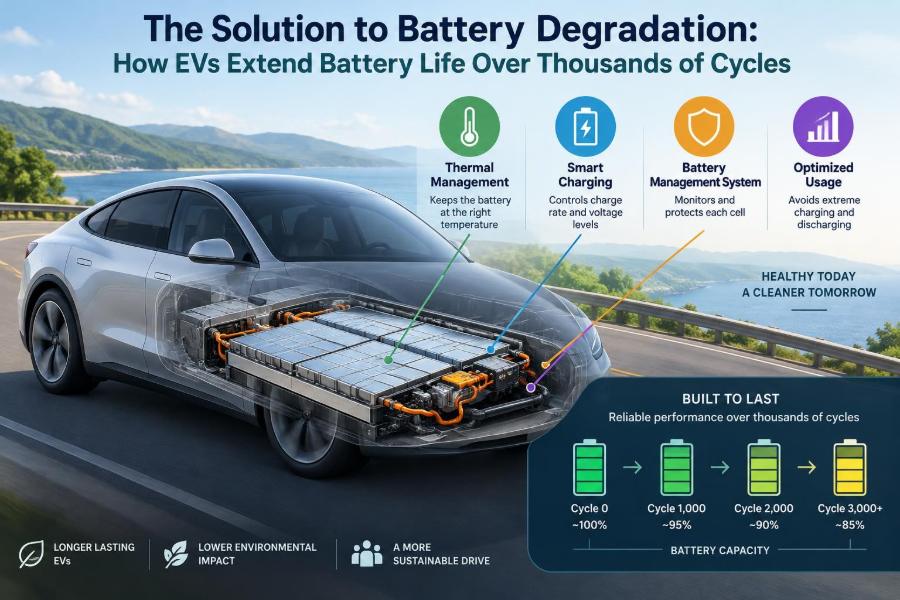

A driver plugs in an electric vehicle at night, sees the battery reach its chosen charging limit, and leaves for work the next morning without giving the pack much thought. That quiet routine hides a demanding engineering task: the battery must deliver useful energy year after year while experiencing thousands of charge and discharge events.
Battery degradation is one of the first concerns many prospective EV owners raise. Will range fall sharply? Will frequent charging ruin the pack? And what happens when the car faces a hot summer, a freezing morning, motorway speeds, and rapid charging—all in the same week?
The reassuring answer is not that EV batteries never age. They do. The more useful answer is that modern EVs are designed as systems that actively slow the conditions causing wear, rather than treating the battery as a simple container of electricity.
Understanding those protections also helps drivers make sensible choices. Good battery life comes from cell chemistry, pack design, thermal management, software control, and realistic charging habits working together.
🔋 Battery Degradation Is a Change in Usable Performance
Battery degradation means a gradual loss of the battery’s original ability to store and deliver energy. In an EV, it may appear as reduced driving range, less power in demanding conditions, slower rapid charging, or a combination of these effects.
A battery can still operate safely and reliably while holding less energy than when new. The key engineering question is not whether degradation exists, but how slowly it progresses and how much useful performance remains over the vehicle’s intended life.
🧪 What Happens Inside a Lithium-Ion Cell
Most EVs use lithium-ion cells. During charging, lithium ions move from the positive electrode, called the cathode, through an electrolyte and into the negative electrode, usually graphite-based. During discharge, the ions travel back while electrons flow through the vehicle’s electrical circuit to power the motor.
These movements are reversible, but never perfectly so. Small chemical side reactions consume active lithium or alter electrode materials. Over time, that leaves fewer ions and fewer active sites available for normal energy storage.
🔄 Cycle Aging and Calendar Aging Are Different
Cycle aging results from using the battery: charging it, discharging it, and moving ions repeatedly through the cell. Deep discharges, high charging currents, and heavy power demand can increase this form of wear.
Calendar aging occurs even when the vehicle is parked. Temperature and state of charge still influence chemical reactions inside the cell. A car stored for long periods at high temperature and very high charge may age faster than one stored in cooler, moderate conditions.
This distinction explains why mileage alone does not tell the whole battery-health story.
📏 A Cycle Is Not Always One Plug-In Event
A full equivalent cycle represents using energy equal to the battery’s complete usable capacity. It does not require one trip from 100% to 0% followed by a full recharge.
For example, two separate uses of roughly half the usable battery capacity add up to about one full equivalent cycle. This is why an EV charged every day is not necessarily undergoing one full cycle every day.
Engineers track energy throughput—the total energy moved into and out of the pack—because it offers a clearer view of use than simply counting charging sessions.
📉 Capacity Fade and Power Fade Need Separate Attention
Capacity fade reduces the amount of energy the battery can store, so the vehicle travels fewer kilometres or miles on a charge. This is the battery-health effect drivers most often notice.
Power fade occurs when internal resistance rises. The cell may still contain substantial energy, but it cannot deliver or accept power as easily. That can limit acceleration, regenerative braking, or DC rapid-charging speed, especially in cold conditions.
A robust EV battery strategy must manage both forms of aging.
⚡ Why High State of Charge Stresses Cells
At very high state of charge, electrode potentials become less favourable for long-term stability. Depending on the chemistry, high charge levels can accelerate reactions that consume electrolyte or stress electrode structures.
That does not mean a driver must fear charging to 100%. Full charge is useful before a long journey and may be expected for some battery types. The practical lesson is simpler: when maximum range is not needed, leaving the battery at its highest charge for many hours or days is usually less gentle than using a moderate limit.
⬇️ The Risks at the Empty End of the Gauge
Very low charge is also not ideal for extended storage. If a battery remains deeply discharged, normal self-discharge and standby loads can push individual cells toward voltages that the battery-management system must protect against.
EVs normally retain a hidden reserve below the displayed 0% and restrict operation before cells reach damaging levels. Still, regularly arriving with almost no charge gives less margin for unexpected delays, cold weather, or a charger that is unavailable.
🛡️ Usable Capacity Is Deliberately Restricted
The battery pack’s physical or gross capacity is often greater than the energy a driver can access. Manufacturers may hold back capacity at the top, bottom, or both ends of the cell’s operating range.
These buffers reduce exposure to the highest and lowest cell voltages. They also allow some capacity loss to occur before the driver sees a proportionate loss in the displayed usable range.
This is an engineering trade-off. Larger buffers can support durability but reduce the range available from a given pack size and mass.
🧠 The Battery Management System Is the Pack’s Supervisor
The battery management system, or BMS, measures cell voltages, temperatures, current, insulation status, and other operating conditions. It estimates state of charge and state of health, then decides how much power the pack may safely accept or deliver.
It may reduce available motor power when the battery is cold, limit rapid charging when temperatures are high, or prevent charging when a cell approaches a voltage limit. These restrictions can feel inconvenient, but they protect the cells from avoidable stress.
⚖️ Cell Balancing Prevents One Weak Cell From Setting the Limit
A battery pack contains many cells connected in series and parallel. In a series string, the usable pack capacity is constrained by the cell that reaches its voltage limit first.
Small differences in cell capacity, resistance, and temperature can grow into voltage imbalance. The BMS uses balancing methods—often bleeding a small amount of charge from higher-voltage cells—to bring cells closer together, commonly near the top of the charging range.
Balancing does not restore a damaged cell. It helps the pack use its healthy cells more evenly and reduces the chance that one cell unnecessarily limits the whole system.
🌡️ Temperature Is One of the Strongest Aging Factors
Heat speeds up many chemical reactions, including unwanted ones that cause battery aging. A pack repeatedly operated or stored hot may lose capacity faster than a similar pack kept within a moderate temperature range.
Cold creates a different challenge. Ions move more slowly, internal resistance rises, and charging must be controlled carefully. Attempting high-power charging into a very cold cell can encourage lithium plating, a harmful deposition of metallic lithium on the negative electrode.
The target is not a single perfect temperature. It is a controlled operating window suited to the cell chemistry and current demand.
❄️ Preconditioning Makes Fast Charging Gentler
Many EVs can precondition the battery before arriving at a DC rapid charger. The car heats or cools the pack toward a suitable temperature while driving, often using navigation information to anticipate the charging stop.
When it works well, preconditioning improves charging speed and reduces the need for the cells to accept high current while too cold or too hot. It uses some energy, so it is not free, but it is a coordinated way to improve both charging performance and battery protection.
💧 Cooling Hardware Matters More Than a Big Battery Case
Battery thermal systems range from air cooling to liquid cooling and, in some designs, refrigerant-assisted cooling. Liquid systems can generally move heat more effectively and distribute temperature control more evenly than simple passive designs.
Good thermal design addresses temperature differences across the pack, not merely the average temperature. If cells near the centre run much hotter than those near an edge, they may age at different rates and create imbalance over time.
Cooling plates, thermal interfaces, sensors, pumps, valves, and control software all contribute to battery longevity.
🏎️ Fast Charging Is Managed, Not Automatically Harmful
DC rapid charging puts substantial power into the battery in a short time. That can increase cell stress, especially when the pack is cold, very full, or already hot from hard driving.
However, the vehicle does not simply accept the charger’s maximum advertised output at all times. The BMS requests a current and voltage appropriate for the pack condition, and the charging rate tapers as the battery fills.
Frequent rapid charging can add wear compared with gentler charging in unfavourable conditions, but it is also a planned use case for many EVs. The sensible approach is to use it when travel requires it, not to treat every rapid-charge session as a battery failure.
📈 Why Charging Curves Taper Near Full
Rapid chargers commonly provide the highest power when the battery is at a low-to-middle state of charge and correctly conditioned. As charge rises, the BMS reduces current to avoid exceeding cell-voltage limits and to control heat.
This is why the final part of a rapid charge often takes disproportionately longer. The taper protects the cells and is one reason journey planning often favours shorter charging stops within the faster middle portion of the battery range.
🏠 AC Charging Usually Creates a Calmer Thermal Load
Home or workplace AC charging typically transfers energy at a lower rate than DC rapid charging. The vehicle’s onboard charger converts AC electricity to the DC electricity required by the battery.
Lower charging power usually creates less heat in the cells and associated hardware. For routine overnight charging, it is often a convenient, controlled method that lets the car finish near the desired departure time.
The exact outcome still depends on ambient temperature, battery chemistry, charge limit, and the vehicle’s thermal strategy.
🕒 Scheduled Charging Reduces Time Spent Full
Many EVs allow owners to set a charging target and departure time. Instead of reaching the selected limit shortly after arriving home and sitting there all night, the car can delay or pace charging to finish closer to departure.
This feature is particularly useful for drivers who usually need only part of the battery’s available range. It is not essential to obsess over every hour at high charge, but it is an easy way to reduce unnecessary high-state-of-charge storage.
🧬 Chemistry Changes the Best Charging Advice
Not all lithium-ion batteries behave identically. Nickel-rich cathode chemistries generally offer high energy density but can be more sensitive to prolonged high state of charge and heat. Lithium iron phosphate, commonly called LFP, has different voltage behaviour and is often valued for thermal stability and cycle durability.
LFP packs may have manufacturer guidance that differs from nickel-based packs, including recommendations for occasional or regular full charging to help the BMS estimate state of charge accurately. Drivers should follow their vehicle’s handbook rather than applying one internet rule to every EV.
| Battery-related factor | Why it affects aging | Useful response |
|---|---|---|
| High temperature | Accelerates unwanted chemical reactions | Use shade, preconditioning, and a functioning thermal system |
| Long time at high charge | Raises voltage-related cell stress | Set a routine charge target below maximum when practical |
| Very cold charging | Raises resistance and plating risk | Allow the car to precondition or limit charging power |
| Repeated high-power charging | Creates higher current and heat loads | Use DC charging for travel, AC charging for routine needs |
| Cell imbalance | Lets one cell constrain the series string | Allow normal BMS balancing and investigate warnings promptly |
🧱 Pack Structure Helps Control Mechanical Stress
Cells expand and contract slightly as lithium moves into and out of electrode materials. Over many cycles, these changes can contribute to mechanical stress, contact resistance, and degradation inside the cell.
Module frames, compression systems, busbars, electrical interconnects, and thermal plates must therefore support cells without damaging them. Modern pack design is not only about fitting more kilowatt-hours into a floorpan; it is also about maintaining stable electrical and thermal conditions through years of vibration and use.
🚦 Regenerative Braking Also Has Limits
Regenerative braking turns the traction motor into a generator, sending energy back to the battery during deceleration. It improves efficiency and reduces brake wear, but the pack must be able to accept that energy.
When the battery is very cold or near full, the BMS may reduce regenerative braking because charging current would be too stressful or cell voltage could rise too high. Drivers may notice a different braking feel, which is why EVs blend regeneration with conventional friction brakes.
🔌 Driving Style Influences Battery Temperature and Throughput
Hard acceleration, high sustained speed, steep climbs, heavy towing, and repeated rapid charging can raise battery temperature and increase energy throughput. They do not instantly ruin a battery, but repeated demanding operation creates conditions the thermal system must manage.
Consider a hypothetical long motorway trip in hot weather while towing. The battery may discharge rapidly, arrive warm at a rapid charger, and then need cooling while charging. The car can protect itself, but charging may be slower than under mild, unloaded conditions.
Efficient driving reduces energy use first; lower battery stress is a useful secondary benefit.
🅿️ Long-Term Storage Needs a Different Routine
A car left unused for weeks or months should not normally be stored fully charged or nearly empty unless the manufacturer specifically advises otherwise. A moderate charge level gives the BMS room to handle gradual energy loss and avoids extended exposure at voltage extremes.
Storage conditions matter too. A sheltered, moderate-temperature location is generally kinder than prolonged heat. Owners should also account for standby consumption from vehicle systems and check the handbook for long-storage procedures.
📊 Range Estimates Are Not a Direct Battery-Health Test
A lower displayed range does not automatically mean the battery has degraded. Range estimates react to recent driving speed, outside temperature, heating or air-conditioning use, tyre pressure, terrain, and trip history.
A proper state-of-health assessment uses diagnostic information and controlled measurements, not a single dashboard prediction after a cold week of short journeys. Comparing real energy use over similar routes and conditions is more informative than comparing one estimate with another.
🧰 Software Updates Can Improve Protection and Usability
Battery control is partly software-defined. Manufacturers can refine charging curves, thermal-control behaviour, state-of-charge estimation, and power limits through software updates where their vehicle architecture supports them.
Such updates cannot reverse chemical aging or create lost capacity from nothing. They can, however, improve how accurately the system understands the pack and how effectively it operates within safe limits.
That is one reason battery health depends on the whole vehicle system rather than cell chemistry alone.
⚠️ Common Habits That Create Avoidable Stress
Most owners do not need a complicated battery ritual. A few habits, however, are worth avoiding when practical:
- Leaving a vehicle at maximum charge for extended periods when that range is not needed.
- Parking for a long time with an almost empty battery.
- Expecting full rapid-charging power from a cold pack without preconditioning.
- Ignoring battery, charging, or cooling-system warnings.
- Assuming every EV needs the same target percentage regardless of chemistry and manufacturer guidance.
Context matters. Charging fully before a holiday drive is sensible; keeping a full pack parked for several hot days is less ideal if avoidable.
🧭 A Practical Daily Charging Strategy
For many drivers, a simple routine works well: use AC charging where convenient, select a charge limit that comfortably covers normal travel, and reserve full charging for days when the extra range is useful.
Use the car’s scheduled charging and preconditioning features if available. On a trip, rapid-charge as the route requires, trusting the vehicle to manage current and temperature. After arriving home, there is no need to compensate for every mile immediately if the next journey does not demand it.
The best routine is one that protects the battery without making ownership inconvenient enough that the driver ignores it.
🏭 What Manufacturers Must Balance
Battery-life engineering involves competing objectives. Bigger buffers and conservative charge limits can improve durability, but drivers may prefer more displayed range. Strong cooling systems improve control, but add cost, mass, complexity, and energy consumption.
Likewise, aggressive rapid-charging performance is attractive, yet it must be reconciled with cell temperature, voltage limits, and long-term health. There is no universal setting that maximises range, charging speed, cost, safety, and durability at the same time.
Good EV engineering makes these compromises visible only when necessary and automatic most of the time.
🔁 Second Life and Recycling Do Not Depend on a Perfect Pack
A battery that no longer meets the demanding range or power requirements of a vehicle may still have value in less demanding stationary applications, subject to inspection, safety assessment, economics, and local infrastructure.
Eventually, recycling can recover valuable materials for new battery production. Neither pathway eliminates the need for durable original design, but both show why a battery’s useful life is not defined solely by the moment it loses some vehicle range.
🧑🔧 When a Battery Concern Needs Professional Diagnosis
Sudden and persistent range loss, repeated charging interruptions, warning messages, unusual cooling-system behaviour, or a large change in power availability deserve investigation. These symptoms can arise from many causes, including software, a charging fault, thermal hardware, sensor issues, or an individual cell problem.
Do not attempt to open or repair a high-voltage battery pack. EV batteries contain hazardous voltage and require trained procedures, insulated tools, diagnostic equipment, and manufacturer-approved safety controls.
🎯 The Core Principle: Keep Cells in a Manageable Operating Window
EV batteries last through thousands of cycles because the vehicle avoids treating every cell at its absolute electrical and thermal limits. Charge buffers, current limits, temperature control, balancing, preconditioning, and software monitoring all serve the same purpose: keeping cell operation within a manageable window.
Drivers add to that protection by avoiding unnecessary extremes, while manufacturers add it through pack design and control logic. Degradation cannot be eliminated, because electrochemical materials age, but it can be slowed enough for the battery to remain useful through extensive real-world service.
The most effective approach is not a single charging percentage or a fear of rapid charging. It is a system-level strategy that matches chemistry, temperature, charging power, and driving needs.
An EV battery lasts longest when smart engineering and sensible everyday use keep it away from unnecessary electrical and thermal extremes. 🔋🚗🌡️