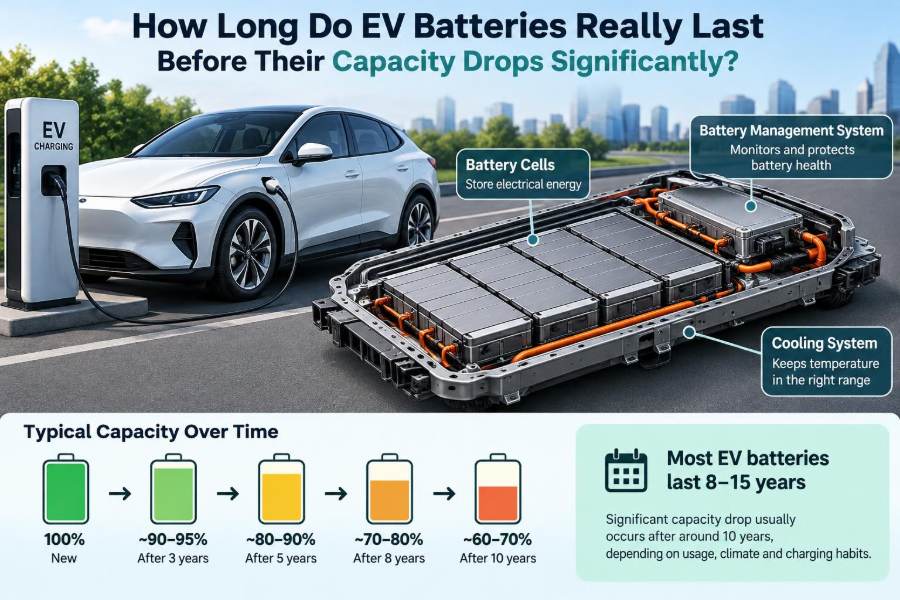

A driver considering a used electric vehicle often asks a simple question: “Will the battery be worn out in a few years?” The concern is understandable. A traction battery is the most expensive component in an EV, and its condition affects both driving range and resale value.
Another owner may notice that a car which once displayed 400 km of range now shows less. That change can feel alarming, even when the battery remains healthy enough for daily commuting. Displayed range, usable capacity, charging habits, weather, and route all influence what the driver sees.
Unlike a phone battery, an EV battery is actively cooled or heated, carefully monitored, and normally operated with protected charge limits. It does age, but the process is slower and more complex than the familiar experience of a small consumer device.
The useful question is therefore not whether an EV battery will degrade, but how quickly it will lose usable capacity, what accelerates that loss, and when the change becomes significant in real driving.
🔋 What “battery life” means in an EV
EV battery life can mean several different things. It may refer to the years before a warranty expires, the distance driven before capacity falls noticeably, or the point at which a pack needs repair or replacement.
Most discussions focus on capacity retention: the percentage of original energy the battery can still store. A 60 kWh pack that can now store 54 kWh has roughly 90% capacity retention, although the energy available to the driver may differ because manufacturers keep a reserve at the top and bottom of the pack.
📉 Capacity loss is not the same as battery failure
A battery with reduced capacity is not automatically defective. It can still deliver power, charge normally, and provide reliable service; the main consequence is shorter range.
True battery failure is different. It can involve a failed module, damaged high-voltage connection, cooling fault, insulation problem, or a cell imbalance serious enough that the vehicle limits operation. These events are not simply the expected, gradual aging of a healthy pack.
📏 When does the drop become significant?
“Significant” depends on the vehicle and the driver. Losing 10% of range may barely matter to someone who drives 30 km per day, but it may remove a useful charging stop margin for a person who regularly makes long motorway trips.
Many battery warranties use a capacity threshold near 70% over a specified time and distance, though exact terms vary by manufacturer, market, model year, and battery chemistry. That threshold is a warranty condition, not a prediction that every battery will suddenly become unsuitable at that point.
🧪 Why lithium-ion cells gradually age
Most EVs use lithium-ion cells. During charging, lithium ions move into the graphite-based anode; during discharge, they move back toward the cathode. This movement is reversible, but never perfectly so.
Small chemical side reactions consume active lithium or alter electrode surfaces. Over time, less lithium remains available for useful energy storage. Think of it as a library gradually losing a few books every time they are borrowed and returned: the system still works, but its total usable stock slowly shrinks.
🕰️ Calendar aging happens even when parked
Calendar aging is degradation that occurs with time rather than driving. A parked EV continues to experience slow chemical change, especially when the cells are warm and held at a high state of charge.
This is why a low-mileage vehicle is not automatically guaranteed to have a perfect battery. A car stored for long periods at a very high charge in hot conditions can age less favorably than its odometer suggests.
🔄 Cycle aging comes from energy throughput
Cycle aging results from moving energy in and out of the battery. One full equivalent cycle means using energy equal to the pack’s full usable capacity, even if that use occurred across several partial trips and charges.
For example, two days of using 50% of the battery each day are approximately one full equivalent cycle. Partial charging is not harmful simply because it happens often; what matters more is total energy throughput, temperature, charging conditions, and time spent at charge extremes.
🌡️ Heat is one of the strongest aging accelerators
Heat speeds up the unwanted chemical reactions inside a cell. High battery temperature combined with a high state of charge is particularly demanding because the cell is both chemically active and held at an energetically stressful condition.
Modern EVs use thermal management systems to circulate coolant, operate pumps, and sometimes use air conditioning or heating to protect the pack. This engineering is a major reason an EV battery should not be judged by smartphone behavior.
❄️ Cold reduces range, but usually not permanent capacity
Cold weather makes ion movement slower and increases internal resistance. The car may show lower range, accept slower charging, and use energy to heat the cabin and battery.
That temporary winter reduction is often confused with degradation. Once the battery returns to a moderate temperature, much of the lost usable range returns. Repeated operation in severe conditions can still add wear over time, but a single cold day is not evidence of permanent battery damage.
⚡ Fast charging is a factor, not a verdict
DC fast charging pushes energy into the pack at a higher rate than typical AC charging. Under unfavorable conditions, high charging current can increase heat and stress, particularly when charging a cold battery or continuing close to full.
Yet fast charging is a designed use case for modern EVs. The sensible approach is not to avoid it completely, but to use it strategically for trips while relying on slower home or workplace charging when convenient. The car may reduce charging power on its own to protect the cells.
🔌 AC charging is gentler, but not magic
AC charging usually places less heat-related stress on the battery because the vehicle’s onboard charger supplies power at a lower rate. It is often a practical default for routine overnight charging.
However, gentle charging cannot erase the effect of leaving a battery at 100% for days in hot weather. Battery health reflects the whole operating pattern, not one habit viewed in isolation.
🔝 Why staying at 100% can matter
At a high state of charge, cell voltage is high, which can accelerate some aging mechanisms. This is more relevant when the vehicle remains full for extended periods, especially in warmth.
For everyday use, many EVs allow the owner to set a lower charge limit. A limit such as 70% or 80% may suit a routine commute, while 100% can be reserved for a long journey and ideally scheduled to finish near departure. The best setting depends on the owner’s available range and the manufacturer’s guidance.
🔻 Very low charge has its own risks
Running low occasionally is normal; vehicles include buffers and warnings for that reason. The more avoidable situation is leaving a battery at a very low indicated charge for a long time, particularly when it may self-discharge slowly while parked.
Long storage at either extreme is undesirable. If an EV will be unused for weeks or months, the owner’s manual should guide the storage charge level and any periodic checks. A moderate charge is commonly more suitable than full or nearly empty.
🧬 Battery chemistry changes the answer
Not every EV battery uses the same chemistry. Nickel-rich lithium-ion variants can offer high energy density, helping manufacturers package more range into limited space. Lithium iron phosphate, often called LFP, typically has different strengths, including good cycle durability and thermal stability.
These broad differences do not create a universal winner. Pack design, cooling, charging controls, climate, and software all matter. Owners should follow the charging advice written for their specific vehicle rather than applying a rule from a different chemistry.
🛡️ The battery management system protects the pack
The battery management system, or BMS, measures cell voltages, temperatures, current, and other operating conditions. It controls charging and discharge limits, balances cells, and can reduce power or charging speed when protection is needed.
The dashboard’s 0% and 100% are therefore usually not the absolute electrochemical limits of the cells. Manufacturers retain hidden margins, known as buffers, to reduce damage from deep discharge and overcharge.
🧊 Thermal management separates designs
Liquid-cooled packs can move heat away from cells more effectively and evenly than simpler systems, especially during high-load driving and rapid charging. Air-cooled designs can work, but may have less control in repeated heat-intensive use.
Thermal management is not merely a comfort feature. It influences charging consistency, available power, winter performance, and the conditions that shape long-term degradation. When comparing models, the cooling and heating strategy is worth understanding.
🚘 Driving style affects energy use more than aging
Hard acceleration, high motorway speed, steep grades, heavy loads, and towing increase energy consumption and battery temperature. They can contribute to wear when they repeatedly create high thermal stress, but they do not make normal energetic driving inherently destructive.
For most owners, the immediate effect is range rather than measurable degradation. The vehicle’s cooling system, battery temperature, and charging behavior after demanding driving matter more than an occasional brisk overtaking maneuver.
🧭 Range loss does not always equal capacity loss
Range estimates are calculated from recent energy consumption, temperature, climate-control use, terrain, and sometimes the driver’s previous trips. A fast, cold, wet motorway journey can produce a lower estimate even if the pack’s stored energy has not changed.
Tyre pressure, wheel alignment, roof accessories, and a worn tyre specification can also affect consumption. Before concluding that the battery has degraded sharply, compare performance over similar routes, temperatures, speeds, and charge levels.
🧮 How manufacturers measure battery health
A formal battery-health assessment may estimate usable capacity through controlled charging and discharging, analyze cell voltage behavior, and read diagnostic data from the BMS. The precise method is manufacturer- and service-tool-specific.
A single dashboard range reading is not a laboratory capacity test. Likewise, a third-party health score can be useful but should be interpreted with its test conditions, access to vehicle data, and uncertainty in mind.
📊 A practical way to interpret degradation
Battery aging commonly appears fastest early in a vehicle’s life and then settles into a slower pattern, although individual vehicles vary. Small changes can also be hidden or revealed when the BMS recalibrates its estimate.
| Observation | Likely interpretation | Sensible next step |
|---|---|---|
| Lower range during winter | Temperature and heating load may be dominant | Compare again in mild weather |
| Gradual range reduction over years | Normal capacity aging may be involved | Track comparable trips and charging behavior |
| Sudden major range or charging change | Software, sensor, cell balance, or hardware issue is possible | Check warnings and arrange diagnosis |
| Rapid charging repeatedly slows unusually | Temperature, charge level, station limits, or a fault may be involved | Test under different conditions; consult service guidance |
🧾 What a battery warranty actually covers
Battery warranties commonly cover defects and, in many cases, capacity falling below a stated retention threshold during the warranty period. They often have both a time limit and a distance limit, so the first reached may apply.
Read the exact terms. Coverage may distinguish gradual degradation from manufacturing defects, exclude damage caused by external events, and specify the approved method for capacity testing. A warranty is valuable protection, but it is not a promise that capacity will never decline.
🔍 Buying a used EV requires evidence, not assumptions
Age and mileage are useful clues, but neither tells the whole story. Ask for service records, battery warranty details, software update history, charging behavior where available, and any diagnostic battery-health report.
During a test drive, look for warning messages, abnormal charging limitations, erratic state-of-charge changes, and a range figure that seems implausible for the conditions. A professional pre-purchase inspection can be particularly worthwhile when the remaining warranty is limited.
🏠 The best everyday charging routine
A practical routine should fit the driver’s needs rather than chase a perfect number. If daily driving uses a modest share of the pack, setting a lower routine charge limit can reduce time spent at very high charge while still leaving ample reserve.
- Use scheduled charging so the vehicle finishes closer to departure when practical.
- Charge to full before trips when the range is genuinely useful.
- Do not leave the car nearly empty or fully charged for prolonged storage.
- Follow vehicle-specific advice, especially where the manufacturer recommends a different routine for its chemistry.
Convenience also has value. A habit that is technically gentle but causes regular range anxiety or unnecessary detours is not necessarily the best ownership strategy.
🛣️ Road-trip charging without unnecessary worry
On a long journey, arriving at a rapid charger with a relatively low charge and leaving when enough energy is available for the next leg is usually efficient. Charging slows as the battery approaches a high state of charge, so repeatedly waiting for 100% can add time as well as keep the cells at high voltage.
Use route planning, battery preconditioning if the car provides it, and realistic weather-adjusted range. These measures improve charging performance without requiring the driver to obsess over every percentage point.
🅿️ Long-term storage needs a plan
For extended parking, consult the manual first because requirements differ. A sensible storage plan usually includes a moderate charge level, a suitable temperature where possible, and checks that the vehicle does not remain unpowered long enough for the low-voltage battery to cause complications.
A hot, enclosed location is less favorable than a shaded, moderate environment. Plugging in is not automatically better or worse; some vehicles manage storage best when connected, while others have specific instructions.
⚠️ Habits that are commonly misunderstood
Several popular rules are too simplistic. “Never fast charge,” “always charge to 80%,” and “never let the battery fall below 20%” may be useful shorthand in certain situations, but they are not universal technical laws.
- Charging to 100% for a trip is normal when done with a purpose.
- Using a low state of charge occasionally is not the same as storing the car empty.
- Partial charges do not create a memory effect like older battery types.
- A lower range estimate after a demanding week does not by itself prove damage.
The more reliable principle is to avoid prolonged extremes and unnecessary heat while letting the car’s protection systems do their job.
🚨 Signs that deserve professional attention
Gradual range decline is usually less urgent than a sudden change. Seek qualified diagnosis if the vehicle reports a high-voltage fault, shows a persistent charging error, loses a large amount of indicated charge unusually quickly, or experiences major power limitation without an obvious temperature explanation.
Physical damage after a collision, scraping the battery enclosure, flooding, smoke, or unusual odors also requires caution. High-voltage battery packs are not DIY service items; emergency and manufacturer procedures should take priority.
♻️ A degraded battery still has value
When an EV pack no longer provides the desired driving range, it may still be useful for less demanding stationary energy applications if it passes appropriate testing and is handled through qualified channels. Not every pack is suitable for second life, but reduced vehicle capacity does not automatically mean zero value.
Eventually, recycling can recover materials for new products. Collection, transport, dismantling, and recycling methods continue to develop, and safe handling remains essential because damaged lithium-ion batteries can present electrical and fire risks.
💰 Replacement is not the only repair path
A battery pack is made from modules, cells, wiring, cooling components, contactors, sensors, and a protective enclosure. Depending on the design and fault, a repair may involve a component, module, or pack-level intervention rather than a complete new battery.
Repair options vary widely with manufacturer support, parts availability, diagnostic access, safety procedures, and local specialist capability. It is unwise to assume either that every battery issue requires a whole-pack replacement or that every pack can be cheaply repaired.
🔮 Why future batteries may age differently
Cell chemistry, electrode materials, pack cooling, software controls, and manufacturing quality are all evolving. Some improvements target energy density, others fast charging, durability, cost, safety, or reduced material use; gains in one area can involve trade-offs in another.
This means experience with one generation of EV does not perfectly predict another. Buyers should evaluate the actual vehicle, its warranty, thermal system, charging curve, and known service support rather than relying solely on broad claims about “EV batteries.”
🧠 The core takeaway on EV battery longevity
An EV battery normally loses capacity gradually through both time and use. The rate depends on chemistry, temperature control, charging pattern, climate, energy throughput, and the manufacturer’s operating buffers—not simply on the number of times the car has been plugged in.
For most drivers, a well-managed battery remains useful long after its range is no longer identical to when new. Focus on consistent real-world performance, use charging limits intelligently, avoid long periods at extreme charge in heat, and investigate sudden changes rather than fearing ordinary aging.
EV battery life is best understood as a managed, gradual decline in usable energy—not a sudden countdown to failure—and sensible ownership habits can preserve flexibility without making the car difficult to use. 🔋🚗🌿