
A sudden brake light appears ahead on a wet evening commute. Before the driver has fully processed the risk, the vehicle may warn of the closing gap, tighten the seat belts, prepare the brakes, or even begin braking. That ordinary moment captures how far automotive safety has moved beyond a strong body shell and careful driving.
Yet modern safety systems can create a misleading impression: that a car can always prevent a crash. It cannot. Road conditions, sensor visibility, tyre grip, driver attention, and the laws of physics still decide what is possible.
The real story is more useful than a list of features. Automotive safety has evolved by identifying where injury occurs, reducing the forces involved, helping drivers avoid hazards, and increasingly predicting risk before a collision becomes unavoidable.
For engineering students, technicians, and vehicle owners, understanding this progression makes it easier to evaluate technology properly—and to use it without overtrusting it.
🧭 Safety Has Shifted From Survival to Prevention
Early vehicle safety focused largely on making occupants more likely to survive an impact. Modern design still does that, but it also tries to prevent the impact or reduce its severity before contact occurs.
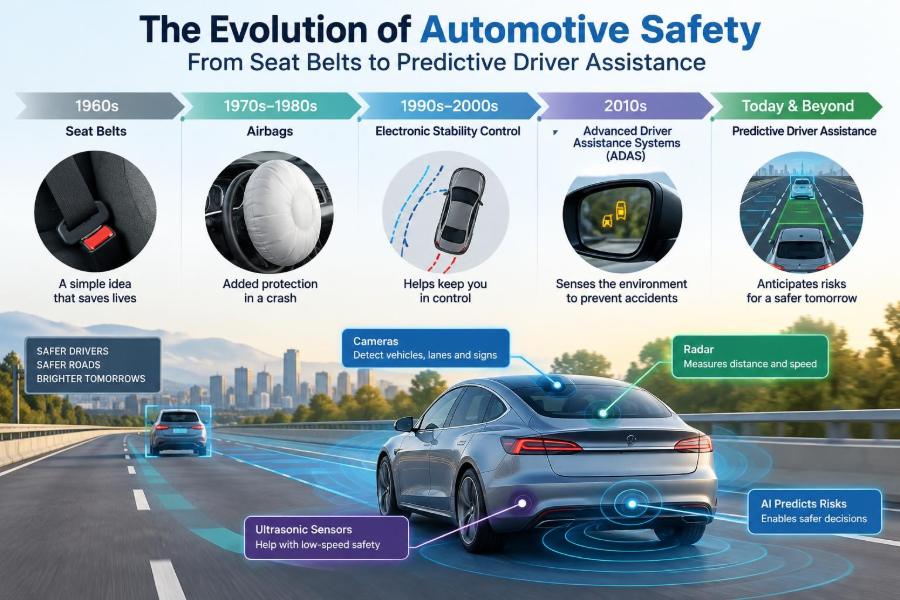
This progression is often described in three layers: passive safety protects people during a crash, active safety helps maintain control and avoid danger, and predictive safety detects developing risk and intervenes earlier.
🚧 Why Road Crashes Create Such Severe Loads
In a collision, a moving vehicle’s kinetic energy must be dissipated. The dangerous part is not merely speed; it is the rapid deceleration imposed on the vehicle and its occupants.
A longer, controlled stopping distance reduces peak forces. This principle explains crumple zones, seat-belt load limiters, airbags, and modern automated braking: each manages energy, time, or both.
🪖 The Earliest Protection Was Basic Occupant Restraint
Early automobiles had limited occupant protection. Rigid steering columns, hard dashboards, weak latches, and unrestrained passengers made the interior itself a major injury source.
The crucial insight was simple: an occupant continues moving forward after the vehicle stops. A restraint must slow the body over a controlled distance rather than allow impact with the steering wheel, windscreen, or dashboard.
🪢 Seat Belts Changed the Safety Baseline
The three-point seat belt became foundational because it restrains the torso and pelvis while spreading load across stronger parts of the body. The lap portion should sit low across the hips, while the shoulder portion crosses the centre of the chest and shoulder.
Correct positioning matters. A belt tucked behind the back, placed under the arm, or worn loosely cannot manage crash loads as intended and may increase injury risk.
⚙️ Pretensioners and Load Limiters Refined the Belt
Modern belts are not simply straps on retractors. A pretensioner rapidly removes belt slack when crash sensors detect a serious impact, securing the occupant earlier in the event.
A load limiter then permits a controlled amount of webbing payout once force reaches a designed threshold. Together, these functions balance restraint against excessive chest loading and work closely with airbags.
💥 Airbags Became a Supplemental Restraint System
An airbag inflates in milliseconds to provide a broad, energy-absorbing surface between an occupant and hard interior structures. Front airbags, side thorax bags, curtain airbags, and knee airbags address different impact directions and seating areas.
They are called supplemental restraints for a reason: airbags are designed to work with seat belts, not replace them. An unbelted occupant may be out of position when deployment occurs.
🏗️ Crashworthy Structures Create a Protective Space
Vehicle bodies are engineered with two apparently opposite goals. Front and rear structures should deform predictably to absorb energy, while the passenger compartment should remain as intact as possible.
High-strength steels, tailored blanks, aluminium components, and carefully planned load paths help route crash forces around the cabin. Material strength alone is not enough; joints, geometry, and deformation sequence also determine performance.
🧱 Crumple Zones Are Designed to Fail Well
A crumple zone is not a weak design error. It is a deliberately engineered structure that folds in controlled patterns, converting kinetic energy into deformation.
If every part of a car were extremely rigid, deceleration could occur over a shorter distance, increasing loads on occupants. The challenge is making deformation predictable across many crash scenarios without compromising cabin survival space.
🧠 The Safety Cell Must Protect Occupant Space
The reinforced passenger compartment is commonly called the safety cell. It aims to limit intrusion from the engine bay, doors, roof, floor, and steering system.
Offset frontal crashes, side impacts, and pole impacts are particularly demanding because load paths may bypass the main rails. Engineers therefore use simulations and physical testing to examine local deformation, not just overall vehicle damage.
🧒 Child Restraint Design Recognises Different Bodies
Children are not smaller adults. Their proportions, bone development, and ability to remain correctly positioned differ, so adult belts alone may not provide suitable restraint.
Appropriate child restraints, correctly installed and matched to the child and vehicle instructions, are essential. A common mistake is focusing only on installation tightness while overlooking harness adjustment, belt routing, or incompatible seating positions.
📏 Crash Testing Turns Safety Goals Into Measurable Requirements
Crash tests use instrumented test devices, often called dummies, to record acceleration, forces, and movement during representative impacts. The resulting measurements help engineers compare designs and identify injury mechanisms.
No laboratory test can reproduce every real crash. Vehicles vary in speed, angle, occupants, roadside objects, and secondary impacts. Tests are valuable benchmarks, but they are not guarantees of identical real-world outcomes.
🧪 Virtual Simulation Speeds Up Safer Design
Finite element analysis divides a complex vehicle into many small elements so engineers can model deformation, stresses, and contacts during an impact. It allows design alternatives to be evaluated before physical prototypes are built.
Simulation is only as credible as its material models, boundary conditions, and validation. Physical testing remains essential because real structures, fasteners, and manufacturing variation can behave differently from idealised models.
🛞 Tyres Are the First Active-Safety Component
Every steering, braking, and stability function ultimately depends on the tyre-road contact patch. This small area must transmit longitudinal force for braking, lateral force for cornering, and often both at once.
Worn tread, incorrect pressure, damaged tyres, or unsuitable compounds reduce available grip. No electronic system can manufacture traction on ice, deep water, loose gravel, or a badly maintained tyre.
🛑 Anti-lock Braking Preserves Steering Control
Under hard braking, a locked wheel slides rather than rolls, making steering response poor and often increasing stopping distance on ordinary paved surfaces. Anti-lock braking systems monitor wheel speeds and modulate brake pressure to keep wheels near useful slip levels.
ABS does not mean “brake later.” Its primary advantage is that a driver can keep steering while braking hard, which may create an escape path around a hazard.
🔄 Electronic Stability Control Corrects a Developing Skid
Electronic stability control compares the driver’s intended path, inferred from steering input, with the vehicle’s actual motion measured by yaw-rate and acceleration sensors. When the vehicle begins to understeer or oversteer, it can apply braking at selected wheels and, in some designs, reduce engine torque.
It cannot defeat momentum. Entering a bend too fast may leave too little friction for the system to restore the desired path, particularly on low-grip surfaces.
⛰️ Traction Control Helps at the Limits of Drive Grip
Traction control addresses excessive wheelspin during acceleration. It may reduce motor or engine torque, apply brake force to a spinning wheel, or combine both strategies.
This improves controllability when pulling away on slippery roads. However, some loose-surface situations require a little wheelspin to build momentum, which is why certain vehicles provide carefully designed off-road modes.
👁️ Sensors Give Assistance Systems Their Awareness
Camera systems identify lane markings, signs, vehicles, and sometimes pedestrians. Radar estimates range and relative speed, while ultrasonic sensors assist at low speed; some vehicles also use lidar or high-definition map data.
Each sensor has limitations. Cameras can struggle with glare, darkness, snow, or faded markings; radar may interpret certain objects differently from a human; dirt, ice, damage, or misalignment can degrade any sensor.
📡 Sensor Fusion Builds a More Useful Picture
Sensor fusion combines information from multiple sources to estimate what surrounds the vehicle. Radar can measure closing speed well, while a camera may provide useful classification and lane context.
Combining sensors can improve robustness, but it also introduces engineering challenges: timestamps must align, uncertainties must be managed, and conflicting readings need safe resolution. More sensors do not automatically mean flawless perception.
⚠️ Forward-Collision Warning Buys Reaction Time
Forward-collision warning estimates whether a vehicle is closing on an object quickly enough to create a potential crash. It alerts the driver through visual, audible, or haptic signals such as steering-wheel or seat vibration.
The system’s value is often the brief moment it gives a driver to brake or steer. Its warning logic must avoid being so sensitive that drivers ignore frequent alerts, yet must react early enough to be useful.
🛑 Automatic Emergency Braking Can Reduce Impact Severity
Automatic emergency braking, commonly abbreviated AEB, can apply brakes when a likely collision is detected and the driver has not responded sufficiently. Depending on conditions and system capability, it may avoid some low- to moderate-speed crashes or reduce impact speed in others.
It should not be treated as permission to follow closely. Performance can be limited by speed, visibility, object type, weather, road curvature, and the system’s detection design.
🛣️ Lane Support Helps With Unintentional Drift
Lane-departure warning alerts the driver when the vehicle crosses or approaches a lane boundary without an indicated manoeuvre. Lane-keeping assistance can add gentle steering support, while lane-centering systems aim to maintain a position within visible lanes.
These systems can be helpful during monotony or momentary distraction, but they depend heavily on detectable lane boundaries. Construction zones, worn paint, shadows, and unusual road layouts remain challenging.
🚗 Adaptive Cruise Control Manages Following Gaps
Adaptive cruise control adjusts speed to maintain a selected following interval behind detected traffic. It reduces repetitive throttle and brake input on suitable roads, especially in steady-flow conditions.
It is not a substitute for observation. A driver must still monitor cut-ins, stationary hazards, changing speed limits, curves, and traffic that the system may not interpret as expected.
🪞 Blind-Spot and Rearward Safety Address Hidden Areas
Blind-spot monitoring warns when another road user occupies an adjacent area that may be difficult to see in mirrors. Rear cross-traffic alerts can warn of approaching vehicles when reversing out of a parking space.
These features support mirror checks and shoulder checks rather than replacing them. Motorcycles, bicycles, fast-approaching traffic, and obstructed sensor areas deserve particular attention.
😴 Driver Monitoring Addresses the Human Link
Many collisions involve fatigue, distraction, or loss of attention rather than a lack of braking capability. Driver-monitoring systems may analyse steering behaviour, eye direction, eyelid patterns, head position, or interaction with vehicle controls.
An alert can prompt a break, but it cannot cure fatigue. The safe response to drowsiness is to stop in a suitable location and rest, not to rely on warnings while continuing to drive.
🔮 Predictive Assistance Looks Beyond the Nearest Object
Predictive driver assistance seeks to identify risk before an emergency is obvious. It may combine route data, road geometry, traffic information, vehicle dynamics, and sensor observations to anticipate a sharp curve, an emerging conflict, or an unsuitable approach speed.
Think of it as extending the driver’s horizon, not replacing judgement. Predictions are estimates, and unusual behaviour by other road users or incomplete map and sensor data can invalidate them.
🧩 Safety Features Work Best as an Integrated System
A crash event may trigger a sequence: sensors detect deceleration, pretensioners remove belt slack, airbags deploy, doors may unlock, fuel or high-voltage systems may be isolated, and emergency-call functions may become available where equipped.
Pre-crash systems can also prepare restraint components when severe braking or an imminent impact is detected. The engineering goal is coordinated timing, because a device acting at the wrong moment can be ineffective or harmful.
🔋 Electrification Creates New Safety Engineering Tasks
Electric vehicles remove some conventional hazards but add others, including high-voltage isolation, battery protection, thermal management, and safe post-crash handling. Battery enclosures must resist intrusion while disconnect systems aim to reduce electrical risk after a serious collision.
Emergency responders and repair technicians need vehicle-specific procedures. Damaged high-voltage components or battery packs should never be treated as ordinary mechanical repairs.
🧰 Maintenance Protects the Systems You Already Have
Safety technology depends on basic maintenance. Correct tyre condition, brake service, wheel alignment, functioning lights, intact windscreens, and clean sensor areas all influence how a vehicle behaves and what its assistance systems can detect.
- Keep cameras, radar covers, and windscreens clean and free from stickers or damage.
- Use tyre sizes and pressures specified for the vehicle.
- Investigate warning lamps and calibration messages promptly.
- After collision repair or windscreen replacement, confirm whether sensor calibration is required.
⚖️ Automation Has Clear Boundaries and Shared Responsibility
Driver-assistance functions vary greatly in capability. A system that controls speed and steering under defined conditions may still require the driver to supervise continuously and take over immediately.
Feature names can be misleading if treated as technical descriptions. Owners should read the manual, learn activation conditions, and understand alerts, handover requests, and conditions that disable the system.
🚫 Common Misunderstandings Can Create New Risks
The most frequent error is overreliance: assuming a vehicle “sees everything” or will always brake in time. Another is disabling alerts because they seem inconvenient without correcting the behaviour that triggers them.
- Do not test emergency braking systems by deliberately creating hazards.
- Do not use cruise or lane support to compensate for fatigue, phone use, or poor weather.
- Do not ignore a blocked sensor or assistance-system fault message.
- Do not assume a newer car is safe regardless of speed, tyres, or seat-belt use.
🎓 The Core Principle: Layers Beat Single Solutions
Automotive safety has not advanced through one miracle invention. It has improved by stacking layers: attentive driving, road-aware speed choice, tyres and brakes, stable vehicle dynamics, protective structures, restraints, airbags, and increasingly capable assistance systems.
Each layer has limits, but together they create resilience. When one barrier is weakened—a distracted driver, poor tyre grip, or a late reaction—another may reduce the consequences.
The safest vehicle is not the one with the longest feature list; it is the one whose driver, maintenance, restraint systems, structure, and assistance technology all work together within their real limits. That is the enduring lesson from seat belts to predictive driver assistance. 🚗🛡️⚙️