
You are comparing two cars that look almost equally practical. Their prices are close, both have airbags, both advertise emergency braking, and both carry a prominent safety score. It is tempting to treat that score as a simple answer: choose the car with more stars.
But a crash rating is not a prediction that every occupant will be safe in every collision. It is a carefully controlled assessment of how a particular vehicle, fitted with particular equipment, manages a defined set of crash and crash-avoidance scenarios.
That distinction matters when buying a vehicle, specifying a fleet, repairing accident damage, or designing one. The number on the label is the visible result of structural engineering, restraint calibration, sensor performance, testing rules, and assumptions about real people.
Understanding what lies behind the score makes it easier to use ratings intelligently rather than treating them as a universal guarantee.
🧭 What a Vehicle Crash Rating Actually Represents
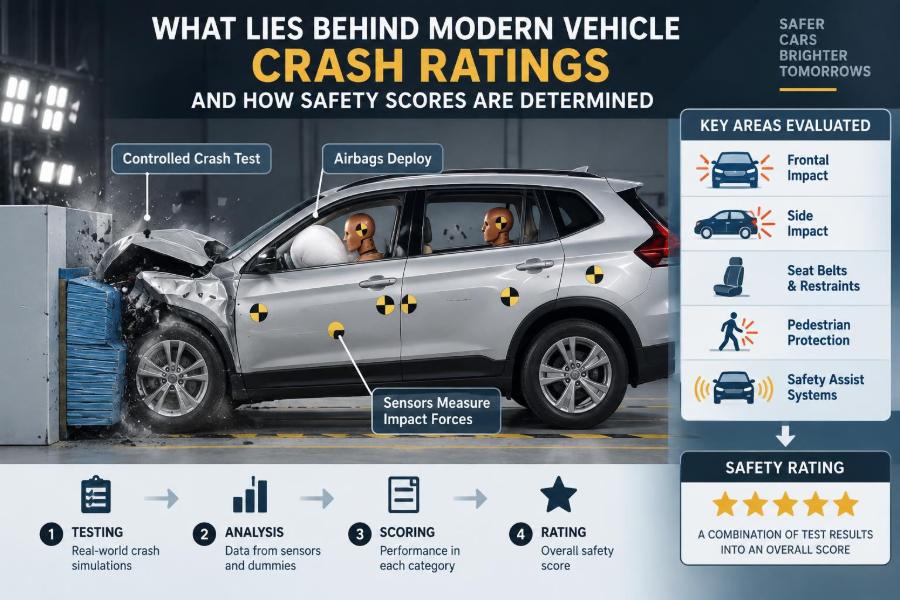
A vehicle crash rating summarizes performance in a test programme. Depending on the programme and region, it may describe protection for adult occupants, child occupants, vulnerable road users, safety-assist systems, or a combination of these areas.
It is best understood as a comparative result within a defined protocol. A five-star vehicle has met a high threshold under that programme’s current tests; it does not mean it is immune to severe crash forces or superior in every possible collision.
Ratings are particularly useful for comparing vehicles tested under the same rules and at broadly similar times. Rules develop, so a high score earned years ago may not be directly comparable with a current result.
🎯 Why Controlled Tests Are Necessary
Real crashes vary enormously. Speed, impact angle, road surface, vehicle mass, occupant posture, weather, belt use, and post-crash rescue conditions can all change the outcome. No laboratory can reproduce every combination.
Instead, test programmes select repeatable situations that represent important risks. Repeatability lets engineers compare designs fairly and lets consumers see whether one vehicle controls injury risk better than another under the same challenge.
A crash test is therefore not a miniature version of all road accidents. It is an engineering measurement tool: the inputs are specified, the vehicle response is recorded, and performance is judged against published criteria.
🏛️ Who Creates the Test Rules
Different organizations operate vehicle assessment programmes around the world. Some are government programmes, while others are independent consumer-information programmes. Their detailed procedures, scoring systems, and availability differ by market.
Manufacturers must also satisfy legal vehicle regulations before a car can be sold. A consumer-facing rating may go beyond the minimum legal requirement by using more demanding crash configurations or by rewarding technologies that reduce the chance of a collision.
This is why regulatory compliance and a top safety rating are not identical claims. One establishes that a vehicle meets applicable rules; the other ranks performance using the programme’s chosen tests.
📋 The Test Protocol Is the Real Rulebook
The protocol specifies far more than “crash the car.” It defines the vehicle configuration, tyre condition, test mass, seating positions, dummy setup, impact speed, overlap, barrier properties, data channels, scoring limits, and how results are combined.
Small details can matter. A test may require a specific safety-assist feature to be fitted as standard, may distinguish left- and right-hand-drive variants, or may limit a rating to vehicles with a stated equipment package.
Before comparing scores, read the model year, tested variant, and equipment notes. A rating assigned to a well-equipped version cannot automatically be transferred to a base model sold with fewer airbags or without the tested driver-assistance hardware.
💥 Crash Energy Sets the Engineering Challenge
At the heart of crash safety is kinetic energy. A moving vehicle carries energy that rises sharply with speed; in simple terms, kinetic energy is proportional to mass and to the square of speed. A modest speed increase can therefore demand much more from the structure and restraints.
The aim is not to make energy disappear. The vehicle must convert it through controlled deformation, friction, and other processes while keeping occupant deceleration and cabin intrusion within survivable limits.
A useful analogy is catching an egg. Stopping it instantly against a hard surface breaks it. Catching it through a longer, controlled movement lowers the peak force. Crumple zones create that controlled stopping distance for the vehicle.
🧱 The Safety Cell and Crumple Zones Work Together
The front and rear of a modern car are designed to deform progressively in many impacts. These crumple zones absorb energy before it reaches the passenger compartment.
The occupant cell has a different task. Strong load paths through the floor, roof rails, pillars, cross-members, and side structures help preserve survival space. The ideal result is not a vehicle that stays perfectly undamaged; it is one that sacrifices outer structure while maintaining a stable cabin.
Engineering trade-offs are unavoidable. A structure must manage frontal loads, side impacts, roof loading, weight targets, packaging constraints, repairability, pedestrian protection, and manufacturing realities without directing harmful forces toward occupants.
↔️ Frontal Tests Reveal Load-Path Performance
Frontal tests can use full-width barriers, offset deformable barriers, or other prescribed arrangements. Each arrangement asks a different question about how the vehicle manages energy and distributes loads.
In an offset collision, only part of the front structure initially engages. This can expose weak load paths, excessive intrusion around the footwell or dashboard, and poor compatibility between the vehicle and an opposing structure.
Full-width impacts tend to place strong demands on restraint systems because much of the vehicle decelerates together. A good frontal result depends on both body structure and the precise timing of belts and airbags.
🛡️ Side Impacts Are Especially Demanding
There is much less space between a side door and an occupant than between a front bumper and a front-seat occupant. For that reason, side-impact protection relies heavily on strong door beams, reinforced pillars, seat structures, curtain airbags, and torso airbags where fitted.
Programmes may assess an impact from a moving barrier or a narrow rigid object representing a pole or tree. The latter can concentrate force into a small area and can be particularly challenging for head and chest protection.
Side results also depend on correct occupant position. Leaning far toward a door, sitting improperly, or allowing a child to use the wrong restraint can reduce the protective margin available in a real event.
🧍 Crash-Test Dummies Turn Motion Into Data
Crash-test dummies, formally called anthropomorphic test devices, are instrumented measuring tools. They contain sensors that record acceleration, forces, moments, and deflections at defined body regions.
Different dummies represent different occupant sizes and seating positions, such as front occupants, rear occupants, and children in child restraints. They do not reproduce every person, body shape, age, health condition, or posture.
That limitation is important. Dummy results provide a standardized indicator of injury risk, not a literal medical forecast for a specific driver or passenger. Test programmes continue refining dummy designs and assessment methods as knowledge improves.
📈 From Sensor Signals to Injury Criteria
High-speed video shows what happened, but sensors provide the numerical evidence. Engineers evaluate measures associated with risks to the head, neck, chest, abdomen, pelvis, femur, lower legs, and other regions, depending on the test.
For example, chest deflection measures compression of the chest area, while head measurements can combine acceleration and rotational effects through defined assessment criteria. The precise calculation and threshold depend on the applicable protocol.
Values are not interpreted in isolation. Test engineers also inspect steering-column movement, pedal displacement, door opening, airbag interaction, belt loading, and deformation of the occupant compartment.
🧠 Head Protection Involves More Than One Number
Head injury risk can be influenced by linear acceleration, rotational motion, contact timing, and the surface struck. An airbag, head restraint, interior trim, side curtain airbag, and structural clearance may all contribute to the final outcome.
This explains why an airbag alone is not a complete solution. It must deploy at the correct time, with suitable pressure and shape, while the seat belt positions the occupant so the airbag can work as intended.
Out-of-position occupants present a difficult problem. A driver leaning forward, a child placed in front of an active passenger airbag, or an unbelted passenger may interact with the restraint system very differently from the standardized test dummy.
🔒 Seat Belts Remain the Primary Restraint
Airbags supplement seat belts; they do not replace them. The belt holds the occupant in the correct zone, spreads load across stronger parts of the body, and prevents excessive forward or sideways movement.
Modern systems often use pretensioners to remove belt slack early in a crash. Load limiters then allow controlled belt payout after force reaches a calibrated level, helping avoid unnecessarily high chest loading.
Fit matters in daily use. The lap belt should sit low across the pelvis, the shoulder belt should cross the centre of the shoulder and chest, and bulky clothing or twisted webbing should be avoided. Never place the shoulder belt behind the back.
💨 Airbags Need Timing, Geometry, and Sensors
Frontal airbags, knee airbags, side torso airbags, curtain airbags, and centre airbags can address different injury mechanisms. Their usefulness depends on the crash direction, seat position, impact severity, and the vehicle’s sensing strategy.
Electronic control units combine inputs from accelerometers, pressure sensors, seat sensors, and other devices. They determine whether deployment is required and, in some systems, how forcefully or in which stage an inflator should fire.
Airbags deploy extremely quickly, but they are not gentle cushions in the everyday sense. Their intended protection depends on occupants sitting properly and wearing belts. A warning light indicating an airbag-system fault deserves prompt diagnosis.
👶 Child Occupant Scores Require Extra Context
Children are not simply smaller adults. Their anatomy, restraint needs, and seating positions differ, so child assessments commonly consider compatible child seats, installation provisions, vehicle instructions, and protection in tested configurations.
ISOFIX or similar lower-anchor systems can simplify installation for compatible child restraints, but they do not eliminate the need to follow the child-seat and vehicle manuals. Size classification, support legs, top tethers, belt routing, and rear-facing requirements still matter.
A strong child score is useful evidence, yet the safest practical outcome still depends on using a suitable restraint correctly every trip. A loose harness or poorly installed seat can defeat much of the vehicle’s designed protection.
🚶 Protecting Pedestrians and Cyclists Changes Front-End Design
A vehicle’s front end affects people outside it as well as people inside it. Assessment can include the bonnet, windscreen base, bumper, and front edge, because these areas may contact a pedestrian or cyclist in a collision.
Manufacturers may use energy-absorbing bumper structures, carefully shaped bonnet panels, active bonnet systems, and sensor-based braking to reduce harm. Packaging is difficult because the same front-end area also houses cooling hardware, lighting, structural members, and styling features.
These measures reduce risk; they cannot remove it. Speed remains a major factor in impacts with vulnerable road users, which is why avoidance technology and careful driving are both relevant to safety scores.
📷 Safety Assist Measures Crash Avoidance
Modern ratings increasingly include systems intended to prevent or reduce collisions. Typical examples include autonomous emergency braking, lane-support functions, speed-assistance features, driver monitoring, and seat-belt reminders.
Assessment may examine whether the system detects vehicles, pedestrians, cyclists, lane markings, or other defined targets in specified daylight or low-light conditions. It may also assess warning timing and whether braking or steering support responds appropriately.
These are driver-assistance systems, not autonomous driving promises. Cameras can be obscured, radar performance can be affected by conditions or damage, and system boundaries vary. Drivers remain responsible for observation and control.
🌙 Why Scenario Limits Matter for ADAS
An emergency-braking system may perform well when a target, road layout, speed range, lighting condition, and sensor state match its tested operational envelope. That does not establish equal performance in every rainstorm, sharp bend, construction zone, or complex urban scene.
For example, a test might evaluate a car approaching a standardized target at a stated speed. A real situation could involve a partially obscured person, glare, worn lane markings, or a vehicle cutting across the path with little warning.
Users should learn what their vehicle’s systems are designed to do, but should avoid “testing” them on public roads. Safety features work best as a backup to attentive, anticipatory driving.
⚖️ How Points Become Percentages and Stars
Programmes generally award points across several assessment areas, convert those results into percentages or category scores, and apply conditions before assigning an overall star rating. The exact formula is programme-specific and may change with new protocols.
A vehicle usually needs balanced performance. Excellent protection in one category may not compensate fully for a weak result in another, especially if that weakness concerns a serious injury risk or a required safety-assist capability.
| Assessment area | Typical question behind the score | Examples of evidence |
|---|---|---|
| Adult occupant protection | How well are adults protected in defined crashes? | Dummy measurements, intrusion, restraint performance |
| Child occupant protection | How suitable is the vehicle for protected child travel? | Child dummy results, restraint compatibility, installation information |
| Vulnerable road-user protection | How does the vehicle manage contact with people outside it? | Front-end impact assessment, braking-system performance |
| Safety assist | Can fitted technology help avoid or mitigate specified crashes? | Detection, warning, braking, lane and speed-support tests |
Stars make results accessible, while the category breakdown explains where the vehicle is strong and where its compromises lie.
🗓️ Ratings Age as Protocols Become Tougher
Crash-rating programmes raise expectations as vehicle technology and engineering knowledge evolve. A test suite may add new crash configurations, more demanding side-impact assessments, tougher compatibility requirements, or broader driver-assistance evaluation.
Consequently, comparing stars without checking the test year can mislead. An older five-star result may reflect excellent performance under its original rules, but it was not necessarily tested against newer requirements.
When comparing used cars, examine the date, the exact model generation, and the detailed assessment. Age does not make a car unsafe by itself, but it changes what the rating tells you relative to current designs.
🚙 Vehicle Size and Mass Do Not Tell the Whole Story
Large vehicles often provide more physical space and may perform differently in certain multi-vehicle crashes, particularly where mass mismatch is involved. However, size and mass alone do not guarantee superior occupant protection or crash avoidance.
A well-engineered smaller car can achieve a strong rating within its class, while a larger vehicle may have weaknesses in structure, restraints, rollover behaviour, pedestrian protection, or active safety.
Crash compatibility matters too. Designers seek structures that manage their own crash loads without unnecessarily overriding or penetrating another vehicle’s protective structures. This is a system-level road-safety challenge, not merely a contest of vehicle weight.
🔄 A Good Rating Cannot Cover Every Crash Type
Many serious real-world events occur outside a particular rating’s tested scenarios: high-speed impacts, multiple collisions, severe underride, unusual angles, rollovers, impacts with fixed objects, and crashes involving heavy vehicles.
Roadside hazards, ejection risk, fire, water immersion, delayed medical care, and unbelted occupants also lie beyond what a single overall score can capture. The rating should inform judgment, not replace it.
Think of it as an exam result. It provides strong evidence about performance on a defined syllabus, but it cannot prove mastery of every problem an engineer might encounter.
🧰 Repair Quality Can Preserve or Undermine Safety
Crash-tested performance applies to a vehicle in the tested condition. After a collision, proper repair is essential because body alignment, welding, bonded joints, airbag components, sensors, wiring, bumper absorbers, and calibration can affect future protection.
A cosmetic-looking repair may conceal structural or electronic issues. Reused, counterfeit, unsuitable, or incorrectly fitted safety parts can compromise restraint deployment or the operation of camera- and radar-based assistance systems.
Owners should use repairers equipped to follow manufacturer procedures and should ensure that required post-repair scans and sensor calibrations are completed. Keep repair documentation, especially when buying a vehicle with accident history.
🔍 Reading a Rating Report Like an Engineer
Start with the exact vehicle tested. Confirm body style, powertrain where relevant, model year, market, and standard safety equipment. Then read beyond the overall result.
- Check category scores rather than relying only on stars.
- Look for notes about passenger-compartment stability and critical body regions.
- Identify which driver-assistance features were standard or optional.
- Check whether the rating applies to a safety pack rather than every variant.
- Compare results only within the same programme and preferably the same protocol period.
This approach is particularly useful when two vehicles have the same star rating but different strengths. One may offer stronger adult protection, while another may provide more capable collision-avoidance support.
🛒 Choosing a Car Beyond the Headline Score
A high rating should be a major consideration, but it is not the only one. Buyers should also assess whether the vehicle fits the people who will use it, including child-seat installation, rear-seat space, visibility, head-restraint adjustment, and ease of operating controls.
Check that important safety equipment is included on the exact trim level. In some markets, specifications vary across versions, and a vehicle advertised under one name may not carry identical equipment everywhere.
A sensible shortlist combines independent rating information with practical inspection, ownership costs, reliability considerations, and a test drive that checks seating position and outward visibility. Safety is partly designed in and partly used well.
🧑🔧 What Engineers Learn From Failed Tests
When testing exposes high dummy loads, excessive intrusion, unstable body deformation, or missed detection events, engineers investigate the full chain of cause. The solution may involve material thickness, geometry, restraint calibration, sensor algorithms, seat design, or a change in manufacturing process.
Computer simulation allows many design iterations before physical prototypes are built. Physical tests remain vital because real structures, materials, joints, and deployment systems can behave in ways that models must be checked against.
This feedback loop is one reason crash ratings have value beyond consumer guidance. Public results create an incentive to address safety weaknesses and make performance visible across competing vehicles.
⚠️ Common Misreadings of Safety Scores
One common mistake is assuming that a top score means any trim, any year, and any market version is equally safe. Another is assuming that more airbags automatically outweigh weak structure, poor belt use, or limited crash-avoidance performance.
It is also misleading to claim that a lower-rated vehicle is always dangerous. It may have been tested under a newer, tougher protocol, may lack a particular standard assistance feature, or may still provide strong protection in the areas most relevant to a buyer’s use.
- Do not compare star labels across widely separated test years without context.
- Do not disable safety systems without understanding their purpose and limitations.
- Do not let a rating encourage faster or less attentive driving.
- Do not overlook tyres, brakes, maintenance, and seat-belt use.
🛣️ The Driver Is Still Part of the Safety System
The best vehicle design cannot repeal physics. Excess speed, alcohol or drug impairment, distraction, fatigue, aggressive following distance, worn tyres, and failure to wear a belt all increase crash risk or severity.
Driver-assistance systems can provide a valuable extra layer, but safe driving creates the first layer: leave space, scan ahead, adapt speed to visibility and grip, and keep occupants correctly restrained.
For professionals managing fleets, this means pairing safer vehicle procurement with driver training, maintenance controls, journey planning, and incident review. A strong crash score supports a broader safety culture; it does not substitute for one.
🧩 The Core Principle Behind Modern Crash Ratings
Modern vehicle safety ratings combine two connected goals: protect people when a crash occurs and reduce the chance or severity of a crash before it occurs. Structural design, restraints, pedestrian protection, and electronic assistance all contribute to this layered approach.
The overall score is valuable because it condenses a complex engineering assessment into a usable comparison. Its limits matter just as much: it belongs to a defined vehicle, a defined equipment set, and a defined group of tests.
The most informed use of a safety rating is to look beneath the stars, understand the category results, verify the exact specification, and continue using the vehicle in ways that allow its safety systems to do their work.
A crash rating is not a promise of invulnerability; it is evidence of how thoughtfully a vehicle has been engineered for specified risks. Read it closely, choose carefully, maintain the vehicle properly, and keep safe driving at the centre of every journey. 🚗🛡️🛣️