
A driver brakes hard as traffic suddenly stops ahead. In the moment before impact, the car’s front end may seem like the part that should remain perfectly rigid. Yet a vehicle designed to resist all deformation can transmit a far more severe shock to the people inside.
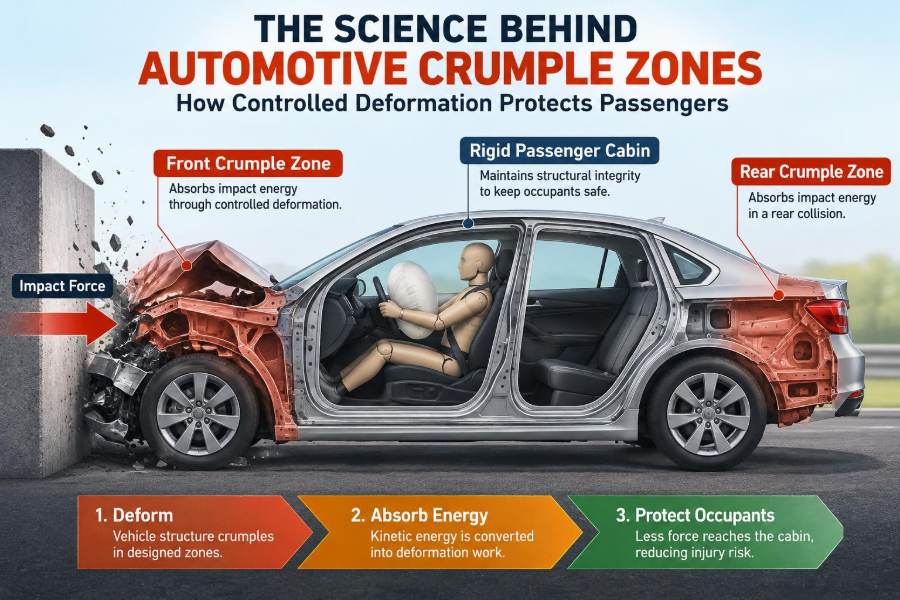
Modern cars are engineered to behave differently. Their outer structure is intended to deform in a planned sequence, while the passenger compartment is designed to remain as intact as practical. This is the basic idea behind the automotive crumple zone.
Crumple zones are easy to misunderstand because visible damage looks alarming. A heavily damaged front end does not automatically mean the safety structure failed; in many collisions, it means that structure performed part of its intended energy-management job.
Understanding the science helps students interpret vehicle design, helps professionals connect materials and crash testing to real outcomes, and helps every road user see why a safe car is more than a strong-looking body shell.
🚘 What a Crumple Zone Is Designed to Do
A crumple zone is a vehicle region designed to deform progressively during a collision. It is most commonly located at the front and rear of the vehicle, outside the main passenger cell.
Its purpose is not simply to “crumple.” It must absorb crash energy, lower the peak forces transmitted through the vehicle, and provide a controlled distance over which the vehicle can decelerate.
Engineers therefore design the front and rear structures as energy absorbers, not as sacrificial styling panels. Rails, cross-members, brackets, crash boxes, and load paths all contribute to the result.
🧱 The Passenger Cell Has a Different Job
In contrast, the central occupant area is usually called the safety cell or passenger compartment. Its primary role is preserving survival space around occupants.
This area uses strong structural members around the floor, roof, side openings, pillars, and bulkheads. The goal is to limit intrusion from another vehicle, a pole, a barrier, the powertrain, or the car’s own deformed front structure.
Vehicle safety is therefore not based on making every part equally stiff. It depends on a deliberate contrast: deformable zones at the ends and a comparatively rigid occupant enclosure in the middle.
⚡ Why Stopping Distance Changes Injury Risk
A moving vehicle carries kinetic energy. In simplified form, kinetic energy is expressed as ½mv², where m is mass and v is speed. This relationship explains why even modest increases in speed can substantially raise the energy involved in a crash.
That energy must go somewhere. It can become structural deformation, heat, sound, tire motion, vehicle rebound, and movement of the struck object. If the vehicle stops over a very short distance, the deceleration tends to be more severe.
A crumple zone increases the distance and time over which the vehicle comes to rest. It cannot remove crash energy, but it can manage how rapidly that energy is converted and transmitted.
📉 Force, Deceleration, and the Crash Pulse
The term crash pulse describes how vehicle deceleration changes during an impact. Engineers do not seek merely a low average deceleration; they also work to avoid sudden, damaging peaks.
From Newton’s second law, force is related to mass and acceleration. For a given vehicle mass, a rapid change in velocity requires high deceleration and can create high force demands on the restraint system and the human body.
A well-managed structure produces a more controlled pulse. This gives seat belts, airbags, seat structures, and load limiters a more usable time window in which to restrain occupants.
🔨 Controlled Deformation Is Not Random Collapse
Good crash performance requires repeatable deformation. A rail that folds unpredictably, bends away from its intended path, or tears too early may not absorb energy as planned.
Manufacturers use shaped sections, local reinforcements, trigger features, and carefully chosen joints to guide collapse. Some members are designed to buckle at a known location before a more critical part is overloaded.
A useful analogy is a folding carton with intentional crease lines. The carton does not fold randomly; its geometry encourages it to fold where the designer intended. Automotive structures apply the same principle under far larger loads and much shorter timescales.
📐 Geometry Controls How Structures Collapse
Structural geometry strongly affects bending and buckling. Closed box sections, hat sections, tubes, and tailored stamped rails can carry loads efficiently while packaging within limited space.
When an axial load reaches a critical level, a thin-walled member can buckle. Uncontrolled buckling is undesirable, but progressive buckling can be an effective way to absorb energy through repeated folding.
Engineers tune wall thickness, section shape, beads, holes, and local changes in stiffness so the member initiates collapse in a predictable mode rather than acting like a long, unstable column.
🪜 Trigger Features Start Collapse Where Needed
A structure that is too strong at its leading end may transfer excessive load farther rearward before it begins to deform. To avoid that, engineers may add features that initiate folding early in a controlled location.
These can include stamped indentations, reduced-section areas, slots, corrugations, or specially formed crush initiators. They are not signs of weakness in the casual sense; they are calibrated features within a larger load-management strategy.
The challenge is balance. An initiator that activates too easily can reduce energy absorption, while one that activates too late can create an undesirable force spike.
🧲 Material Choice Shapes the Energy Response
Vehicle bodies use a mix of materials, including mild steels, high-strength steels, advanced high-strength steels, aluminium alloys, plastics, composites, and, in some designs, magnesium or other specialized materials.
Material strength alone does not determine crashworthiness. Engineers also consider ductility, strain-hardening behavior, fracture resistance, joining method, corrosion performance, manufacturing variation, cost, and repairability.
Ductility is especially useful in crash structures because it describes a material’s ability to plastically deform before fracture. A component that tears prematurely may stop absorbing energy in the intended way.
🧪 High-Strength Steel Is Used Selectively
Ultra-high-strength steels are particularly valuable in areas where intrusion resistance matters, such as portions of the safety cell, pillars, roof rails, and reinforcements around door openings. Their high strength can help preserve occupant space without excessive mass.
However, a crumple zone does not always benefit from the highest possible strength everywhere. A front rail must crush progressively rather than simply resist deformation until another component fails.
Modern body engineering often uses different grades and thicknesses within one structure. This allows stiffness and collapse behavior to vary from one location to another.
🧩 Tailor-Welded Blanks Fine-Tune Stiffness
A tailor-welded blank is a sheet made by joining pieces of different thicknesses or material grades before stamping. The final part can then be stronger where loads are high and more deformable where controlled folding is needed.
This approach can reduce part count and place material more efficiently. It also shows why a body panel’s visible shape reveals little about the engineering hidden inside it.
Other methods, including tailored rolling and local reinforcements, serve similar purposes. Their value lies in achieving the desired force-displacement behavior, not merely maximizing strength.
🛤️ Load Paths Spread Crash Forces
A load path is the route through which crash forces travel from the impact point into the rest of the structure. A frontal crash may use upper rails, lower rails, subframes, cross-members, floor structures, and bulkheads simultaneously.
Multiple load paths reduce dependence on one member. They can also guide forces around the passenger compartment rather than directly into it.
Continuity matters. A strong rail that does not connect effectively to another structural member can lose much of its benefit. The joints and interfaces are part of the crash structure, not secondary details.
🎯 Small-Overlap Crashes Challenge the Design
In a full-width frontal impact, a large portion of the front structure can engage the barrier. In a small-overlap impact, only a limited outer part of the vehicle may contact the obstacle.
That condition can bypass major longitudinal rails and place heavy demand on the wheel, suspension, front corner structure, firewall area, and side of the safety cell. It is one reason modern crash engineering must consider more than a single straight-on collision.
Design responses may include stronger corner structures, improved wheel control, additional load paths, and better interaction between the front rail and the occupant cell.
🧱 Offset Impacts Need Asymmetric Energy Management
Offset frontal collisions engage one side of the vehicle more heavily than the other. This can create rotation as well as forward deceleration, making the body structure and restraint system work under uneven loading.
The loaded side must absorb substantial energy without allowing excessive compartment deformation. The unloaded side may still contribute through cross-car members and the floor structure.
Crash simulations are valuable here because they reveal local bending, joint loads, and force paths that are difficult to predict from simple static calculations.
↔️ Side Impacts Leave Very Little Crush Space
Side impacts present a different problem: there is much less distance between the striking object and the occupant. A conventional front crumple zone cannot solve this risk.
Side-impact protection relies on strong door beams, reinforced pillars, roof rails, rocker panels, seats, and carefully managed load paths through the vehicle’s side structure. Side curtain and torso airbags may provide additional occupant protection.
The key distinction is that side structures often prioritize intrusion resistance because available deformation space is so limited. This illustrates why crashworthy design changes with impact direction.
🔙 Rear Crumple Zones Protect More Than Cargo
Rear structures absorb energy in rear-end impacts and help control loads reaching the rear seat area, fuel or energy-storage systems, and the occupant compartment. They are designed around packaging constraints such as luggage space, exhaust systems, and suspension components.
Rear impacts vary widely, from low-speed bumps to severe collisions with large speed differences. No single structure can optimize every possible case, so engineers balance low-speed repair considerations with high-energy crash performance.
Seat and head-restraint design is also central in rear impacts because neck loading can occur even when the vehicle body damage appears limited.
🔋 Electric Vehicles Add Packaging Challenges
Battery-electric vehicles may place a large traction battery within or beneath the floor. The structural design must protect that enclosure from deformation, penetration, and harmful loading while maintaining occupant space.
The battery pack can contribute to overall body stiffness, but it also imposes strict requirements on underbody rails, cross-members, side sills, and crash load paths. High-voltage systems require isolation and shutdown measures in addition to physical protection.
Electric vehicles still use front and rear energy-absorbing structures. The absence of a conventional engine does not eliminate the need for carefully controlled crash deformation.
🛞 Wheel and Suspension Behavior Matters
During a frontal offset crash, a wheel can be driven rearward toward the footwell. Suspension links, subframes, and wheelhouse structures may therefore be designed to manage wheel movement as part of the overall crash response.
In some vehicle designs, the wheel is guided outward or away from the passenger compartment as the structure deforms. This is not a universal motion or a guarantee in every crash; actual movement depends on impact geometry and vehicle design.
The broader lesson is that crashworthiness is a vehicle-level system problem. Components normally associated with handling and ride can become major participants in an impact.
🧍 Occupant Restraints Complete the Safety System
Crumple zones protect occupants indirectly by managing vehicle motion. Seat belts, pretensioners, load limiters, airbags, seats, head restraints, and child restraints then manage the occupant’s motion relative to the interior.
A belt pretensioner can remove slack early in a crash. A load limiter can allow controlled webbing payout at higher loads, helping avoid excessive chest force in appropriately designed conditions. Airbags provide supplementary cushioning; they are not substitutes for seat belts.
These components are calibrated together. Changing one part of the system can alter the demands placed on the others, which is why vehicle modifications and improper repairs deserve caution.
⏱️ Timing Is as Important as Strength
A crash unfolds in milliseconds. Structural deformation, sensor signals, pretensioner activation, airbag deployment, and occupant movement must occur in a coordinated sequence.
An airbag must not deploy simply because a vehicle experiences a minor contact, and it must deploy rapidly enough in a severe qualifying event to offer protection. Decision algorithms use signals from sensors and are designed for particular crash conditions.
Similarly, the vehicle structure must not collapse too slowly or too quickly. The desired result is a compatible crash pulse for both the safety cell and the restraint system.
🧍♀️ Real Occupants Are Not Identical
Occupants differ in height, mass, posture, age, seating position, and restraint use. Children require appropriate child restraint systems, while an out-of-position occupant may interact with an airbag differently than a correctly seated one.
Engineering tools and testing procedures continue to address a broader range of occupants and impact conditions, but no vehicle can reproduce every real-world situation exactly. Seat position and belt use remain practical factors drivers can control.
For every occupant, sitting upright, keeping the belt properly positioned, and maintaining reasonable distance from the steering wheel or dashboard supports the safety systems’ intended operation.
🧫 Physical Crash Tests Validate the Structure
Physical crash tests remain essential because real structures involve complex contact, material behavior, joining methods, and component interactions. Test vehicles are instrumented to measure acceleration, deformation, intrusion, and loads on anthropomorphic test devices, commonly called crash test dummies.
Tests may use fixed barriers, deformable barriers, moving barriers, angled impacts, poles, and other configurations. Each setup answers a different question about how the vehicle manages impact energy.
A single test result should not be treated as a complete portrait of safety. It represents performance under specific conditions, while real crashes vary in speed, angle, vehicle compatibility, occupant position, and environment.
💻 Simulation Speeds Up Design Decisions
Finite element analysis divides a complex vehicle model into many small elements so engineers can estimate deformation, stresses, strain, contact, and energy absorption during a virtual impact. It allows many design variations to be explored before physical prototypes are built.
Simulation can reveal whether a rail folds as intended, whether a joint might fail, or whether a load path places too much stress on a pillar or floor member. It is especially useful for comparing alternatives quickly.
Yet simulation requires accurate material models, boundary conditions, and validation against physical tests. A detailed-looking computer animation is not automatically a reliable prediction.
🔩 Joining Methods Can Decide Structural Performance
Welds, adhesive bonds, rivets, bolts, clinches, and hybrid joints determine how forces transfer between panels. A strong component attached by an inadequate joint may not deliver the intended crash performance.
Structural adhesives can spread loads over a larger area and improve stiffness, while spot welds provide discrete connections. Aluminium-intensive structures often use different joining combinations than steel bodies because material behavior and corrosion concerns differ.
Repair procedures must respect these choices. Using an incorrect welding method, omitting adhesive, or replacing a specified high-strength part with unsuitable material can change how the repaired vehicle responds in a later collision.
🛠️ Crash Repair Is a Safety-Critical Process
After a collision, cosmetic appearance is not enough to judge whether a vehicle has been restored properly. Hidden rails, reinforcements, sensor mounts, and restraint-system components may require inspection or replacement.
Modern repair information can specify measurement points, replacement sections, approved joining methods, corrosion protection steps, and calibration requirements. These procedures exist because structural dimensions and material properties affect crash behavior.
Consumers should be cautious about repairs that focus only on visible panels or unusually low cost. A qualified assessment is particularly relevant after impacts involving airbags, suspension damage, underbody contact, or deformation near the passenger cell.
🚫 Common Misunderstandings About “Strong” Cars
One common misconception is that the safest vehicle is the one with the least visible damage. In a severe impact, a vehicle that remains completely rigid may subject occupants to very high deceleration unless another system absorbs the energy.
Another misconception is that crumple zones make a car fragile. Properly designed zones are strong enough to manage substantial loads, but they are engineered to yield in a controlled manner when crash forces exceed normal driving demands.
- Myth: More metal thickness always means better safety.
- Reality: Geometry, material behavior, load paths, restraint compatibility, and intrusion control matter as much as thickness.
- Myth: Airbags alone protect occupants.
- Reality: Airbags are supplemental restraints and work best with correctly worn seat belts.
⚖️ Low-Speed Damage and High-Speed Protection Conflict
Drivers understandably prefer vehicles that resist damage in parking impacts and minor bumps. However, a structure optimized only for low repair cost could be too stiff or too expensive to repair after a more serious crash.
Manufacturers often use replaceable crash boxes or bumper absorbers to manage certain lower-speed impacts, while the larger rails and safety cell address more severe events. This layered approach helps balance repairability and occupant protection.
There is no simple design choice that eliminates all damage and all injury risk. Engineering involves managing competing requirements within limits of mass, cost, packaging, manufacturing, and physics.
🚚 Vehicle Compatibility Affects Real Crashes
When vehicles of different heights and masses collide, their structures may not engage as intended. A taller vehicle can interact with a smaller vehicle above or below its primary energy-absorbing members.
Compatibility engineering seeks to improve how front structures interact with other road vehicles, not merely how a vehicle performs against a standardized barrier. Front-end geometry, underride considerations, and load-path alignment are relevant concerns.
Physics still matters: mass differences influence the motion after impact. Safer structural design reduces risk but cannot make every mismatch between vehicles equivalent.
🧠 What Drivers Can Do to Support the Design
Drivers cannot control the structure’s engineering, but they can help its safety systems operate as intended. Wear the seat belt correctly, ensure passengers do the same, and use child restraints appropriate to the child and vehicle instructions.
Maintain a proper driving position: sit upright, adjust the head restraint near the back of the head, and avoid placing feet on the dashboard. Do not defeat warning lights or ignore recalls involving airbags, sensors, seat belts, or structural components.
Most importantly, crumple zones are a last line of defense. Speed management, space, attention, and sober driving remain the best ways to reduce the energy that must be managed in the first place.
🔍 A Practical Way to Read Vehicle Safety Information
When comparing vehicles, look beyond a single label or headline score. Consider which crash configurations were assessed, what occupant positions were represented, and whether the information applies to the specific model year and body style.
Features such as automatic emergency braking may reduce the likelihood or severity of some impacts, while crumple zones and restraints manage consequences once an impact occurs. These are complementary layers rather than interchangeable technologies.
Use official owner information and recognized assessment programs where available, but remember that no rating can predict an individual crash with certainty.
🌐 The Core Principle: Manage Energy, Preserve Space
Automotive crumple zones work because they convert a violent, short-duration impact into controlled structural deformation over a greater distance and time. Their success depends on predictable collapse, suitable materials, reliable joints, and well-designed load paths.
At the same time, the passenger cell must resist intrusion and the restraint system must control occupant motion. These elements are engineered as one interconnected safety system rather than separate features.
The most useful mental model is simple: let the parts outside the occupants do carefully planned work, while protecting the space around the occupants as effectively as possible.
A safer crash structure is not the one that never changes shape; it is the one that manages energy deliberately while preserving the occupant compartment and supporting the restraint system. That balance is the central science of controlled deformation. 🚗🛡️⚙️