
You are waiting at a traffic light behind an older car, and a sharp exhaust smell reaches the cabin. Or perhaps the check-engine light comes on, the engine feels reluctant to accelerate, and a workshop mentions an expensive part beneath the vehicle: the catalytic converter.
That metal canister in the exhaust system is easy to overlook because it has no moving parts, no dashboard control, and no routine service interval like engine oil. Yet it performs a demanding chemical task every time the engine runs.
Combustion in an engine releases useful energy, but it does not produce perfectly clean exhaust. A catalytic converter helps deal with several harmful gases before they leave the tailpipe and enter the air around roads, homes, and pedestrians.
Understanding how it works also explains why engine faults, wrong fuel, and neglected warning lights can damage it. The converter is not simply an exhaust silencer; it is a carefully controlled chemical reactor operating in an extremely hot, harsh environment.
🚘 Where the Catalytic Converter Sits
In most petrol and diesel vehicles, the catalytic converter is installed in the exhaust path between the engine and the rear silencer. Many modern vehicles place it close to the exhaust manifold or integrate it into the manifold assembly.
That location is deliberate. The converter must heat up before it can work effectively, so keeping it near the engine allows it to receive hot exhaust gases soon after start-up. Some vehicles also use an additional underfloor converter farther downstream.
🌫️ Why Engine Exhaust Needs Treatment
An ideal combustion process would combine fuel and oxygen completely, producing mainly carbon dioxide and water. Real engines operate across changing speeds, loads, temperatures, and air-fuel ratios, so their exhaust can contain undesirable compounds.
Key pollutants include carbon monoxide, unburned hydrocarbons, and nitrogen oxides. Their formation is tied to incomplete combustion, high combustion temperatures, fuel evaporation, and the chemistry of nitrogen in intake air.
The catalytic converter does not make exhaust harmless in every respect. It primarily reduces particular toxic or smog-forming gases; it does not eliminate carbon dioxide, which is a greenhouse gas produced whenever carbon-containing fuel is burned.
🧪 The Three Main Pollutants
The three pollutants commonly addressed by a petrol-engine three-way catalytic converter have different causes and need different chemical responses.
| Pollutant | How it arises | Converter’s main action |
|---|---|---|
| Carbon monoxide (CO) | Incomplete combustion when insufficient oxygen is available | Oxidises it into carbon dioxide |
| Hydrocarbons (HC) | Unburned or partly burned fuel molecules | Oxidises them into carbon dioxide and water |
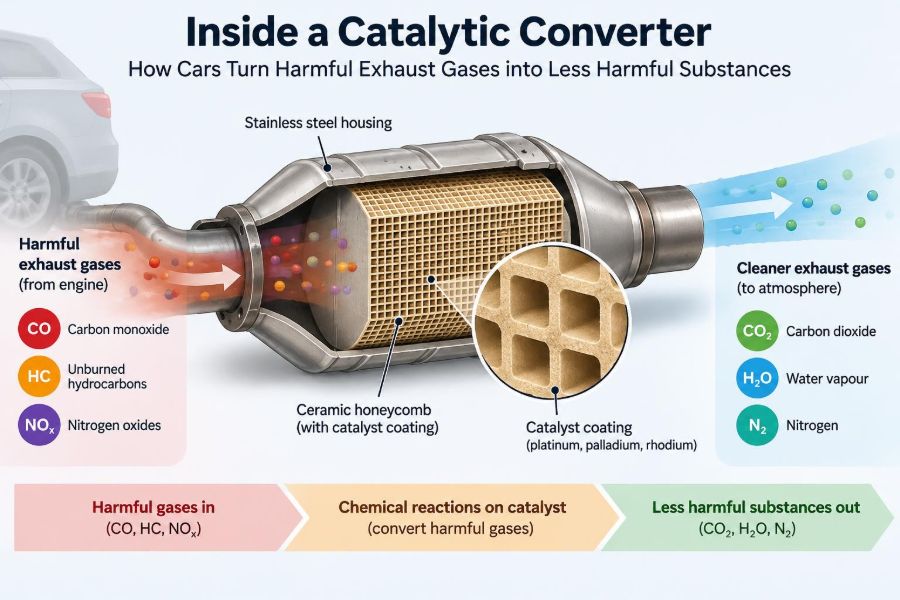
| Nitrogen oxides (NOx) | High combustion temperatures encourage nitrogen and oxygen to react | Reduces them mainly to nitrogen |
Carbon monoxide is poisonous because it interferes with oxygen transport in the blood. Hydrocarbons can contribute to ground-level ozone formation under sunlight, while nitrogen oxides affect air quality and participate in smog-forming reactions.
🧱 The Honeycomb Core
Cut open a converter and the most recognisable component is its honeycomb-shaped core, called the substrate. It is commonly ceramic, although some designs use thin corrugated metal foil.
Thousands of narrow channels let exhaust flow through while creating a very large internal surface area. Think of it as a compact chemical-processing block rather than an empty exhaust chamber.
The channels must remain open. If they melt, break apart, or become blocked, exhaust backpressure rises and the engine may lose power, especially under acceleration.
🪨 Precious Metals Do the Chemical Work
The substrate is coated with a porous layer often called a washcoat. This layer increases usable surface area and carries small quantities of catalytic materials, typically platinum, palladium, and rhodium.
These metals are called catalysts because they allow reactions to proceed more readily without being consumed in the intended reaction. They help pollutant molecules meet and react on the coated surface.
Precious-metal content is one reason replacement converters can be costly and why converter theft has occurred in some areas. The value varies by design and market conditions, but the engineering purpose is emissions control, not decoration.
⚗️ What a Catalyst Actually Changes
A catalyst does not create energy from nowhere or violate chemical limits. It lowers the activation energy needed for a reaction, providing a more favourable route for molecules to rearrange.
Inside the converter, exhaust molecules contact the coated channel walls. Carbon monoxide and hydrocarbons can combine with oxygen, while nitrogen oxides can release oxygen and become nitrogen under suitable conditions.
The converter’s effectiveness depends on temperature, gas composition, flow rate, and the condition of its active coating. This is why a healthy engine and a healthy converter must work as one system.
🔄 Why It Is Called a Three-Way Converter
The conventional petrol-engine unit is called a three-way catalytic converter because it performs three main pollutant-control tasks at once:
- oxidising carbon monoxide into carbon dioxide,
- oxidising hydrocarbons into carbon dioxide and water, and
- reducing nitrogen oxides into nitrogen and oxygen-related products.
These tasks can conflict chemically. Oxidation needs available oxygen, while NOx reduction works best when exhaust oxygen is very low. Engine management therefore aims for a tightly controlled compromise near the chemically ideal air-fuel ratio.
🎯 The Importance of the Stoichiometric Air-Fuel Ratio
Stoichiometric combustion means there is approximately enough oxygen to burn the supplied fuel completely. For ordinary petrol, the often-cited mass ratio is near 14.7 parts air to one part fuel, though the exact requirement varies with fuel composition.
A petrol engine does not hold this ratio perfectly at every instant. Instead, its control system continuously adjusts fuelling around the target, allowing the converter to alternate between oxidation and reduction conditions.
If an engine runs persistently rich, it sends excess fuel and carbon monoxide into the exhaust. If it runs persistently lean, excess oxygen can make NOx reduction much more difficult.
📡 Oxygen Sensors Guide the Process
Oxygen sensors, often called lambda sensors, are central to closed-loop fuel control. An upstream sensor, placed before the converter, measures whether exhaust is relatively rich or lean and helps the engine control unit correct fuel delivery.
A downstream sensor monitors gas after the converter. Its signal helps the control unit judge whether the converter is storing and releasing oxygen as expected and whether it is still cleaning the exhaust effectively.
A sensor fault does not automatically mean the converter has failed. However, inaccurate sensor information can cause poor mixture control and may eventually overload a healthy converter.
🌡️ Light-Off: When the Converter Wakes Up
A catalytic converter needs heat before it reaches useful activity. The point at which it begins converting pollutants efficiently is called light-off.
Cold starts therefore matter disproportionately. In the first minutes after starting, the engine and converter are cooler, and a larger share of certain tailpipe emissions can occur before the catalyst reaches operating temperature.
Close-coupled converter placement, insulated exhaust parts, calibrated ignition timing, and prompt fuel control all help shorten this warm-up period. This is also why repeated very short trips can be harder on emissions performance than a fully warmed drive.
🔥 Why Exhaust Temperature Must Be Managed
Heat activates the catalyst, but excessive heat can destroy it. Under demanding operation, the converter may run extremely hot, particularly if unburned fuel enters the exhaust and burns inside the unit.
Misfires are especially damaging. A cylinder that fails to burn its mixture can send fuel and oxygen downstream, where oxidation reactions generate abnormal heat in the converter.
If a warning light flashes during a misfire, continuing to drive hard can turn a repairable ignition or fuel-system fault into a failed converter as well. The exact response should follow the vehicle manual and safe roadside practice.
💨 Oxidation Reactions in Plain Language
Oxidation is a reaction involving oxygen. Within the converter, carbon monoxide can react with oxygen to form carbon dioxide, while hydrocarbons react to form carbon dioxide and water.
In simplified form, the reactions look like this:
2CO + O₂ → 2CO₂
Hydrocarbon + O₂ → CO₂ + H₂O
Real exhaust contains many different hydrocarbon compounds, so the second line is a general representation rather than one complete fuel-specific equation. The important point is that incomplete-combustion products are converted into more stable substances.
🛡️ Reducing Nitrogen Oxides
At high cylinder temperatures, nitrogen and oxygen from the intake air can combine to form nitrogen oxides. These compounds are difficult to avoid entirely because high temperature also supports engine efficiency and power production.
On the reduction side of a three-way converter, NOx molecules give up oxygen and are converted primarily toward nitrogen, which makes up most of the atmosphere. Carbon monoxide and hydrocarbons can help provide the reducing conditions needed for this chemistry.
The balance is delicate: too much oxygen in the exhaust can reduce NOx-conversion performance. This is one reason precise fuelling matters far beyond fuel economy.
🧽 Oxygen Storage Smooths Rapid Changes
The converter washcoat commonly includes oxygen-storage materials, such as cerium-containing compounds. These materials can temporarily store oxygen during lean moments and release it during rich moments.
This buffering effect helps the converter cope with the rapid rich-lean switching commanded by the engine control unit. It is like a small chemical reservoir that stabilises conditions at the catalyst surface.
As a converter ages, its oxygen-storage capability can decline. The downstream oxygen sensor is one source of information the vehicle uses to identify this loss of efficiency.
⛽ Petrol and Diesel Systems Differ
Petrol engines using stoichiometric operation are well suited to three-way catalysts. Diesel engines normally operate with excess air, which means their exhaust contains more oxygen and cannot use the same three-way strategy for NOx control.
Diesel exhaust systems may use an oxidation catalyst for carbon monoxide and hydrocarbons, a diesel particulate filter for soot, and a separate NOx-control system. The exact combination depends on engine design and emissions requirements.
It is a common mistake to treat every exhaust after-treatment system as one interchangeable “catalytic converter.” The broad purpose is similar, but the chemistry and components can be quite different.
🧯 Diesel Oxidation Catalysts and Particulate Filters
A diesel oxidation catalyst helps oxidise carbon monoxide and hydrocarbons. A diesel particulate filter, or DPF, serves a different function: it captures solid soot particles from diesel exhaust.
The filter must periodically regenerate, meaning accumulated soot is oxidised under controlled high-temperature conditions. A DPF is not a substitute for a catalyst, and a catalyst is not a filter.
Drivers should avoid assuming that a warning related to one component has the same cause or remedy as a warning related to another. Diagnostic trouble codes and manufacturer procedures matter here.
💧 Selective Catalytic Reduction for NOx
Many diesel vehicles use selective catalytic reduction, usually called SCR, to reduce NOx. A carefully metered urea-based fluid is injected into the exhaust, where it produces ammonia that reacts over a catalyst.
Under appropriate conditions, this process converts NOx mainly into nitrogen and water. It requires a fluid tank, injection hardware, sensors, control software, and sufficient exhaust temperature.
SCR illustrates an important engineering principle: modern emissions control is often a coordinated system rather than a single canister. Fuel injection, sensors, exhaust temperature, filters, catalysts, and software all affect the final tailpipe result.
🚗 Direct-Injection Petrol Engines Add Complexity
Petrol direct injection can improve control over fuel delivery and may support performance or efficiency goals. However, under some operating conditions it can produce more particulate matter than older port-injection petrol systems.
For that reason, some direct-injection petrol vehicles use a gasoline particulate filter in addition to a three-way catalyst. It captures particles while the catalyst continues treating gaseous pollutants.
The presence of more hardware does not automatically mean a vehicle is unreliable. It means diagnosis must consider the complete after-treatment layout rather than one familiar component.
🧩 What Happens During a Cold Start
Immediately after start-up, the engine control unit may use strategies intended to warm the catalyst quickly. Depending on the vehicle, these can include changes to ignition timing, idle speed, and fuelling.
The driver may notice a different exhaust note or a temporarily higher idle. These behaviours can be normal, particularly in cold weather, but persistent rough running, fuel smell, or warning lights are not normal warm-up features.
Short journeys are sometimes unavoidable. When possible, combining errands rather than repeatedly cold-starting for very brief trips gives the after-treatment system more opportunity to reach stable operating temperature.
⚠️ Common Causes of Converter Damage
Catalytic converters often fail because of another fault rather than because their coating simply “wears out.” Finding that root cause is essential before fitting a replacement.
- Persistent misfires from worn ignition parts, injector faults, or compression problems
- Excessive oil consumption caused by engine wear or sealing faults
- Coolant entering combustion chambers through an engine fault
- Rich running from sensor, fuel-pressure, or air-intake problems
- Physical impact from road debris or incorrect lifting
- Contamination from unsuitable additives or materials
Oil ash, coolant deposits, and fuel-related contamination can coat active surfaces. Overheating can melt the substrate, while impact can crack it and allow fragments to obstruct exhaust flow.
🔍 Symptoms That Need Proper Diagnosis
A failed converter can cause a check-engine light, an emissions-test failure, rattling from broken substrate pieces, sulphur-like odours under some conditions, reduced power, or poor fuel economy. None of these symptoms proves the converter alone is at fault.
For example, low power can result from a blocked exhaust, but it can also come from a turbocharger issue, restricted intake, poor fuel supply, transmission faults, or incorrect sensor signals. Replacing parts based only on a symptom is expensive guesswork.
A technician may use diagnostic codes, live sensor data, temperature observations, exhaust backpressure testing, and a physical inspection. The correct test depends on the vehicle and suspected failure mode.
🧰 Why “P0420” Is Not a Diagnosis
On many vehicles, a code such as P0420 indicates that the engine control unit has judged catalyst efficiency to be below its expected threshold for one bank of cylinders. It does not directly identify the reason.
The underlying cause may be catalyst ageing, an exhaust leak, a lazy oxygen sensor, an engine running problem, wiring damage, or software-related diagnostic conditions. Code definitions and test logic vary by manufacturer.
Clearing the code without correcting the cause merely resets the monitor temporarily. If the fault remains, the control unit is likely to detect it again after the required operating conditions are met.
🛠️ A Sensible Diagnostic Sequence
Good diagnosis starts upstream. Before condemning a converter, the engine should be checked for misfires, mixture-control faults, leaks, oil burning, coolant loss, and relevant service issues.
- Read fault codes and freeze-frame data rather than looking at one code in isolation.
- Check for obvious exhaust leaks, damaged wiring, and signs of impact.
- Confirm that the engine reaches normal operating temperature and runs smoothly.
- Assess fuel trims, oxygen-sensor behaviour, and misfire information with suitable scan data.
- Use manufacturer-approved tests to evaluate catalyst efficiency or restriction.
This sequence helps prevent a new converter from being damaged by the same unresolved problem.
🚫 Why Removing a Converter Is Not a Repair
Some owners consider removing a blocked or damaged converter because it may temporarily reduce backpressure or avoid replacement cost. That approach increases pollutant emissions and can create noise, drivability, diagnostic, and legal problems depending on local regulations.
It also masks the original cause. If a misfire, oil-burning issue, or fuelling fault destroyed the first converter, removing it does nothing to restore proper combustion.
A sound repair addresses both the failed component and the condition that caused it to fail. Exhaust-emissions equipment should be serviced in accordance with local laws and the vehicle manufacturer’s procedures.
🧴 Fuel Additives and “Converter Cleaners”
Products marketed as converter cleaners may be tempting when a warning light appears. They cannot repair melted substrates, broken honeycombs, depleted catalyst coatings, major oil contamination, or a continuing engine misfire.
In limited situations, addressing minor deposit-related issues alongside the actual root cause may improve operation, but outcomes depend on the vehicle and fault. A bottle should not replace diagnosis.
Use only fuels, oils, and additives approved for the vehicle where possible. Unverified chemical fixes can delay proper repair and make fault patterns harder to interpret.
🧱 Replacement Parts: Fit, Quality, and Compatibility
A replacement converter must match the vehicle’s engine, emissions calibration, sensor layout, and physical exhaust configuration. A low-cost universal unit may fit physically but may not have the catalyst loading or thermal design needed for every application.
Original-equipment and approved replacement parts are generally engineered around a specific vehicle’s emissions system. In regions with inspection programs, replacement parts may also need to meet local compliance requirements.
Before replacement, confirm why the old unit failed. Installing a new converter on an engine that is still misfiring or consuming oil is a short route to repeat failure.
🧭 Driving Habits That Help the System
Drivers cannot control every cause of converter failure, but basic maintenance reduces risk. Responding promptly to a flashing malfunction indicator lamp, avoiding prolonged driving with obvious misfires, and using the correct engine oil all matter.
Regular servicing also helps identify worn spark plugs, ignition coils, intake leaks, injector problems, and cooling-system faults before they become exhaust-system damage. The best converter protection is stable combustion.
There is no need to drive aggressively to “clean out” a healthy converter. A properly maintained vehicle driven normally and allowed to reach operating temperature during ordinary use is the practical goal.
🌍 Air Quality Benefits Beyond the Tailpipe
A converter works vehicle by vehicle, but its purpose has a wider effect. Carbon monoxide, hydrocarbons, and nitrogen oxides are released where people live, walk, cycle, and travel, especially in dense traffic corridors.
Reducing these pollutants lowers the raw ingredients that contribute to unhealthy urban air and ground-level ozone formation. The benefit is greatest when the entire system—engine controls, catalyst, sensors, and fuel quality—operates as intended.
This does not mean internal-combustion vehicles have no environmental impact. It means after-treatment technology substantially changes the composition of their local exhaust emissions.
⚖️ Limits of Catalytic Conversion
Catalytic converters are highly capable within their design conditions, but they are not universal pollution erasers. They do not capture every pollutant, do not eliminate carbon dioxide from fuel combustion, and perform less effectively before warming up.
They also depend on correct fuel mixture, adequate temperature, intact sensors, and uncontaminated catalyst surfaces. Severe engine faults can overwhelm them faster than the system can compensate.
Recognising these limits leads to better decisions: improve combustion first, maintain the exhaust system, and choose broader transport and fuel solutions where reduced climate impact is the objective.
🔮 How Emissions Systems Are Evolving
Modern powertrains increasingly combine closer-coupled catalysts, electrically heated components in some designs, particulate filters, improved sensor strategies, and more precise engine control. The aim is often to reduce emissions during the difficult cold-start period as well as during normal driving.
Hybrid vehicles introduce another challenge: the engine may stop and restart frequently, so thermal management becomes more important. Engineers must keep after-treatment hardware ready to work despite changing engine operation.
Battery-electric vehicles have no tailpipe combustion exhaust, while combustion and hybrid vehicles continue to rely on sophisticated after-treatment as long as they burn fuel.
📚 Core Takeaway: A Controlled Chemical System
A catalytic converter is best understood as a high-temperature chemical reactor built into the exhaust system. Its honeycomb substrate and precious-metal coatings convert carbon monoxide, hydrocarbons, and nitrogen oxides into less harmful products when the engine supplies the right conditions.
It cannot compensate indefinitely for misfires, poor mixture control, oil burning, or physical damage. Sensors, electronic control, fuel quality, engine health, and exhaust design all support its performance.
For students, it is a strong example of how materials science, thermodynamics, combustion, electronics, and environmental engineering meet in one compact automotive component.
A catalytic converter turns cleaner combustion control into cleaner tailpipe chemistry, but it can only succeed when the entire engine and exhaust system are healthy. 🚗🧪🌍