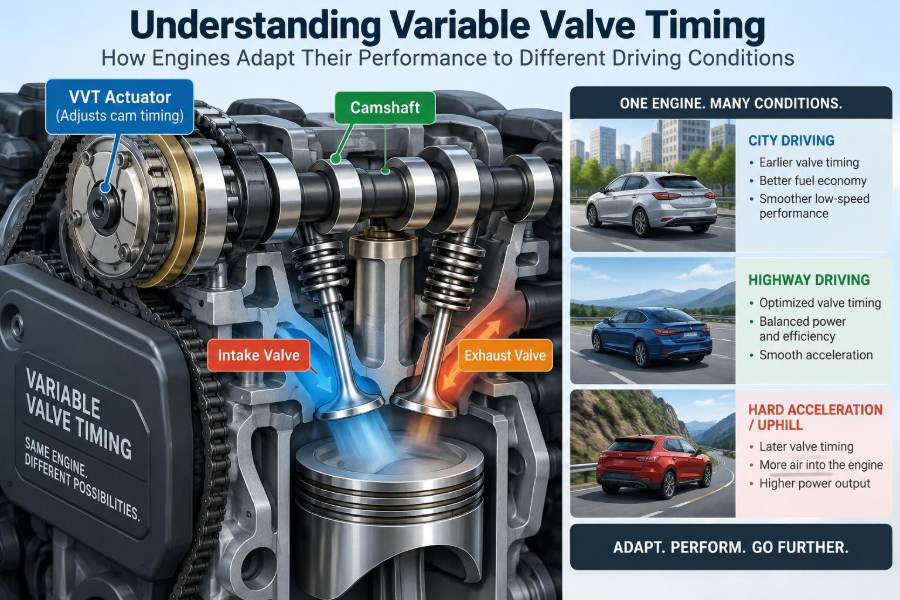

You pull away from a traffic light, join a fast-moving highway, then ease into a steady cruise. Although the engine experiences three very different demands, it is expected to remain smooth, responsive, economical, and clean.
A fixed mechanical setup cannot be perfect for every one of those situations. Valve timing that helps an engine breathe efficiently at high speed may make it less stable at idle, while timing that produces a calm idle can restrict power at higher engine speeds.
Variable valve timing, usually shortened to VVT, is one of the systems that allows a modern internal-combustion engine to make these compromises intelligently. It changes valve events while the engine runs, guided by sensors and the engine control unit.
The idea is mechanical, electronic, and highly practical: give the cylinders the airflow characteristics they need now rather than forcing them to use one fixed valve schedule for every journey.
🔧 The valve events that control engine breathing
In a four-stroke engine, each cylinder must draw in fresh charge, compress it, release energy through combustion, and expel exhaust gas. Intake and exhaust valves open and close to control this gas exchange.
A valve event is described by more than its open-or-closed state. Engineers consider opening time, closing time, duration, lift, and overlap. Together, these determine how easily the cylinder fills and clears itself.
- Opening time: when a valve begins to move off its seat.
- Closing time: when it seals the combustion chamber again.
- Duration: how long the valve remains open.
- Lift: how far the valve opens.
- Overlap: the period near the end of exhaust and start of intake when both valves are open.
⚙️ Why a conventional camshaft is a compromise
A traditional camshaft has fixed lobes. As it rotates, the lobe shape dictates a repeated valve motion profile, so the engine receives essentially the same timing and lift pattern at idle, during acceleration, and near maximum speed.
This arrangement is durable and simple, but airflow needs do not stay constant. Gas behaves differently when it is moving slowly through the ports than when it has strong momentum at high rpm.
A cam profile chosen for strong high-speed power may cause a rougher idle or weaker low-speed torque. A mild profile can provide pleasant everyday operation but limit breathing when engine speed rises.
🌬️ Airflow changes as engine speed rises
At low rpm, there is relatively little time-based flow momentum in the ports. The engine often benefits from stable combustion, limited overlap, and intake-valve events that preserve useful cylinder pressure.
At high rpm, each intake stroke happens very quickly. Air in the intake runner has inertia; if the valve closes too early, that moving air can be stopped before the cylinder receives its full charge.
VVT lets engineers shift timing so this inertia can be used rather than wasted. The objective is not simply to move more air at all times, but to produce the most appropriate trapped charge and combustion conditions for the operating point.
🧠 The central idea behind variable valve timing
Most VVT systems alter the angular relationship between a camshaft and the crankshaft. This is called cam phasing. Advancing a cam means its valve events happen earlier relative to crankshaft position; retarding it means they happen later.
The system can therefore make a running engine behave as though it has more than one valve-timing setting. It does not usually change the basic lobe shape when using phasing alone, but it moves that profile to a more useful position.
Some systems add variable lift or duration as well. Those designs offer a broader range of control, but cam phasing remains the common foundation of many VVT-equipped engines.
🌀 Understanding advance and retard without jargon
Picture the crankshaft as the clock that defines piston position. If the intake cam is advanced, the intake valve opens and closes earlier on that clock. If it is retarded, both events happen later.
The effects depend on engine speed, load, intake and exhaust design, and whether the exhaust cam is also adjustable. There is no universal rule such as “advanced is always better.” The calibration selects the timing that meets the current torque, emissions, and refinement target.
This is why service information uses specified crankshaft degrees and operating conditions. A change that helps at one point can be harmful at another.
🔁 Valve overlap and the exchange of gases
Valve overlap occurs around top dead centre between the exhaust and intake strokes, when the exhaust valve has not fully closed and the intake valve has begun opening. Overlap can help replace spent gases with fresh charge when exhaust flow is energetic.
At higher speeds, carefully controlled overlap can improve cylinder scavenging. Exhaust gases leaving the cylinder may help initiate intake flow, reducing the work needed to fill the cylinder.
At idle or light load, excessive overlap can dilute the fresh mixture with exhaust gas, destabilize combustion, and create poor vacuum characteristics. Independent control of intake and exhaust cams gives engineers a useful way to manage this trade-off.
🏙️ What VVT does during idle and city driving
At idle, the engine must run evenly with small airflow and little kinetic energy in the gas path. VVT commonly adopts a position that limits unwanted overlap and supports stable combustion.
During gentle urban driving, the controller may choose timing that improves low-speed torque and reduces pumping losses. Pumping losses are the work an engine spends drawing air past a partly closed throttle.
The result is not necessarily dramatic acceleration. More often, the driver notices a cleaner response from low revs, fewer downshifts, and calmer operation in stop-start traffic.
🛣️ What changes during highway cruising
At steady cruising, maximum power is not the priority. The engine needs only enough torque to overcome rolling resistance, aerodynamic drag, gradients, and accessory loads.
VVT can adjust valve timing to reduce inefficient pumping work and, in some engines, retain a controlled amount of exhaust gas internally. This internal residual gas can serve a purpose similar to external exhaust-gas recirculation under suitable conditions.
Because combustion and emissions control are closely connected, the chosen timing is a compromise. The calibration must preserve stable combustion and acceptable exhaust temperatures while pursuing efficiency.
🏁 What happens under hard acceleration
When the driver requests strong acceleration, the engine management system seeks greater cylinder filling and useful torque. Intake and exhaust timing can be moved toward settings that support airflow at the current rpm.
At moderate speeds, this may mean preserving intake charge and improving torque. At higher speeds, it may mean using flow momentum and overlap more effectively so the engine continues to breathe as cycles become shorter.
A VVT engine can therefore have a wider, more usable torque band than a comparable engine with one fixed timing compromise. Final output still depends on displacement, induction system, fuel, compression ratio, and many other design choices.
📈 Torque is often the driver-facing benefit
Peak horsepower attracts attention, but everyday drivability is strongly influenced by torque across ordinary engine speeds. A broad torque curve makes a vehicle easier to launch, climb, overtake, and cruise without frequent gear changes.
Variable timing helps engineers shape that curve. Rather than optimizing only for one rpm point, they can improve the match between breathing characteristics and engine speed over a wider range.
For a driver, this may feel like an engine that responds willingly from low revs and does not suddenly become useful only near the redline.
⛽ Fuel economy and pumping losses
In a spark-ignition engine at light load, the throttle restricts intake air. The pistons must pull against this restriction during the intake stroke, consuming energy that does not reach the wheels.
Appropriate valve timing can reduce this penalty. Some engines use delayed intake-valve closing or other timing strategies to manage effective compression and load with a more open throttle.
The benefit varies with driving pattern and engine design. VVT supports efficiency, but it cannot overcome aggressive acceleration, poor maintenance, low tyre pressure, or aerodynamic drag.
🌱 Emissions control begins inside the cylinder
Combustion temperature, oxygen availability, residual exhaust gas, and combustion stability all influence emissions. Valve timing affects each of these conditions before exhaust reaches the catalytic converter.
By controlling overlap and residual gases, VVT can reduce the need for certain operating strategies that would otherwise increase fuel use. It can also help the engine warm and manage exhaust conditions in ways that support after-treatment performance.
However, emissions behavior is highly calibration-specific. Engineers must balance hydrocarbons, carbon monoxide, nitrogen oxides, particulate formation in relevant engines, and catalyst operating needs rather than optimize a single pollutant in isolation.
🧩 The main forms of variable valve control
“VVT” is a broad label. Different manufacturers use different mechanical arrangements and names, so the badge on an engine cover is less informative than the mechanism beneath it.
| System type | What changes | Typical purpose |
|---|---|---|
| Cam phasing | Camshaft position relative to crankshaft | Adjust opening and closing timing |
| Variable lift | Valve opening height | Control airflow and reduce throttling losses |
| Variable duration | How long the valve stays open | Broaden low- and high-speed breathing capability |
| Cam profile switching | Which cam lobe or rocker profile operates the valve | Provide distinct low- and high-speed modes |
Many engines combine more than one approach. The terminology differs, but the engineering purpose remains adaptive control of cylinder gas exchange.
🛢️ Hydraulic cam phasers: the common mechanism
A common phasing system uses a cam phaser mounted at the end of the camshaft. Engine oil, directed into passages in the phaser, applies pressure to move internal vanes or chambers and rotate the camshaft slightly relative to its drive sprocket.
Oil pressure alone is not enough; it must be accurately directed. An electronically controlled oil-control valve, often called a solenoid valve, meters oil flow according to commands from the engine control unit.
This reliance on clean oil explains why lubrication condition matters directly to VVT operation. Dirty oil, sludge, unsuitable viscosity, or blocked fine passages can slow or prevent the phaser from reaching its commanded position.
🔌 Sensors, solenoids, and the engine control unit
The engine control unit, or ECU, needs to know both the desired and actual cam positions. It uses crankshaft and camshaft position sensors to compare the rotating components precisely.
Inputs such as engine speed, throttle demand, intake air conditions, coolant temperature, load estimate, and exhaust-sensor feedback help determine the requested timing. The ECU then commands the oil-control solenoid or other actuator.
If actual cam movement does not match the target quickly enough, the ECU may store a diagnostic fault code and illuminate the malfunction indicator lamp. The code is a starting point for diagnosis, not proof that one particular component has failed.
🎛️ Variable lift changes a different part of the equation
Cam phasing shifts when a fixed lift profile occurs. Variable valve lift changes how far a valve opens, and some systems can vary it continuously or in steps.
At light load, smaller lift can regulate airflow more directly at the valves, reducing dependence on a closed throttle plate. At higher load, greater lift can reduce flow restriction and improve cylinder filling.
Variable lift mechanisms may use altered rocker geometry, eccentric shafts, switchable followers, or other arrangements. They can improve control flexibility but add mechanical complexity and tighter manufacturing requirements.
🔀 Profile switching versus continuously variable systems
Some engines change between two or more cam profiles. A mild lobe may support low-speed operation, while a more aggressive lobe provides greater lift or duration at higher speed and load.
Other systems move through a continuous range of phase, lift, or duration. Continuous control allows fine adjustment, while profile switching can achieve useful results with a more discrete mechanical strategy.
Neither approach is automatically superior. The best choice depends on cost, packaging, reliability targets, emissions requirements, engine architecture, and the desired character of the vehicle.
🚙 Naturally aspirated and turbocharged engines
Naturally aspirated engines depend on atmospheric pressure and intake flow dynamics to fill cylinders. VVT is particularly useful because valve events strongly influence how effectively those engines use pressure waves and air momentum.
Turbocharged engines have compressed intake air available, but valve timing remains essential. It influences low-speed response, turbocharger energy on the exhaust side, knock tendency in spark-ignition engines, internal residual gas, and exhaust temperature.
Boost does not replace careful valve control. In fact, combining forced induction with VVT gives calibrators more interacting variables, requiring careful control across changing loads and ambient conditions.
🔥 Interaction with compression and combustion
Valve timing can change the amount of charge effectively trapped in a cylinder before compression. For example, a later intake-valve closing event can allow part of the inducted air to move back toward the intake path at low load.
This means the engine’s effective compression behavior can differ from its geometric compression ratio, which is fixed by piston and combustion-chamber dimensions. The distinction helps explain how some engines pursue efficiency while retaining useful expansion characteristics.
The precise effects depend on combustion system design. Timing choices must also avoid knock, misfire, excessive exhaust temperature, and poor transient response.
🧪 Internal exhaust-gas recirculation
External exhaust-gas recirculation routes a measured amount of exhaust through a dedicated path back into the intake. Internal EGR uses valve overlap and valve timing to leave or reintroduce a controlled amount of exhaust gas within the cylinder process.
Residual exhaust gas can lower oxygen concentration and moderate peak combustion temperatures under appropriate conditions. It may help reduce pumping work as well.
Too much residual gas, especially at idle or cold operation, can destabilize combustion. VVT allows internal EGR to be adjusted rather than fixed, but it does not eliminate the need for careful calibration.
❄️ Cold starts and warm-up behavior
When an engine is cold, fuel vaporization is poorer, lubricating oil is thicker, and the emissions-control system has not yet reached its preferred operating temperature. Valve timing strategies during this period may differ substantially from warm-engine strategies.
The ECU may prioritize stable combustion and catalyst warm-up over maximum efficiency. A driver may notice a different idle speed or exhaust note briefly after starting, depending on the vehicle design.
Short journeys make this phase a larger share of total use. VVT can help manage it, but no valve system can completely erase the fuel and emissions penalty of repeated cold starts.
⏱️ Transient operation is where control quality matters
An engine does not always operate at a neat, steady rpm. Gear changes, throttle openings, hill climbs, and deceleration create rapid transitions in airflow and torque demand.
During these transitions, the controller must move the phaser promptly without causing hesitation, surge, or unstable combustion. Oil temperature, actuator response, and the control algorithm all affect this behavior.
A well-designed system feels unobtrusive. The driver does not sense “a timing mode”; they simply experience predictable torque as conditions change.
🧰 Timing chains, belts, and VVT are related but different
The timing chain or belt synchronizes crankshaft and camshaft rotation. VVT then makes controlled, limited adjustments around that basic relationship. These are connected systems, but they are not the same component.
A worn chain, stretched belt system, failed tensioner, or incorrect mechanical timing can cause camshaft correlation faults that resemble VVT problems. Replacing a solenoid without confirming mechanical timing can waste time and money.
Mechanical timing errors can be serious in interference engines, where piston and valve travel may overlap if synchronization is lost. Manufacturer repair procedures and correct locking tools matter.
🛠️ Common symptoms of a VVT-related fault
Symptoms vary widely because a system may fail in an advanced, retarded, fixed, or slow-moving position. Some faults are obvious; others appear mainly as reduced efficiency or an illuminated warning lamp.
- Rough idle, hesitation, or stalling in some operating conditions.
- Reduced low-speed torque or weak higher-rpm response.
- Rattling noise near the cam phaser area, especially on certain starts.
- Poorer fuel economy than expected for the same driving pattern.
- Engine warning light with camshaft timing or correlation-related diagnostic codes.
These signs are not unique to VVT. Ignition faults, intake leaks, fuel-delivery problems, sensor failures, and mechanical wear can produce similar complaints.
🔍 A sensible diagnostic sequence
Diagnosis should begin with basic information: the exact symptom, service history, oil specification, oil level, stored codes, and freeze-frame data captured when a fault was recorded.
A technician can then use scan data to compare commanded and actual cam angles. Electrical checks of solenoids and sensors, oil-pressure assessment where appropriate, and inspection for contamination may follow.
- Confirm oil level, condition, and specified grade.
- Read all diagnostic codes and live data, not only the first code displayed.
- Inspect connectors, wiring, and accessible oil-control valves.
- Verify base mechanical timing if correlation or noise suggests a mechanical issue.
- Test components according to the manufacturer’s procedure before replacement.
A code naming a camshaft position does not automatically condemn the cam sensor. It may indicate that the camshaft did not reach the position the ECU expected.
🛢️ Oil quality is a functional requirement
For engines with hydraulic cam phasers, oil is both lubricant and hydraulic working fluid. Its viscosity and cleanliness influence the speed and accuracy of phaser movement.
Using the specified oil grade and approved specification, changing it at appropriate intervals, and avoiding prolonged low-oil operation are practical ways to protect VVT hardware. The correct requirement is found in the vehicle documentation, not guessed from a similar engine.
Very thick oil is not automatically “better protection,” particularly in a design with narrow control passages. Equally, an unsuitable thin oil may not provide the behavior anticipated by the engine’s calibration and hardware.
⚠️ Misconceptions that complicate repairs
One common mistake is treating every VVT issue as an electrical solenoid failure. Solenoids can fail, but contamination, oil-pressure problems, worn phasers, incorrect timing, or wiring faults must remain in the diagnostic picture.
Another misconception is that performance camshafts and factory VVT pursue exactly the same goal. An aggressive fixed cam may favor a narrow operating range, whereas production VVT is generally calibrated to balance drivability, emissions, economy, durability, and power.
Finally, a quiet engine is not proof that cam timing is correct, and a noisy engine is not proof that a phaser is at fault. Evidence from inspection and data matters more than assumptions.
🏭 Manufacturing precision and calibration challenges
Variable valve control adds moving parts, oil passages, sensors, software logic, and tolerance requirements. The system must work reliably with cold oil, hot oil, different altitudes, changing loads, and normal component aging.
Calibration teams must also prevent undesirable interactions. A timing setting that improves fuel consumption may affect catalyst temperature, noise, turbo response, or combustion stability.
This is why VVT is not merely a bolt-on performance feature. It is an integrated part of the engine’s mechanical design and control strategy.
🔮 VVT in hybrid and future powertrains
Hybrid vehicles create additional opportunities because the electric motor can assist during conditions where an engine would otherwise need to operate inefficiently. The combustion engine may then be calibrated for efficient operating regions, with valve timing playing a significant role.
Some hybrid engine concepts use valve timing to achieve an expansion-focused cycle, trading some low-speed engine torque for efficiency. Electric assistance can compensate for that torque characteristic when needed.
As battery-electric vehicles grow, internal-combustion technology still matters in many fleets and hybrid applications. VVT remains a useful example of how mechanical systems and electronic control can work together to reduce compromises.
🎓 What engineering students should observe
When studying VVT, avoid viewing it as a single device. Consider the complete system: gas dynamics, valve-train mechanics, lubrication, sensing, control software, combustion, emissions, and driver demand.
A useful exercise is to compare an engine map at idle, part load, and wide-open throttle. Ask what the engine is trying to optimize at each point, then predict whether reduced overlap, increased overlap, earlier closing, or later closing could help.
The answer will rarely be one simple rule. That complexity is exactly why variable valve timing is valuable.
✅ The core principle: match breathing to the moment
Variable valve timing exists because an engine’s ideal breathing arrangement changes continuously. Low-speed stability, mid-range torque, high-speed airflow, fuel economy, and emissions control demand different valve behavior.
By shifting cam timing—and, in some designs, changing lift, duration, or profile—VVT gives engineers room to manage those conflicting demands. It broadens the useful operating range without requiring the driver to understand the mechanical changes taking place.
The system works best when its mechanical timing is accurate, its sensors and actuators are functioning, and its oil supply is clean and correct. Those conditions turn a clever concept into reliable day-to-day performance.
Variable valve timing is best understood as an engine’s adjustable breathing system: it adapts valve events so each cylinder can work more effectively in the driving condition at hand. That quiet adjustment is a major reason modern engines can be both flexible and refined. 🚗⚙️🌿