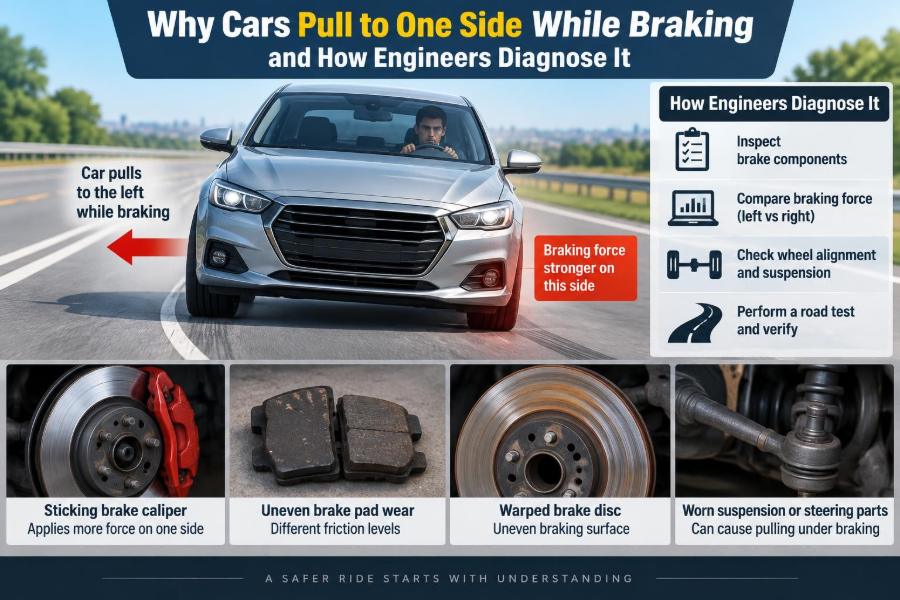

You press the brake pedal on a straight, familiar road, and the steering wheel suddenly tugs in your hands. The car drifts left or right just as its speed falls. It may be mild enough to feel like an annoyance, or sharp enough to make a firm stop unsettling.
A vehicle that pulls while braking is not behaving randomly. Braking is a carefully balanced force-sharing task: each tyre must generate an appropriate amount of longitudinal grip, and the left and right sides of an axle must contribute predictably. When that balance changes, the vehicle yaws—rotates about its vertical axis—toward one side.
The cause is not always a seized brake caliper, although that is a common suspicion. Tyres, suspension geometry, hydraulic pressure, road camber, wheel bearings, electronic controls, and driver input can all influence what the driver feels.
For engineers and technicians, the useful question is not simply, “Which part is bad?” It is: what unequal force is being created, when does it appear, and what evidence separates one cause from another?
🧭 What a Braking Pull Actually Means
A braking pull is a directional deviation that appears because braking creates different forces on the left and right sides of the vehicle. If the right front wheel produces less braking force than the left front wheel, the stronger left-side force tends to rotate the vehicle toward the left.
The direction of the pull is therefore a clue, but not a complete diagnosis. A vehicle may pull toward the side with the stronger brake, yet tyre behaviour and suspension movement can modify the sensation at the steering wheel.
⚙️ The Force Balance Behind a Straight Stop
During a straight-line stop, tyre-road friction supplies the force that slows the car. At each wheel, braking torque from the disc or drum brake resists rotation, and the tyre transmits that resistance to the road.
If the two front wheels have similar vertical load, tyre condition, and brake torque, their opposing forces are broadly balanced. The car decelerates with little yaw. A mismatch creates a yaw moment, much like a small steering input applied while the brakes are on.
📐 Why Front-Axle Differences Feel So Strong
Most passenger cars transfer load forward during braking. This happens because the vehicle’s centre of mass is above the road surface; deceleration shifts normal load from the rear axle to the front axle.
Front brakes are consequently designed to do a large share of the work in a typical stop. A front-to-front imbalance often produces a more obvious pull than a similar rear imbalance, because the front tyres carry more braking load and directly influence steering direction.
🛞 Tyre Grip Is Part of the Braking System
Brakes do not stop a vehicle by themselves; tyres do. The brake applies torque, but the available stopping force is limited by the tyre’s contact patch and the road surface.
A worn tyre, mismatched tread pattern, incorrect pressure, internal belt damage, or contamination can make one side reach its grip limit earlier. On a wet or loose surface, these differences become especially noticeable. A technically sound brake system cannot overcome a tyre with poor or inconsistent grip.
🌧️ Road Surface and Camber Can Mislead Diagnosis
Many roads slope slightly from the centre toward the gutter for drainage. This crossfall, often called road camber, can encourage a vehicle to drift downhill even without braking.
Surface changes complicate testing further. One wheel may cross a polished patch, paint marking, standing water, gravel, or a repaired strip of asphalt. A meaningful road test compares repeated stops on a reasonably flat, uniform, low-traffic surface when safe and lawful to do so.
🔥 A Sticking Caliper and Unequal Clamp Force
A disc-brake caliper must slide or clamp freely so both pads apply force correctly. Corroded guide pins, a binding piston, damaged pad abutments, or swollen seals can prevent normal movement.
A caliper that applies too weakly can leave one wheel under-braked. One that remains partly applied can create drag, heat, and a different imbalance once the pedal is pressed. The symptom may change after several stops because temperature alters friction and component movement.
- A hot wheel after a gentle drive may suggest brake drag.
- Uneven pad wear can indicate restricted caliper or pad movement.
- A burning smell requires caution; avoid touching wheels or brake components because they may be extremely hot.
🧱 Brake Pads Can Create Uneven Friction
Pad material is formulated to provide stable friction over a working temperature range. If one pad is glazed, contaminated by oil or grease, cracked, incorrectly fitted, or of substantially different friction behaviour from its counterpart, braking torque can differ between sides.
Replacing pads one side at a time is poor practice. Friction components should generally be serviced as axle pairs, with compatible parts and proper bedding-in procedures. New pads and discs also need time and controlled use to establish an even transfer layer on the disc surface.
💿 Disc Condition: Judder Is Not Always a Pull
Drivers often group several symptoms together as “warped discs.” In practice, steering-wheel vibration during braking can result from disc thickness variation, runout, uneven friction deposits, hub corrosion, or suspension sensitivity.
Judder and directional pull may occur together, but they are different clues. A disc-related torque variation tends to pulse with wheel rotation. A persistent pull generally points more strongly to a left-right force difference, though both conditions deserve inspection.
🪛 Flexible Brake Hoses Can Fail Internally
A flexible hydraulic hose can deteriorate internally even when its outer surface looks acceptable. An internal restriction may limit fluid flow toward a caliper, reducing application force, or restrict return flow, leaving pressure trapped after pedal release.
This fault is difficult to confirm by appearance alone. A technician compares wheel drag, pressure release behaviour, and hydraulic response rather than replacing parts based only on a guess.
🛢️ Hydraulic Pressure Must Reach Both Sides
In a hydraulic braking system, pedal force is converted into fluid pressure by the master cylinder and distributed through lines, valves, hoses, and calipers or wheel cylinders. Air in the system usually causes a soft or long pedal, but it can also contribute to inconsistent operation if bleeding or component condition is poor.
A blocked line, malfunctioning valve, leaking component, or incorrect repair can alter pressure delivery. Because brake systems are safety-critical, hydraulic diagnosis and repair should follow manufacturer procedures and should not rely on improvised methods.
🥁 Rear Drum Brakes Have Their Own Imbalances
Drum brakes use shoes pressed outward against a rotating drum. Their geometry can create a self-energising effect: rotation can help pull a leading shoe into contact. This makes correct shoe orientation, adjustment, hardware condition, and contamination control particularly important.
A sticking wheel cylinder, seized adjuster, weak return spring, or brake-fluid leak onto the lining can produce unequal rear braking. The driver may notice rear-end instability more than steering pull, especially under firm braking.
🧲 Parking-Brake Mechanisms Can Hold a Brake On
On many rear calipers and drums, the parking brake uses cables, levers, or integrated mechanisms. Corrosion or a damaged cable can stop the mechanism returning fully.
That creates residual drag and heat, sometimes only on one rear wheel. The problem may first show up as reduced fuel economy, a hot wheel, or a smell after driving, then become a braking-direction issue as the affected brake behaves differently from the opposite side.
📏 Wheel Alignment Changes the Vehicle’s Response
Alignment does not normally create a large braking force imbalance by itself, but it can make a vehicle more sensitive to one. Toe, camber, caster, and steering-axis geometry determine how tyres point and how forces feed back through the steering.
For example, unequal caster can make a car drift during normal driving and change its response under braking. Alignment readings are useful only after worn or loose suspension parts have been identified; adjusting angles around a damaged component does not solve the underlying fault.
🔩 Worn Suspension Bushes Let Geometry Move
Control-arm bushes, ball joints, tie-rod ends, strut mounts, and subframe mountings locate the wheel under load. When they wear, braking force can move a wheel rearward or sideways and change toe or camber dynamically.
A soft rear control-arm bush, for instance, may allow one front wheel to steer slightly under braking. This is sometimes called compliance steer. It can mimic a brake fault even when measured brake force is reasonably balanced.
🧰 Wheel Bearings and Hub Surfaces Matter
Excessive wheel-bearing play can allow disc runout and unstable brake-pad contact. A corroded or dirty hub face can prevent a replacement disc from seating squarely, introducing runout from the moment it is installed.
These conditions more often produce pulsation or noise than a steady pull, but they can contribute to inconsistent braking. Clean mounting surfaces, correct fastener torque, and measurement rather than assumption are core service disciplines.
🧠 ABS, ESC, and Brake-Force Control
Anti-lock braking systems monitor wheel speeds and modulate pressure when a wheel approaches lock. Electronic stability control can selectively brake individual wheels to help manage yaw. Some vehicles also use electronic brake-force distribution to adjust front-rear braking according to load and grip.
These systems can reduce the consequences of unequal traction, but they cannot make worn tyres, seized hardware, or damaged suspension harmless. Warning lamps, stored diagnostic trouble codes, or unusual ABS activation add valuable evidence to the diagnostic process.
🚦 When the Pull Occurs Is a Major Clue
The timing and severity of the symptom narrow the possibilities. A pull only during very gentle braking may involve pad contact, caliper slide movement, or tyre conicity. A pull during hard braking may expose suspension compliance, tyre grip differences, or ABS intervention.
| Observed pattern | Possible direction for investigation |
|---|---|
| Pull also present while coasting | Tyres, alignment, road camber, or suspension geometry |
| Pull begins after several stops | Heat-related drag, sticking caliper, hose restriction, friction instability |
| Steering vibration with pedal pulsation | Disc runout, thickness variation, hub mounting, bearing condition |
| One wheel unusually hot | Dragging brake or parking-brake mechanism |
| Pull accompanies ABS warning or activation | Wheel-speed sensing, tyre mismatch, hydraulic or electronic diagnosis |
👂 The Driver’s Description Is Diagnostic Data
“It pulls right” is helpful, but a technician needs context. Does it happen with a cold vehicle, after motorway driving, only in rain, only with passengers, or only when the pedal is pressed hard? Does the steering wheel move, does the vehicle yaw, or both?
Clear observations reduce unnecessary parts replacement. A safe note of conditions, warning lights, smells, noises, and changes after tyre rotation can be more useful than a vague request to “check the brakes.”
🧪 Engineers Start With a Repeatable Road Test
Professional diagnosis begins by confirming the concern. The vehicle is assessed on an appropriate route under controlled, safe conditions, using repeated applications rather than drawing conclusions from one stop on an uneven road.
The technician first checks whether the vehicle pulls while rolling without brake input. That distinction separates a baseline directional issue from a symptom created specifically by braking. Any test must be stopped if the vehicle becomes unstable, a warning lamp appears, or a severe fault is suspected.
🔍 A Visual Inspection Finds High-Value Clues
With the vehicle safely raised and supported, inspection can reveal missing hardware, damaged boots, fluid leaks, cracked hoses, uneven tyre wear, loose joints, or obvious pad wear differences. Both sides must be compared; a component can look acceptable in isolation but be abnormal relative to its opposite number.
Technicians also inspect discs, drums, wheel-cylinder areas, and parking-brake linkages. Leaks around brake components demand prompt attention because braking performance can deteriorate quickly.
🌡️ Temperature Comparison Can Reveal Drag
After a controlled drive, technicians may compare temperatures near corresponding brake assemblies with suitable non-contact equipment. A substantially hotter corner can support suspicion of drag, although readings depend on braking history, airflow, measurement location, and vehicle design.
Temperature is therefore a clue, not a verdict. The next step is to determine whether the heat came from a sticking caliper, restricted hose, parking-brake mechanism, bearing issue, or simply an unusually demanding recent stop.
📊 Brake Testing Measures Rather Than Guesses
A brake dynamometer or roller brake tester can measure braking force at individual wheels under test conditions. A decelerometer measures vehicle deceleration during a road test. These tools help identify imbalance, but each has limitations related to tyre condition, surface, loading, and test setup.
Measured values are interpreted alongside physical inspection. A force difference tells the engineer that an imbalance exists; it does not automatically identify whether the source is friction material, hydraulic pressure, tyre grip, or mechanical movement.
📡 Scan Tools Add the Electronic Picture
On modern cars, scan tools can retrieve diagnostic trouble codes and display live wheel-speed data, brake-switch status, steering-angle information, and sometimes pressure or stability-control data. A damaged wheel-speed sensor or incorrect signal can cause unintended ABS or stability-control behaviour.
Live data should be checked sensibly. A wheel-speed difference during a turn is expected; a signal that drops out on a straight road is more suspicious. Electronic evidence must still be correlated with the actual symptom.
🔄 Tyre Rotation Is a Useful Isolation Test
Where tyre sizes and vehicle manufacturer guidance allow it, moving tyres from side to side or front to rear can help identify a tyre-related pull. If the pull changes direction or substantially changes character after an approved swap, tyre conicity or construction variation becomes more likely.
Conicity means the tyre behaves somewhat like a shallow cone, generating a lateral force as it rolls. It may not be obvious from tread appearance. Rotation is an investigative step, not a universal cure, and directional tyres must be handled correctly.
🧩 Avoid the “Replace Parts Until It Stops” Method
Replacing calipers, discs, pads, and hoses without evidence can be expensive and can introduce new faults through poor installation. It also obscures the original cause, especially when a tyre or suspension issue is responsible.
A better sequence is to verify the symptom, inspect safety-critical basics, measure where possible, isolate variables, and repair the confirmed fault. This approach is slower only at the beginning; it usually saves time compared with repeated guesses.
⚠️ Why Delaying Repair Carries Real Risks
A mild pull may become dangerous during emergency braking, on wet surfaces, or when towing or carrying a heavy load. Dragging brakes can overheat pads, discs, fluid, bearings, and tyres. Uneven braking can also increase stopping distance or make a vehicle harder to control.
Drivers should not attempt high-speed “tests” to see whether the pull disappears. If braking direction changes suddenly, the pedal feels abnormal, a warning light remains on, smoke appears, or a wheel is extremely hot, the vehicle should be assessed promptly by a qualified professional.
🧑🔧 Repair Means Restoring the Whole System
A correct repair may involve servicing caliper slides, replacing a caliper or hose, fitting friction parts in axle pairs, renewing tyres, repairing suspension joints, correcting alignment, or addressing a sensor fault. The appropriate solution depends on confirmed evidence.
After work, technicians verify free wheel rotation, fluid integrity, fastener torque, brake-pedal feel, warning-light status, and road behaviour. Where new friction parts are fitted, the owner should follow the bedding guidance supplied for that vehicle and component combination.
🗓️ Preventive Habits That Reduce Brake Imbalance
Regular inspections help catch uneven pad wear, perished hoses, seized slide pins, and tyre damage before they become major symptoms. Using the parking brake periodically on systems designed for it can help keep mechanical linkages moving, although the vehicle handbook remains the right reference for specific use.
- Maintain tyre pressures to the vehicle manufacturer’s specification.
- Replace tyres and friction components in sensible axle pairs when required.
- Ask for brake and suspension findings to be explained side by side.
- Investigate new noises, smells, vibration, warning lamps, or directional changes early.
🎯 The Core Engineering Takeaway
A car pulls under braking because the forces at its tyres are not balanced, or because the chassis changes the direction of those forces under load. The visible symptom is simple, but the underlying path can run through braking hardware, hydraulics, tyres, electronics, suspension, or the road itself.
Good diagnosis follows the physics: establish when the pull occurs, compare left with right, inspect for heat and movement, measure brake performance, and avoid treating a single clue as final proof. That method protects both vehicle reliability and the people inside it.
A braking pull is best understood as a force-balance problem, and the safest repair is the one supported by systematic evidence rather than guesswork. A straight, stable stop is the result of tyres, brakes, suspension, and control systems working together. 🚘🛞🔧