
A driver pulls away from a junction, presses the accelerator, and hears a faint metallic rattle from the engine bay. It may disappear as the car gains speed, or return only on a steep hill with several passengers aboard. That sound is often described as “pinging,” “pinking,” or engine knock.
Not every unusual engine noise is knock, and a modern car may prevent true knock so effectively that its driver never hears it. Yet the combustion event that engineers call knock remains one of the central limits on gasoline-engine performance, efficiency, compression ratio, and boost pressure.
Understanding it helps explain why fuel grades matter, why turbocharged engines need careful calibration, and why an engine control unit sometimes reduces power when conditions are demanding. It also helps separate a minor fuel-related issue from a mechanical noise that needs attention.
At its core, knock is a problem of combustion timing and combustion speed. The air-fuel mixture should burn in a controlled flame front; knock occurs when part of that mixture reacts in an uncontrolled way before the normal burn has finished.
🔊 What Engine Knock Actually Means
In a spark-ignition gasoline engine, the spark plug initiates combustion shortly before the piston reaches top dead center. A flame then travels across the combustion chamber, raising pressure in a smooth, planned manner that pushes the piston down on its power stroke.
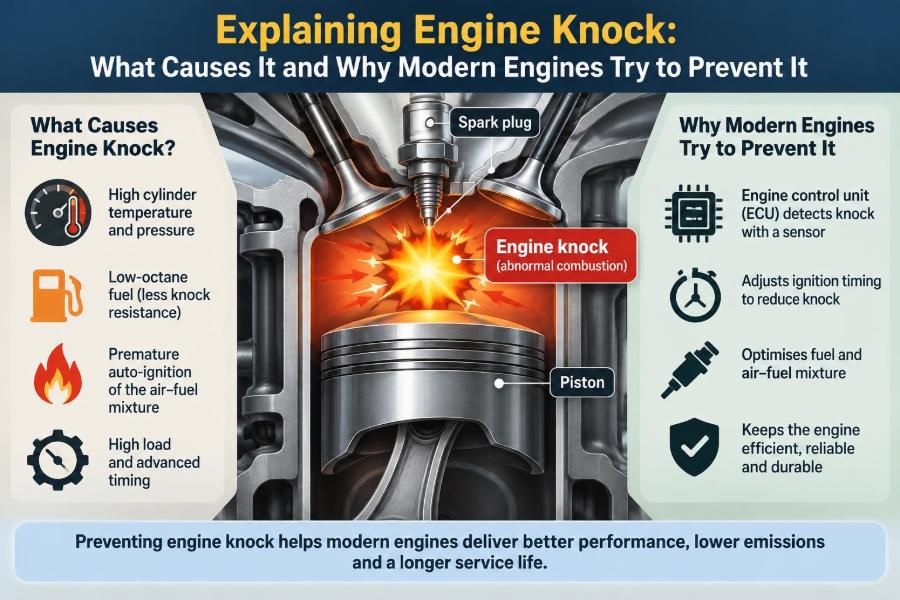
Engine knock is abnormal combustion caused by spontaneous ignition of the remaining unburned mixture, often called the end-gas. Instead of being consumed progressively by the advancing flame front, that end-gas reacts extremely rapidly, creating pressure waves inside the cylinder.
Those waves can make the cylinder wall, piston, and other components vibrate at audible frequencies. The result may sound like small metal pellets shaking in a tin, although the source is combustion rather than loose hardware.
🔥 The Normal Combustion Event
Normal combustion is neither an explosion nor an instant burn throughout the cylinder. It is a controlled chemical reaction that begins at the spark plug and propagates as a flame front through a compressed mixture of air and fuel.
Combustion timing is arranged so that peak cylinder pressure occurs shortly after top dead center. This gives expanding gases useful leverage on the descending piston. If peak pressure arrives too early, the piston is still rising and the engine must do work against the pressure.
A useful analogy is lighting one edge of a dry sheet of paper rather than setting off many tiny fires across it at once. The first is ordered and predictable; the second releases energy too abruptly.
⚡ The End-Gas and Autoignition
As the normal flame travels, it compresses and heats the unburned mixture ahead of it. This last portion of charge, the end-gas, sits in a severe environment: its temperature and pressure rise while it waits to be reached by the flame.
If the end-gas remains chemically stable long enough, the flame consumes it normally. If its chemical reactions accelerate until it ignites by itself, multiple reaction zones form rapidly and create the sharp pressure oscillations associated with knock.
Autoignition does not mean the spark plug failed. The spark can initiate combustion correctly, while conditions elsewhere in the chamber allow the remaining charge to self-ignite too soon.
📈 Why Pressure and Temperature Matter
Higher pressure and temperature make autoignition more likely because they shorten the time required for fuel-air chemistry to progress toward self-ignition. This is why knock is most likely when the engine is heavily loaded, not necessarily when it is spinning at its highest speed.
Opening the throttle at low or medium rpm, climbing a hill in a tall gear, towing, or accelerating with a full vehicle can all increase cylinder filling and pressure. Turbocharging and supercharging increase that charge density further.
Ambient heat also matters. A hot intake charge, a heat-soaked engine bay, or a high coolant temperature can reduce the margin between normal combustion and knock, though the exact response depends on the engine design and calibration.
🧱 Compression Ratio and Knock Tendency
The compression ratio compares the cylinder volume when the piston is at the bottom of its stroke with the much smaller volume when it is near the top. A higher ratio generally improves the thermodynamic potential for efficiency, but it also raises the temperature and pressure of the compressed charge.
That creates a design trade-off. Engineers want enough compression to extract useful work efficiently, while retaining a sufficient knock margin across hot weather, fuel variation, deposits, altitude, and demanding driver inputs.
Modern gasoline engines can use relatively high compression ratios because they combine careful chamber design, fuel injection strategies, cooled exhaust-gas recirculation in some applications, variable valve timing, and electronic knock control.
⛽ Octane Rating and Fuel Resistance
Octane rating describes a gasoline fuel’s resistance to knock under specified test conditions. It does not measure energy content, cleanliness, or general fuel quality in every respect.
A fuel with a higher octane rating can tolerate more severe temperature and pressure before autoignition. It therefore gives an engine designed for it more operating margin, particularly under load or boost.
Using a higher grade than an engine requires does not automatically produce more power. Some engines can adapt and advance ignition timing when they detect better knock resistance; others are calibrated so that the practical difference is small. The owner’s manual remains the correct source for the required minimum grade.
🧪 Why Fuel Chemistry Is Not Simple
Gasoline is a blend of many hydrocarbons and, in many markets, oxygenated components such as ethanol. Two fuels with the same advertised octane rating can behave somewhat differently in volatility, energy content, deposit-control additives, and response to temperature.
For knock control, the critical point is resistance to premature autoignition in the intended engine operating range. Fuel blending is designed around standardized measurements, but a running engine sees changing temperatures, airflow, residual exhaust gases, and cylinder-to-cylinder variation.
Fuel that is contaminated, stale, or unsuitable for the vehicle may contribute to poor operation. However, a single tank of fuel should not be used to explain every rattle, hesitation, or warning light without diagnosis.
🌀 Turbocharging Raises Both Opportunity and Risk
A turbocharger uses exhaust energy to compress intake air. More air allows more fuel to be burned, increasing potential torque from a relatively small engine. That is why turbocharged gasoline engines are common in modern passenger vehicles.
The same benefit raises knock risk: compression by the turbocharger increases intake charge temperature and density, and high cylinder pressure follows when the mixture is compressed again in the cylinder. Intercoolers reduce the temperature of compressed intake air, improving density and knock resistance.
Boost control, ignition timing, fuel delivery, and charge cooling must work together. A turbo engine is not inherently unreliable, but it has less tolerance for incorrect calibration, poor fuel choice, or a fault that creates excessive boost or inadequate cooling.
🗺️ Ignition Timing: Power Versus Margin
Ignition timing determines when the spark occurs relative to piston position. Advancing the spark allows more time for the flame to develop, which can improve torque up to the point where combustion pressure becomes poorly timed or knock begins.
Retarding the spark gives the end-gas less severe conditions and is one of the fastest ways to suppress knock. The trade-off is reduced efficiency and, often, lower torque because peak pressure occurs later in the power stroke.
Engine calibration is therefore a moving compromise rather than a single ideal setting. The best timing at light load on a cool day may be unsafe under heavy acceleration in hot weather.
🎛️ How a Knock Sensor Listens
Most modern gasoline engines use one or more knock sensors, commonly piezoelectric accelerometers attached to the engine block. They convert vibration into an electrical signal that the engine control unit can analyze.
The control unit does not simply react to every vibration. Engines create normal mechanical noise from valves, injectors, pistons, and combustion. Software evaluates the signal within a crank-angle window and frequency range where knock is expected for that engine.
When the system identifies knock, it can retard timing for a particular cylinder or for the engine as a whole. It may then cautiously restore advance when conditions permit. This closed-loop response lets the engine protect itself while using available fuel quality effectively.
💻 The ECU’s Protective Responses
Ignition retard is the usual first response, but it is not the only one. Depending on engine architecture, the ECU may reduce boost, enrich the mixture under certain high-load conditions, alter valve timing, adjust cam phasing, or limit requested torque.
To the driver, this may feel like a brief softness in acceleration rather than an obvious fault. Persistent intervention can reduce performance noticeably, especially in a turbocharged engine climbing a grade or accelerating repeatedly in hot conditions.
Protection has limits. A control system cannot reliably compensate for severe mechanical defects, the wrong fuel grade over all conditions, uncontrolled overheating, or modifications that exceed the hardware’s thermal and pressure capability.
🌡️ Cooling Systems and Hot Spots
The cooling system controls metal temperatures around the combustion chambers, valve seats, and cylinder head. If coolant flow is poor, the coolant level is low, the radiator is restricted, or the engine is overheating, local hot spots can increase knock tendency.
Hot spots matter because combustion does not occur in a perfectly uniform chamber. Edges around valves, deposit layers, and locally overheated surfaces can influence the temperature of nearby end-gas.
An overheating warning, coolant loss, or rising temperature gauge deserves prompt attention. Continuing to demand high power from an overheating gasoline engine can turn a manageable cooling fault into a more serious combustion or component-damage problem.
🧼 Carbon Deposits Change the Chamber
Combustion deposits can accumulate over time on pistons, cylinder heads, intake valves in certain engine designs, and other surfaces. Their effects vary by engine, fuel, oil consumption, operating pattern, and maintenance history.
Deposits can reduce combustion-chamber volume slightly, effectively raising compression. They may also retain heat and alter airflow or fuel distribution. In some cases, deposits contribute to knock sensitivity or create conditions that promote pre-ignition.
Not every older engine with deposits needs aggressive cleaning, and chemical cleaning is not a universal cure. A diagnosis should consider oil consumption, injector condition, valve deposits, compression, fault codes, and the manufacturer’s approved service procedures.
🕯️ Spark Plugs and Their Heat Range
A spark plug must ignite the mixture reliably while transferring enough heat away from its firing tip. Its heat range describes that thermal behavior; it is not simply a measure of spark strength.
A plug that runs too hot for an application can retain excessive heat, while a plug that runs too cold may foul more easily under light-load operation. Incorrect plug type, gap, condition, or installation torque can all affect combustion quality and reliability.
Use the plug specification recommended for the engine. Modified or competition engines may require an engineering-based change in plug heat range, but selecting a colder plug casually does not solve the underlying cause of knock.
🔥 Knock Is Different From Pre-Ignition
These terms are often used interchangeably, but they describe different events. Knock occurs after the spark has initiated normal combustion, when the remaining end-gas autoignites. Pre-ignition begins before the scheduled spark, often because a hot surface or glowing deposit ignites the mixture early.
Pre-ignition can be particularly damaging because combustion pressure may rise while the piston is still traveling upward. It can also make knock more likely by creating unusually high temperatures and pressures.
Low-speed pre-ignition is a related concern in some small, highly boosted direct-injection engines. Its exact causes are complex and may involve oil droplets, deposits, fuel behavior, and operating conditions. Engine and oil specifications are developed partly with such risks in mind.
🔩 Knock Is Also Different From Mechanical Rattle
A metallic noise does not confirm combustion knock. Loose heat shields, worn accessory-drive components, piston slap, valvetrain noise, timing-chain wear, exhaust leaks, and driveline parts can each create sounds that change with engine speed or load.
Mechanical noises often follow rpm consistently, whereas audible knock is commonly more load-sensitive and may occur during acceleration. That is only a clue, not a diagnosis. Modern engines may suppress knock before it becomes audible.
A trained technician can use scan data, sound analysis, service information, and physical inspection to distinguish combustion control issues from mechanical faults. Guessing based on noise alone can lead to unnecessary parts replacement.
🚦 Everyday Conditions That Can Trigger Audible Knock
Older vehicles without sophisticated control systems are more likely to reveal knock audibly, but any gasoline engine can become knock-limited. Common situations include high load at low rpm, high ambient temperature, heavy towing, and low-octane fuel where a higher grade is specified.
- Accelerating hard in too high a gear, especially uphill.
- Carrying a heavy load or towing near the vehicle’s limits.
- Using fuel below the manufacturer’s required octane rating.
- Operating with an engine that is overheating or poorly maintained.
- Driving a modified turbocharged engine with unsuitable calibration.
These conditions do not prove damage has occurred. They identify circumstances in which the combustion system has less safety margin.
🛠️ What To Do If You Hear Pinging
First, reduce engine load: ease off the accelerator and, in a manual vehicle, select a lower gear if appropriate. Avoid repeated wide-open-throttle acceleration until the cause is understood.
Check whether the vehicle has received the fuel grade specified by its manufacturer. If it has not, using the correct grade at the next fill is sensible. Do not add unapproved fuel additives or attempt adjustments to sensors or ignition components as a first response.
Arrange inspection sooner if the sound persists on correct fuel, appears with overheating, is accompanied by a check-engine light, causes substantial loss of power, or sounds harsh enough to suggest a mechanical issue. Severe knocking or flashing warning indicators call for stopping safely and following the vehicle guidance.
📋 A Sensible Diagnostic Path
Effective diagnosis starts with a clear description: when the sound occurs, engine temperature, fuel used, vehicle load, gear, rpm, and whether any warning lamps appear. Reproducing the condition safely is often more useful than replacing parts based on a general complaint.
- Check for relevant diagnostic trouble codes and review live data where available.
- Verify correct fuel and inspect for signs of overheating, intake leaks, or obvious wiring faults.
- Inspect spark plugs, ignition components, air and fuel systems, and cooling-system operation.
- Assess injector performance, deposits, compression, and mechanical condition when basic checks do not explain the issue.
- Confirm any software updates or manufacturer service procedures applicable to the engine.
This sequence varies by vehicle. Direct-injection engines, for example, may need different inspections from older port-injected designs.
🧰 Common Misdiagnoses to Avoid
One frequent mistake is assuming every rattle needs premium fuel. Premium gasoline may be necessary for an engine designed for it, but it cannot repair a broken heat shield, failing tensioner, exhaust leak, or worn internal component.
Another is treating an octane booster as a diagnostic tool. Its effect depends on the product and fuel, and it may complicate an otherwise simple fault. It is not a substitute for the specified fuel or for correcting a cooling, ignition, injector, or calibration problem.
Drivers also sometimes “lug” the engine: demanding strong acceleration at very low rpm in a high gear. Modern automatic transmissions usually downshift to avoid this, but manual drivers should select a lower gear rather than relying on the engine to pull heavily from low speed.
📐 Why Engine Designers Shape the Combustion Chamber
Combustion-chamber geometry strongly affects how quickly and consistently the mixture burns. Engineers position the spark plug, valves, injectors, and piston crown to encourage rapid flame travel and reduce the amount of end-gas exposed to extreme conditions.
Squish regions are narrow spaces where the piston approaches the cylinder head near top dead center. They can generate turbulence, helping the flame burn faster. Faster, well-controlled burning can reduce the time available for end-gas autoignition.
There is no universal chamber shape. Designs must also meet airflow, emissions, packaging, manufacturing, cooling, and durability requirements. The final geometry reflects many competing constraints.
💨 Direct Injection and Charge Cooling
In gasoline direct injection, fuel is delivered into the cylinder rather than upstream of the intake valve. As the fuel evaporates, it can absorb heat from the incoming charge, providing a cooling effect that can improve knock resistance.
This allows useful combinations of compression ratio, boost, and torque, especially when paired with precise electronic control. However, direct injection also brings design challenges, including injector deposits, particulate emissions management, and—in some engines—intake-valve deposits because fuel no longer washes those valves.
Technology changes the balance of trade-offs; it does not eliminate them. A direct-injection engine still needs correct fuel, cooling, lubrication, calibration, and maintenance.
♻️ Exhaust Gas Recirculation as a Control Tool
Exhaust gas recirculation, or EGR, returns a controlled amount of inert exhaust gas to the intake charge in suitable operating conditions. The recirculated gas absorbs heat and can lower peak combustion temperatures, reducing knock tendency and certain emissions.
Cooled EGR can be especially helpful at higher loads in engines designed to use it. The system must be carefully controlled because too much dilution can slow combustion, reduce stability, or affect drivability.
Variable valve timing can create an internal EGR effect by changing when valves open and close. This is one reason modern valve-control systems influence much more than peak power.
🏎️ Performance Tuning and the Reduced Safety Margin
Aftermarket tuning often seeks more torque by raising boost, advancing timing, increasing fuel delivery, or changing torque limits. Each change can reduce the margin engineers built in for hot weather, variable fuel quality, aging components, and repeated high-load operation.
A calibration that appears acceptable during a short cool-weather drive may behave differently during sustained acceleration, towing, track use, or heat soak. Knock control is protective, but constantly forcing it to intervene is not a sound performance strategy.
Any tuning should account for fuel availability, intercooling, exhaust temperature, injector capacity, engine condition, and the vehicle’s intended use. For road vehicles, emissions compliance and warranty implications may also apply.
🧯 Can Knock Cause Engine Damage?
Light, brief knock detected and corrected by a modern control system does not necessarily mean damage has occurred. Production engines are designed with knock sensing and calibration margins precisely because real driving conditions vary.
Persistent or severe knock can be harmful. Repeated pressure waves and high local temperatures may contribute to piston damage, ring-land cracking, bearing distress, head-gasket problems, or other failures, depending on severity and engine design.
The risk is greater when knock is combined with pre-ignition, overheating, excessive boost, or continued heavy use despite warning signs. Prevention is preferable because internal damage is often expensive and may not be visible from outside the engine.
🔍 Why Modern Engines Often Knock Without You Hearing It
Modern control systems can identify incipient knock and make small cylinder-specific corrections quickly. As a result, the engine may operate close to its efficient limit without producing an audible ping for the driver.
This is useful, but it can hide a loss of performance margin. If an engine consistently pulls timing because of low-octane fuel, high intake temperatures, deposits, or a developing fault, the driver may only notice reduced power or fuel economy under load.
Diagnostic data can reveal learned timing corrections and knock-related activity, but those values need interpretation. Some correction is normal in many strategies; the pattern, severity, operating conditions, and accompanying faults matter more than one isolated number.
📝 Maintenance Habits That Preserve Knock Margin
Routine maintenance cannot guarantee freedom from knock, but it protects the systems that influence combustion. Follow the manufacturer’s service schedule and use the specified fuel, engine oil, spark plugs, coolant, and air filter.
- Address cooling-system leaks, overheating, and warning lamps promptly.
- Replace spark plugs at the specified interval with the correct part and gap.
- Investigate unusual oil consumption rather than only topping up oil.
- Use reputable fuel from normal retail supply channels.
- Avoid high-load operation when the engine is clearly overheating or malfunctioning.
These habits support clean, controlled combustion without treating maintenance as a collection of miracle fixes.
🧠 Reading the Whole System
Engine knock is best understood as a system-level outcome. Fuel chemistry, compression ratio, boost, chamber shape, intake temperature, cooling, deposits, spark timing, airflow, and driver demand all influence the same combustion margin.
That is why one simple answer rarely fits every vehicle. The correct repair for a naturally aspirated older engine that pings under load may be very different from the correct repair for a modern turbocharged direct-injection engine with a torque-management fault.
The most useful question is not merely “What noise is this?” but “Under what conditions is combustion becoming unstable, and which part of the system is reducing the available margin?”
✅ The Core Principle Behind Knock Prevention
Modern engines try to prevent knock by keeping the unburned end-gas below the conditions where it will autoignite before the flame reaches it. They do this through fuel specification, combustion-chamber design, cooling, air-charge management, ignition control, sensors, and adaptive software.
Engineers do not eliminate every possibility of knock by making an engine overly conservative. Instead, they manage a changing boundary between efficiency and abnormal combustion. That boundary shifts with load, temperature, fuel, altitude, deposits, and component condition.
For drivers and technicians, the practical lesson is straightforward: use the specified fuel, avoid ignoring persistent pinging or overheating, and diagnose unusual noises with the whole engine system in mind.
Engine knock is a warning that combustion has lost some of its intended control, and modern engines prevent damage by sensing that change early and restoring a safer operating margin. Respecting fuel, maintenance, and warning signs helps that protection do its job. 🚗🔥🛠️