
A car can feel completely ordinary on a daily commute—until the engine note changes, the steering wheel vibrates, or a sudden stop reminds you how much work is happening beneath the bodywork.
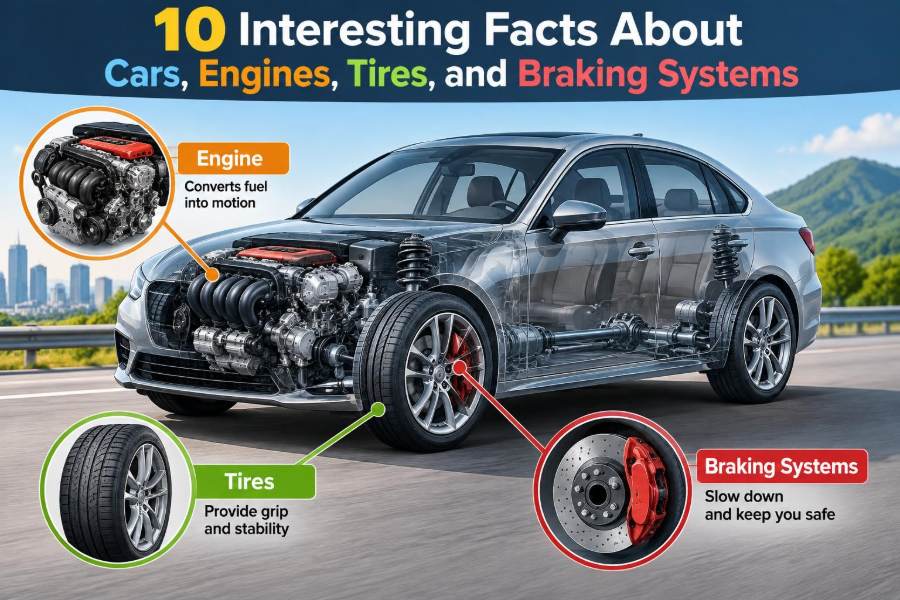
Every journey depends on several systems working together: the engine must turn fuel or electrical energy into motion, tires must create usable grip, and brakes must convert the car’s motion into heat in a controlled way.
Understanding these systems is useful far beyond an exam or workshop. It helps a driver notice early warning signs, make better maintenance decisions, and appreciate why engineers make compromises instead of simply chasing maximum power or maximum grip.
Here are ten interesting automotive facts, expanded through the engineering ideas behind them. Some are surprising at first, but each explains something you can observe in a real vehicle.
🚘 A Car Is a System of Energy Conversions
A conventional car begins with chemical energy stored in fuel. The engine releases part of that energy as heat, converts some into rotating crankshaft torque, and sends it through the transmission and final drive to the wheels.
An electric vehicle follows a different route, storing electrical energy in a battery and using an electric motor to create torque. Yet both types face the same basic challenge: useful motion is always accompanied by losses from heat, friction, air resistance, tire deformation, and accessory loads.
This is why vehicle engineering is rarely about one “best” component. The best result comes from making the whole system work efficiently together.
🔥 Fact 1: Most Engine Energy Does Not Reach the Wheels
In an internal-combustion engine, much of the fuel’s energy leaves as heat through the exhaust and cooling system. Further energy is lost overcoming friction between moving parts and running equipment such as pumps and alternators.
The engine’s job is therefore not merely to produce power. It must do so while controlling temperature, emissions, vibration, durability, and fuel consumption. A highly powerful engine can still be inefficient if much of its available energy becomes unwanted heat.
This also explains why a cooling system is essential. It is not a sign that an engine is failing; it is a necessary method of managing normal combustion heat.
⚙️ Four Strokes Create One Combustion Cycle
Most petrol and diesel passenger-car engines use a four-stroke cycle. The piston moves through intake, compression, power, and exhaust strokes while valves admit air, seal the cylinder, and release combustion products.
- Intake: air enters the cylinder; petrol engines generally add fuel before or during this process.
- Compression: the piston squeezes the trapped charge, raising its temperature and pressure.
- Power: combustion increases pressure and pushes the piston down.
- Exhaust: the piston pushes burnt gases out so the cycle can repeat.
The crankshaft’s inertia and the staggered timing of multiple cylinders keep the engine rotating between individual power strokes.
🧨 Petrol Engines Spark, Diesel Engines Compress
Petrol engines normally use a spark plug to ignite a prepared air-fuel mixture. Diesel engines compress air much more strongly, making it hot enough that injected diesel fuel ignites without a conventional spark plug.
This difference affects the character of each engine. Diesel engines often produce strong low-speed torque because of their operating conditions and design, while petrol engines commonly operate smoothly at higher speeds. Modern turbocharging, injection systems, emissions controls, and hybrid systems have narrowed many traditional differences.
Neither combustion method is automatically superior. The appropriate choice depends on duty cycle, emissions requirements, load, cost, and the vehicle’s intended use.
🌀 Fact 2: Torque Gets the Car Moving, Power Sustains Performance
Torque is a twisting force. At the engine crankshaft, it is what attempts to rotate the drivetrain and wheels. Power describes how quickly work can be done, combining torque with rotational speed.
A simple analogy is turning a wrench. Torque is the turning force you apply; power depends on how much turning work you can complete in a given time. A vehicle needs wheel torque to accelerate, climb, or tow, but it needs adequate power to continue accelerating strongly at higher road speeds.
Gear ratios multiply torque at the wheels. That is why first gear feels strong even when the engine itself is not producing its maximum power.
🔁 Gears Trade Wheel Force for Wheel Speed
A low gear gives the wheels more turning force but limits road speed for a given engine speed. A high gear gives less torque multiplication but allows faster vehicle travel without over-revving the engine.
Manual, automatic, dual-clutch, and continuously variable transmissions achieve this trade-off in different ways. Their purpose is similar: keep the engine or motor in a useful operating range while meeting the driver’s demand.
Downshifting before a hill is not just a habit from older vehicles. It places the engine at a speed where it can deliver more usable power and, in many cases, provide stronger engine braking.
🌬️ Fact 3: Turbochargers Reuse Exhaust Energy
A turbocharger uses exhaust gas flow to spin a turbine. That turbine is connected by a shaft to a compressor, which forces more air into the engine cylinders. More available oxygen allows more fuel to be burned when additional power is requested.
Because exhaust energy would otherwise leave through the tailpipe, turbocharging can improve the power available from a smaller engine. It does not create free energy, however: higher cylinder pressures increase thermal and mechanical demands, and the engine must be designed accordingly.
Turbo response can feel delayed when the driver suddenly opens the throttle because exhaust flow and turbine speed need time to build. Modern control systems, smaller turbines, and electrically assisted designs can reduce this effect.
🌡️ Intercoolers Help Compressed Air Stay Dense
Compressing air raises its temperature. Hot air is less dense than cooler air, so it contains less oxygen for the same volume. An intercooler cools the compressed intake air before it enters the engine.
Cooler intake air can improve charge density and reduce the tendency for abnormal combustion in petrol engines. The intercooler is often visible behind the front grille because it needs moving air—or a liquid cooling circuit—to remove heat.
A turbocharger and intercooler are therefore a pair of related technologies: one compresses the intake charge, and the other manages a consequence of that compression.
🎵 Cylinders Shape Smoothness and Sound
Every firing event creates pulses of force, and engine layouts are arranged to balance those pulses as effectively as practical. Cylinder count, bank angle, crankshaft design, firing order, and balance shafts all influence vibration and sound.
A small three-cylinder engine may be compact and efficient, but its vibration characteristics differ from those of a six-cylinder engine. Engineers use engine mounts, counterweights, software-controlled idle speed, and balancing systems to make the result acceptable for the vehicle class.
More cylinders can improve smoothness, but they also add parts, friction, weight, packaging difficulty, and cost. Refinement is an engineering trade-off, not simply a cylinder-count contest.
🛢️ Oil Does More Than Make an Engine “Slippery”
Engine oil forms a protective film between moving surfaces such as bearings, piston rings, and camshaft components. It also carries away some heat, suspends contaminants for removal by the filter, and helps certain hydraulic components operate.
The correct oil specification matters because viscosity changes with temperature and different engines have different oil-flow, emissions-system, and wear-control requirements. Using an oil that is merely “close enough” can be unsuitable even if the engine appears to run normally.
Oil level should be checked according to the vehicle manufacturer’s procedure. Too little oil risks inadequate lubrication; overfilling can also cause problems as the crankshaft agitates the oil.
🛞 Fact 4: A Tire’s Contact Patch Is Surprisingly Small
The contact patch is the small area where each tire touches the road. It is the only connection through which the vehicle accelerates, brakes, corners, and receives much of its road feedback.
The patch changes shape as the tire rolls, steers, brakes, and carries varying loads. It is not a fixed rectangle, and its usable grip depends on tire compound, tread, pressure, road texture, temperature, water, and vertical load.
That modest area of rubber is why tire condition deserves the same attention as engine maintenance. Extra engine power cannot compensate for tires that cannot transmit force safely.
📐 Tire Sidewall Numbers Describe Function
A marking such as 225/45 R17 describes key dimensions. The first number is nominal tread width in millimetres; the second is the sidewall height as a percentage of width; R indicates radial construction; and 17 is the wheel-rim diameter in inches.
| Marking element | What it indicates | Why it matters |
|---|---|---|
| 225 | Nominal tire width | Affects packaging, steering feel, and potential contact area |
| 45 | Aspect ratio | Lower profiles usually have shorter, stiffer sidewalls |
| R | Radial construction | Common modern design with cords arranged radially |
| 17 | Rim diameter | Must match the installed wheel |
Other markings state load and speed capability. Replacement tires should meet the vehicle’s required specifications, not just physically fit the rim.
🌡️ Tire Pressure Changes Safety and Efficiency
Tire pressure supports the vehicle’s load and helps the tire maintain its intended shape. Underinflation allows excessive sidewall flexing, which generates heat, worsens steering response, and can accelerate shoulder wear.
Overinflation can reduce compliance over rough surfaces and may concentrate wear toward the center of the tread. The correct target is the vehicle manufacturer’s specified cold pressure, not a value guessed from the tire sidewall.
Check pressures when tires are cold and include the spare if the vehicle has one. A tire-pressure monitoring system is useful, but it does not replace visual inspections for damage, embedded objects, or uneven wear.
💧 Fact 5: Tread Channels Water Away From the Road
Tread grooves provide routes for water to escape from beneath a moving tire. On a wet road, the tire must displace water rapidly enough for rubber to maintain meaningful contact with the surface.
If water cannot escape, aquaplaning can occur: the tire partly or fully rides on a film of water and loses much of its grip. Speed, water depth, tread depth, tire pressure, and road texture all affect the risk.
There is no mechanical trick that makes aquaplaning harmless. Reducing speed before standing water and maintaining suitable tread depth are the practical defenses.
🔄 Tire Rotation Is About Wear Patterns, Not Ritual
Front tires often wear differently from rear tires because front wheels may steer, carry more drivetrain duties, and support a different share of vehicle load. Rear-wheel-drive, all-wheel-drive, and electric vehicles can produce other patterns.
Rotating tires at the interval and in the pattern recommended for the vehicle can help wear develop more evenly, provided the tires are compatible for rotation. Directional tires and staggered wheel setups may restrict the possible pattern.
Rotation does not cure alignment faults. If one edge is wearing rapidly, the cause may be incorrect alignment, worn suspension components, or a tire-pressure issue that requires diagnosis.
🧲 Fact 6: Brakes Turn Motion Into Heat
A moving car has kinetic energy. During braking, the friction surfaces in disc or drum brakes convert much of that energy into heat. The faster and heavier the vehicle, the more energy the braking system must manage.
In a disc brake, hydraulic pressure pushes pads against a rotating disc, also called a rotor. The resulting friction resists rotation. In a drum brake, shoes press outward against the inside of a rotating drum.
Brakes do not “destroy” energy; they transform it. This is why hard repeated stops can make brake components extremely hot.
🦶 The Brake Pedal Multiplies the Driver’s Force
Pressing the brake pedal applies force through a lever mechanism. A brake booster—often assisted by vacuum or an electric system—reduces the pedal effort required, while the master cylinder converts pedal force into hydraulic pressure.
Brake fluid transmits that pressure through lines to calipers or wheel cylinders. Hydraulic systems work well because brake fluid is intended to be nearly incompressible under normal operating conditions.
A soft or sinking pedal, a warning light, or a sudden change in braking behavior should not be dismissed. These can indicate air, fluid loss, worn parts, or an electronic fault and require competent inspection.
🛑 Fact 7: ABS Helps Preserve Steering Control
The anti-lock braking system, or ABS, monitors wheel speeds. If a wheel is approaching lock-up during heavy braking, the system rapidly adjusts brake pressure to help that wheel continue rotating.
A rolling tire can generally provide steering response; a fully locked tire tends to slide. ABS is therefore designed mainly to help the driver retain directional control during severe braking.
ABS does not repeal physics. Stopping distance can still be long on loose gravel, snow, ice, or uneven surfaces, and the driver still needs a safe following distance. When ABS activates, firm pedal pressure and steering toward a safe path are generally more useful than repeatedly pumping the pedal in an ABS-equipped car.
🧠 Electronic Stability Control Builds on ABS
Electronic stability control uses information from wheel-speed sensors, steering-angle sensors, and vehicle-motion sensors to estimate whether the car is following the driver’s intended path. If it detects excessive understeer or oversteer, it may brake individual wheels and reduce propulsion torque.
For example, during a slippery bend, selectively braking a wheel can create a corrective yaw moment—a turning effect around the vehicle’s vertical axis. The intervention is often subtle, appearing as a flashing dashboard symbol.
Stability control assists recovery; it cannot create grip that the tires and road do not provide. Smooth steering, speed management, and good tires remain its foundation.
♨️ Fact 8: Brake Fade Is Usually a Heat Problem
Brake fade describes a reduction in braking effectiveness after repeated or sustained heavy use. High temperatures can alter friction behavior, heat brake fluid, and reduce the system’s ability to generate consistent stopping force.
A long downhill descent is a familiar example. Riding the brakes continuously adds heat with little opportunity for cooling. Selecting a lower gear, where appropriate, lets the engine or motor contribute retarding force and reduces brake workload.
Engine braking should not be confused with replacing the service brakes. The brakes remain necessary for precise speed control and stopping, especially in an emergency.
🔋 Regenerative Braking Recovers Some Energy
Hybrid and electric vehicles can often use the drive motor as a generator during deceleration. Instead of converting all kinetic energy into heat at the friction brakes, the motor converts some into electrical energy returned to the battery.
Regenerative braking is limited by battery state of charge, temperature, motor capability, traction, and the requested deceleration. At low speeds or during hard stops, friction brakes may provide more of the required force.
The blending between regenerative and friction braking is managed by vehicle controls. A well-calibrated system makes the transition feel natural, though pedal feel can vary across vehicle designs.
⚖️ Weight Transfer Changes Braking and Cornering
When a car brakes, inertia shifts load toward the front axle. During acceleration, load shifts rearward; during cornering, it shifts toward the outside wheels. The car’s mass has not moved location dramatically, but the forces on the tires have changed.
This is why front brakes are often larger or do more of the braking work. It is also why sudden inputs can upset a vehicle: abrupt braking or steering changes alter tire loading quickly, sometimes exceeding available grip.
A lower center of gravity reduces the amount of load transfer for a given maneuver, one reason vehicle height and suspension design matter so much to handling.
🧭 Wheel Alignment Is About More Than a Straight Steering Wheel
Alignment refers to the angles at which wheels meet the road and point relative to the vehicle. Important terms include toe, camber, and caster. Small deviations can affect tire wear, straight-line stability, steering effort, and cornering behavior.
A steering wheel that sits off-center may be noticeable, but uneven tire wear is often the more valuable warning sign. Hitting a pothole or kerb can disturb alignment, although worn suspension or steering joints can produce similar symptoms.
Alignment should be measured with suitable equipment rather than judged only by how the vehicle feels. A vehicle can appear to drive straight while still wearing tires unevenly.
🪛 Suspension Keeps Tires Working Over Imperfect Roads
Springs support vehicle weight and allow wheel movement. Dampers, often called shock absorbers, control the speed of that movement by resisting oscillation. Together with linkages and bushes, they keep the tire in useful contact with uneven roads.
A worn damper does not necessarily make a vehicle bounce dramatically every time. It may instead reduce composure over rough surfaces, lengthen the time a wheel takes to settle, and contribute to irregular tire wear.
Comfort and handling are linked but not identical. A very stiff suspension can reduce body motion on smooth roads while making a vehicle less settled over broken surfaces if the tires cannot follow the road effectively.
🧱 Vehicle Mass Affects More Than Fuel Use
Greater mass generally requires more energy to accelerate and more braking energy to be absorbed when stopping. It also increases demands on tires, suspension, and structures.
Mass can sometimes improve ride quality or make a vehicle feel stable, but it is not automatically an advantage. The engineering goal is appropriate mass, intelligently placed, with sufficient strength and crash protection.
Payload matters too. Loading a vehicle beyond its rated limits can overload tires, change handling balance, increase stopping distances, and strain braking and suspension components.
🌪️ Aerodynamics Matters Most at Higher Speeds
At higher road speeds, air resistance becomes a major force opposing motion. Aerodynamic drag rises rapidly as speed increases, so a modest speed increase can demand noticeably more power.
Designers shape body panels, undertrays, mirrors, wheel openings, and rear ends to manage airflow. The aim may be lower drag, improved cooling, reduced wind noise, better high-speed stability, or a compromise among all four.
An open window, roof box, or bicycle carrier can change airflow and energy consumption. That does not make these accessories wrong; it simply illustrates that the surrounding air is part of the vehicle’s operating environment.
🔧 Maintenance Prevents Small Faults From Becoming Expensive
Many reliability problems develop gradually. Low fluid levels, aging rubber hoses, contaminated filters, uneven tire wear, and unusual noises often provide early clues before a breakdown occurs.
- Inspect tires for pressure, tread condition, sidewall damage, and foreign objects.
- Follow the specified service schedule for oil, filters, fluids, and inspections.
- Pay attention to warning lights, new vibrations, pulling under braking, and changed pedal feel.
- Use parts and fluids that meet the vehicle’s required specification.
Maintenance schedules are not identical for every driver. Frequent short trips, towing, dusty conditions, severe temperatures, and stop-start use can justify more careful inspection or shorter service intervals.
🚨 Common Misconceptions Can Create Real Problems
One misconception is that wider tires always give better grip. Width can influence contact-patch shape and heat behavior, but compound, tread design, pressure, temperature, vehicle setup, and wet-road water clearance also matter.
Another is that a brake warning light can wait until the next service. Brake-system warnings deserve prompt attention because their causes range from low fluid to faults affecting braking assistance or electronic control.
It is also unwise to assume a quiet engine or brake system is automatically healthy. Some faults make little noise, which is why inspections and correct service intervals remain valuable.
🧑🔧 Diagnostic Thinking Starts With Symptoms
Good diagnosis avoids replacing parts at random. Begin with the conditions under which a symptom occurs: cold or hot engine, low or high speed, turning left or right, braking gently or firmly, or driving over bumps.
A vibration that appears only while braking points toward a different group of possible causes than one felt constantly at a particular road speed. A technician then confirms causes through inspection, measurements, scan tools, and test procedures.
For safety-critical systems such as brakes, steering, tires, and suspension, avoid risky experiments on public roads. If the vehicle feels unsafe, arrange professional assessment rather than attempting to “test” it at speed.
🏁 The Core Principle: Every System Depends on Grip, Heat, and Control
The engine supplies torque, the transmission applies it appropriately, tires transmit it, and brakes manage the vehicle’s kinetic energy. Electronics add valuable control, but they work through the same physical contact patches and friction surfaces.
The most useful ownership habit is to view the car as a connected system. An engine issue can affect performance and heat management; poor tires can limit braking and stability; worn suspension can reduce the tire’s ability to use available grip.
Understanding those connections makes automotive engineering less mysterious and makes everyday decisions—slowing for rain, checking pressure, selecting a gear downhill, or responding to a warning light—far more informed.
Cars are remarkable not because one component does everything, but because energy, grip, heat, and control are carefully managed together on every journey. Drive with that system in mind, and the machine becomes easier to understand and safer to use. 🚗🛞⚙️