
You press the brake pedal at the end of an ordinary commute and hear a faint squeal. The vehicle still stops normally, so it is tempting to turn up the radio and deal with it later.
Or perhaps a technician mentions that the brake pads are “getting low” during a routine service. That phrase can sound vague, especially when the brakes do not yet feel dramatically different.
Brake pads are designed to wear away, but the decision to replace them should not be based on sound alone, calendar age, or a single glance through the wheel. It depends on the remaining friction material, the condition of related components, the way the vehicle is used, and whether wear has reached a point where safety and repair cost can change quickly.
Knowing the difference between a sensible inspection and a necessary brake-pad replacement helps drivers make safer decisions and gives engineering students a useful real-world view of friction braking systems.
🛞 What Brake Pads Actually Do
Most passenger vehicles use disc brakes at the front and often at the rear. When the driver applies the brake pedal, hydraulic pressure moves pistons in the caliper, clamping two brake pads against a rotating metal disc called the brake rotor.
The pad’s friction material converts the vehicle’s kinetic energy into heat. That heat must be managed by the pads, rotor, caliper, brake fluid, and airflow around the wheel. Pads therefore wear by design: a controlled layer of friction material is gradually sacrificed to protect the system and produce predictable stopping force.
A brake pad is not simply a block of “brake material.” It normally includes a steel backing plate, bonding or mechanical retention features, friction material, shims to control noise, and sometimes an electronic or mechanical wear indicator.
🔍 Inspection Answers a Different Question Than Replacement
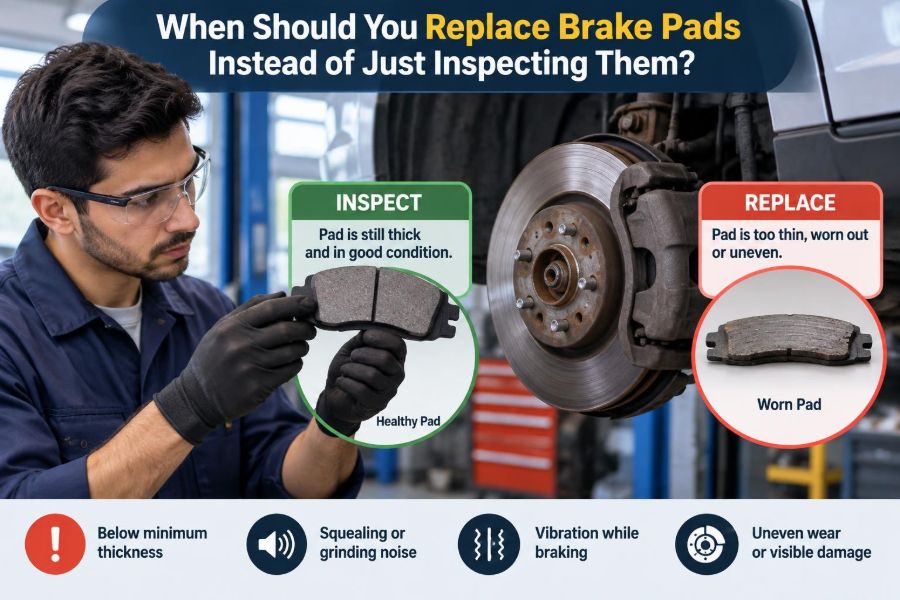
A brake inspection asks, “What is the current condition of this braking system?” Replacement asks, “Has a component reached the point where continued use is unsuitable?” These decisions are related but not identical.
Inspection may reveal plenty of usable pad material, even if there is light dust, minor surface discoloration, or an occasional noise. In that situation, cleaning, lubrication of approved contact points, or monitoring may be more appropriate than fitting new pads.
Replacement becomes justified when remaining material, damage, uneven wear, contamination, noise caused by a wear indicator, or a related fault means the pads cannot reliably continue in service. A good assessment examines both pads on an axle and the components that guide and clamp them.
📏 Remaining Friction Material Is the Primary Measure
The most direct replacement criterion is the thickness of the friction material remaining above the steel backing plate. A technician measures this with the wheel removed or, on some designs, through an inspection opening.
Manufacturers, pad suppliers, and workshops may use different service thresholds, so there is no single thickness that applies to every vehicle. However, once pad material is down to only a few millimetres, replacement planning should become immediate rather than casual. At very low thickness, the risk of the backing plate contacting the rotor rises sharply.
Do not confuse the total visible pad assembly thickness with friction-material thickness. The steel backing plate and any shim are not usable braking material. Ask for the measurement of the friction lining itself and whether the inner and outer pads differ.
⚠️ Why “A Few Millimetres Left” Needs Context
A pad with several millimetres remaining may be serviceable for a short period, but it may not be sensible to postpone replacement until the next distant service. Wear rate is not constant. Heavy city traffic, steep descents, towing, and repeated short trips can remove material much faster than relaxed highway driving.
For example, a vehicle used mostly on open roads may cover substantial distance with modest brake use. The same vehicle used for daily stop-start deliveries may consume pads rapidly, particularly at the front axle.
Brake-pad thickness is therefore a condition measurement, not a precise countdown clock. The practical question is whether enough material remains for the expected use before the next realistic opportunity for inspection or service.
🔔 A Squeal May Be a Wear Warning
Many pads include a small metal wear indicator. As the friction material approaches a low limit, the indicator touches the rotor and produces a high-pitched squeal during wheel rotation or braking.
This sound is meant to prompt service before metal-to-metal contact occurs. If the sound is consistent and changes with brake application, worn pads are a likely possibility and the brakes should be inspected promptly.
However, not every squeal means the pads are worn out. Moisture, light rotor corrosion after overnight parking, dust, glazing, or pad vibration can also make noise. Sound is a useful symptom, but visual measurement and system inspection determine the repair.
📡 Electronic Wear Sensors Need a Proper Diagnosis
Some vehicles use an electrical wear sensor embedded in or attached to a brake pad. When the pad reaches a specified wear point, the sensor circuit changes and a dashboard warning appears.
That warning should not be ignored simply because braking still feels normal. Depending on the design, the sensor itself may need replacement with the pads, and the vehicle may require a warning reset procedure after repair.
A warning can also result from damaged wiring, a connector problem, or an incorrect previous installation. The right response is inspection of pad thickness and the sensor circuit, rather than replacing parts solely to extinguish a lamp.
🧱 Replace Pads Immediately if the Backing Plate Is Near the Rotor
When friction material is almost gone, the steel backing plate can rub directly against the rotor. This often creates a harsh grinding or scraping sound, but drivers should not wait for that symptom.
Metal-to-metal contact damages the rotor surface, reduces braking quality, creates heat, and can turn a pad replacement into a larger repair involving rotors and possibly caliper inspection. Continued use also raises the chance of unpredictable braking behavior.
If grinding occurs during braking, minimize driving and arrange a prompt professional assessment. A vehicle may still stop, but that does not mean it is suitable for normal operation.
📐 Uneven Pad Wear Changes the Decision
Brake pads on the same axle should wear broadly similarly. Some inner-to-outer difference can occur because of caliper design, but a major difference is a diagnostic clue, not merely a reason to fit new pads.
An inner pad worn much thinner than its outer partner may indicate a sticking caliper piston. An outer pad worn disproportionately may point to seized or dry caliper guide pins. Pads that taper from one end to the other can suggest poor alignment, hardware problems, or caliper movement issues.
Replace worn pads, but also correct the cause. Otherwise, new pads may wear unevenly, drag on the rotor, overheat, or create a repeat repair soon afterward.
🧰 Caliper Slides and Pistons Must Move Freely
A floating caliper relies on guide pins or slide pins to center itself as the pads clamp the rotor. These components must move smoothly within their boots and use lubricant compatible with the brake system materials.
A seized slide can leave one pad doing more work than the other. A corroded or sticking piston can prevent a pad from releasing after braking, causing drag, heat, odor, rapid wear, and sometimes a vehicle pull.
Pad replacement is therefore not just a friction-material job. A competent service checks caliper movement, dust boots, mounting hardware, and the condition of the surfaces where pads slide in the bracket.
🔥 Heat Damage Can Make Replacement Necessary Early
Brake pads work at elevated temperatures, but excessive heat changes their behavior. Repeated hard braking, long downhill descents, a dragging caliper, or overloading can overheat pads and rotors.
Heat-affected pads may become glazed: their surface turns unusually smooth and hard, reducing consistent friction and sometimes causing noise. Severe overheating may discolor rotors, degrade pad bonding, damage shims, or affect nearby rubber components.
Not every discolored part requires automatic replacement. The repair decision depends on inspection, rotor condition, measured thickness, and the underlying cause. But pads showing cracking, crumbling, separation, or clear heat damage should not simply be monitored.
💧 Contamination Cannot Always Be Cleaned Away
Brake friction material is porous enough to absorb certain contaminants. Oil from a leaking seal, grease from an over-lubricated component, brake fluid, or some cleaning chemicals can reduce friction or cause erratic braking.
If contamination is limited to a removable surface deposit, a technician may determine that cleaning is appropriate. If fluid has soaked into the lining, replacement is generally the safer approach because its friction characteristics may not return predictably.
The leak or source of contamination must be repaired as well. Replacing pads without addressing a failed axle seal, caliper leak, or grease issue treats the symptom while allowing the same failure to recur.
🌧️ Surface Rust Is Often Normal, Deep Corrosion Is Not
After rain, washing, or humid storage, a thin orange film can appear on exposed rotor surfaces. The first few brake applications usually remove this light surface rust, sometimes with a brief scraping sound.
Longer parking periods can produce heavier corrosion. Rust may create pitting, roughness, or an uneven braking surface that prevents full pad contact. On rear brakes, especially where the vehicle is used infrequently, corrosion can be more pronounced.
Inspecting the rotor through the wheel is useful, but it is not enough to judge pad life. If corrosion has damaged the rotor’s working surface, pads may need replacement alongside rotor service because new pads must bed correctly against a sound surface.
🌀 Rotor Condition Determines Whether Pads Alone Are Enough
Brake pads and rotors operate as a matched friction pair. A rotor should have a reasonably even surface, sufficient thickness, and no cracks or serious heat damage. Its minimum permitted thickness is usually specified by the vehicle manufacturer.
Rotors with deep grooves, severe scoring, pronounced lips, cracks, excessive runout, or thickness variation may need replacement. Runout is sideways wobble as the rotor rotates; thickness variation can contribute to pedal pulsation during braking.
Fitting new pads onto a badly damaged rotor may lead to poor bedding, noise, vibration, and shorter pad life. Conversely, a rotor with light marks but acceptable thickness and surface condition may remain in service. Measurement is better than assumption.
🦶 Pedal Feel Is a Symptom, Not a Pad Gauge
A low, soft, spongy, or changing brake pedal should never be diagnosed as “worn pads” by default. Pad wear can slightly alter piston position, but hydraulic issues, air in the system, fluid loss, hose problems, and master-cylinder faults can also affect pedal feel.
A hard pedal with poor braking assistance may indicate a booster or vacuum-related issue rather than pad wear. Pedal pulsation may relate to rotor condition, wheel-bearing play, suspension components, or the braking system itself.
Any sudden change in pedal feel, stopping behavior, or warning lights deserves prompt inspection. Replacing pads without identifying the real cause may leave a safety-critical fault unresolved.
↔️ Pulling During Braking Requires More Than New Pads
If a vehicle pulls left or right under braking, one wheel may be generating more braking force than the other. A seized caliper, contaminated pad, hydraulic restriction, uneven rotor condition, tire problem, or suspension alignment issue can contribute.
New pads may be part of the repair, but they are not a reliable cure by themselves. A technician should compare the condition and movement of both sides of the axle and consider tire pressures, tire condition, and vehicle behavior.
A mild road-camber drift is different from a strong pull that appears specifically when braking. The latter should be investigated rather than accepted as normal.
🛻 Vehicle Use Can Shorten Pad Life Dramatically
There is no universal mileage interval for brake pads. The same model can need pads at very different distances because drivers, routes, loads, and climate impose different braking demands.
- Urban stop-start driving uses brakes frequently and often wears pads faster.
- Mountain roads demand repeated energy absorption on descents.
- Towing and carrying heavy loads increase the energy that brakes must dissipate.
- Frequent short trips can promote rotor corrosion because brakes may not reach stable operating conditions.
- Highway driving may reduce friction-pad wear but does not eliminate age, corrosion, or caliper issues.
Use pattern helps decide how often to inspect, but the pads should be replaced because of their measured condition, not because a generic interval has arrived.
🏁 Driving Technique Affects Wear Without Excusing Faults
Anticipating traffic, maintaining a safe following distance, and releasing speed early can reduce unnecessary braking. This lowers heat input and can extend pad and rotor life.
On long descents, selecting a lower gear where appropriate allows engine braking to share the load. This is especially valuable in heavier vehicles and automatic transmissions with manual or low-range modes.
These habits cannot compensate for faulty brakes. A dragging caliper will wear pads regardless of careful driving, and a warning light or grinding noise still requires inspection.
🔄 Replace Pads in Axle Sets
Brake pads should normally be replaced on both wheels of the same axle: both front wheels or both rear wheels. This helps maintain balanced braking force and consistent friction characteristics from side to side.
Replacing only one pad or one wheel’s pad set can create uneven response, particularly if the opposite side is already partly worn or made from a different friction formulation. The exception would be a specific diagnostic or repair situation directed by a qualified technician, not routine service practice.
Front and rear pads do not necessarily need replacement at the same time. Front brakes often wear sooner because weight transfers forward during deceleration, increasing front-axle tire load and braking demand.
🧩 Choose the Correct Pad Specification
Brake pads are offered in different friction formulations, including low-metallic, ceramic-type, and other application-specific designs. The best choice depends on the vehicle, rotor material, operating conditions, noise expectations, and manufacturer requirements.
A pad marketed as low-dust or performance-oriented may involve trade-offs in cold response, noise, rotor wear, or operating-temperature behavior. The objective is not to choose the most aggressive-sounding product; it is to choose a pad appropriate for the system.
For vehicles with advanced driver-assistance systems, electronic parking brakes, regenerative braking, or unusual duty cycles, correct fitment matters even more. Use parts from a reputable source that match the vehicle’s specified application.
⚡ Regenerative Braking Does Not Eliminate Pad Inspections
Hybrid and electric vehicles can use the traction motor as a generator during deceleration, recovering energy and reducing reliance on friction brakes in many situations. This can extend pad life.
However, less frequent friction-brake use can allow corrosion to develop on rotors and may contribute to stiff caliper slides or uneven pad movement, depending on environment and maintenance. Friction brakes are still required for stronger stops, emergency braking, and low-speed control.
Some vehicles periodically apply friction braking automatically to maintain rotor condition, but owners should still follow the manufacturer’s inspection schedule. Long pad life is not the same as a maintenance-free braking system.
🅿️ Electronic Parking Brakes Add Service Steps
Rear calipers with electric parking-brake motors often require a service mode before rear pads are replaced. This retracts or positions the mechanism correctly so it is not damaged during piston retraction.
Depending on the vehicle, service mode may require dashboard controls, a scan tool, or a specified procedure. Forcing the piston back without following the design’s requirements can damage the actuator or create fault codes.
This is one reason a pad job should begin with vehicle-specific information, not a one-size-fits-all method. The mechanical task is familiar, but the control system may not be.
🛠️ What a Thorough Brake Inspection Includes
A useful inspection considers the entire operating system, not only pad thickness. It should identify conditions that will affect the next set of pads or the vehicle’s stopping consistency.
- Friction-material thickness on inner and outer pads
- Rotor surface, thickness, corrosion, and damage
- Caliper piston and guide-pin movement
- Pad hardware, shims, clips, and contact surfaces
- Brake hoses, fluid leaks, and wear-sensor wiring where fitted
- Uneven wear patterns, overheating signs, and abnormal noise reports
On a road test, a technician may also assess noise, pull, vibration, warning lamps, and parking-brake operation. This wider view prevents a narrow pad measurement from concealing a more important defect.
📋 Questions to Ask When a Shop Recommends Pads
A recommendation is easier to evaluate when it is specific. You do not need to be a mechanic to ask for clear information about what was found and why replacement is advised.
- What is the remaining friction-material thickness on each pad?
- Are the inner and outer pads wearing evenly?
- Are the rotors within their specified thickness and in good surface condition?
- Is there any sign of a sticking caliper, seized slide, leak, or contamination?
- Will wear sensors, hardware, or brake fluid service be needed?
- What condition makes replacement urgent rather than something to monitor?
Photographs can be helpful when available, though a photo should support rather than replace proper measurements. Specific answers distinguish a condition-based repair from a vague sales recommendation.
🚫 Common Mistakes That Shorten Brake Life
One common mistake is waiting for grinding before arranging service. By then, inexpensive friction material may have been replaced by rotor damage and more extensive labor.
Another is fitting pads while ignoring seized hardware, badly corroded rotor surfaces, or a leaking caliper. The new pads may initially feel better but will not resolve the fault that caused the old pads to wear abnormally.
Other avoidable errors include contaminating pad faces with grease, using unsuitable lubricant on rubber components, failing to torque wheel fasteners correctly, and skipping the bedding-in procedure recommended for the installed pads.
📉 Why Cheap Repairs Can Cost More Later
The least expensive estimate may exclude hardware, rotor measurement, caliper service, wear-sensor replacement, or diagnostic time. That does not automatically make it wrong, but it makes comparison difficult.
A low-quality or incorrect pad can produce persistent noise, excessive dust, inconsistent feel, or accelerated rotor wear. Equally, replacing every related component automatically without measured need is not good maintenance.
The balanced approach is to repair what inspection supports: replace worn or compromised pads, address the root cause of irregular wear, and retain sound components that meet specifications. Value comes from correct work, not simply the smallest parts list.
🧪 Bedding-In Helps New Pads and Rotors Work Together
New pads need a controlled break-in process, often called bedding-in or burnishing. Moderate applications transfer a thin, even layer of pad material to the rotor surface, helping the friction pair develop stable behavior.
The exact process depends on the pad manufacturer and vehicle application. Aggressive repeated stops without proper cooling can overheat fresh pads, while extremely gentle use for too long may delay proper contact.
Follow the supplied instructions where available. During the first period after replacement, remain alert for unusual pulling, noise, smell, warning lights, or vibration; these are reasons for review rather than assumptions that “new brakes always do that.”
👨🔧 DIY Work Has Clear Limits
Experienced DIY technicians can replace brake pads on some vehicles, but the work requires correct tools, vehicle-specific procedures, safe lifting support, torque information, and a disciplined approach to cleanliness.
Brake work is not a good place for improvisation. A misplaced clip, damaged hose, incorrectly seated pad, contaminated rotor, or improper caliper fastener torque can create serious consequences.
Professional help is especially appropriate when there is pedal trouble, a pull, fluid leakage, electronic parking-brake service requirements, severe corrosion, repeated noise, ABS or brake warnings, or uncertainty about rotor and caliper condition.
🗓️ Build Inspection Into Normal Maintenance
Brake pads should be inspected at routine service intervals and before long trips involving heavy loads, mountain driving, or towing. An earlier inspection is sensible whenever a warning lamp, new noise, vibration, pull, burning smell, or change in braking response appears.
There is little value in checking pads daily, and there is risk in assuming they will last until a guessed mileage figure. Periodic condition checks provide a better balance between unnecessary work and delayed repair.
Keeping service records is useful. Notes on pad thickness, rotor condition, and any uneven wear create a trend that can reveal whether a vehicle’s brake wear is normal for its use.
✅ The Core Rule: Replace on Condition, Not Guesswork
Brake pads should be replaced when the usable friction material is near the relevant service limit, when a wear indicator or warning system confirms low material, or when the pads are damaged, contaminated, overheated, or wearing abnormally.
They should also be replaced as part of a justified repair when rotor condition, caliper faults, or hardware problems have compromised their ability to work predictably. Yet a squeak, dusty wheel, or calendar date alone does not always prove replacement is necessary.
The strongest decision combines measured pad thickness with an inspection of rotor condition, caliper movement, brake-system symptoms, and the vehicle’s expected use. That is the engineering mindset: assess the system, identify the failure mode, and repair the cause as well as the worn component.
Replace brake pads when their measured condition or a related fault makes continued service unsafe or unreliable—not simply because a symptom is inconvenient or an interval has passed. Regular inspection turns that decision from a guess into informed maintenance. 🚗🛞🔧