
On a busy motorway, traffic slows just enough to make a fixed-speed cruise-control setting uncomfortable. A vehicle ahead eases off the throttle; moments later, the gap begins to close. In a modern car, the driver may feel the vehicle gently reduce power and apply the brakes before the situation becomes urgent.
Later, in town, a distracted pedestrian steps from between parked vehicles or the car ahead brakes sharply at a junction. Here, the available time is much shorter, and the vehicle’s safety systems must decide whether a warning is enough or whether automatic braking is justified.
These actions can look almost intuitive from the driver’s seat. Underneath, however, they depend on sensors, mathematical models, prediction routines, and carefully designed safety rules running many times per second.
Adaptive Cruise Control (ACC) and Automatic Emergency Braking (AEB) are not substitutes for attentive driving. They are driver-assistance systems whose usefulness depends on understanding what their algorithms can see, what they infer, and where uncertainty remains.
🚘 Two Systems, Two Driving Jobs
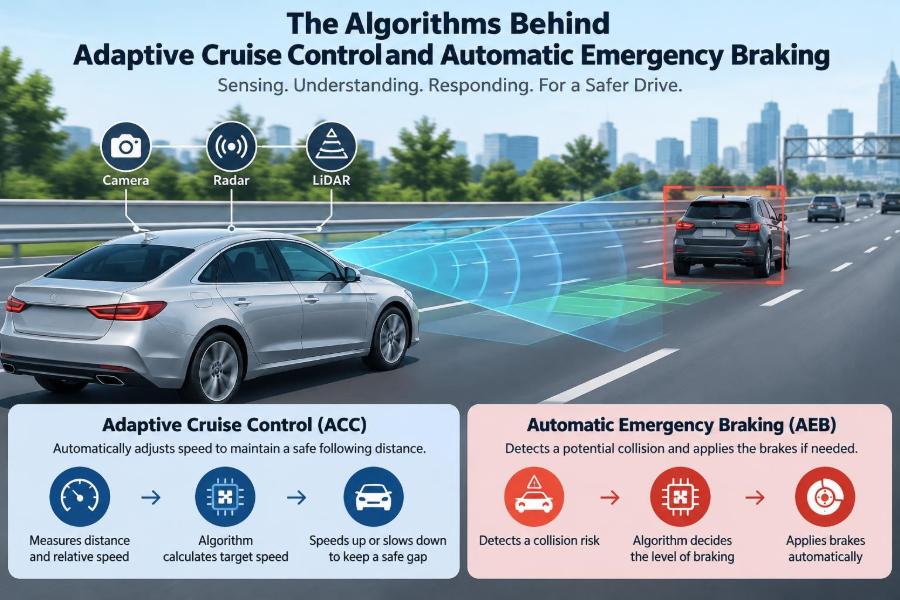
Adaptive Cruise Control is primarily a comfort and gap-management system. It maintains a driver-selected speed when the road is clear, then adjusts speed to follow a detected vehicle ahead at a chosen time gap.
Automatic Emergency Braking is primarily a collision-mitigation system. It monitors for a likely impact and can warn the driver, pre-charge or assist braking, and in some conditions apply brakes automatically.
The systems may share cameras, radar, and braking hardware, but their objectives differ. ACC aims for smooth, acceptable longitudinal control; AEB prioritizes acting soon enough to reduce impact risk.
🧠 The Basic Algorithmic Loop
Both functions follow a repeating perception-decision-action loop. Sensors collect evidence about the road scene, software estimates what that evidence means, a decision module selects a response, and actuators carry out the command.
- Perception: detect vehicles, pedestrians, lane markings, and other relevant objects.
- Estimation: calculate range, relative speed, object motion, and confidence.
- Prediction: estimate where the vehicle and objects may be shortly ahead.
- Control: request propulsion reduction, braking, warnings, or restraint preparation.
The loop runs repeatedly because the scene changes continuously. A single measurement is rarely sufficient for a safe decision.
📡 Radar and the Value of Direct Speed Measurement
Automotive radar transmits radio waves and analyses their reflections. It is especially useful for estimating the distance to an object ahead and its relative radial velocity, commonly using the Doppler effect.
If the lead vehicle is moving away more slowly than the host vehicle, radar can indicate that the gap is closing. Radar generally remains useful in darkness and can operate in many weather conditions, although heavy precipitation, object geometry, and interference can still affect performance.
Radar does not automatically understand every reflection. A bridge, guardrail, parked vehicle, or vehicle in another lane can create returns that must be classified and tracked correctly.
👁️ Cameras Add Scene Understanding
A forward-facing camera turns light into image data. Computer-vision algorithms can identify object classes such as cars, trucks, motorcycles, cyclists, and pedestrians, while also detecting lane boundaries, traffic signs, and brake lamps in suitable conditions.
Unlike radar, a camera can provide rich visual context. It can help distinguish a car in the driver’s lane from one travelling beside it, which is vital when ACC chooses a vehicle to follow.
Camera quality depends strongly on visibility. Glare, low sun, darkness, fog, rain on the lens, dirt, snow, and poor contrast can reduce reliability. The algorithm must account for this rather than treating every image result as equally certain.
🔦 Other Sensors in the Safety Stack
Some vehicles supplement radar and cameras with ultrasonic sensors, lidar, high-definition maps, wheel-speed sensors, steering-angle sensors, and inertial measurement units. Each adds a different piece of evidence.
Wheel speeds and inertial sensors help estimate the host vehicle’s own motion: speed, yaw rate, acceleration, and whether it is turning. These signals matter because an object’s apparent movement depends on both vehicles’ motion.
Lidar, where fitted, can create detailed range measurements using light pulses. It has useful strengths but, like every sensor type, has operating limitations related to weather, contamination, cost, and packaging.
🧩 Sensor Fusion Is More Than Averaging
Sensor fusion combines evidence from different sensors into a more reliable estimate than any individual sensor can usually provide. It is not simply averaging two distances; the software must decide which detections correspond to the same physical object and how trustworthy each measurement is.
For example, radar may supply a stable range and relative-speed estimate while a camera provides lane position and an object class. Together, they can support a more confident conclusion that the detected target is a car directly ahead.
Fusion also preserves uncertainty. If a camera is temporarily blinded by glare, its contribution may be reduced. If radar produces an ambiguous reflection, image and motion information may prevent an inappropriate brake request.
📍 Building an Object Track
A detected object becomes useful only when the system can follow it over time. An object track is a continuously updated record containing estimated position, velocity, direction, size or class, and confidence.
Tracking helps separate a real vehicle from momentary noise. It also allows the controller to estimate whether an object is accelerating, braking, cutting in, or leaving the lane.
Many tracking methods use a prediction-and-correction pattern. The software predicts where an object should be at the next instant, compares that expectation with the new sensor reading, and updates the track accordingly.
📐 Coordinate Systems Make Motion Comparable
Algorithms commonly describe surrounding objects in coordinates relative to the host vehicle. The longitudinal direction points forward and backward; the lateral direction points left and right.
A vehicle 35 metres ahead is not necessarily an ACC target. Its lateral position relative to the predicted driving path matters. A vehicle in the adjacent lane may be close in range but should not cause the host car to follow or brake unnecessarily.
When the road curves, lane and path estimation become more difficult. The system must distinguish an object that is physically ahead on the curve from one that merely appears near the forward line of sight.
🛣️ Selecting the Relevant Lead Vehicle
ACC must choose the object that matters most for longitudinal control. This is often called target selection or lead-vehicle selection.
The algorithm considers several cues: lane boundaries, host-vehicle trajectory, object position, heading, relative speed, and track confidence. It may also consider how stable the target has been over recent time steps.
A classic difficult case is a bend with a truck in the adjacent lane. Braking for the truck when the driver’s lane is clear feels intrusive; ignoring a vehicle actually in the lane is unsafe. This trade-off explains why target selection is a core engineering problem, not a simple nearest-object rule.
⏱️ Time Gap Is ACC’s Main Following Rule
ACC usually follows a time gap rather than a fixed physical distance. The desired gap grows with speed, because a faster vehicle travels farther in each second and generally needs more room to respond.
A simplified desired-distance model is:
desired distance = standstill offset + (selected time gap × host speed)The standstill offset prevents the desired distance from falling to zero in slow traffic. The selected time gap is often adjustable by the driver, though the available settings and their behavior differ by vehicle.
📉 Relative Speed Explains Closing Risk
Distance alone does not reveal urgency. A 25-metre gap can be comfortable at low speed but demanding if the host vehicle is rapidly approaching a slower vehicle.
The key quantity is relative speed: the host vehicle’s forward speed compared with the target’s forward speed. If the host is faster, the range is closing; if it is slower, the gap is opening.
Algorithms use relative speed both to control ACC smoothly and to identify whether a collision threat is developing.
⌛ Time to Collision Is a Useful, Imperfect Signal
Time to collision (TTC) estimates how long it would take to reach an object if current relative motion continued unchanged. In a simple straight-line closing case, it can be approximated by dividing range by closing speed.
TTC ≈ range / closing speedReal traffic rarely remains unchanged. The lead vehicle may accelerate, the host vehicle may steer, or the object may leave the lane. Therefore, TTC is a valuable trigger input, not a complete collision prediction on its own.
AEB algorithms combine TTC with object classification, braking capability, path overlap, sensor confidence, and other checks before escalating intervention.
🔮 Predicting Paths Instead of Freezing the Scene
A capable safety system predicts short-term trajectories for both the host vehicle and detected objects. This is especially important at junctions, on curves, and when a cyclist or pedestrian is moving across the road.
A simple prediction may assume nearly constant velocity over a short interval. More advanced models can include likely turning behavior, road geometry, steering input, and object type.
Prediction remains uncertain. A pedestrian may stop, reverse direction, or be occluded. Good algorithm design does not pretend that uncertainty disappears; it weighs possible outcomes and sets appropriate response thresholds.
⚖️ The Trade-off Between Misses and False Brakes
A safety system faces two undesirable errors. A false negative occurs when it fails to detect or respond to a genuine hazard. A false positive occurs when it warns or brakes despite no meaningful collision risk.
False negatives can leave the driver without expected assistance. False positives can surprise the driver, disrupt traffic, and reduce trust in the system. Neither can be eliminated in every imaginable scenario.
Engineering teams tune detection and braking thresholds to manage this trade-off. That is why AEB normally requires stronger evidence before full braking than before giving an initial warning.
🚨 AEB Escalates Rather Than Jumping Straight to Full Braking
AEB commonly uses stages. The exact sequence varies by manufacturer and vehicle, but the underlying logic is often progressive.
- Detect a potential conflict and estimate its severity.
- Provide a visual, audible, or haptic forward-collision warning.
- Prepare the braking system or increase brake-assist sensitivity.
- Apply partial or full automatic braking if the threat remains credible and urgent.
If the driver brakes decisively, the system may support that action rather than competing with it. The intended result is to avoid the crash where possible or reduce impact speed where avoidance is no longer feasible.
🦶 Brake Assist Recognizes Emergency Intent
Some drivers press the brake pedal quickly but do not apply enough force to reach maximum braking, particularly under surprise. Brake assist algorithms infer emergency intent from pedal speed, pedal force, or related signals.
When conditions warrant it, brake assist can request higher hydraulic brake pressure than the pedal input alone would produce. Anti-lock braking system (ABS) control then works to preserve wheel rotation and steerability under heavy braking.
This is different from AEB initiating braking without a pedal request, although the functions can work together in the same safety event.
🎛️ ACC Control Must Feel Predictable
Once ACC has chosen a target and desired gap, it must convert that goal into acceleration or deceleration commands. A controller compares actual distance and relative speed with the desired values, then adjusts throttle, regenerative braking where available, and friction braking.
Comfort matters. Abrupt acceleration, repeated brake-throttle oscillation, or overly sharp deceleration can make a technically correct system unpleasant and can unsettle passengers.
Control logic therefore limits acceleration, deceleration, and jerk, which is the rate at which acceleration changes. Smoothness is not merely a luxury; it helps make automated longitudinal control predictable.
🔋 Regenerative and Friction Braking Need Coordination
Electrified vehicles can use the drive motor as a generator during deceleration, recovering some energy into the battery. This is called regenerative braking.
ACC and AEB braking requests may need to be shared between regeneration and conventional friction brakes. The available regenerative torque can depend on battery state, temperature, motor speed, traction conditions, and system limits.
For an emergency stop, the priority is required deceleration and stability, not energy recovery. The brake-control system must blend sources without causing a delayed or inconsistent pedal and vehicle response.
🧱 Vehicle Dynamics Set the Physical Boundaries
No algorithm can create tire grip that is not available. Wet, icy, loose, or uneven surfaces can lengthen stopping distances and alter how much stable braking force each wheel can transmit.
ABS, electronic stability control, and traction-control functions monitor wheel behavior and help manage these limits. ACC and AEB must operate within the capability reported by the brake and stability systems.
A vehicle carrying a heavy load, towing a trailer, descending a slope, or travelling on low-grip pavement may behave differently from the nominal conditions assumed by a simple stopping model.
🌧️ Weather, Contamination, and Visibility Limits
Rain, fog, snow, spray, dirt, ice, and direct sunlight can degrade sensor performance. A camera lens may lose contrast; radar returns may become less clear; lane markings may be hidden; and the road surface may offer reduced friction at the same time.
Vehicles may display a message when a sensor is blocked or a driver-assistance function is unavailable. Drivers should treat this as a meaningful limitation, not as a minor dashboard inconvenience.
Cleaning sensor areas according to the vehicle manual and maintaining clear glass can help, but it does not make the system immune to difficult conditions.
🚶 Vulnerable Road Users Are a Harder Detection Problem
Pedestrians, cyclists, and motorcyclists have smaller, more variable shapes than passenger vehicles. Their movement can be less predictable, and they may be partly hidden by parked cars, street furniture, or larger vehicles.
Camera classification is particularly valuable here, but classification alone is insufficient. The system also needs to judge whether paths are likely to intersect and whether an intervention is physically achievable.
Drivers should never assume AEB will detect every vulnerable road user in every light, weather, speed, or crossing situation. Sight lines and speed remain the driver’s responsibility.
🔀 Cut-Ins, Cut-Outs, and Stop-Start Traffic
Traffic creates situations that change rapidly. When another car cuts into the gap, ACC must identify it, reassess the desired following distance, and respond without excessive delay or harshness.
When a lead vehicle changes lanes away, a previously hidden stationary or slower object may suddenly become visible. This is often a more demanding case because the host vehicle has less time to establish a reliable track and react.
In stop-start traffic, systems may follow at very low speeds and sometimes resume after a brief stop. The driver must understand the specific vehicle’s operating rules, including whether a pedal press or steering-wheel command is required to resume.
🛑 Stationary Objects Require Careful Judgment
A stationary object in the travel path can be a genuine obstacle, but it can also be an overhead sign, bridge structure, drain cover, or object outside the usable lane. This makes indiscriminate braking unsafe.
Algorithms use road geometry, object shape, track history, and path prediction to decide whether a stationary return is relevant. These judgments can be challenging when the lead vehicle changes lane and exposes an obstacle late.
This limitation is one reason drivers must continue scanning ahead, particularly at motorway speeds and around stopped traffic.
🧪 Validation Happens in Simulation and on the Road
Engineers develop ACC and AEB using simulation, controlled test tracks, hardware-in-the-loop rigs, and real-world vehicle testing. Simulation can reproduce numerous scenarios efficiently, including rare edge cases that are difficult to encounter safely on public roads.
Track testing uses controlled targets, defined approach speeds, lane arrangements, and surface conditions. It helps verify sensing, braking, warning timing, and vehicle dynamics without exposing road users to unnecessary risk.
No test programme can reproduce every future road scene. Validation therefore focuses on defined operating conditions, systematic scenario coverage, fault handling, and conservative behavior when confidence is low.
🧾 Functional Safety and SOTIF Address Different Questions
Functional safety concerns hazards caused by electrical or electronic faults: for example, a failed sensor signal, corrupted communication, or an unintended actuator command. Systems use diagnostics, redundancy where appropriate, monitoring, and safe fallback behavior to reduce such risks.
Safety of the Intended Functionality, often abbreviated SOTIF, considers hazards that can arise even when components have not failed. A camera may function correctly yet face a visually ambiguous scene; an algorithm may have insufficient information to classify it safely.
The distinction matters because reliable hardware alone does not guarantee reliable interpretation of a complex road environment.
🔐 Cybersecurity Protects the Decision Chain
Driver-assistance systems rely on networks that connect sensors, electronic control units, braking systems, and diagnostic interfaces. Cybersecurity engineering aims to prevent unauthorized access, manipulated messages, and compromised software updates.
Secure design includes controlled update processes, authentication, monitoring, and separation of critical functions where appropriate. The goal is to preserve the integrity of the information used for safety decisions.
For owners, using authorized service procedures and keeping approved vehicle software current can be part of maintaining the system’s intended operation.
🧑✈️ The Driver Remains the Supervising Decision-Maker
ACC can reduce routine workload on suitable roads, but it does not understand every road rule, temporary sign, emergency vehicle, or human intention. AEB can react quickly in certain conflicts, but it may not prevent every crash.
Hands on the wheel, attention on the road, and sufficient following distance still matter. Drivers should be ready to steer, brake, or accelerate when conditions require it, and should not use ACC as permission to disengage from driving.
The owner’s manual describes sensor locations, speed ranges, alerts, and known restrictions for a particular vehicle. Those details are more dependable than assumptions based on a similarly named feature in another model.
🛠️ Practical Habits That Support System Performance
Good driving habits make the algorithms’ job easier and preserve a margin when they cannot help.
- Set a following gap that suits visibility, road grip, traffic flow, and personal reaction time.
- Keep camera areas, radar covers, windscreen sections, and number plates clean where relevant.
- Do not fit accessories, repairs, paint films, or decals over sensor areas unless approved for the vehicle.
- Pay attention to warnings that indicate blocked sensors, unavailable assistance, or braking-system faults.
- After collision repair or windscreen replacement, follow manufacturer procedures for any required sensor alignment or calibration.
These steps do not turn ACC or AEB into autonomous driving, but they reduce avoidable sources of degraded performance.
⚠️ Common Misunderstandings to Avoid
One misunderstanding is that ACC will always stop for any obstacle. Its behavior depends on system design, speed, target classification, operating conditions, and the scenario. Another is that AEB makes tailgating acceptable; it does not.
Drivers may also mistake a warning or brief brake pulse for proof that the system will handle the entire event. Warnings are prompts to act, not evidence that the vehicle has taken over responsibility.
Finally, a clean dashboard with no warning messages does not mean the road scene is easy for sensors. Low sun, unusual loads, sharp curves, and partial occlusions can still challenge perception.
🔗 Why ACC and AEB Work Better as a System
ACC, forward-collision warning, brake assist, AEB, ABS, and stability control form a connected chain. Perception identifies a potential issue; longitudinal control manages ordinary gaps; emergency logic escalates when ordinary control is no longer enough; braking and stability functions execute the request within physical limits.
The systems may share information but should not be confused. An ACC deceleration is usually a comfort-oriented response to gap error, whereas AEB is an urgent safety response to a credible collision threat.
Seeing the whole chain helps engineers diagnose faults and helps drivers interpret what the vehicle is doing.
🏁 The Core Engineering Takeaway
The central challenge is not simply detecting an object. It is estimating, under uncertainty, whether that object lies in the vehicle’s future path, how quickly the conflict is developing, and what response is both safe and physically achievable.
ACC uses this reasoning to maintain speed and spacing with acceptable comfort. AEB uses it to identify imminent threats and intervene when delay could make a meaningful difference.
Both functions depend on sound sensing, robust fusion, credible prediction, well-tuned thresholds, dependable brake control, and a driver who remains engaged with the road.
Adaptive Cruise Control and Automatic Emergency Braking are best understood as probability-aware assistants: they turn imperfect sensor evidence into timely support, but safe driving still depends on human attention and real-world physics. 🚗📡🛑