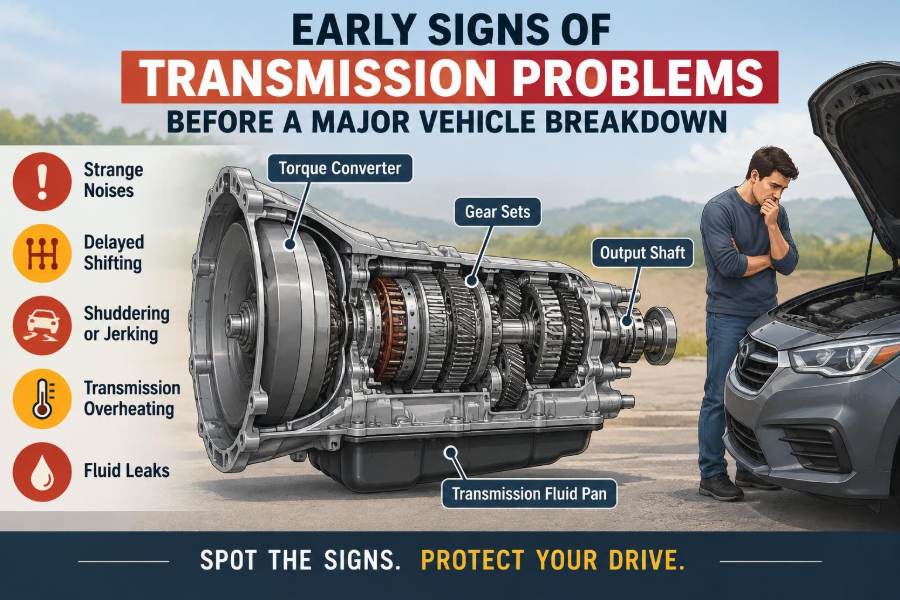

A vehicle can feel almost normal right up until the moment it does not. Perhaps it hesitates while joining traffic, shudders in a car park, or takes an extra second to move after the selector is placed in Drive. Many drivers notice these moments, then dismiss them because the car still gets them home.
That is understandable. A transmission problem rarely announces itself with a single, perfectly clear symptom. The same rough shift might come from low fluid, a worn engine mount, an electronic control issue, or normal behaviour in a cold vehicle. The useful question is not whether every unusual sensation means failure, but whether a new, repeatable change deserves investigation.
The transmission is responsible for matching engine power to road speed. In automatic, manual, continuously variable, hybrid, and dual-clutch systems, it does this in different ways, but the warning signs often follow the same pattern: delayed response, abnormal noise, slipping, overheating, or a change in shift quality.
Recognising those signs early can prevent a small service issue from becoming a roadside breakdown or extensive internal damage. It also helps students and working professionals describe symptoms accurately when speaking with a technician.
⚙️ What the Transmission Actually Does
A transmission varies the ratio between engine speed and wheel speed. Lower gears multiply torque for pulling away and climbing; higher gears reduce engine speed during cruising. It must transfer power smoothly while responding to throttle demand, vehicle load, temperature, and driver input.
In a conventional automatic transmission, hydraulic fluid, clutches, bands, planetary gearsets, valves, and electronic solenoids work together. A manual transmission relies on a driver-operated clutch and mechanical gear engagement. A CVT uses variable pulleys and a belt or chain, while many hybrids use electrically managed gear arrangements.
Because the design differs, the exact symptom can differ too. Still, any drivetrain that no longer engages, shifts, or transmits power predictably requires attention.
🧭 Know Your Vehicle’s Normal Behaviour First
Some transmissions hold lower gears when cold, downshift on a steep hill, or briefly delay an upshift under firm acceleration. A CVT may allow engine speed to rise and remain steady while vehicle speed catches up. These can be normal, design-specific behaviours.
The most useful baseline is your own vehicle’s usual behaviour under similar conditions. Notice how it reverses out of a driveway, shifts during a gentle commute, and responds after warming up. A symptom is more meaningful when it is new, worsening, or reliably tied to a particular situation.
⏳ Delayed Engagement When Selecting Drive or Reverse
After selecting Drive or Reverse, a healthy vehicle should engage within a short, consistent interval. A noticeable pause followed by a bump or surge can indicate that pressure is building slowly or that an internal clutch pack is not applying as cleanly as it should.
Low or degraded transmission fluid is one possible cause. Internal seal wear, valve-body faults, solenoid problems, and selector-linkage issues can also produce delayed engagement. Do not compensate by raising engine speed before engagement; that can turn a delayed apply into a harsh shock load.
📉 Slipping: Engine Speed Rises Without Matching Acceleration
Transmission slipping occurs when engine speed increases but vehicle acceleration does not follow as expected. In an automatic, the tachometer may flare during a shift or when climbing. In a manual, engine revs may rise under acceleration while road speed builds slowly, often most obvious in a higher gear.
Friction elements need adequate clamping force and suitable friction characteristics. Low fluid, overheated fluid, worn clutch material, hydraulic leakage, or control faults can prevent that. Occasional traction-control intervention on a slippery surface is different: it usually comes with wheelspin-related indicators and occurs only when grip is limited.
🪜 Harsh, Jerky, or Abrupt Gear Changes
A hard shift feels like a jolt, thump, or unusually sharp change in vehicle motion. It may happen only between certain gears, only after warming up, or only at light throttle. The driver may also feel a pronounced bump when slowing down as the transmission downshifts.
Harsh shifting does not automatically mean internal damage. Control software adaptation, a sticking solenoid, deteriorated fluid, incorrect fluid level, engine performance faults, or worn mounts can all contribute. What matters is a shift quality change that persists rather than an isolated rough change during unusual driving conditions.
🔄 Hunting Between Gears
Gear hunting means repeated upshifts and downshifts when road speed and throttle position appear relatively steady. It is often noticed on rolling roads or mild inclines, where the transmission seems unable to choose and hold an appropriate ratio.
A transmission may legitimately hunt somewhat when towing, climbing, or driving into a strong headwind. Persistent hunting on familiar, level routes may point to sensor input problems, fluid-pressure issues, software calibration concerns, or a powertrain fault that makes the requested torque unpredictable.
🎚️ A Shudder During Take-Off or Light Acceleration
A shudder is a rapid vibration or judder rather than a single hard shift. In conventional automatics, it can occur as the torque converter clutch applies at moderate speed. In CVTs, it may appear during take-off or ratio changes. Dual-clutch systems may feel rough during low-speed clutch engagement.
The source is not always the transmission. Engine misfires, damaged driveshaft joints, brake drag, wheel issues, and worn mounts can create similar sensations. A useful observation is timing: note the speed, gear range, throttle opening, and whether the engine is hot or cold when it happens.
🔊 Whining, Humming, and Other New Noises
A transmission-related whine may rise and fall with vehicle speed, engine speed, or gear selection. Low fluid can allow a pump to draw air, while worn bearings or gear damage may create more persistent noises. A hum that changes only with road speed can also come from tyres or wheel bearings, so diagnosis should not rely on sound alone.
Grinding deserves particular attention. In a manual, it may occur when selecting a gear because the clutch is not fully disengaging or synchronisers are worn. In an automatic, a grinding or metallic sound accompanied by poor movement is a reason to stop driving and arrange assessment.
🧪 Why Transmission Fluid Is More Than Lubricant
Automatic transmission fluid commonly lubricates components, carries heat away, transmits hydraulic pressure, and provides carefully engineered friction behaviour for clutches. CVT fluid and dual-clutch fluid are also highly specific to the system. They are not interchangeable simply because they look similar.
Manual gear oil mainly lubricates gears and bearings, although the exact specification still matters for synchroniser operation. Using an unapproved fluid can alter shift feel or damage components over time. Always use the manufacturer’s specified fluid and filling procedure rather than choosing by colour or generic label.
🌡️ Overheating and the Smell of Burnt Fluid
Overheating accelerates fluid degradation and can damage friction materials, seals, and electronic components. A burnt smell after heavy towing, steep climbing, deep sand, or prolonged stop-start strain may be an early warning that the transmission has been working beyond its thermal comfort zone.
Some vehicles display a transmission-temperature warning or enter a reduced-power mode. If this happens, follow the owner’s manual, reduce load if safe, and allow the system to cool as directed. Continuing to tow or repeatedly accelerating hard after an overheating warning can make an initially recoverable problem worse.
🟤 Fluid Colour, Level, and Leaks
Fluid appearance can offer clues, but it is not a complete diagnosis. Fresh fluid may be red, amber, greenish, or another colour depending on its specification. Darkening can occur with age, while a sharp burnt odour or visible debris may justify prompt professional inspection.
Check fluid only if the vehicle manual provides a method. Many modern transmissions have no owner-accessible dipstick and require a particular fluid temperature, engine state, and level surface. An incorrect check can lead to an incorrect refill, and overfilling can aerate fluid and cause shifting faults.
- Look for fresh drips beneath the transmission or cooler lines.
- Check whether a leak is red, amber, or clear rather than assuming its source.
- Record where the vehicle was parked and whether the level changes over time.
💡 Warning Lights and Transmission Messages
A check-engine light may illuminate for a transmission-related fault because the powertrain control module monitors gear ratio, sensor signals, solenoid circuits, and clutch operation. Some vehicles also show a specific transmission warning, a flashing gear indicator, or a message to service the drivetrain.
A warning light does not identify the failed part. Diagnostic trouble codes are starting points, not replacement instructions. A code for an incorrect gear ratio, for example, may result from low fluid pressure, a sensor fault, clutch slip, wiring damage, or an internal mechanical issue.
🛡️ Limp Mode Is a Protective Strategy
When the control system detects a serious or potentially damaging condition, it may limit available gears, reduce engine torque, or hold one fixed gear. This is commonly called limp mode or fail-safe mode. The vehicle may feel slow and may not shift normally.
Its purpose is to help prevent further damage and allow limited movement to safety, not to support normal commuting. If limp mode returns after restarting, or is accompanied by overheating, leaks, severe noise, or smoke, avoid extended driving and seek qualified assistance.
🧷 Manual-Transmission Clutch Warning Signs
Manual-transmission concerns are often blamed on the gearbox when the clutch or clutch-release system is actually at fault. A high clutch bite point, slipping under load, difficulty selecting gears at a stop, or a pedal that feels unusually soft, stiff, or slow to return can all provide clues.
For example, difficulty selecting first or reverse with the engine running, but easy selection with the engine off, can suggest clutch drag. That means the clutch is not fully separating the engine from the transmission. Hydraulic faults, cable adjustment, release-bearing problems, or clutch wear may be involved.
📐 CVT Symptoms Have Their Own Pattern
A CVT does not always create the stepped shift sensation familiar from a conventional automatic. During acceleration, engine speed may climb to an efficient or high-power point while road speed continues to increase. That characteristic alone is not slipping.
Concerning CVT signs include new juddering, delayed response when selecting a range, abnormal whining, overheating messages, or engine speed flaring with weak acceleration compared with the vehicle’s normal behaviour. CVTs are particularly sensitive to correct fluid specification and service procedures.
⚡ Dual-Clutch and Automated Manual Behaviour
Dual-clutch transmissions use electronically controlled clutches to preselect gears. They can shift very quickly at speed, yet feel less smooth during low-speed manoeuvres because clutches must engage and disengage much like those in a manual vehicle.
A slight hesitation in traffic may therefore be characteristic. Persistent shuddering, overheating warnings, inability to select a gear, repeated fault messages, or worsening engagement quality is not something to normalise. The distinction depends on whether the behaviour matches the manufacturer’s description and the vehicle’s past pattern.
🔌 Sensors, Solenoids, and Wiring Can Mimic Mechanical Failure
Modern transmissions depend on inputs such as vehicle speed, turbine speed, temperature, throttle demand, brake status, and gear-selector position. Solenoids direct hydraulic fluid through the valve body according to commands from the control module.
A corroded connector, damaged wiring, weak sensor signal, or sticking solenoid can cause late shifts, harsh shifts, or fail-safe operation without a broken gearset. This is why systematic diagnosis matters. Replacing a transmission before checking fluid condition, electrical supply, grounds, and scan data can be unnecessarily expensive.
🔩 Do Not Overlook Mounts, Axles, and Engine Faults
Powertrain mounts restrain engine and transmission movement. When they deteriorate, a normal gear engagement can feel like a hard thump because the assembly moves excessively. A worn constant-velocity joint, driveshaft issue, or differential fault may also be felt as vibration or clunking during acceleration.
Engine misfires and intake or fuel-system problems can make shifts feel poor because the transmission receives uneven torque. A good diagnosis considers the complete powertrain rather than treating every drivability complaint as a transmission failure.
🧾 A Symptom Log Makes Diagnosis More Efficient
Intermittent faults can disappear by the time a workshop sees the vehicle. A concise log gives useful context and reduces guesswork. It is more valuable than the vague description, “It shifts badly sometimes.”
- Record the date, outside temperature, and whether the vehicle was cold or fully warmed.
- Note speed, selected range, road gradient, throttle input, and whether towing or carrying a load.
- Describe the sensation: flare, shudder, bang, delay, whine, vibration, or loss of drive.
- Photograph warning messages safely when parked, and retain service records.
🧰 What a Proper Diagnostic Process Looks Like
A technician may begin with a road test, visual inspection, scan-tool check, and review of service history. Fluid level and condition may be checked using the manufacturer’s procedure. Electrical tests can assess sensor signals, solenoid circuits, and wiring integrity.
Further work can include hydraulic pressure testing, inspection of pan debris where applicable, adaptation checks, or module software updates. No single test answers every question. The goal is to separate external control or maintenance faults from internal wear before authorising major repair work.
🚫 Common Responses That Can Make Things Worse
Ignoring a recurring slip is risky because friction surfaces generate heat when they are not fully locked. Repeated hard acceleration to “clear” a hesitation can add load precisely when the system is struggling. Likewise, shifting abruptly between Drive and Reverse before the vehicle stops stresses clutches, gears, and mounts.
Another common mistake is adding a generic fluid additive or topping up with whatever fluid is available. Additives may change friction characteristics, and incorrect fluid can create symptoms that resemble the original fault. Diagnose first; use approved products only when appropriate.
🛢️ Fluid Service: Helpful, but Not a Universal Cure
Correctly performed fluid service can restore protection and shift quality when deterioration or an incorrect level is involved. It does not rebuild worn clutch packs, repair broken hard parts, or cure every electronic fault. A service recommendation should fit the vehicle’s service schedule, fluid condition, operating history, and diagnosed concern.
Be cautious about assuming that any fluid change caused a pre-existing failure merely because symptoms became obvious afterward. Equally, do not assume a fluid change is harmless in every neglected transmission. The right approach is to discuss risks, procedure, and manufacturer guidance with a competent workshop.
🚚 Towing, Heat, and Severe Use
Towing, mountain driving, dense urban traffic, repeated launches, and heavy payloads increase transmission heat and load. A vehicle that behaves normally on an empty commute may reveal a marginal cooling, fluid, or clutch problem when asked to pull a trailer.
Use the vehicle’s rated towing limits and any recommended tow mode. Tow mode generally changes shift strategy to reduce gear hunting and manage heat; it does not increase the vehicle’s mechanical capacity. Severe use may also justify a different maintenance interval specified by the manufacturer.
🅿️ Habits That Reduce Unnecessary Stress
Good driving habits cannot eliminate age-related wear, but they can reduce avoidable strain. Come to a complete stop before changing between Drive and Reverse. Apply the parking brake before releasing the service brake when parked on an incline, so the parking pawl is not carrying the entire vehicle load.
Allow a cold vehicle to move gently at first rather than demanding full power immediately. Avoid holding a vehicle on a hill using throttle alone; use the brake or hill-hold function. These practices benefit the whole driveline, not just the transmission.
🛑 When You Should Stop Driving
Some symptoms warrant stopping rather than monitoring. These include loss of drive in a traffic situation, smoke, a strong burning smell, a major fluid leak, loud grinding, repeated severe jolts, or an overheating warning that does not clear according to the manual’s instructions.
If the vehicle will not reliably engage a gear, do not repeatedly rev it in an attempt to force movement. Arrange recovery where practical. Continuing can spread debris through the fluid, overheat friction material, or leave the vehicle stranded in a more dangerous location.
🧠 Separating Urgency From Panic
Not every delayed shift requires a new transmission, and not every noise is drivetrain damage. Temperature, operating mode, road grade, and electronic calibration can all affect how a vehicle feels. A calm, evidence-based assessment is better than either denial or alarm.
The practical threshold is simple: if a behaviour is new, repeatable, worsening, linked to a warning light, or affecting safe control of the vehicle, arrange diagnosis. Early assessment often gives more repair options than waiting for total loss of drive.
🔍 A Practical Pre-Appointment Checklist
Before booking a diagnostic visit, gather information without dismantling anything or adding fluid blindly. Clear observations help a workshop reproduce the concern and identify whether it is related to the transmission, engine, driveline, or electronics.
- Check the owner’s manual for warning-light meanings and approved operating advice.
- Write down the symptoms and the conditions in which they occur.
- Look for obvious leaks and confirm whether other dashboard warnings are present.
- Bring maintenance history, including prior fluid services and repairs.
- Explain whether the vehicle tows, carries heavy loads, or has recently had battery, engine, or driveline work.
✅ The Core Principle: Act on Changes, Not Assumptions
Transmission failures are often preceded by smaller changes in engagement, shift quality, noise, temperature, or warning messages. Those signs do not identify the exact fault by themselves, but they provide an opportunity to investigate while the vehicle still operates.
Watch for patterns, use the correct fluid and maintenance procedures, and avoid treating a warning symptom as normal simply because the vehicle remains drivable. A methodical diagnosis protects both the vehicle and the owner from unnecessary repairs or preventable damage.
A transmission is easiest to protect when its first change in behaviour is treated as useful information rather than something to drive through. 🚗⚙️🛠️