
A driver approaching a busy intersection is already processing a remarkable amount of information: a pedestrian near the kerb, brake lights ahead, a cyclist filtering through traffic, a speed-limit sign partly hidden by a tree, and the changing signal phase. Much of this happens so quickly that it feels automatic.
Modern vehicles are increasingly given a second set of “eyes” to assist with that workload. Cameras behind the windscreen, in mirrors, and around the body capture the road scene, while computer software turns pixels into useful warnings or driving decisions.
This capability is called computer vision. It supports familiar driver-assistance features such as parking cameras and lane-departure warnings, and it is also a central technology in vehicles designed to drive under limited or highly automated conditions.
Understanding what computer vision can see, what it can infer, and where it can fail is essential for automobile engineers. A useful system is not simply one that recognizes objects in ideal daylight; it must behave predictably amid glare, rain, unusual road layouts, and human uncertainty.
👁️ What Computer Vision Means in a Vehicle
Computer vision is the use of algorithms to extract meaning from images or video. In automotive applications, a camera provides a stream of frames, and the vision system identifies road boundaries, vehicles, people, signs, traffic lights, and other relevant features.
A camera image is initially just an array of coloured or brightness values. The engineering task is to transform that raw data into information such as “a pedestrian may enter the lane” or “the vehicle is drifting toward the lane marking.”
Unlike ordinary photography, automotive vision must work in real time. Its output must be accurate enough, fast enough, and communicated clearly enough to support a safety-related action.
🧠 From Pixels to Driving Understanding
Vision processing is usually arranged as a pipeline. The system captures an image, corrects or prepares it, detects relevant features, tracks them over time, estimates their position and motion, and passes results to a decision-making function.
For example, a forward camera may identify a car in successive frames. By observing how its apparent size and image position change, the system can estimate whether the gap is closing and whether a forward-collision warning may be appropriate.
Modern systems often use machine-learning models, particularly deep neural networks, for perception. These models learn visual patterns from large labelled datasets, but they still require engineering checks for unusual scenes and known failure modes.
📷 The Automotive Camera as a Sensor
Automotive cameras are designed for a harsher job than a phone camera. They must tolerate vibration, temperature changes, dust, water, and long operating hours while preserving useful detail across bright and dark regions.
Common camera locations include the windscreen-facing front camera, rear parking camera, mirror or wing cameras, grille cameras, and interior driver-monitoring cameras. Their placement determines both their field of view and the obstructions they may encounter.
Lens choice matters. A wide-angle lens sees more of the nearby scene but distorts straight lines and may provide less detail for distant objects. A narrow field of view reaches farther ahead but can miss objects approaching from the side.
🌈 Why Image Quality Changes with Conditions
A vision algorithm can only use the information captured by the sensor. Strong sun behind a pedestrian may create silhouette and glare; entering a tunnel can cause a sudden exposure transition; rain droplets can scatter light and blur markings.
High dynamic range imaging helps preserve detail in both shadows and bright areas. Camera exposure control, image signal processing, lens heating, and cleaning strategies are therefore practical safety considerations, not just image-quality refinements.
Even good hardware has limits. Engineers must define what the system should do when confidence falls, rather than assuming every image can be interpreted correctly.
🛣️ Lane Detection and Lane-Keeping Support
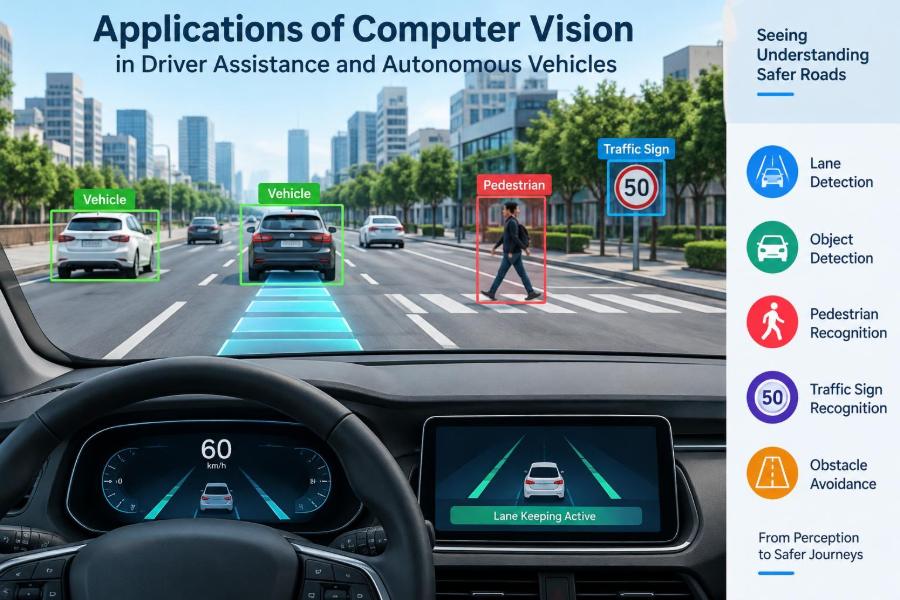
Lane detection estimates the boundaries that organize traffic flow. Earlier approaches often searched for painted line patterns using edges, colour, and geometric models. Current systems may combine these cues with learned scene understanding.
The result can support lane-departure warning, lane-keeping assistance, or lane-centering functions. A warning system may alert the driver when an unintended drift is detected, while steering assistance can apply a limited corrective input.
Lane markings are not always visible or consistent. Construction zones, worn paint, snow, shadows, merges, and roads without marked lanes make this task much harder. The vehicle must not treat a tentative lane estimate as unquestionable fact.
🚘 Vehicle Detection and Following Distance
Detecting other vehicles allows driver-assistance systems to identify potential conflicts and maintain a safer following gap. A camera can classify a region as a car, truck, motorcycle, or sometimes a more general road user.
Vision alone can estimate relative movement, but distance estimation may be uncertain when object size is unknown or visibility is poor. Many vehicles therefore combine camera information with radar, which is particularly useful for measuring range and relative speed.
For adaptive cruise control, perception is only one part of the problem. The system must also decide which detected vehicle is actually in the host vehicle’s path, especially when lanes curve or vehicles are changing lanes.
🚶 Pedestrian and Cyclist Recognition
Vulnerable road users are visually complex. Pedestrians vary in clothing, posture, height, and movement, while cyclists may be partly hidden by parked vehicles or appear from side streets with little warning.
Vision models look for characteristic shapes and motion patterns, but recognition is not enough. The system must estimate whether a person is relevant to the vehicle’s future path. Someone standing safely on a pavement presents a different risk from someone stepping toward a crossing.
Occlusion is a major challenge. A pedestrian concealed behind a van may not be visible until late, which shows why a vehicle cannot “see through” objects simply because it has a camera.
🚦 Reading Traffic Signs and Signals
Traffic-sign recognition detects signs and interprets their meaning, such as speed limits, no-entry restrictions, or warning signs. This can inform the driver through the instrument display and can support functions such as intelligent speed assistance.
Traffic-light recognition requires more than finding a coloured spot. The system must identify the correct signal for the vehicle’s movement, distinguish it from lights for other lanes, and cope with reflections, sun glare, and temporary signals.
Map information can help contextualize what the camera sees, but maps can become outdated. A robust design treats signs, signals, maps, and vehicle motion as complementary sources rather than relying blindly on one source.
🅿️ Parking Vision and Surround-View Systems
Low-speed manoeuvring is one of the clearest applications of computer vision. Rear-view cameras reveal obstacles behind the vehicle, while multiple wide-angle cameras can create a synthetic overhead or surround-view image.
The overhead view is not a literal camera position above the car. Software corrects lens distortion and stitches images from several cameras into a useful composite. Imperfect calibration can produce seams or misleading object placement near the vehicle.
Parking assistance may show predicted path lines based on steering angle, detect kerbs, or identify cross-traffic. Drivers should still look directly around the vehicle, because a displayed image may not reveal every low, narrow, or moving obstacle.
↔️ Blind-Spot and Rear Cross-Traffic Awareness
Side and rear cameras can help identify vehicles, cyclists, or pedestrians outside the driver’s direct field of view. This is especially useful during lane changes and when reversing from a parking space.
Camera-based blind-spot functions may be paired with radar because each sensor sees different aspects of the scene. Radar can maintain range information in conditions where visual contrast is weak, while cameras provide rich classification information.
A dashboard icon or mirror warning is only useful when the driver understands its scope. It does not remove the need for a shoulder check, because a fast-approaching vehicle or an object hidden by vehicle structure may not be detected in time.
⚠️ Forward-Collision Warning and Automatic Braking
Forward-collision warning uses perception and motion estimates to identify a possible rear-end impact. It may alert the driver through sound, visual indication, or haptic feedback when the predicted closing situation becomes concerning.
Automatic emergency braking can then apply braking if the driver does not respond sufficiently and the system judges intervention appropriate. The details vary by vehicle, speed, target type, road friction, and system design.
These functions are designed to reduce risk, not eliminate it. A dirty camera, sharp crest, sudden cut-in, or uncertain target classification can constrain performance, so the driver remains responsible in systems intended for driver supervision.
😴 Driver Monitoring with Interior Vision
Computer vision also looks inward. An interior camera may estimate head pose, eye direction, eyelid behaviour, or whether the driver appears to be facing the road.
Driver-monitoring systems can support warnings when attention seems to be reduced, particularly when a lane-centering or other assistance function is active. They are not medical devices and cannot reliably infer every cause of fatigue or distraction.
Interior sensing raises privacy questions. Vehicle designers need clear data policies, appropriate security, and careful choices about whether images are processed locally, stored, or transmitted.
🧩 Object Detection, Classification, and Tracking
These three terms describe related but distinct tasks. Detection locates an object, often with a bounding box. Classification assigns a category, such as pedestrian or bicycle. Tracking maintains the object’s identity across consecutive frames.
Tracking reduces instability caused by individual noisy frames. If a cyclist is observed repeatedly, the system can estimate trajectory and speed more reliably than it could from a single image.
| Task | Typical question | Driving use |
|---|---|---|
| Detection | Where is an object? | Locate a vehicle ahead |
| Classification | What kind of object is it? | Distinguish a cyclist from roadside clutter |
| Tracking | How is it moving over time? | Predict whether it may cross the path |
| Segmentation | Which pixels belong to each region? | Separate drivable road from kerb or grass |
🗺️ Semantic Segmentation and Drivable Space
Semantic segmentation labels image pixels by category, such as road, lane marking, pavement, vehicle, sky, or vegetation. It provides a richer scene representation than a few detected boxes.
For automated driving, the key question is often not merely “where is the road?” but “which area is currently safe and permitted to drive through?” Construction cones, temporary barriers, kerbs, and parked vehicles can change the answer.
Segmentation may struggle where categories blend visually, such as a faded kerb against wet asphalt. System designers must combine visual output with geometry, maps, motion, and other sensors.
📐 Estimating Depth from Cameras
A single camera sees a three-dimensional scene projected onto a two-dimensional image. Depth can be inferred from perspective, familiar object sizes, motion, and learned visual cues, but the estimate has uncertainty.
Stereo vision uses two cameras separated by a known distance. Nearby objects appear at different image positions in the two views, a difference called disparity. Larger disparity generally indicates a closer object.
Depth estimation becomes difficult for textureless surfaces, reflective objects, low light, or distant targets. Calibration between cameras is critical; a small alignment error can produce a significant range error.
📡 Sensor Fusion: Cameras Are Not Alone
Automotive perception often combines cameras with radar, lidar where fitted, ultrasonic sensors, wheel-speed signals, inertial sensors, and satellite-based positioning. This is called sensor fusion.
Cameras are strong at recognizing colours, text, shapes, and lane markings. Radar is valuable for range and motion measurement, including in many adverse weather conditions. Lidar can provide detailed three-dimensional geometry, though its performance, cost, and packaging characteristics differ by implementation.
Fusion is not automatically safer simply because more sensors are added. The system must synchronize their data, handle disagreements, and recognize when one sensor is degraded.
⏱️ Time-to-Collision and Motion Prediction
Perception answers what is present now; planning needs an estimate of what may happen next. A simple measure is time-to-collision, based on relative distance and closing speed when two objects remain on the same path.
Real traffic is more complicated because paths change. A vehicle may turn away, a pedestrian may stop at the kerb, or a cyclist may swerve around a drain cover. Prediction systems therefore represent possible future paths rather than asserting one certain outcome.
Conservative behaviour can reduce risk, but excessive false alarms or unnecessary braking may create new hazards and cause drivers to lose trust. Calibration of these trade-offs is a central engineering challenge.
🧭 Localization and Visual Odometry
An automated vehicle needs to know not only what is around it, but also where it is. Visual odometry estimates vehicle movement by comparing features across image frames, such as building edges, poles, or road texture.
This technique can supplement satellite positioning and inertial sensors, especially where satellite signals are weak or reflected by tall buildings. However, a repetitive tunnel wall or snow-covered road may provide too few reliable visual features.
High-definition maps can improve localization by matching observed landmarks to mapped features. They should be treated as aids, because roadworks and changed infrastructure can make a map incomplete.
🧑⚖️ Levels of Automation and Driver Responsibility
Driver assistance and automated driving are not interchangeable terms. Many production features provide steering or speed support while expecting the human driver to supervise the environment and take over when necessary.
A more automated system may perform the complete dynamic driving task only within a defined operational design domain, or ODD. The ODD can specify road type, speed range, weather, geography, time of day, and other conditions.
Marketing language can create dangerous expectations. The relevant question is always: what task is the system designed to perform, under what conditions, and who must respond when conditions fall outside its capability?
🌧️ Weather, Lighting, and Dirty-Lens Limitations
Rain, fog, snow, road spray, glare, darkness, and lens contamination reduce visual information in different ways. Fog lowers contrast over distance; sun glare can saturate parts of an image; droplets and mud may hide critical regions entirely.
Vehicles may detect a blocked camera and display a warning, but detection itself is not perfect. Heated lenses, washer systems, protective placement, and redundancy can improve availability, yet no arrangement makes visual perception immune to the environment.
For engineers, degraded conditions should be tested deliberately rather than treated as rare exceptions. For drivers, a camera warning is a reason to inspect and clean the relevant area when it is safe to do so.
🏗️ Construction Zones and Unusual Road Scenes
Temporary traffic management exposes a gap between ordinary road patterns and real-world variety. Cone layouts, temporary lane markings, workers’ gestures, shifted lanes, and uncovered surfaces may not resemble the scenes used to train a model.
Other difficult cases include emergency vehicles parked at an angle, a hand-held stop sign, an object falling from a truck, or a person directing traffic. These examples illustrate why automated systems need explicit operating boundaries and cautious fallback behaviour.
Testing must include unusual but plausible situations. The aim is not to predict every possible event exactly, but to identify uncertainty and avoid unjustified confidence.
🧪 Training Data and the Long-Tail Problem
Machine-learning vision systems learn from examples. If training data overrepresents clear daytime roads, the model may perform less consistently on night scenes, regional sign styles, unusual vehicles, or pedestrians with atypical clothing and mobility aids.
The long-tail problem refers to the huge number of rare situations that matter but occur infrequently. A roadway scene can combine several uncommon factors at once: rain, low sun, a temporary lane shift, and an obscured cyclist.
Data diversity, targeted collection, simulation, and carefully designed evaluation sets all help. They do not remove the need for real-world validation and ongoing safety analysis.
🔍 Validation, Verification, and Scenario Testing
Verification asks whether a system was built correctly according to its requirements. Validation asks whether it is appropriate for its intended use. Both are essential when computer vision contributes to vehicle behaviour.
Testing can include recorded data, controlled tracks, hardware-in-the-loop simulation, software simulation, and supervised road trials. Each method reveals different problems: simulation helps create difficult repeatable scenes, while real driving exposes sensor effects and human behaviour that models may simplify.
A strong test programme measures not only successful detections but also false positives, missed detections, response timing, degraded operation, and interaction with other vehicle systems.
🛡️ Functional Safety and Intended-Function Safety
Functional safety considers hazards caused by faults, such as a camera communication failure or corrupted data. Engineers use diagnostics, monitoring, fault handling, and fail-safe or fail-operational strategies according to the vehicle function.
A separate concern is whether the system behaves safely when components are working as designed but perception is limited or the scenario is outside expectations. A camera may function perfectly yet misinterpret an unusual visual scene.
These perspectives lead to practical safeguards: confidence estimates, sensor plausibility checks, driver alerts, restricted operating domains, and controlled transitions when automation cannot continue safely.
🔐 Cybersecurity and Data Protection
Camera feeds and perception outputs are valuable vehicle data. If an attacker interfered with sensor communication, software updates, or processing units, safety-relevant functions could be affected.
Secure software development, authenticated updates, network separation, monitoring, and incident-response planning are part of responsible automotive engineering. Security must be considered across the vehicle life cycle, not added after a feature is released.
Privacy also deserves attention. Exterior cameras may capture public scenes, while interior cameras can reveal sensitive behavioural information. Data minimization and transparent handling policies help align technical capability with responsible use.
🔧 Calibration, Service, and Repair Considerations
A camera’s mounting angle and position are fundamental to its interpretation of the world. Windscreen replacement, bumper repair, suspension changes, or a minor collision can affect calibration, depending on the vehicle design.
Many vehicles require a specified calibration procedure after relevant repairs. This may use targets in a workshop, a driving-based procedure, or both. Skipping the procedure can leave an assistance feature operating with inaccurate assumptions.
Technicians need correct service information, clean sensor surfaces, suitable equipment, and an understanding of diagnostic messages. Advanced driver-assistance systems are as much a service discipline as a design discipline.
🧰 Practical Habits for Drivers and Fleet Operators
Driver-assistance features work best when users understand their limits. The owner’s manual and instrument-panel messages explain which sensors support a feature, how activation is indicated, and when the system may be unavailable.
- Keep camera and sensor areas clean, especially after snow, mud, or road spray.
- Do not assume a warning covers every direction or every type of hazard.
- Maintain attention and hands or feet ready where the vehicle requires supervision.
- Arrange calibration after repairs specified by the manufacturer.
- Report repeated unexpected warnings or unavailability for proper diagnosis.
Fleet operators should include sensor inspection and driver education in routine procedures. Repeated short trips, dirty industrial sites, and frequent minor damage can affect system availability more than drivers expect.
⚖️ Benefits, Trade-Offs, and Human Factors
Computer vision can reduce workload in routine tasks, provide earlier awareness of hazards, and support intervention when a driver reacts too slowly. It can also make parking and low-speed manoeuvres more manageable.
However, automation can encourage overreliance if its capability is misunderstood. Frequent nuisance alerts may lead users to ignore warnings, while sudden system disengagement may leave too little time for a disengaged driver to respond.
Good human-machine interface design matters. Alerts should be timely, distinguishable, and proportionate to urgency. The system should communicate its state clearly so the driver knows whether it is observing, warning, assisting, limited, or unavailable.
🔮 Emerging Directions in Automotive Vision
Vision systems are progressing toward richer scene understanding, more efficient on-vehicle processing, improved camera resolution, and models that combine images with radar, maps, and language-like scene descriptions. The practical value of each advance depends on verification, cost, energy use, and integration.
Some designs are exploring thermal cameras to improve detection in low-light conditions, while others are using better sensor cleaning and redundant camera coverage. These additions bring their own calibration, packaging, and validation requirements.
The future is unlikely to depend on one perfect sensor or one perfect algorithm. It will depend on layered systems that recognize uncertainty and manage it safely.
🎓 Skills Automobile Engineers Need
Work in automotive computer vision crosses mechanical, electrical, software, and systems engineering. Useful foundations include vehicle dynamics, embedded computing, image processing, control systems, sensor calibration, networking, safety engineering, and data analysis.
Engineers do not all need to train neural networks, but they should understand the difference between a model’s output and physical truth. They must be able to ask practical questions: What does this confidence score mean? What happens in glare? How is the sensor diagnosed? What does the vehicle do when it cannot decide?
Clear communication is equally valuable. Perception teams, chassis teams, safety engineers, service technicians, and end users need a shared understanding of system limits.
✅ The Core Principle: Perception Must Be Managed, Not Assumed
Computer vision gives vehicles a powerful way to interpret lanes, road users, signs, obstacles, and driver state. It enables many useful assistance functions and is indispensable to most concepts of automated driving.
Yet a camera does not understand the road as a human does, and a model output is not a guarantee. Safe automotive design combines perception with sensor fusion, robust engineering, scenario testing, clear interfaces, maintenance requirements, and realistic limits on where automation can operate.
The most capable system is therefore not the one that claims to see everything. It is the one that recognizes what it knows, detects when it is uncertain, and responds in a way that preserves safety.
Computer vision becomes genuinely valuable in vehicles when its strengths are paired with disciplined engineering, informed supervision, and honest treatment of its limitations. 🚗👁️🛣️