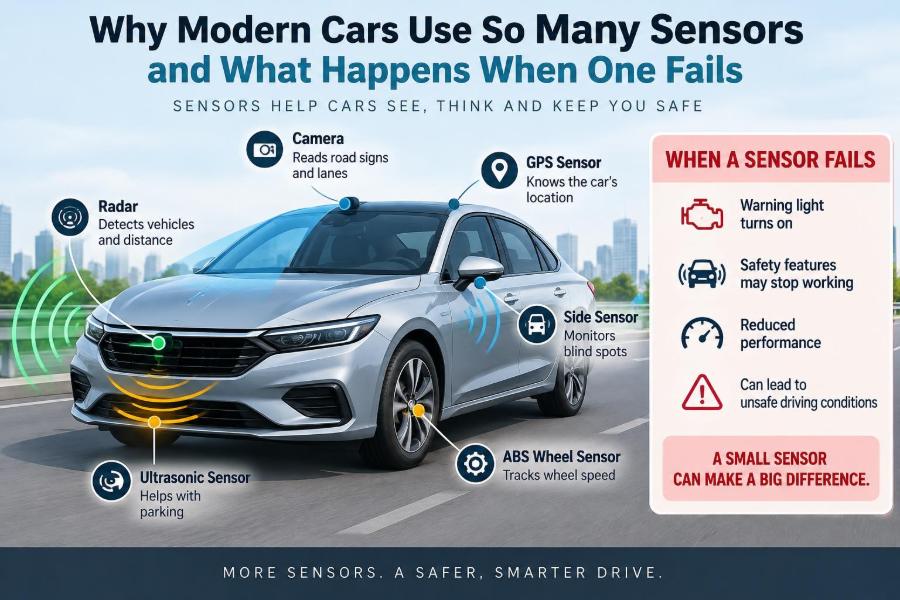

You are driving normally when an amber warning light appears. The car may still feel fine, but the dashboard says there is a problem with the engine, tyres, braking system, or driver assistance features. It is tempting to assume that one small electronic component cannot matter much.
In a modern vehicle, that small component may be the source of information used by several control systems at once. A sensor can influence fuel injection, automatic braking, gear changes, stability control, airbag decisions, battery charging, and the display in front of the driver.
Cars have become safer, cleaner, more efficient, and more capable partly because they can measure what is happening around and inside them. The trade-off is that an inaccurate signal can make a healthy mechanical part look faulty—or prevent a system from operating at full capability.
Understanding sensors helps drivers respond sensibly to warnings and helps engineering students see how mechanical, electrical, and software systems now work as one vehicle.
🧠 A Car Needs Information Before It Can Make Decisions
A sensor is a device that detects a physical condition and converts it into an electrical signal. Depending on its design, it may measure temperature, pressure, speed, position, acceleration, gas concentration, light, distance, or electrical current.
An electronic control unit, usually called an ECU, interprets that signal. The ECU then commands an actuator: a fuel injector, cooling fan, throttle motor, valve, brake modulator, warning lamp, or another output device.
In this sense, sensors are the vehicle’s senses. An ECU without reliable sensor inputs is like a driver trying to steer through fog with a speedometer, mirrors, and road signs all giving conflicting information.
📈 Why Sensor Counts Have Increased So Much
Older vehicles used many mechanical controls and had relatively simple electrical systems. Modern regulations, emissions targets, safety expectations, convenience features, and electrification require much finer control than a purely mechanical arrangement can provide.
For example, precise fuel delivery needs information about engine speed, intake air, throttle demand, exhaust oxygen, and temperature. Electronic stability control needs each wheel’s speed, vehicle rotation, steering angle, and acceleration.
Sensor growth is therefore not just about adding gadgets. It supports control strategies that continuously adapt to changing loads, weather, road surfaces, component temperature, and driver demand.
🔄 The Basic Sensor-to-Action Control Loop
Most automotive systems operate as a feedback loop. A sensor reports the present condition, the ECU compares it with a desired condition, and an actuator makes a correction. The sensor then reports again.
Consider engine cooling. The coolant temperature sensor reports temperature; the ECU decides whether fan operation is required; the fan changes airflow; and the next sensor reading confirms whether the temperature is falling.
This repeated process can happen many times per second. The response must be fast enough for the task, but it must also reject electrical noise and occasional abnormal readings rather than reacting wildly to every signal fluctuation.
⚙️ Engine Speed and Position Sensors
The crankshaft position sensor tells the ECU crankshaft speed and angular position. This information is fundamental because the ECU needs to know when each cylinder should receive fuel and ignition.
A camshaft position sensor adds information about which stroke a cylinder is completing. Together, these inputs support sequential fuel injection and variable valve timing on many engines.
If a crankshaft signal disappears entirely, an engine may stall or refuse to start. Some faults are intermittent: vibration, heat, or damaged wiring can briefly interrupt the signal, producing a difficult-to-reproduce starting or stalling complaint.
🌬️ Measuring Air Entering the Engine
An engine needs an appropriate air-fuel ratio for efficient combustion and emissions control. A mass airflow sensor estimates the mass of air entering the intake, while a manifold absolute pressure sensor measures intake pressure. Many engines use one approach primarily and the other as a cross-check or backup input.
A contaminated airflow sensor can under-report or over-report intake air. The ECU may then deliver too little or too much fuel, causing rough idle, hesitation, poor fuel economy, or an emissions warning.
These symptoms do not prove the sensor is faulty. An intake leak, restricted air filter, damaged duct, or wiring problem can create similar readings, which is why diagnosis must look beyond a fault code.
🔥 Oxygen Sensors and Exhaust Feedback
Oxygen sensors, often called lambda sensors, monitor oxygen content in exhaust gas. Their signal helps the ECU adjust fuelling during normal operation so the catalytic converter can reduce harmful exhaust pollutants effectively.
Many vehicles have sensors both before and after the catalytic converter. The upstream sensor is closely involved in fuel-control feedback, while the downstream sensor helps the ECU assess converter performance and monitor the system.
A slow or failed sensor can increase fuel consumption and emissions, but exhaust leaks, fuel-system problems, and engine misfires can also generate oxygen-sensor-related codes. Replacing the sensor without finding the cause can waste both parts and time.
🌡️ Temperature Sensors Protect Components
Temperature affects combustion, lubrication, battery performance, material expansion, and electronic reliability. Modern cars may measure coolant, intake air, oil, exhaust, transmission fluid, cabin air, refrigerant, battery cells, and electric motor temperatures.
A coolant temperature sensor influences cold-start fuelling, radiator-fan operation, dashboard information, and overheating protection. If it reports an implausibly cold engine, the ECU may enrich the mixture longer than needed. If it reports excessive heat, the ECU may limit power or activate a warning strategy.
Temperature sensors are simple in principle, but their surrounding environment is harsh. Heat cycling, corrosion at connectors, and damaged insulation are common reasons for unreliable signals.
🛞 Wheel-Speed Sensors Enable More Than ABS
Each wheel-speed sensor detects how quickly its wheel is rotating. Anti-lock braking systems use this information to identify a wheel approaching lock-up and to modulate brake pressure.
The same data often supports traction control, electronic stability control, hill-start functions, tyre-pressure monitoring strategies, speedometer operation, and some advanced driver-assistance features. One sensor can therefore affect several dashboard messages.
A wheel-speed fault may come from the sensor itself, but it can also result from a damaged tone ring, a corroded wheel bearing encoder, debris, or a broken harness near the suspension. The location is especially exposed to water, salt, stones, and repeated movement.
🧭 Steering Angle, Yaw, and Acceleration
Stability control must determine whether the car is moving in the direction the driver intends. It compares steering-angle input with wheel speeds, lateral acceleration, and yaw rate, which is the vehicle’s rotation around its vertical axis.
If a vehicle begins to understeer or oversteer, the system can reduce engine torque and apply braking to selected wheels. It cannot repeal the limits of tyre grip, but it can help the driver regain a more stable path in many situations.
After alignment work, steering-component replacement, or battery-related issues on some models, a steering-angle sensor may need calibration. A mechanically straight steering wheel does not always mean the electronic reference is correctly learned.
🛑 Brake Pressure and Pedal Sensors
Brake systems increasingly measure driver demand electronically. A brake-pedal position sensor or switch may inform brake lights, engine torque reduction, regenerative braking coordination, cruise-control cancellation, and automatic emergency braking readiness.
Brake-pressure sensors help the control unit assess how strongly the hydraulic system is being applied. This supports functions such as brake assist, electronic brake-force distribution, and fault monitoring.
Because braking is safety-critical, a detected sensor fault commonly disables selected assistance functions and illuminates a warning. Conventional hydraulic braking may remain available, but the driver should never assume that every braking feature is still operating normally.
🧯 Airbag Sensors Make Millisecond Decisions
Airbag systems use accelerometers, impact sensors, seat-occupancy sensors, seat-belt buckle switches, and sometimes pressure sensors in doors. The restraint control module evaluates direction, severity, occupant status, and belt use before deciding which restraints to deploy.
It is not simply a case of “impact equals airbag.” Deployment logic is designed to distinguish events that require restraint deployment from those that do not, using multiple signals and stored calibration data.
An airbag warning lamp deserves prompt professional attention. A fault may disable part of the supplemental restraint system, and probing connectors or resistance circuits incorrectly can create further faults or safety risks.
📏 Parking Sensors, Cameras, and Proximity Detection
Ultrasonic parking sensors send sound pulses and estimate distance from the returning echo. Cameras provide visual information, while radar sensors use radio waves and can work in conditions where a camera view is limited.
These systems are useful aids, not substitutes for checking surroundings. A low object, soft surface, narrow post, dirty sensor face, or unusual angle can reduce detection reliability.
A bumper repair, repaint, tow-bar installation, or minor impact may affect sensor alignment or signal transmission. When a parking system gives a continuous warning or stops working after bodywork, the sensor installation deserves inspection as well as electronic scanning.
📡 Radar, Cameras, and Driver Assistance
Adaptive cruise control, lane-support functions, blind-spot monitoring, and automatic emergency braking may use radar, cameras, and sometimes other sensing technologies. Each has strengths: radar measures relative distance and speed well, while cameras can identify lane markings, signs, and object shapes.
Sensor fusion combines inputs so that a system can make better decisions than it could from one source alone. However, fusion does not make a system infallible; poor visibility, road geometry, obstruction, or unusual objects can still challenge recognition.
Drivers should treat these features as assistance. The vehicle handbook specifies operating limits, and warnings about blocked or unavailable sensors should not be ignored.
🌧️ Weather, Dirt, and Sensor Obstruction
A camera behind the windscreen may be affected by condensation, ice, mud, glare, or a wiper pattern that leaves its viewing area dirty. Radar covers can be affected by thick snow, dirt, damage, or unsuitable paint repairs.
Ultrasonic parking sensors may behave erratically when coated with ice or heavily soiled. Even a tyre-pressure sensor can appear faulty when a low battery, severe temperature change, or incorrect relearn procedure is involved.
Cleaning sensor areas carefully is sensible maintenance. Abrasive products, high-pressure water at very close range, or aftermarket coverings placed over sensor zones can create new problems rather than solving the original one.
🔌 Wiring Is Often the Real Fault
When a diagnostic scan names a sensor circuit, it does not necessarily condemn the sensor. The ECU is reporting that it received a signal outside its expected range, no signal, or an electrically implausible condition.
The cause might be a loose connector, corrosion, rubbed-through wire, poor ground, water ingress, weak reference voltage, or damage caused during previous repairs. Rodent damage and harness strain near moving suspension parts are practical examples.
Good diagnosis follows the circuit: verify the complaint, inspect the installation, check power and ground where applicable, assess signal quality, and compare live data with realistic operating conditions.
🧪 What a Diagnostic Trouble Code Actually Means
A diagnostic trouble code, or DTC, is a structured message stored when a module detects a fault condition. It is a starting point for testing, not a complete repair instruction.
For instance, a code referring to an intake-air signal may mean the signal is too high, too low, implausible compared with another sensor, or absent. Each description points to a different testing path.
Freeze-frame data can be valuable because it records certain operating conditions when the fault was detected, such as engine temperature, speed, or load. This context can help distinguish a cold-start issue from a fault that appears only during acceleration.
🖥️ Live Data Is More Useful Than Guesswork
A scan tool can display live sensor readings while the vehicle operates. Technicians can compare coolant temperature with ambient conditions after an overnight stop, inspect wheel-speed signals during a road test, or look for unrealistic throttle and pressure values.
The useful question is not merely whether a number appears on the screen. It is whether the number is plausible, stable when it should be stable, responsive when conditions change, and consistent with related inputs.
For complex faults, an oscilloscope may reveal waveform interruptions that a basic scan tool misses. This is especially relevant for fast signals such as crankshaft, camshaft, and some wheel-speed sensors.
⚠️ Fail-Safe and Limp-Home Strategies
Manufacturers program many ECUs to respond safely when a sensor fails. The ECU may substitute a default value, use a related sensor, limit engine torque, run a cooling fan, disable a driver-assistance function, or restrict transmission operation.
This is often called fail-safe or limp-home operation. Its purpose is to reduce risk and allow limited mobility, not to certify that the vehicle is safe for normal use or long journeys.
A reduced-power message can be frustrating, but repeatedly overriding it or continuing to drive aggressively can turn a manageable sensor or wiring issue into overheating, catalyst damage, drivetrain stress, or a roadside breakdown.
🚦 Why Some Failures Feel Serious and Others Do Not
A sensor’s effect depends on its role, the available backups, and the fault strategy. A failed external temperature sensor may mainly affect displayed information and climate-control refinement. A failed crankshaft signal can stop the engine entirely.
| Sensor group | Typical consequence of a fault | Practical response |
|---|---|---|
| Engine timing or fuel-control sensors | Stalling, no-start, rough running, reduced power | Avoid unnecessary driving; diagnose promptly |
| Wheel-speed and stability sensors | ABS or stability assistance may be unavailable | Drive cautiously and arrange inspection |
| Airbag and restraint sensors | Part of the restraint system may be disabled | Seek qualified service promptly |
| Parking and ADAS sensors | Assistance functions may be limited or unavailable | Use direct observation and correct the fault |
The warning colour, message, symptoms, and vehicle handbook all matter. A red warning generally calls for a more urgent response than an information message, but the manufacturer’s guidance takes priority.
🔋 Sensors in Hybrid and Electric Vehicles
Hybrid and electric vehicles add high-voltage battery, inverter, electric motor, insulation-monitoring, charging, and thermal-management sensors. Their control systems need accurate data to protect battery cells, regulate power delivery, and manage heating or cooling.
Battery-management systems monitor parameters such as cell voltage, current, and temperature. They use these measurements to estimate operating limits and to balance cells where the design permits.
High-voltage components require specific training and safe isolation procedures. A warning involving the high-voltage system should not be treated as a do-it-yourself electrical task, even by someone comfortable with conventional 12-volt vehicle work.
🌱 Emissions Systems Depend on Reliable Measurement
Modern emissions control uses temperature, pressure, oxygen, and gas-composition information to manage catalytic converters, exhaust-gas recirculation, particulate filters, and, on some diesel vehicles, exhaust after-treatment systems.
A differential-pressure sensor can help indicate restriction across a particulate filter. Exhaust temperature sensors help the ECU control temperatures during operating strategies that protect components or support filter regeneration.
These systems are interconnected. A pressure code may reflect a blocked sensing hose, while a repeated regeneration problem may have an underlying engine, thermostat, injector, or driving-pattern cause. Reading only the final code can hide the real fault path.
🧰 Common Diagnosis Mistakes to Avoid
The most expensive approach is often replacing whichever part a scan tool mentions first. Modern vehicles have too many shared circuits and interdependent systems for that shortcut to be reliable.
- Clearing codes before recording them: this erases useful fault context.
- Ignoring low battery voltage: weak supply voltage can trigger multiple unrelated-looking messages.
- Using poor-quality replacement sensors: inaccurate calibration or connector fit can create recurring faults.
- Skipping calibration: cameras, radar, steering sensors, and tyre systems may need a specified setup procedure.
- Assuming no warning means no problem: some faults are intermittent or have not yet met the conditions needed to set a code.
🛠️ Repairs May Require Calibration, Not Just Replacement
Some sensors work immediately after installation, while others need coding, initialization, or calibration. The procedure tells the ECU what a normal reference looks like and confirms the physical installation is correctly aligned.
A forward-facing camera may need calibration after windscreen replacement. Radar alignment may be necessary after collision repair. Tyre-pressure monitoring systems may require a relearn after wheel changes, depending on the design.
Calibration should be performed with the specified equipment, target setup, floor conditions, tyre pressures, and vehicle loading where required. A hurried procedure can leave an apparently repaired system operating with an incorrect reference.
🧼 Preventive Care That Actually Helps
Drivers cannot prevent every electronic failure, but basic care reduces avoidable problems. Keep service intervals, inspect warning lights rather than masking them, maintain the correct battery condition, and avoid damaging wiring during accessory installation.
When washing the car, keep cameras, radar covers, and parking sensors clean without scraping their surfaces. After a collision, even a minor one, pay attention to new assistance-system messages or changes in bumper-mounted sensor operation.
Use the correct fluids and air filters, too. An incorrectly fitted air filter or damaged intake housing can affect airflow measurements, while neglected cooling-system maintenance can create temperature conditions that confuse diagnosis and stress components.
👨🔧 When a Driver Should Stop and Seek Help
Stop safely and follow manufacturer guidance if a warning is red, the engine overheats, braking feel changes, the engine runs severely rough, there is a burning smell, or a high-voltage warning appears. Continuing may create an immediate safety risk or expensive secondary damage.
An amber warning with normal vehicle behaviour may allow a cautious journey to a repair facility, but this varies by system and model. Loss of ABS, stability control, or driver assistance does not necessarily mean the vehicle cannot move, but it does mean its capability has changed.
When booking a diagnosis, describe the conditions: cold or hot engine, rain, speed, turning direction, recent repairs, warning wording, and whether the issue is intermittent. Clear observations help technicians reproduce the fault.
🧑🎓 What Sensor Systems Teach Engineering Students
Automotive sensors show why vehicle engineering is multidisciplinary. A correct solution depends on mechanics, electronics, materials, control theory, software logic, manufacturing tolerances, environmental exposure, and human factors.
A wheel-speed sensor, for example, must survive vibration and contamination, produce a usable electrical signal, communicate with a controller, and support a braking algorithm that reacts predictably. The sensor is not an isolated part; it belongs to a system.
This systems view is essential in modern diagnosis and design. Engineers must consider not only what happens when a component works, but also what the vehicle should do when information becomes uncertain or unavailable.
🧩 The Core Principle: Sensors Make Capability Possible
Modern cars use many sensors because precise control needs precise, timely information. The same measurements that improve efficiency and comfort also enable safety systems and protect complex powertrains.
When one sensor fails, the outcome ranges from a minor inconvenience to a no-start condition or the loss of a safety feature. The severity depends on the sensor’s function, the quality of its signal, available redundancy, and the ECU’s fail-safe strategy.
The sensible response is neither panic nor dismissal: understand the warning, consider the vehicle’s symptoms, avoid unsafe assumptions, and diagnose the complete system rather than replacing parts by guesswork.
A sensor is small, but the decision it informs may affect the whole vehicle—so accurate diagnosis matters as much as the replacement part. 🚗🔧⚡