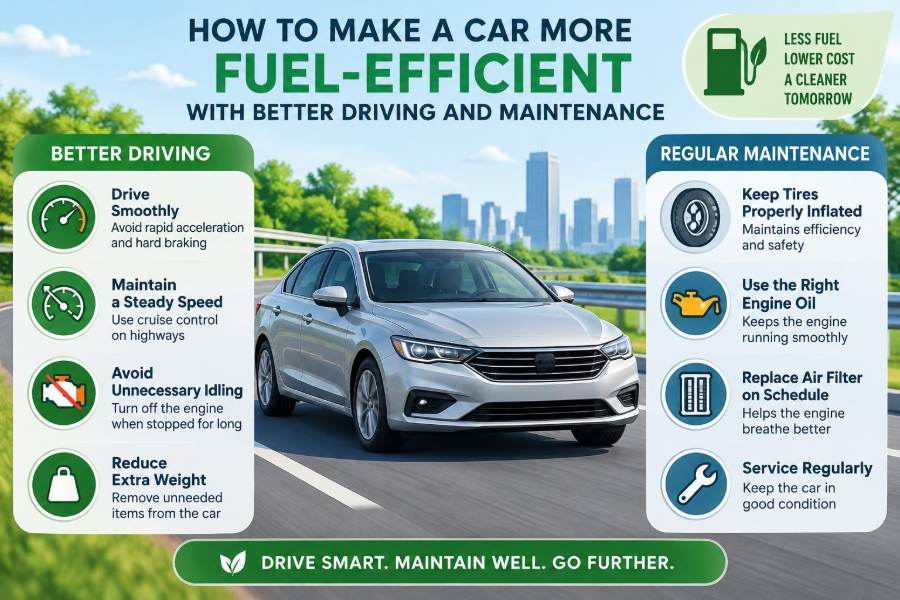

A familiar pattern plays out at the fuel station: the tank seems to empty sooner than expected, yet the daily route, vehicle, and fuel price have not changed much. It is tempting to assume the engine has simply become thirsty.
In many cases, fuel use is shaped less by one dramatic fault than by dozens of small decisions. Hard acceleration, low tyre pressure, unnecessary cargo, a neglected air filter, and long periods of idling can each add resistance or waste energy.
Fuel efficiency is not just about saving money. Using less fuel for the same journey can reduce exhaust emissions, lower wear on some components, and make a driver more aware of how the vehicle is operating.
The practical goal is not to drive painfully slowly or skip necessary maintenance. It is to help the engine, transmission, tyres, and driver work together with the least unnecessary energy loss.
🚘 Start with the Meaning of Fuel Efficiency
Fuel efficiency describes how far a vehicle travels for a given amount of fuel. It may be expressed as distance per litre or as fuel used per 100 kilometres, depending on local convention.
A more efficient car needs less fuel to overcome the forces acting against it. Those forces include rolling resistance at the tyres, aerodynamic drag through the air, mechanical friction, climbing gradients, and acceleration of the vehicle’s mass.
Real-world consumption will always vary. Traffic, weather, road surface, passenger load, and driving style mean that a brochure figure should be treated as a controlled comparison, not a promise for every trip.
⚙️ Follow Where the Fuel Energy Goes
A combustion engine does not turn all of fuel’s chemical energy into motion. A substantial portion leaves as heat through the cooling system and exhaust, while some is lost to internal friction and auxiliary systems.
The useful energy that reaches the wheels must still push the car through air and roll the tyres along the road. Efficient driving reduces the demand placed on that limited useful energy.
Think of the accelerator as a request for power, not simply a speed control. A larger request usually means more air and fuel entering the engine, particularly when accelerating or climbing.
🛣️ Understand the Four Main Road Loads
At steady speed on level ground, a car mainly works against rolling resistance, aerodynamic drag, drivetrain friction, and small losses in accessories. On hills, gravity becomes a major additional load.
- Rolling resistance comes from tyre deformation where each tyre meets the road.
- Aerodynamic drag is the force of moving air resisting the vehicle.
- Drivetrain losses occur in the engine, gearbox, differential, bearings, and related parts.
- Inertia is the energy required to accelerate the vehicle’s mass.
These loads explain why a smooth, lightly loaded car on a calm level road often uses less fuel than the same car in stop-start traffic or at high motorway speed.
💨 Recognize Why Speed Raises Consumption
Aerodynamic drag rises rapidly as speed increases. The engine must supply considerably more power to maintain a higher speed because it is pushing through more resistant air every second.
This is why a modest reduction in cruising speed can make a noticeable difference on an open road, especially in a vehicle with a large frontal area such as an SUV or van. The exact saving depends on the vehicle, wind, road gradient, and chosen speeds.
Driving below the speed limit is not automatically safer or more efficient if it disrupts traffic. Choose a legal, appropriate speed and keep it steady where conditions allow.
🦶 Accelerate Firmly but Smoothly
Very hard acceleration can use a rich fuel mixture in some petrol engines and causes the engine to operate at high power. On the other hand, extremely weak acceleration can keep a vehicle in low gears for too long.
A practical approach is moderate, deliberate acceleration: build speed positively, then ease the throttle once the target speed is reached. Automatic transmissions generally respond well to a smooth pedal input rather than repeated deep presses and releases.
For example, when joining a flowing road, accelerate safely to match traffic, then settle into a stable following speed. This is usually better than surging ahead and immediately braking.
👀 Look Far Ahead to Avoid Wasteful Braking
Braking turns the car’s kinetic energy into heat at the brake discs or drums. In a conventional vehicle, that energy has already been purchased as fuel, so unnecessary braking is unnecessary waste.
Scan traffic well ahead, observe brake lights early, and leave enough space to adjust speed gradually. Lifting off the accelerator sooner may allow the car to coast or use engine braking instead of requiring a sharp stop.
This does not mean rolling through junctions or delaying needed braking. Safe observation and legal road positioning always come first.
📏 Keep a Useful Following Distance
Tailgating creates a cycle of acceleration and braking because the driver has little time to react to small changes ahead. It also increases collision risk.
A larger, conditions-appropriate gap gives time to release the accelerator early and preserve momentum. In urban traffic, this may mean moving smoothly while another driver briefly closes the gap; that is often preferable to repeated stop-start inputs.
Distance should increase greatly in rain, darkness, poor visibility, or on low-grip surfaces. Fuel economy is never a reason to compromise stopping safety.
🔄 Choose Gears That Suit the Engine
In a manual car, lower gears multiply torque and are useful for moving off, hills, and overtaking. They also produce higher engine speed for a given road speed, which can raise fuel use if held unnecessarily.
Upshift smoothly once the car is moving and the engine can pull comfortably in the next gear. Avoid labouring the engine: if the vehicle vibrates, struggles, or needs a very large throttle opening at low revs, select a lower gear.
Modern automatics choose gears electronically, but the driver still influences them through throttle use, drive modes, and manual selection where fitted.
🧭 Use Cruise Control with Judgment
Cruise control can help maintain a steady speed on relatively flat, lightly trafficked roads. It may reduce the small speed variations that occur when a driver unconsciously presses and releases the accelerator.
On rolling hills, however, some systems hold speed aggressively and add throttle on every incline. A driver who allows a small, safe speed change uphill and downhill may sometimes use less fuel.
Do not use cruise control where traffic, weather, curves, or fatigue demand frequent active speed control. Its value is consistency, not automatic efficiency in every situation.
⏱️ Reduce Idling Where It Is Safe to Do So
An idling engine consumes fuel while producing no distance. Long waits at kerbs, railway crossings, or collection points can therefore raise average consumption.
If the vehicle has an automatic stop-start system, it can reduce fuel use during suitable short stops. Keep the system in normal operation unless conditions make it inappropriate, such as certain manoeuvres, extreme cabin demands, or a weak battery condition identified by the vehicle.
Never switch off the engine where it would affect safety, visibility, steering assistance, traffic flow, or the ability to move promptly.
🌡️ Avoid Excessive Warm-Up Time
Most modern vehicles do not need a long stationary warm-up before ordinary driving. Gentle driving after starting usually brings the engine and transmission to operating temperature more efficiently than prolonged idling.
A cold engine may use more fuel initially because its lubrication, combustion control, and emissions systems have not reached their intended operating condition. Avoid hard acceleration and high load until it has warmed through.
In very cold conditions, follow the manufacturer’s instructions and clear all windows properly before moving. Visibility matters more than saving a small amount of fuel.
🛞 Set Tyre Pressures Correctly
Underinflated tyres flex more as they rotate. That extra deformation increases rolling resistance, makes the engine work harder, and can accelerate shoulder wear.
Check pressures when tyres are cold, using the vehicle manufacturer’s recommended values for the actual load and wheel size. The correct figures are commonly shown on a door frame, fuel flap, handbook, or tyre information label.
Do not inflate tyres beyond the stated recommendation simply to chase economy. Excess pressure can reduce grip and ride comfort and may cause uneven wear.
🔍 Inspect Tyres Beyond the Pressure Gauge
Tyres influence safety, handling, and consumption at the same time. Uneven wear can indicate poor alignment, worn suspension parts, incorrect pressure, or an unsuitable tyre rotation pattern.
Look for cuts, bulges, embedded objects, and worn tread. A damaged tyre should be assessed promptly; fuel saving is irrelevant if tyre integrity is uncertain.
When replacement is due, compare tyres in the correct approved size and load rating. A tyre designed for low rolling resistance may help efficiency, but wet grip, noise, durability, and driving conditions also deserve consideration.
📐 Correct Wheel Alignment Problems
Wheel alignment refers to the angles at which wheels meet the road and point relative to the vehicle. Incorrect toe, camber, or related settings can make tyres scrub sideways rather than roll cleanly.
Common clues include a steering wheel that sits off-centre, a car that pulls on a suitable level road, or unusual tyre wear. Kerb strikes and potholes can disturb alignment, though worn components may also be responsible.
An alignment check is most useful after impact damage, suspension work, or abnormal wear. It should not be used to hide a fault in steering or suspension hardware.
🧰 Keep the Engine Air and Fuel Systems Healthy
An engine needs the correct balance of air, fuel, and spark or compression to run efficiently. A clogged air filter, failing sensor, injector issue, or ignition fault can disturb that balance.
Follow the service schedule for filters and inspection items. Replacing parts early without diagnosis is not always economical, but ignoring warning lights, misfires, rough idle, or poor performance can allow a small problem to become expensive.
Fuel quality should meet the specification in the handbook. Premium fuel is not automatically more efficient if the engine is designed for regular grade; use the grade the manufacturer requires or recommends.
🛢️ Use the Correct Engine Oil
Engine oil forms a protective film between moving components and helps manage heat and contamination. Its viscosity describes how it flows under specified conditions.
Using the manufacturer-approved viscosity and performance specification matters because modern engines, turbochargers, variable valve timing systems, and emissions equipment may depend on particular oil properties. Oil that is too thick or unsuitable can increase drag or impair component operation.
Change oil and filters at the specified interval, considering severe-use schedules where applicable. Extending intervals without approval is not a fuel-saving strategy.
🌡️ Maintain the Cooling System
The cooling system keeps the engine within a controlled temperature range. A thermostat stuck open may delay warm-up, while overheating can damage the engine and force protective operating modes.
Check coolant level only when the engine is cool and follow the specified coolant type and mixing guidance. Mixing incompatible coolants or opening a hot pressurized system can create avoidable problems.
If the temperature gauge behaves unusually, the heater output changes suddenly, or coolant loss is visible, investigate the cause rather than repeatedly topping up.
🔋 Watch the Battery and Charging System
The alternator converts some engine power into electrical power. Heavy electrical demand therefore adds a small load, although many essential systems must run regardless of economy.
A weak battery or charging fault can interfere with stop-start operation and cause unreliable starting. Corroded terminals, loose connections, or warning lights should be inspected properly.
Do not turn off headlights, demisters, or safety systems merely to save fuel. Use electrical accessories thoughtfully, but never at the expense of visibility or roadworthiness.
❄️ Use Air Conditioning Intelligently
Air conditioning uses engine or electrical energy to move heat from the cabin. Its effect on fuel use varies with outside temperature, vehicle type, compressor design, and how hard the system is working.
On a very hot day, ventilate the car briefly after entering, then use sensible temperature and recirculation settings as appropriate. Parking in shade can reduce the initial cooling load.
At higher speeds, opening windows can increase aerodynamic drag. In that situation, moderate air-conditioning use may be more practical than fully open windows, while at low urban speeds the trade-off may differ.
📦 Remove Unnecessary Weight
Every extra kilogram requires additional energy during acceleration and hill climbing. The effect is especially noticeable in stop-start driving, where the mass must be accelerated repeatedly.
Clear out heavy items that do not need to travel with the car: unused tools, sports equipment, boxes, and seasonal gear. Keep required emergency and safety equipment; preparedness is not clutter.
Weight has less influence during steady high-speed cruising than aerodynamic drag, but a lighter vehicle still places less demand on tyres, brakes, and suspension.
🏄 Remove Roof Racks and External Carriers
A roof box, bike rack, ladder rack, or empty roof bars disrupts airflow around the vehicle. The added drag can be significant at motorway speeds because air resistance dominates more of the energy demand.
Remove external carriers when they are not needed, and fit them according to their instructions when they are. An insecure load is a serious hazard, not merely an efficiency issue.
If cargo must be carried outside, choose the most suitable approved carrier and drive with the changed height, stability, and crosswind sensitivity in mind.
🗺️ Plan Trips Rather Than Chasing Shortcuts
The shortest route is not always the lowest-fuel route. A route with fewer stops, smoother traffic flow, and less steep climbing may use less fuel even if it adds a small distance.
Combine errands when practical, avoiding repeated cold starts and duplicate journeys. Navigation tools can help identify congestion, but their suggestions should be weighed against local road conditions and safety.
For a hypothetical example, a slightly longer ring road route may be preferable to a dense town-centre route if it avoids repeated queues and traffic lights. The result depends on actual traffic, not distance alone.
🚦 Treat Urban Driving as an Anticipation Skill
City fuel economy is often determined by how often the car stops and restarts. Traffic signals, pedestrian crossings, delivery vehicles, and changing lanes all interrupt momentum.
Read the road early: observe signal phases, gaps in traffic, and vehicles preparing to turn. A gentle lift from the accelerator before a red light may mean you arrive as it changes, rather than stopping completely.
Do not try to “beat” lights or coast in neutral. Staying in gear provides better control and allows modern fuel-cut systems to operate during deceleration in many vehicles.
⛰️ Drive Hills with a Simple Energy Plan
Climbing stores energy as vehicle height, so more fuel is required. Descending returns that energy as speed, which must be controlled safely.
Approach an uphill section with a steady, sensible speed and avoid a last-second full-throttle surge. Select a gear that lets the engine pull smoothly without straining.
On a descent, use engine braking when appropriate to control speed and reduce brake heating. In hybrids and electric vehicles, regenerative braking can recover some energy, but it cannot recover all energy lost to drag, tyre resistance, and heat.
🔧 Do Not Ignore Warning Signs
A sudden fuel-economy drop can be an early symptom of a mechanical issue. Causes may include a sticking brake, low tyre pressure, sensor fault, ignition problem, coolant-temperature issue, or transmission concern.
Arrange diagnosis if you notice a persistent warning light, fuel smell, smoke, misfiring, loss of power, overheating, unusual noises, or a sharp unexplained rise in fuel use. Continued driving may increase damage or compromise safety.
Fault codes can guide diagnosis, but a code does not automatically identify the failed part. Good repair work combines scan data with inspection and testing.
📊 Measure Consumption Consistently
Tracking fuel use helps separate normal variation from a genuine problem. Record fuel added, distance travelled, major driving conditions, and any maintenance work.
The tank-to-tank method is useful when done consistently: fill to a similar point, note the odometer or trip distance, and calculate consumption over several fills. One short trip or one unusual fill is rarely enough to establish a trend.
| Pattern noticed | Possible explanation | Useful first check |
|---|---|---|
| Gradual rise in fuel use | Tyre pressure, driving pattern, service needs | Check pressures and recent journey conditions |
| Sudden sharp change | Fault, dragging brake, leak, warning condition | Inspect safely and arrange diagnosis |
| Poor urban but normal highway use | Short trips and stop-start traffic | Review trip pattern and anticipation |
🧠 Avoid Popular Fuel-Saving Myths
Several habits sound economical but can be ineffective or unsafe. Coasting downhill in neutral removes engine braking and can reduce vehicle control. Turning off the engine while moving is dangerous and may disable assistance systems.
Likewise, aftermarket devices that claim dramatic savings should be treated cautiously. A legitimate improvement should have a clear engineering mechanism and must not interfere with emissions controls, safety systems, or manufacturer requirements.
Skipping maintenance, using incorrect fluids, or overinflating tyres may appear cheap in the moment but can create larger costs through wear, poor running, or safety risks.
🌿 Consider the Vehicle’s Powertrain Type
Petrol and diesel vehicles benefit from many of the same principles: correct tyres, smooth driving, reduced drag, and timely maintenance. Their engines differ in combustion characteristics and may have different service requirements.
Hybrids can recover some braking energy and may run the engine in efficient operating zones, but aggressive acceleration, high speeds, and heavy loads still consume more energy. Plug-in hybrids depend heavily on whether they are charged and driven within their electric range.
Electric vehicles do not use fuel, but they still lose energy to tyre resistance, air drag, heating or cooling, and acceleration. Efficient driving remains an engineering principle, not a petrol-only habit.
📋 Build a Practical Efficiency Routine
The most effective changes are usually repeatable ones. Rather than trying to transform every journey, make a short routine part of normal vehicle ownership.
- Check tyre pressures and tyre condition regularly.
- Remove unnecessary load and external carriers.
- Service the vehicle with approved fluids and parts.
- Accelerate smoothly, look ahead, and preserve safe momentum.
- Track consumption over time and investigate meaningful changes.
Choose one or two habits first, such as earlier lifting for junctions and a monthly tyre check. Consistency produces more value than occasional extreme economy efforts.
✅ Bring Driving and Maintenance Together
Better fuel efficiency comes from reducing avoidable losses, not from one miracle adjustment. The driver manages speed, anticipation, route choice, and vehicle load; maintenance keeps tyres, fluids, brakes, sensors, and mechanical systems operating as designed.
The core principle is simple: use energy only where it moves the car safely and usefully. Smooth inputs, correct tyre pressure, sound maintenance, and realistic trip planning reinforce one another.
When a car suddenly seems less efficient, do not assume it is normal aging. Compare recent conditions, inspect the basics, and seek qualified help for warning signs or persistent changes.
A fuel-efficient car is usually the result of calm driving habits and a well-maintained machine working together. Small improvements made consistently can protect both the journey budget and the vehicle over time. 🚗🛞🌿