
A driver approaches a green traffic light on a wet morning. A delivery van blocks the view of a cyclist crossing ahead, while an ambulance is coming from behind. None of these road users can see the full situation alone.
Vehicle-to-Everything communication, usually shortened to V2X, is designed for exactly these moments. It allows vehicles to exchange selected safety and traffic information with other vehicles, roadside equipment, pedestrians’ devices, and traffic-management systems.
The idea is not that cars will suddenly drive themselves everywhere. Rather, V2X can give drivers, automated driving systems, and road operators earlier awareness of hazards that cameras, radar, and human vision may miss.
For automobile engineers, the subject sits at the intersection of vehicle electronics, wireless networks, functional safety, cybersecurity, and transport planning. Its real value depends less on impressive demonstrations and more on whether it improves decisions in messy, everyday traffic.
🚦 What Vehicle-to-Everything Communication Means
V2X is an umbrella term for wireless communication between a vehicle and its surroundings. A participating vehicle can broadcast its position, speed, direction, braking status, and other relevant messages while receiving information from nearby road users or infrastructure.
These messages are designed to be short and time-sensitive. Unlike a navigation app that may update over seconds, many safety applications need information quickly enough to influence an immediate driving decision.
V2X is best understood as an additional sensing channel. It extends awareness beyond line of sight; it does not replace mirrors, driver attention, onboard sensors, road signs, or sound engineering judgment.
🧩 The Main Families of V2X Connections
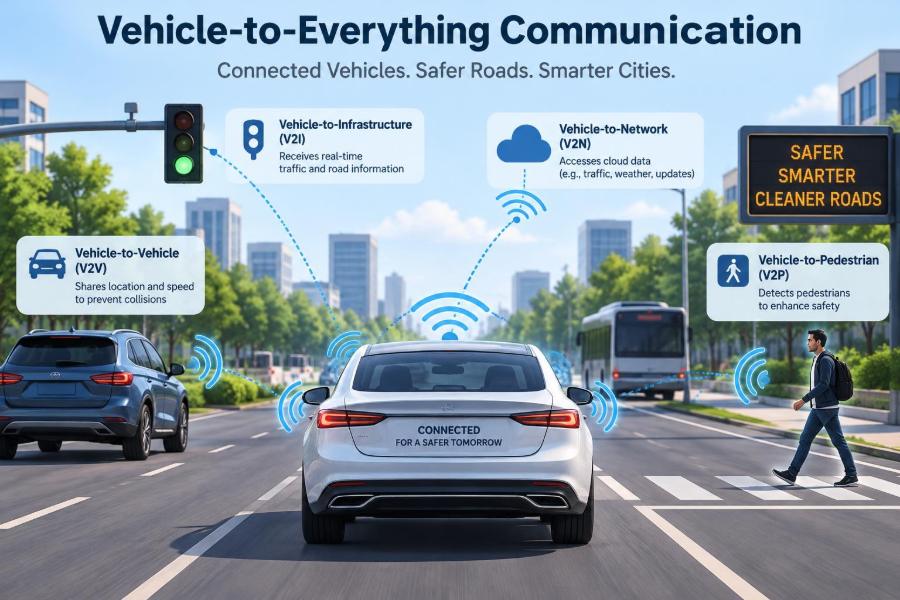
The “everything” in V2X includes several practical communication paths. Each serves a different road-safety or mobility purpose.
| Connection | Communicates with | Typical use |
|---|---|---|
| V2V | Vehicle to vehicle | Forward-collision or sudden-braking warnings |
| V2I | Vehicle to infrastructure | Signal timing, work-zone alerts, priority requests |
| V2P | Vehicle to pedestrian | Warnings involving vulnerable road users |
| V2N | Vehicle to network | Cloud-supported traffic and fleet services |
These categories often overlap. For example, an emergency vehicle may communicate directly with nearby cars, while intersections receive a priority request through an infrastructure or network connection.
📡 Direct Radio Links and Cellular V2X
V2X systems can use direct short-range radio communication, cellular-based communication, or a combination of both. The best choice depends on the application, network availability, regulation, installed equipment, and required response time.
Direct communication can allow nearby participants to exchange messages without relying on a distant server. This is useful when local awareness matters most, such as a vehicle warning others that it has braked hard around a blind bend.
Cellular V2X can also support direct communication and network-assisted services, depending on implementation. Network connectivity is particularly useful for broader traffic information, fleet coordination, map updates, and services that are not limited to one immediate location.
👀 Why V2X Complements Vehicle Sensors
Modern vehicles already use cameras, radar, ultrasonic sensors, and sometimes lidar. These technologies observe the physical environment, but every sensor has blind spots. Rain can reduce camera clarity, a truck can block radar, and a curve can hide traffic until it is too late to react comfortably.
V2X can provide information from the other side of an obstruction. A vehicle approaching an intersection may transmit its motion even when it is hidden behind a building.
That does not mean the message should be trusted blindly. A safe system compares communication data with sensor observations, map context, and plausibility checks. Engineers call this sensor fusion: combining multiple imperfect sources to produce a more reliable understanding.
🚗 V2V Warnings for Sudden Braking
One of the clearest V2V applications is a warning that traffic ahead is braking sharply. Brake lights remain essential, but they may be obscured by intervening vehicles, glare, fog, or a road crest.
If several connected cars detect abrupt deceleration, they can share their status down the traffic stream. A following vehicle may then alert its driver earlier or prepare an advanced driver-assistance system for possible braking.
The warning must be calibrated carefully. If it arrives too often during ordinary stop-and-go traffic, drivers may ignore it. If it arrives too late, it offers little benefit. Relevance filtering is therefore as important as communication speed.
🛣️ Detecting Hazards Beyond a Blind Curve
A stalled vehicle, crash scene, debris field, or patch of low traction beyond a curve creates a classic line-of-sight problem. V2X can allow a vehicle, roadside unit, or road operator to transmit a hazard alert before approaching drivers can physically see the danger.
Consider a hypothetical rural-road example: a connected car detects a deployed airbag and remains stationary after a collision. Nearby approaching vehicles could receive a warning that encourages earlier speed reduction, particularly at night or in poor weather.
The system should communicate the nature and location confidence of the hazard where possible. A vague alert is less useful than one that distinguishes a stopped vehicle from a lane closure or road-surface concern.
🚑 Clearing a Safer Path for Emergency Vehicles
Drivers often struggle to locate an ambulance or fire engine in dense traffic. Sirens and lights are indispensable, but buildings, closed windows, traffic noise, and complex intersections can delay recognition.
Emergency vehicle alerts can notify equipped vehicles that a response vehicle is approaching and indicate its direction or route context. This may give motorists more time to make a calm, lawful, and safe decision about yielding.
Infrastructure can add another layer by supporting signal priority at intersections. Priority is not a guarantee of a clear route: cross traffic, pedestrians, and local operating rules still require careful control.
🚥 Signal Phase and Timing at Intersections
Signal phase and timing information describes the current traffic-signal state and, where systems provide it, information relevant to the expected phase transition. A vehicle might use it to tell a driver that a green phase is likely to end soon or to support smoother speed guidance.
For drivers, the safe purpose is not to encourage “beating the light.” It is to reduce surprise and promote appropriate approach behavior. For automated functions, the information can supplement visual signal recognition.
Signal messages need robust design because traffic signals may enter flashing operation, manual control, fault modes, or special phases for pedestrians and transit. The vehicle must always treat the physical signal and road situation as authoritative.
🌊 Smoother Approaches and Reduced Stop-Start Driving
When a vehicle receives reliable signal information, it may offer speed advice intended to help reach the next intersection during a suitable phase. This concept is sometimes called green-light speed advisory.
The potential benefit is smoother movement: less unnecessary acceleration toward a red signal and less harsh braking at the stop line. In fleets, it can also support more predictable driving behavior.
Real roads impose limits. Pedestrians may step into crossings, queues may extend beyond an intersection, and signal plans can change. Advice must remain subordinate to posted speed limits, road conditions, and the driver’s duty to observe the road.
🚧 Work Zones and Temporary Road Layouts
Work zones are difficult because road geometry changes quickly. Narrowed lanes, shifted traffic paths, temporary speed restrictions, workers near live lanes, and construction vehicles all increase the consequences of late recognition.
Connected work-zone systems can share information about closures, lane shifts, queue conditions, and active work areas. A vehicle can then alert the driver before roadside signs come into view, especially where large vehicles block visibility.
Temporary data must have a short validity period and clear ownership. An old “lane closed” message after a work crew has reopened the road is not merely inconvenient; it can undermine confidence in the entire system.
🚸 Protecting Pedestrians, Cyclists, and Other Vulnerable Road Users
V2P applications focus on people who are more exposed in a collision: pedestrians, cyclists, scooter riders, road workers, and others outside vehicle cabins. Their movements can be difficult to predict, particularly in crowded urban areas.
A smartphone, wearable device, bicycle unit, or roadside system might share a limited safety message when it identifies a relevant conflict risk. For example, an equipped vehicle turning across a cycle lane could receive a warning about an approaching connected cyclist.
Privacy and practicality matter here. People should not need to continuously broadcast detailed personal location data simply to walk safely. Systems should minimize data, avoid unnecessary identification, and work alongside physical measures such as crossings, lighting, protected lanes, and lower speeds.
🏙️ Smarter Intersection Management
An intersection controller can combine data from detectors, cameras, pedestrian buttons, and connected vehicles. This can improve the operator’s view of demand across approaches, including vehicles that may be difficult for fixed detectors to classify.
For example, a transit bus approaching behind a queue may be identified earlier than it would be by a stop-line detector alone. A traffic controller can then make a better-informed decision within its configured safety and operational rules.
Connected data should improve traffic management, not create unfair access. Policies must define when priority is appropriate and ensure that pedestrians, cyclists, public transport, emergency services, and general traffic are considered transparently.
🚌 Public Transport Priority and Reliability
Bus journeys are especially sensitive to small delays. Missing a favorable signal phase can affect the next stop, passenger transfers, and later trips on the same route.
V2I can support conditional transit signal priority. A bus that is behind schedule or carrying a high passenger load may request a modest adjustment, such as a short green extension where safe and permitted.
Priority must be conditional because intersections serve many users. Granting every request without limits can create delays in other directions, interfere with pedestrian timing, and make the network less predictable.
🚚 Freight, Ports, and Commercial Fleet Operations
For commercial fleets, V2X is not only a collision-warning technology. It can support better coordination around logistics hubs, port gates, warehouses, and managed corridors.
A truck may receive route-specific restrictions, gate instructions, queue information, or warnings about low-clearance routes. In a depot, controlled vehicle-to-infrastructure communication can support orderly movement where pedestrians, forklifts, trailers, and trucks share constrained space.
Fleet operators should avoid treating connectivity as a reason to pressure drivers for unrealistic schedules. The safest operational use provides earlier information and better choices, rather than demanding faster responses.
🔋 Electric Vehicles and Energy-Aware Routing
Connected services can help electric-vehicle drivers plan around charging availability, route conditions, and expected travel demand. This is primarily a V2N use case rather than a split-second safety message.
For a fleet, network data may support charging schedules that reduce avoidable waiting and keep vehicles available for service. It can also help a route planner account for hills, temperature, traffic conditions, and payload effects that influence energy consumption.
Charging information can change quickly, so a system should present uncertainty honestly. A charger reported as available may become occupied before the vehicle arrives, and real energy use still depends on driving conditions.
🌧️ Weather, Road Friction, and Localized Warnings
Weather reports cover broad areas, but road hazards are often highly local. A bridge deck may freeze before nearby pavement, and standing water may form in one underpass while adjacent streets remain clear.
Vehicles can potentially contribute observations such as activated stability-control events, wiper use, outside temperature, or abrupt changes in wheel behavior. Roadside weather stations can add more direct measurements.
Such signals are indicators, not definitive proof of ice or flooding. Engineers need aggregation, quality checks, and cautious message wording before issuing a warning. A stability-control event, for instance, may result from an aggressive maneuver rather than low friction.
🗺️ Cooperative Perception and Shared Awareness
Cooperative perception means sharing interpreted observations, not only each vehicle’s own position and speed. A roadside camera or a connected vehicle may detect an object hidden from another vehicle’s viewpoint and communicate that relevant awareness.
This can be valuable at occluded intersections, around parked trucks, or near complex merging areas. It is a more demanding application because the system must communicate object location, timing, confidence, and classification without creating confusion.
A receiving vehicle must account for delay and uncertainty. If an object has moved since it was detected, an old message can be misleading. Time stamps, confidence information, and fusion with onboard sensing are fundamental.
🤖 Supporting Automated Driving Without Overreliance
V2X may support automated driving functions by providing context beyond onboard sensors: a work-zone map, a signal message, a closure notice, or another road user’s presence behind an obstruction.
It should not become a single point of failure. Wireless links can be unavailable, data can be outdated, and not every vehicle or intersection will be connected. Automated systems must retain a safe fallback behavior when communication is absent or inconsistent.
The practical engineering question is not “Can V2X make automation perfect?” It is “What additional decisions can it improve while preserving safe behavior under communication failure?”
⏱️ Latency, Range, and Message Reliability
Safety-relevant communication must arrive early enough to affect a decision. Latency is the time between an event and usable receipt of its message; excessive latency can turn a timely warning into historical information.
Range also has a trade-off. A very distant warning may be irrelevant, while a very short communication range leaves little time to react. Buildings, terrain, trucks, radio congestion, and weather can affect practical performance.
Good system design considers message priority, update rate, channel load, receiver behavior, and the warning algorithm together. Reliable transportation outcomes cannot be inferred from radio range alone.
🔐 Cybersecurity Must Be Designed In
A connected transport system can be targeted by false messages, unauthorized devices, software vulnerabilities, or attempts to disrupt communications. A fabricated emergency alert or lane-closure message could cause unsafe or disruptive behavior.
Security mechanisms can help verify that messages come from authorized participants and have not been altered. Vehicles also need secure software updates, protected keys, intrusion monitoring, and sensible responses when messages fail validation.
Authentication does not automatically make a message true. An authorized device can malfunction, be compromised, or send inaccurate data. Plausibility checks and conservative vehicle behavior remain necessary.
🔒 Privacy and Data Minimization
Location and movement data can reveal sensitive patterns, such as commutes, workplace visits, or regular travel routes. V2X designers must distinguish between the information needed for a short-lived safety message and data that should never be collected or retained.
Privacy-aware approaches may use changing identifiers, limited data retention, and message designs that avoid including personal identity. Governance also matters: organizations need clear rules about access, purpose, retention, and accountability.
Public trust is an engineering requirement as well as a policy issue. People are less likely to accept a system if its data practices are opaque or broader than the safety function requires.
⚖️ Interoperability and Standards Challenges
A vehicle can cross city, regional, and national boundaries in a single journey. V2X is most useful when equipment from different manufacturers and road operators can understand essential messages consistently.
Interoperability involves more than radio compatibility. It includes message formats, security credentials, map references, test procedures, software behavior, and definitions of what a warning means.
Engineers should avoid assuming that a feature demonstrated in one controlled corridor will work identically elsewhere. Deployment conditions, regulation, spectrum policy, and infrastructure maintenance practices vary substantially.
📶 The Adoption Problem: Value Grows With Participation
Some V2X benefits are available with limited deployment, particularly infrastructure-to-vehicle alerts at a hazardous intersection. Others, such as widespread vehicle-to-vehicle awareness, become more useful as more vehicles participate.
This creates a practical transition challenge. Early adopters need useful functions before the majority of the fleet is connected, while the system must remain effective for drivers in older, unconnected vehicles.
Road agencies can target high-value sites first: complex junctions, recurring work zones, emergency corridors, or locations with poor sight distance. Focused deployment is usually more credible than installing equipment everywhere without a clear operational purpose.
🧠 Preventing Alert Overload and Driver Distraction
More information is not automatically safer. A driver facing repeated beeps, dashboard messages, and navigation prompts may become distracted, annoyed, or desensitized to genuinely urgent alerts.
Human-machine interface design should prioritize threats by urgency and confidence. An imminent collision risk deserves a different warning from an advisory about a signal phase several blocks ahead.
- Present only information that is relevant to the current driving task.
- Use consistent sounds, symbols, and escalation logic.
- Suppress duplicate alerts from multiple sources.
- Allow noncritical messages to wait until driver workload is lower.
Testing with real drivers in varied traffic conditions is essential. An interface that appears clear in a laboratory may become distracting during rain, merging, or night driving.
🛠️ Engineering Validation Before Deployment
V2X functions require testing at several levels: radio performance, message interpretation, cybersecurity, vehicle control behavior, user interface design, and system behavior during faults. No single road test can cover every combination.
Simulation can explore rare scenarios, while closed-course testing can assess repeatable conflicts without exposing road users to unnecessary risk. Public-road pilots then reveal practical issues such as signal maintenance, map changes, radio interference, and driver understanding.
Validation should include degraded conditions: lost connectivity, inaccurate positioning, delayed messages, conflicting reports, and devices that stop transmitting. A system is mature when it fails safely and predictably, not only when it works in ideal conditions.
🧰 Practical Guidance for Engineers and Fleet Managers
Start with a specific operational problem rather than a technology label. “Reduce late braking before a blind work zone” is a testable goal; “deploy V2X” is not.
- Identify the road users, hazards, and decisions the system should improve.
- Define what data are necessary, how accurate they must be, and how long they remain valid.
- Plan ownership for roadside equipment, certificates, software updates, and incident response.
- Measure operational outcomes and user behavior, not merely message counts.
- Provide training so drivers and operators understand both capabilities and limitations.
A clear use case also makes it easier to decide whether V2X is the right solution or whether better signs, geometry, lighting, enforcement, or conventional sensing would address the problem more directly.
🚫 Common Misconceptions About Connected Vehicles
A frequent misconception is that V2X means every vehicle is continuously tracked. Safety-oriented designs can exchange limited, short-lived messages without building a permanent personal travel record, although privacy protections must be deliberately implemented.
Another is that connected vehicles eliminate crashes. V2X can improve awareness and response opportunities, but it cannot remove human error, unsafe road design, mechanical failures, bad weather, or the presence of unconnected road users.
A third mistake is equating connectivity with autonomy. A connected vehicle may still be entirely driver-controlled, while an automated vehicle must still operate safely if no useful V2X message is available.
🌍 Building a Transportation System That Includes Everyone
The strongest V2X strategy treats communication as one layer within a safe-system approach. Safe speeds, forgiving road design, vehicle crashworthiness, visible markings, protected pedestrian facilities, and effective enforcement remain fundamental.
Equity also deserves attention. Benefits should not be limited to premium vehicles or well-funded districts. Road operators can prioritize applications that protect people walking, cycling, using transit, working on roads, or traveling through high-risk corridors.
Accessibility should shape the design of warnings and interfaces. A system that depends on a particular phone model, language, or sensory cue may exclude people who most need reliable mobility support.
🎯 The Core Takeaway: Better Decisions, Not Magical Roads
The practical promise of V2X is earlier, more informed decision-making. It can reveal a hazard around a blind corner, help an ambulance move through congestion, warn of a work zone, support smoother signal approaches, and coordinate traffic systems more intelligently.
Its limits are equally important. Messages can be delayed, inaccurate, unavailable, or misunderstood; communication coverage will be uneven; and physical road conditions still govern what is safe. Successful systems are secure, privacy-conscious, interoperable, carefully validated, and designed around human behavior.
For automobile engineers, V2X is therefore not just a wireless feature. It is a systems-engineering discipline in which vehicle design, infrastructure, networks, software, and public policy must work together around a simple goal: prevent harm and make movement more predictable.
Vehicle-to-Everything communication is most valuable when it gives people and vehicles earlier awareness while preserving safe judgment when the connection is imperfect or absent. That is the path from impressive connectivity to genuinely safer and smarter transportation. 🚗📡🛣️