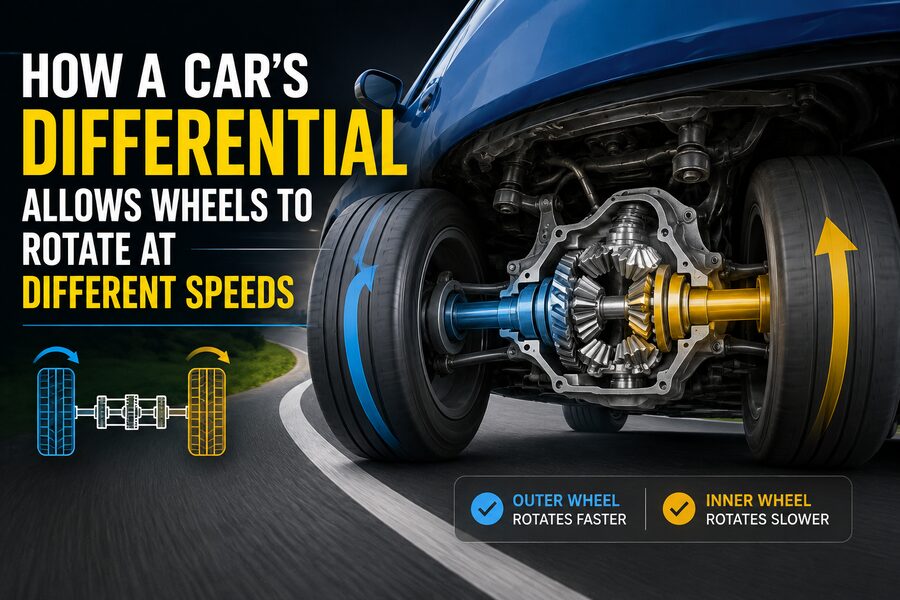

When a car travels in a perfectly straight line, its left and right driving wheels cover approximately the same distance. But the moment the vehicle enters a corner, something changes: the wheel on the outside of the turn must travel farther than the wheel on the inside.
If both wheels were forced to rotate at exactly the same speed, one or both tires would have to slip across the road surface. That would make steering harder, increase tire wear, create unwanted stress in the drivetrain, and reduce vehicle stability.
The component that solves this problem is called the differential. ⚙️
A differential is a mechanical gear assembly that allows two wheels on the same axle to rotate at different speeds while still receiving power from the engine or electric motor. It is one of the most important—and often overlooked—parts of a vehicle’s drivetrain.
Understanding how a differential works reveals an elegant piece of mechanical engineering hidden beneath nearly every conventional car.
🛞 Why Do Car Wheels Need to Rotate at Different Speeds?
Imagine a car making a left turn.
The left wheel is on the inside of the corner, while the right wheel travels around the outside.
Because the outside wheel follows a larger circular path, it must cover more distance in the same amount of time.
For example, suppose the inside wheel travels 8 meters around part of a corner while the outside wheel travels 10 meters.
If both wheels had to rotate at exactly the same speed, they could not naturally cover those different distances. One tire would need to skid or scrub against the road.
That is where the differential becomes essential. 🚘
It allows the outside wheel to spin faster while the inside wheel spins more slowly.
⚙️ Where Is the Differential Located?
The location of the differential depends on the vehicle’s drivetrain layout.
In a rear-wheel-drive vehicle, the differential is usually located between the two rear wheels. Power from the engine travels through the transmission and driveshaft before reaching the differential.
In many front-wheel-drive cars, the differential is integrated into the transmission assembly. This combined unit is sometimes referred to as a transaxle.
All-wheel-drive and four-wheel-drive vehicles may contain multiple differentials, including:
- Front differential
- Rear differential
- Center differential
These systems distribute power not only between left and right wheels but sometimes between the front and rear axles as well.
🔩 The Main Parts of a Traditional Differential
A conventional open differential contains several gears working together.
The major components typically include the ring gear, differential carrier, side gears, and spider gears.
Power entering the differential rotates the ring gear, which turns the differential carrier.
Inside the carrier are smaller gears that allow the two axle shafts to rotate relative to one another.
The axle shafts connect the differential to the wheels.
When the vehicle travels straight, the internal gears mainly rotate together as one unit.
When the vehicle turns, the internal gears begin rotating relative to one another, allowing one wheel to speed up while the other slows down. 🔄
🛣️ What Happens When the Car Drives Straight?
When a car travels in a straight line on a level road, both driven wheels generally need to rotate at the same speed.
In this situation, the differential’s spider gears typically do not spin significantly around their own individual axes.
Instead, the entire differential carrier rotates as a unit.
The side gears connected to the axle shafts therefore rotate at approximately the same speed.
Power is transmitted evenly through the differential to the wheels.
From the driver’s perspective, nothing unusual happens—the vehicle simply moves forward.
The clever behavior of the differential becomes more obvious during cornering.
↪️ What Happens When the Car Turns?
Suppose the vehicle begins turning right.
The right wheel is now on the inside of the turn and travels a shorter distance.
The left wheel is on the outside and must travel farther.
Inside the differential, the spider gears begin rotating relative to the side gears.
This additional gear motion allows the outside axle shaft to rotate faster while allowing the inside axle shaft to rotate more slowly.
The important point is that the differential does not simply disconnect one wheel.
Instead, it continuously balances the rotational speeds of both wheels while transmitting torque through the drivetrain.
The result is smoother cornering and significantly less tire scrubbing. 🚗💨
➗ Why Is It Called a “Differential”?
The name comes from the fact that the mechanism allows a difference in rotational speed between two output shafts.
Interestingly, the speeds are mathematically related.
In a simple open differential, the average rotational speed of the two wheels corresponds to the rotational speed imposed by the differential carrier.
For a simplified example, imagine the differential carrier corresponds to an average wheel speed of 100 revolutions per minute.
If one wheel slows to 80 RPM during a turn, the other may speed up to approximately 120 RPM.
The average remains:
(80 + 120) ÷ 2 = 100 RPM
This mechanical relationship allows the differential to accommodate wheel-speed differences automatically.
No computer is required for the fundamental operation of a traditional mechanical differential. 🧮⚙️
🚨 The Main Weakness of an Open Differential
Although an open differential is excellent for ordinary driving, it has an important limitation.
Torque can effectively become limited by the wheel with the least available traction.
Imagine one wheel is sitting on dry pavement while the other is on ice. ❄️
The wheel on the ice may spin easily because it has very little traction.
In a conventional open differential, much of the available rotational motion can go toward spinning that low-traction wheel.
Meanwhile, the wheel with good traction may not receive enough usable torque to move the vehicle effectively.
This is why a car with an open differential can sometimes become stuck even though one driven wheel is sitting on a surface with plenty of grip.
To address this problem, engineers developed several alternative differential designs.
🔒 Limited-Slip Differentials
A limited-slip differential, often abbreviated as LSD, allows the two wheels to rotate at different speeds while limiting excessive speed differences between them.
There are several types of limited-slip systems.
Some use clutch packs. Others use helical gears, viscous couplings, or electronically controlled mechanisms.
If one wheel begins spinning much faster than the other, the differential can transfer or preserve more useful torque for the wheel that still has traction.
This improves acceleration and grip, particularly during performance driving or on slippery surfaces. 🏎️
Limited-slip differentials are commonly found in sports cars, performance vehicles, off-road vehicles, and some premium passenger cars.
🔐 Locking Differentials
A locking differential can mechanically connect both axle shafts so the wheels rotate at the same speed.
This can be extremely useful off-road.
For example, if one wheel is suspended in the air while the other remains firmly on the ground, a locked differential allows the wheel with ground contact to continue receiving useful drive torque.
However, permanently locking the wheels together would create problems during normal cornering on pavement.
That is why locking differentials are generally engaged only when needed or controlled automatically depending on vehicle design.
They are particularly valuable in trucks, SUVs, and serious off-road vehicles. 🏔️🚙
🖥️ Electronic Traction Control and Modern Differentials
Modern cars may supplement or partly mimic differential functions using electronic systems.
Wheel-speed sensors can detect when one wheel is spinning faster than the others.
The traction-control system may apply the brake to the spinning wheel, reduce engine torque, or coordinate with an electronically controlled differential.
Applying the brake to the slipping wheel can help redirect usable torque toward the wheel with better traction.
Some high-performance vehicles use electronically controlled limited-slip differentials, sometimes called electronic LSDs or e-diffs.
These systems can actively adjust torque distribution during acceleration, cornering, and changing road conditions.
The result can be improved traction, handling, and stability. 🧠⚙️
⚡ How Differentials Work in Electric Vehicles
Electric vehicles have introduced new drivetrain possibilities.
Some EVs still use conventional mechanical differentials, especially when a single motor powers both wheels on an axle.
However, vehicles equipped with separate motors for individual wheels or axles can control wheel torque electronically.
Instead of relying entirely on mechanical gears, software can adjust how much torque each motor produces.
This technique is sometimes called torque vectoring.
During a corner, the system may provide more torque to an outside wheel and less to an inside wheel, helping the vehicle rotate more naturally through the turn.
Advanced torque-vectoring systems can react extremely quickly because electric motors can change torque output almost instantaneously. ⚡🚗
🏎️ How the Differential Affects Handling
The type and tuning of a differential can significantly influence how a vehicle behaves.
An open differential tends to provide smooth and predictable behavior during normal driving.
A limited-slip differential can improve traction while accelerating through corners.
A locking differential can dramatically improve mobility on difficult terrain.
Performance-oriented active differentials can even help influence vehicle balance by controlling how torque is distributed between wheels.
This is one reason differential setup is so important in motorsport.
Race engineers may adjust differential behavior to influence corner entry, mid-corner balance, and acceleration when exiting a turn.
🛠️ Why Differential Lubrication Matters
Differentials contain gears that operate under substantial loads.
To reduce friction and wear, these components are lubricated using gear oil or another manufacturer-specified lubricant.
The lubricant creates a protective film between gear surfaces while also helping carry away heat.
Over time, differential fluid can degrade or become contaminated.
Some vehicles therefore require periodic differential fluid inspection or replacement.
A low fluid level, incorrect lubricant, or internal wear may result in symptoms such as:
- Whining or howling noises
- Clunking during acceleration
- Vibration
- Grinding sounds
- Fluid leaks around the differential housing
Ignoring these symptoms can lead to expensive gear or bearing damage. 🔧
🔊 Why a Worn Differential May Make Noise
Differential gears must mesh together very precisely.
Components such as bearings, ring gears, pinion gears, and side gears experience repeated loads whenever the vehicle accelerates or decelerates.
If bearings wear or gear clearances become incorrect, the differential may begin producing unusual sounds.
A whining noise that changes with vehicle speed can sometimes indicate gear or bearing problems.
A clunk when transitioning between acceleration and deceleration may suggest excessive drivetrain play.
However, similar symptoms can be caused by driveshaft joints, wheel bearings, transmission components, or suspension parts, so correct diagnosis is important.
🧑🔧 Why the Differential Is an Engineering Masterpiece
The basic mechanical differential is remarkable because it solves a complicated problem largely through the geometry of gears.
When the vehicle travels straight, both wheels naturally rotate together.
When the vehicle enters a curve, the mechanism automatically allows their speeds to differ.
The driver does not need to activate anything.
There is usually no need for sensors or software in a traditional open differential.
The gears simply respond to the mechanical conditions at the wheels.
This elegant principle has remained useful for well over a century of automobile development. 🚙⚙️
Modern vehicles have added clutch systems, electronic controls, active torque vectoring, and sophisticated software, but the fundamental challenge remains the same: powered wheels must be able to accommodate different travel distances during a turn.
✅ The Bottom Line
A car’s differential allows the driven wheels on the same axle to rotate at different speeds while continuing to receive power.
This is necessary because the outside wheel travels farther than the inside wheel whenever the vehicle turns.
Without a differential, tires would scrub or skid during cornering, steering would become more difficult, drivetrain components would experience additional stress, and tire wear would increase.
A conventional open differential solves the problem using a clever arrangement of gears. More advanced designs—including limited-slip, locking, active, and electronically controlled differentials—add improved traction and handling capabilities.
So the next time your car smoothly rounds a corner, remember that beneath the vehicle, a compact network of gears is constantly balancing wheel speeds. 🚗🔄
It is a perfect example of mechanical engineering doing something incredibly complex so smoothly that most drivers never notice it happening.