
For most of automotive history, pressing the brake pedal created a direct mechanical or hydraulic action. The driver pushed the pedal, the pedal moved a master cylinder, hydraulic pressure traveled through brake lines, and that pressure forced brake pads against rotating discs or brake shoes against drums. It was a simple physical chain from the driver’s foot to the wheels.
Modern vehicles are increasingly changing that relationship.
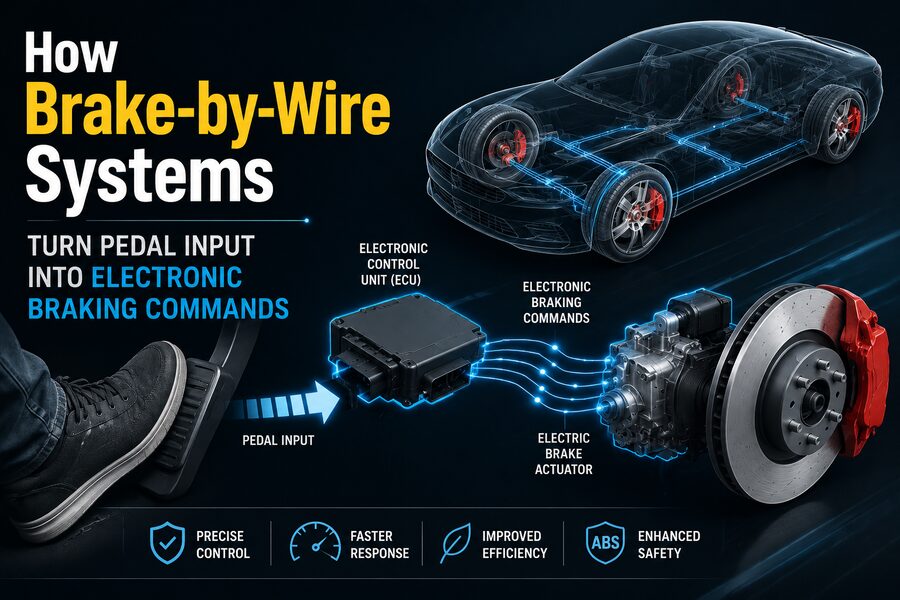
In a brake-by-wire system, the brake pedal can act partly—or, in some architectures, almost entirely—as an electronic input device. Sensors measure what the driver is asking for, electronic control units interpret that request, and actuators generate the braking force required at the wheels. ⚡🛞
This transition is especially important for electric vehicles, hybrids, advanced driver-assistance systems, and highly automated vehicles because electronic braking makes it easier to blend friction brakes with regenerative braking, coordinate stability systems, and respond rapidly to computer-generated commands.
But how can engineers safely replace a traditionally mechanical function with electronics?
The answer involves sensors, redundant computers, high-speed communication networks, hydraulic or electromechanical actuators, and multiple layers of fail-safe engineering.
🦶 What Happens When You Press a Brake-by-Wire Pedal?
Imagine a driver approaching a red traffic light.
The driver presses the brake pedal.
In a conventional braking system, this movement directly helps generate hydraulic pressure. In a brake-by-wire system, the first important event is often electronic measurement.
Sensors detect information such as:
- Pedal travel
- Pedal force
- Rate of pedal application
- Pedal position
- Vehicle speed
- Wheel speeds
- Steering angle
- Vehicle acceleration
- Battery condition in an EV or hybrid
The system then translates these signals into a requested braking force.
A simplified control chain looks like this:
Driver presses pedal 🦶 → sensors measure input 📡 → braking controller calculates required deceleration 🧠 → braking commands are sent electronically ⚡ → actuators create wheel braking force 🛞
This entire process can happen in milliseconds.
📡 Step 1: Sensors Measure the Driver’s Intent
The brake pedal must first determine what the driver wants.
Brake-by-wire systems typically use electronic sensors to measure pedal movement and force.
A pedal position sensor determines how far the brake pedal has moved.
A force sensor may measure how strongly the driver is pressing it.
Engineers often use more than one sensor for the same basic measurement. This is called redundancy.
For example, the pedal assembly may contain two independent position signals. The electronic control unit continuously compares them.
If both sensors report similar values, the system can confidently interpret the command.
If one reports 20% pedal travel while another unexpectedly reports 90%, the controller recognizes that something may be wrong and can enter a protective operating mode. ⚠️
This redundancy is extremely important because a single sensor failure must not cause the vehicle to unexpectedly lose braking.
🧠 Step 2: The Brake Control Unit Calculates the Desired Deceleration
Sensor signals are sent to an electronic controller sometimes referred to as a brake control unit, brake ECU, or integrated vehicle dynamics controller.
The computer does more than simply convert pedal movement into brake pressure.
Instead, it determines how much total braking force the vehicle needs.
Suppose the driver presses the pedal moderately while traveling at highway speed. The controller considers the pedal request along with current vehicle conditions.
It may evaluate:
📌 Vehicle speed
📌 Wheel rotation speeds
📌 Available tire grip
📌 Vehicle stability
📌 Road conditions inferred from wheel behavior
📌 Regenerative braking capability
📌 Battery state of charge
📌 Brake temperature
📌 ABS and stability-control requirements
The result is an electronic brake torque request.
This request describes how much braking force should be produced and, in sophisticated systems, how that force should be distributed among individual wheels.
⚡ Step 3: Electronic Commands Travel Through the Vehicle
Once the desired braking force has been calculated, the brake controller communicates with other vehicle systems through automotive communication networks.
These may include technologies such as:
- CAN bus
- CAN FD
- Automotive Ethernet
- Dedicated safety communication links
The braking system may exchange information with the motor controller, battery management system, stability-control system, autonomous-driving computer, and other electronic modules.
Communication speed and reliability are critical.
A braking command cannot simply disappear because of a temporary network problem.
Safety-oriented automotive networks therefore use mechanisms such as error detection, message counters, time monitoring, redundant data, and diagnostic checks.
If expected messages stop arriving, controllers can recognize the fault and respond appropriately. 🔍
🔋 Step 4: Electric Vehicles First Consider Regenerative Braking
Brake-by-wire becomes particularly valuable in electric and hybrid vehicles because braking can be produced in two fundamentally different ways.
The first is regenerative braking.
During regeneration, the electric traction motor operates as a generator.
Instead of using electricity to turn the wheels, the spinning wheels drive the motor-generator. Some of the vehicle’s kinetic energy is converted into electrical energy and returned to the battery. 🔋
The system therefore asks:
How much of the driver’s braking request can regeneration provide?
Suppose the driver requests 0.2 g of deceleration.
If the motor, battery, and traction conditions allow the electric drivetrain to provide that entire amount, the vehicle may rely heavily on regenerative braking and use little friction braking.
This improves energy efficiency and reduces brake-pad wear.
However, regenerative braking cannot always provide everything the driver requests.
Its capability can decrease when:
- The battery is nearly full
- The battery is extremely cold
- The electric motor reaches operating limits
- Vehicle speed becomes very low
- Tire traction is limited
- Very strong emergency braking is required
When this happens, friction brakes must supply the remaining braking force.
🔄 Step 5: The System Blends Regenerative and Friction Braking
One of the most impressive functions of modern brake-by-wire technology is brake blending.
Suppose a driver requests 1,000 units of total braking torque.
The vehicle might determine that regenerative braking can provide 600 units.
The friction brakes then provide the remaining 400.
From the driver’s perspective, the car should simply slow down smoothly.
The driver should not feel a sudden change in pedal response every time the balance between regeneration and friction braking changes.
Achieving this smooth transition is a significant engineering challenge.
The control system continuously modifies the contribution from each braking source while maintaining the requested deceleration.
This happens dynamically as vehicle speed, battery conditions, traction, and motor capability change. ⚙️
🛞 Step 6: Actuators Generate Physical Braking Force
Electronic commands eventually have to create real physical force at the wheels.
There are several types of brake-by-wire architectures.
💧 Electro-Hydraulic Braking
Many modern systems retain hydraulic wheel brakes but electronically control the pressure.
When the driver requests braking, an electric pump, motor-driven piston, or other hydraulic actuator generates brake-fluid pressure.
The controller determines how much pressure each brake requires.
This design combines familiar hydraulic disc brakes with electronic command and control.
⚙️ Electromechanical Braking
More advanced systems can use electromechanical brake actuators.
Instead of brake fluid providing the clamping force, an electric motor and mechanical transmission push the brake pads directly against the disc.
This approach is sometimes called an electromechanical brake or dry brake-by-wire system.
Potential advantages include eliminating brake fluid, faster individual-wheel control, easier packaging, and greater integration with vehicle automation.
However, these systems must provide extremely high reliability because the electrical actuator becomes directly responsible for producing braking force.
🦿 How Does the Pedal Still Feel Like a Normal Brake Pedal?
A surprising issue appears when the brake pedal is electronically decoupled from traditional hydraulic pressure:
What should the driver feel?
Drivers expect increasing resistance as they push a brake pedal farther.
If the pedal behaved like a loose electronic switch, braking would feel unnatural and difficult to control.
Brake-by-wire vehicles therefore use a pedal feel simulator or pedal-force mechanism.
This may involve springs, elastomers, dampers, hydraulic components, or electronically controlled mechanisms.
The simulator creates a carefully tuned relationship between pedal travel and pedal force.
Engineers may tune the pedal to feel:
🚗 Smooth during normal braking
🏎️ Firm in performance-oriented vehicles
🛋️ Progressive in luxury vehicles
⚠️ Stable and predictable during emergency braking
The braking force happening at the wheels can therefore be electronically controlled even while the driver’s foot experiences familiar resistance.
🛑 Brake-by-Wire and ABS
Traditional anti-lock braking systems already use electronics to regulate brake pressure.
Brake-by-wire takes this concept even further.
During hard braking, an ABS controller monitors the rotational speed of individual wheels.
If one wheel begins approaching lockup, braking force at that wheel can be reduced.
When traction returns, brake pressure is increased again.
This control loop can occur repeatedly many times per second.
Because brake-by-wire systems already have electronically controllable actuators, they can integrate closely with ABS.
Instead of treating anti-lock braking as an additional intervention layered onto the driver’s hydraulic pressure, the system can directly calculate appropriate wheel braking commands.
🌀 Electronic Stability Control Becomes More Powerful
Brake-by-wire also integrates naturally with electronic stability control, or ESC.
Imagine a vehicle entering a corner too quickly.
Sensors detect:
- Steering-wheel angle
- Wheel speed
- Vehicle yaw rate
- Lateral acceleration
The computer compares the driver’s intended direction with the vehicle’s actual motion.
If the vehicle begins to understeer or oversteer, the stability system may apply braking force to one or more individual wheels.
That selective braking creates a corrective yaw moment that helps stabilize the vehicle.
Because brake-by-wire allows precise electronic control, wheel braking can be coordinated rapidly with motor torque, steering assistance, and other vehicle-dynamics systems. 🎯
🤖 Why Autonomous Vehicles Benefit From Brake-by-Wire
Highly automated vehicles need computers to control braking without relying on a human foot.
Brake-by-wire provides a natural interface.
An automated-driving controller can calculate that the vehicle needs to decelerate and send a braking request electronically.
The brake controller then handles the details of producing that deceleration safely.
This is useful for:
🚦 Adaptive cruise control
🚶 Automatic emergency braking
🛣️ Lane-assistance systems
🚗 Traffic-jam assistance
🤖 Automated driving
Importantly, safety-critical functions are usually divided among independent controllers and monitoring systems.
An autonomous-driving computer does not simply receive unrestricted authority over every brake actuator. Commands can be checked for plausibility and safety before execution.
🛡️ What Happens If Electronics Fail?
The most important question surrounding brake-by-wire is obvious:
What happens if a sensor, computer, motor, or electrical supply fails?
Engineers address this through functional safety and redundancy.
Possible protections include:
🔋 Backup electrical power
📡 Redundant pedal sensors
🧠 Multiple processing channels
⚙️ Independent actuator control
🔍 Continuous diagnostics
📊 Signal plausibility checking
🚨 Warning systems
🛑 Mechanical or hydraulic fallback mechanisms in some designs
Different brake-by-wire architectures use different fallback strategies.
Some electro-hydraulic systems maintain a hydraulic connection that can provide limited emergency braking if electronic control is unavailable.
Other future architectures may rely on redundant electrical systems capable of continuing operation after a single failure.
The fundamental principle is that no single reasonably foreseeable fault should cause an immediate catastrophic loss of braking capability.
🔍 Computers Constantly Check the System
Brake-by-wire controllers perform continuous self-diagnostics.
A controller may ask questions such as:
Do both pedal sensors agree?
Are commanded and measured brake pressures consistent?
Did the actuator move when commanded?
Is electrical voltage sufficient?
Are wheel-speed readings physically plausible?
Are communication messages arriving on schedule?
If something fails these checks, the system stores diagnostic information and may switch to a reduced-function mode.
The driver may see a warning light or message indicating that the braking system requires service.
🌡️ Brake Temperature Still Matters
Electronic control does not eliminate the physical limitations of friction brakes.
Brake discs and pads generate heat because kinetic energy is converted into thermal energy.
During repeated heavy braking—such as descending a steep mountain road—brake temperatures can become extremely high.
Modern systems may estimate brake temperature using mathematical models or sensor data.
The vehicle can then adjust regenerative braking, stability strategies, or warnings based on available thermal capacity.
In an EV, regeneration can be particularly useful because it reduces some of the heat that would otherwise be generated by friction brakes. 🌡️🔋
🔧 Brake-by-Wire Can Reduce Maintenance—but Introduces New Challenges
Using regenerative braking frequently can significantly reduce friction-brake wear.
Some EV drivers may travel long distances before brake pads require replacement.
However, reduced use introduces another issue: brake discs can become susceptible to surface corrosion because they are not being cleaned as frequently by pad contact.
Manufacturers may therefore periodically apply friction braking intentionally, even when regeneration could theoretically handle the deceleration.
Brake-by-wire systems can manage this automatically.
Electronic actuators and sensors also require specialized diagnostic equipment when faults occur, shifting some maintenance from purely mechanical inspection toward mechatronic troubleshooting.
⚖️ Advantages of Brake-by-Wire
Brake-by-wire offers several important benefits.
⚡ Faster Electronic Control
Computers can command braking extremely quickly.
🔋 Better Regenerative Braking
Electric and hybrid vehicles can maximize energy recovery while maintaining consistent pedal behavior.
🎯 Precise Wheel Control
Braking force can be adjusted individually at each wheel.
🤖 Automation Compatibility
Advanced driver-assistance and autonomous systems can request deceleration electronically.
🛞 Improved Vehicle Dynamics
Braking can be coordinated with steering, suspension, traction control, and electric motors.
📦 Packaging Flexibility
Some architectures can reduce dependence on large conventional hydraulic components.
⚠️ Engineering Challenges
Brake-by-wire also introduces complex engineering requirements.
Systems must cope with:
- Sensor failure
- Electrical faults
- Software errors
- Communication failures
- Actuator malfunction
- Power loss
- Extreme temperatures
- Electromagnetic interference
- Mechanical wear
- Cybersecurity threats
Because braking is safety-critical, engineers must verify both hardware and software under a huge range of abnormal conditions.
This includes simulated faults, environmental testing, endurance testing, hardware-in-the-loop simulation, track testing, and extensive vehicle validation.
🚘 The Driver May Never Notice the Complexity
One of the goals of a successful brake-by-wire design is that the driver does not have to think about any of this.
The driver simply presses the pedal.
Behind that apparently simple action, computers may be deciding—within milliseconds—how much deceleration is required, how much energy can be recovered, which wheels need friction braking, whether stability intervention is necessary, and whether every part of the system is operating correctly.
Thousands of calculations can occur while the pedal moves only a few centimeters.
🚀 The Future of Electronic Braking
As vehicles become increasingly electrified and software-controlled, brake-by-wire technology is likely to become even more important.
Future systems may combine:
🔋 Regenerative braking
⚙️ Fully electromechanical wheel brakes
🧠 Centralized vehicle computers
📡 Advanced chassis sensors
🤖 Automated-driving systems
🛞 Independent wheel torque control
🔄 Steer-by-wire and suspension-by-wire technologies
Together, these systems could transform the traditional mechanical chassis into a highly coordinated electronic platform.
Electric motors may accelerate individual wheels, electromechanical brakes may slow them, and advanced control software may continuously optimize the forces acting at each tire.
✅ Conclusion
Brake-by-wire fundamentally changes the way a vehicle interprets a driver’s braking request.
Instead of relying exclusively on a direct mechanical or hydraulic connection, the system uses sensors to measure pedal input, computers to calculate desired deceleration, communication networks to distribute commands, and actuators to generate braking force at the wheels.
In electric and hybrid vehicles, the system adds another layer by blending regenerative braking with conventional friction braking so smoothly that the driver may never notice the transition. 🔋⚡
At the same time, brake-by-wire enables precise ABS control, electronic stability intervention, advanced driver-assistance functions, and future autonomous-driving capabilities.
The technology may sound simple when described as “electronic braking,” but its real sophistication lies in safely translating one movement of the driver’s foot into a coordinated series of electronic decisions and physical braking actions.
The next time you press the brake pedal in a modern EV or technologically advanced vehicle, the pedal may not simply be pushing fluid toward the wheels. 🦶⚡ It may be sending the first signal into an intelligent braking network that calculates, verifies, distributes, and executes the safest possible way to slow the vehicle.