
A vehicle’s tires may look simple, but they perform several critical jobs at once. They support the vehicle’s weight, transmit steering and braking forces to the road, absorb bumps, and maintain the contact patch that keeps the vehicle stable. All of those functions depend heavily on one factor: correct tire pressure. 🛞
When a tire begins losing air, the change may be too gradual for a driver to notice immediately. Yet even a modest reduction in pressure can increase heat buildup, worsen handling, lengthen braking distances, reduce fuel efficiency, and accelerate tire wear. A severe pressure loss can eventually lead to structural damage or a blowout.
To help drivers recognize these problems earlier, modern vehicles use Tire Pressure Monitoring Systems, commonly known as TPMS.
These systems continuously or periodically monitor tire conditions and warn the driver when pressure falls below a safe threshold. But how does a vehicle actually know that one tire is losing air? The answer depends on which type of TPMS is installed.
🛞 1. Why Tire Pressure Is So Important
A pneumatic tire works because compressed air inside the tire carries most of the vehicle’s load.
If pressure is too low, the sidewalls flex more than intended as the tire rotates. That excessive flexing produces heat. 🌡️
Heat is especially dangerous because it can weaken the tire’s internal structure over time.
Underinflated tires can also cause:
- Increased rolling resistance
- Reduced fuel economy
- Poor steering response
- Longer braking distances
- Uneven tread wear
- Reduced stability during cornering
- Greater risk of tire damage
- Increased likelihood of failure at highway speeds
Because pressure loss can occur slowly, drivers may not notice anything unusual until the tire is already significantly underinflated.
TPMS provides an important early warning. ⚠️
📡 2. The Two Main Types of TPMS
Tire pressure monitoring systems generally fall into two categories:
Direct TPMS measures the actual air pressure inside each tire.
Indirect TPMS estimates pressure loss by analyzing how the wheels rotate.
Both systems aim to identify underinflation, but they use very different technologies.
Direct TPMS tends to provide more precise pressure information, while indirect systems can operate without pressure sensors inside the tires.
Understanding the difference explains how vehicles detect a dangerous loss of air.
🔧 3. How Direct TPMS Measures Actual Tire Pressure
A direct TPMS uses a small electronic sensor installed in each monitored wheel.
The sensor is usually attached near the tire valve stem or integrated with the valve assembly itself.
Inside the sensor are several tiny components, including:
- A pressure sensor
- A temperature sensor on many designs
- A small battery
- A radio transmitter
- Electronic processing circuitry
- A unique identification code
The pressure sensor measures the force being exerted by the compressed air inside the tire.
That measurement is converted into an electronic signal.
The sensor’s circuitry then transmits the data wirelessly to a receiver inside the vehicle. 📶
The vehicle’s control module compares the measured pressure against predetermined limits.
If the pressure falls below the acceptable threshold, the system activates the TPMS warning light.
⚠️ 4. What Triggers the Warning Light?
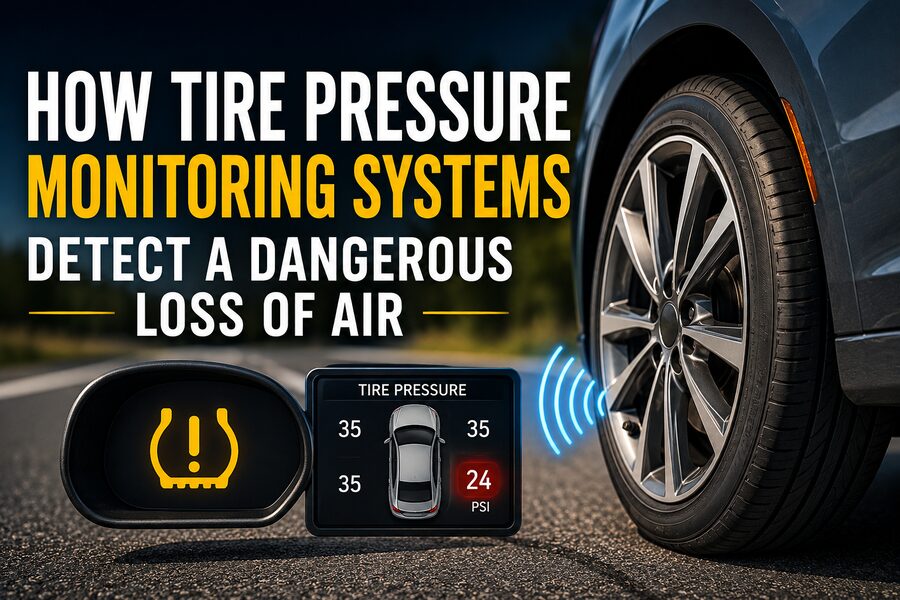
The familiar TPMS warning symbol usually resembles a tire cross-section with an exclamation point inside it.
When it illuminates steadily, the system is generally telling the driver that one or more tires have become significantly underinflated.
In many systems, the warning threshold is based on a percentage below the vehicle manufacturer’s recommended cold inflation pressure.
The exact logic varies by vehicle and market regulations.
For example, imagine a tire that should normally be inflated to approximately 35 psi.
A minor drop of one or two psi may not immediately trigger a warning. But as the pressure continues to fall, the system eventually determines that the tire has crossed the programmed safety threshold.
The warning then appears on the dashboard. 🚨
More advanced vehicles may display the actual pressure of each individual tire, allowing the driver to see exactly which wheel is affected.
📻 5. How Sensors Communicate With the Vehicle
Direct TPMS sensors use low-power radio signals to send their information.
Each sensor typically has its own identification number so the vehicle can distinguish the front-left sensor from the front-right, rear-left, and rear-right sensors.
Depending on the design, the sensors may transmit information at regular intervals or become more active when the vehicle begins moving.
Receivers located in the vehicle capture these signals and pass the information to the TPMS control unit.
Some vehicles can automatically determine which sensor belongs to which wheel position. Others may require a relearning or registration process after tires are rotated or sensors are replaced.
This is why certain vehicles require a TPMS relearn procedure after tire service. 🔄
Without correct sensor identification, the vehicle might receive pressure data but associate it with the wrong wheel position.
🔋 6. TPMS Sensors Need Their Own Power Source
Most direct TPMS sensors contain small internal batteries.
These batteries are designed to last for years because opening a tire simply to replace a battery would be inconvenient.
In many designs, the battery is sealed into the sensor and is not intended to be replaced separately.
When the battery eventually becomes weak, the entire TPMS sensor may need replacement.
Sensor life varies depending on design, operating conditions, transmission frequency, and vehicle use.
When a TPMS sensor stops communicating, the vehicle may display a system malfunction warning rather than a standard low-pressure warning.
This distinction is important.
A low-pressure warning means the system has detected underinflation.
A TPMS malfunction warning means the monitoring system itself may not be working correctly.
🌀 7. How Indirect TPMS Detects Air Loss Without Pressure Sensors
Indirect TPMS takes an entirely different approach.
Instead of measuring air pressure directly, it uses information from the vehicle’s existing wheel-speed sensors.
These sensors are commonly part of the Anti-lock Braking System, or ABS.
Here is the key idea:
When a tire loses air, its effective rolling radius can become slightly smaller.
A smaller tire must rotate slightly faster than a properly inflated tire to travel the same distance.
The vehicle’s control system compares wheel speeds. If one wheel consistently rotates differently from the others, the software may interpret that difference as evidence of underinflation. 🧠
Modern indirect TPMS systems can use more sophisticated signal analysis than simple wheel-speed comparison. They may examine tire vibration characteristics and other rotational patterns to identify pressure changes.
📊 8. Why Indirect TPMS Usually Needs Calibration
Because indirect systems estimate tire pressure rather than measuring it, they often require calibration.
After tires are correctly inflated, the driver may need to initialize or reset the TPMS through a dashboard menu or button.
The system then learns the normal rotational behavior of the tires.
Later, if one tire begins behaving differently, the system can detect the change.
This means the reset process should only be performed after the tires have been checked and inflated correctly.
Resetting an indirect TPMS while a tire is already underinflated may cause the system to treat the incorrect pressure as its new reference condition.
🌡️ 9. Temperature Can Change Tire Pressure
One important reason TPMS warnings sometimes appear unexpectedly is temperature.
Air pressure changes with temperature.
When temperatures fall, the air inside a tire contracts and pressure decreases. ❄️
When temperatures rise, pressure increases.
This is why a TPMS warning may appear on a cold morning even though the tire seemed normal the previous afternoon.
A commonly used approximation is that tire pressure can change by roughly 1 psi for every 10°F change in temperature, although real-world behavior varies.
This does not mean the warning should be ignored.
The system is measuring or estimating the actual operating condition of the tire. If pressure has dropped below the safe limit, the tire still needs attention.
💨 10. How Quickly Can TPMS Detect a Puncture?
Detection time depends on the system and the severity of the leak.
A rapid puncture may cause pressure to fall quickly. A direct TPMS can detect the changing pressure as sensors update their readings.
However, TPMS is not always an instantaneous puncture alarm.
Some sensors transmit intermittently to conserve battery power, and the system may require multiple readings before issuing a warning.
Indirect TPMS may also need the vehicle to travel some distance before wheel-speed differences become obvious.
Therefore, a driver should never assume that the absence of a warning guarantees that every tire is perfectly inflated.
Manual tire inspections remain important. 🔍
🧩 11. Slow Leaks Are Particularly Important
Many dangerous tire-pressure problems do not begin with a dramatic blowout.
Instead, air escapes slowly through:
- Small nails or screws
- Damaged valve stems
- Bead leaks
- Wheel corrosion
- Tiny punctures
- Improper tire installation
- Temperature-related pressure changes
A slow leak may reduce pressure over several days or weeks.
Because the change is gradual, the driver may become accustomed to slightly altered handling without noticing it.
Direct TPMS is especially useful in these situations because it can detect the gradual reduction before the tire becomes visibly flat.
🛣️ 12. Why Underinflation Is Dangerous at Highway Speed
At higher speeds, tires flex rapidly as they rotate.
An underinflated tire flexes more than it was designed to.
That additional movement produces extra heat inside the tire’s sidewalls and internal layers.
If the temperature becomes excessive, structural components may begin deteriorating.
In severe circumstances, the tire can suffer tread separation or sudden failure.
This is why maintaining correct pressure is not simply about fuel economy or tire life—it is a safety issue. 🛡️
TPMS helps reduce risk by alerting the driver before the pressure loss becomes extreme.
🧠 13. Modern TPMS Can Do More Than Trigger a Warning Light
Advanced tire-monitoring systems can provide considerably more information than early versions.
Depending on the vehicle, the system may display:
- Individual tire pressures
- Tire temperatures
- Which tire requires attention
- Low-pressure alerts
- Rapid pressure-loss warnings
- Sensor malfunction messages
Some connected vehicles can even send tire-pressure information to a smartphone application. 📱
Fleet operators may use telematics systems to monitor tire pressure across large numbers of vehicles.
Early detection can prevent roadside breakdowns, tire damage, and unnecessary fuel consumption.
🛞 14. Why the Spare Tire May or May Not Be Monitored
Not every TPMS monitors the spare tire.
Some vehicles equipped with full-size spare wheels include a pressure sensor in the spare.
Others monitor only the four tires currently supporting the vehicle.
Temporary compact spare tires may not always contain TPMS sensors.
Because spare tires can lose pressure while sitting unused for months or years, they should still be inspected manually even if the vehicle has a sophisticated monitoring system.
Discovering that a spare tire is flat during a roadside emergency can turn a manageable problem into a much more difficult situation.
🔧 15. What Happens When Tires Are Replaced?
Direct TPMS sensors are physically located inside or attached to the wheel assembly, so tire technicians must handle them carefully.
During tire replacement, a sensor can be damaged if tools contact it improperly.
Service may also involve replacing items such as:
- Valve cores
- Seals
- Grommets
- Valve caps
- Sensor mounting hardware
If a new sensor is installed, the vehicle may need to learn its identification code.
Some vehicles perform this automatically, while others require a diagnostic tool or specific relearning procedure.
🚨 16. Flashing TPMS Light vs. Solid TPMS Light
On many vehicles, the behavior of the warning light helps distinguish between two different problems.
A solid TPMS warning light typically indicates that one or more tires are underinflated.
A flashing warning light, especially if it later remains illuminated, may indicate a malfunction in the monitoring system.
Possible causes include:
- Dead sensor battery
- Damaged sensor
- Incorrectly programmed replacement sensor
- Communication failure
- Missing TPMS sensor
- Electronic system fault
Vehicle-specific behavior varies, so the owner’s manual should always be consulted for the exact meaning.
🧰 17. TPMS Does Not Replace a Tire Pressure Gauge
A major misunderstanding about TPMS is that the system eliminates the need to check tire pressure manually.
It does not.
TPMS is primarily a warning system, not a substitute for routine maintenance.
Drivers should still check tire pressures periodically using a reliable pressure gauge, preferably when the tires are cold.
The correct pressure should be taken from the vehicle manufacturer’s tire-information label, often found on the driver’s door frame or inside the owner’s manual.
The pressure molded into the tire sidewall is generally not the vehicle’s recommended operating pressure. It usually relates to the tire’s maximum load and pressure specifications.
🛡️ 18. Why TPMS Is an Important Safety Technology
Tire-pressure monitoring systems provide a valuable layer of protection because tire pressure can decline without producing obvious symptoms.
Direct TPMS measures pressure through sensors inside the wheel.
Indirect TPMS analyzes wheel behavior using existing vehicle sensors.
Although the technologies differ, both are designed to answer the same critical question:
Is a tire losing enough air to become unsafe?
By recognizing underinflation earlier, TPMS can help drivers avoid excessive tire heating, poor handling, increased wear, reduced efficiency, and potentially dangerous failures.
🚗 Conclusion
Tire Pressure Monitoring Systems work quietly in the background whenever a modern vehicle is being driven.
In direct systems, small electronic sensors measure actual pressure inside each tire and transmit the information wirelessly to the vehicle. In indirect systems, sophisticated software examines wheel-speed and tire-behavior data to identify signs that a tire has lost air.
When pressure drops beyond an acceptable level, the system warns the driver before the problem becomes much more serious. ⚠️🛞
Yet TPMS is most effective when combined with good maintenance. Drivers should still inspect their tires, check pressures manually, look for damage, and investigate repeated warning messages rather than simply resetting the system.
A tiny pressure sensor or a few lines of software may seem insignificant compared with the rest of a vehicle, but their role is extremely important. By recognizing a dangerous loss of air early, TPMS helps maintain tire performance, vehicle stability, efficiency, and—most importantly—road safety. 🚘🛡️