
A driver notices the temperature gauge climbing during a summer traffic jam. The radiator fan is running, there is no obvious leak, and the coolant reservoir looks full. Yet the engine is warmer than usual because the liquid inside may not have the right coolant-to-water balance.
The opposite problem often appears in winter. A vehicle starts normally, but its cooling system contains mostly plain water after repeated top-ups. Overnight freezing can turn that water into expanding ice, placing hoses, the radiator and even the engine block at risk.
Coolant concentration is not a minor workshop detail. It affects freezing protection, boiling margin, corrosion control, heat transfer, water-pump lubrication and the long-term condition of many expensive engine components.
For students and technicians, the key is to understand that neither “more antifreeze” nor “more water” is automatically better. The correct mixture is a carefully engineered compromise. 💧
🌡️ 1. Coolant concentration means the coolant-to-water ratio
In most passenger vehicles, the word coolant refers to a mixture of water and concentrated antifreeze/coolant. The concentrate commonly uses ethylene glycol or propylene glycol as its freezing and boiling-point protection ingredient, along with corrosion inhibitors and other additives.
Coolant concentration describes how much concentrate is present compared with water. A 50/50 mixture, for example, contains equal parts coolant concentrate and suitable water.
Some products are sold as pre-mixed coolant. Those must not be diluted unless their label and the vehicle manufacturer specifically permit it.
🧪 2. The mixture is a package, not simply coloured liquid
Coolant does more than change the freezing point of water. Modern formulations protect aluminium, cast iron, copper alloys, solder, plastics, elastomers and seals that may all exist in one cooling system.
The coloured dye is not a reliable guide to chemistry or compatibility. Blue, green, pink, orange and other colours vary between brands and regions, so technicians should identify coolant by the required specification rather than appearance.
- Water carries heat effectively.
- Glycol provides freeze and boil protection.
- Additives control corrosion, cavitation and deposit formation.
- The full mixture supports reliable service over time.
💧 3. Why water remains essential
Water has a higher specific heat capacity and generally transfers heat better than glycol-based concentrate. That makes it exceptionally effective at absorbing combustion heat from the cylinder head and releasing it through the radiator.
A cooling system filled with excessive concentrate may therefore have less heat-transfer capability than one with the specified mixture. This is why maximum antifreeze protection and maximum hot-weather cooling performance do not occur at exactly the same ratio.
Water quality matters as well. Minerals in unsuitable water can encourage scale and deposits, so manufacturers often specify distilled, deionised or otherwise appropriate water for mixing.
❄️ 4. What a low concentration does in cold weather
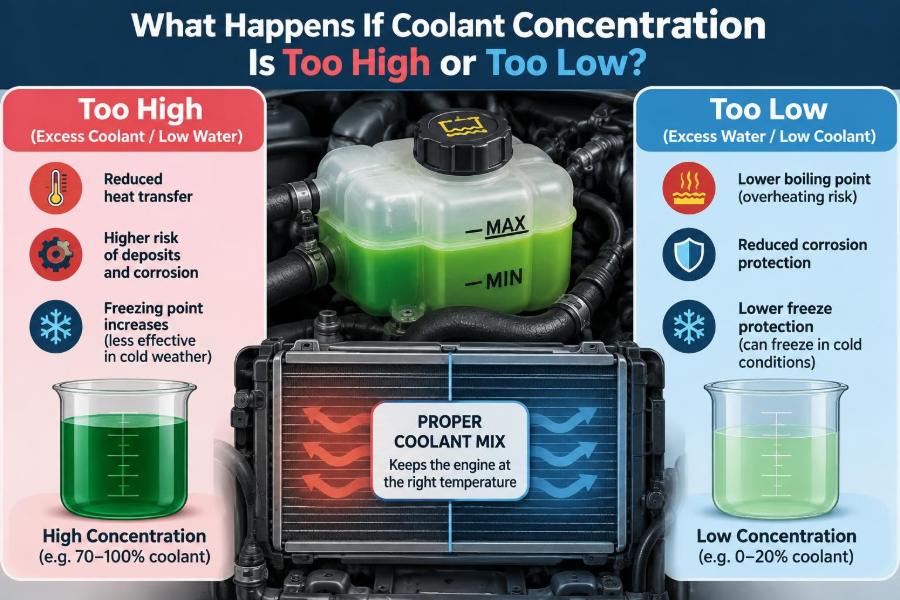
When coolant concentration is too low, the mixture contains too much water. Its freezing protection is reduced, so it can begin freezing at temperatures that a correctly mixed coolant would tolerate.
As water freezes, it expands. In a confined cooling system, this expansion can crack a radiator core, split hoses, damage fittings or, in severe cases, damage cast components.
A partially frozen system can also prevent circulation after startup. The engine may overheat locally even though the ambient temperature is very low.
🔥 5. Low concentration also reduces boiling protection
The cooling system is pressurised to raise the boiling point of the coolant, but mixture strength still matters. Too much water lowers the boiling margin compared with the recommended blend.
Under heavy load, towing, high ambient temperatures or poor airflow, local hot spots can form around exhaust-valve areas and combustion chambers. If coolant boils there, vapour pockets transfer heat poorly and can intensify overheating.
Boiling can also force coolant from the pressure cap or expansion tank, leaving the system low and introducing air. 🌡️
🛡️ 6. Corrosion protection becomes weaker when concentration is too low
Water alone does not provide the inhibitor package required by modern cooling systems. Dilution reduces the concentration of chemicals designed to protect internal metal surfaces.
Corrosion may develop in the radiator, heater core, water pump, thermostat housing, engine block and cylinder head passages. The damage is often gradual, so the vehicle may appear normal until a restriction, leak or component failure occurs.
Low concentration can be especially harmful where dissimilar metals are connected through conductive coolant, because electrochemical corrosion becomes more likely without adequate protection.
⚙️ 7. Water-pump durability can suffer with an overly weak mixture
Coolant additives help create an environment that protects the water pump and its seal. Although coolant is not engine oil, the fluid chemistry around the seal and impeller affects long-term durability.
An overly diluted mixture may promote corrosion and abrasive deposits near the pump. It can also offer less resistance to cavitation-related surface damage in demanding operating conditions.
A weeping water-pump seal, noisy bearing or corroded impeller should be investigated as a system issue, not treated only as an isolated part failure.
📉 8. Too much water encourages deposit and scale formation
If repeated top-ups use mineral-rich tap water, dissolved minerals can precipitate on hot surfaces. These deposits act as insulation inside narrow cooling passages and reduce heat exchange.
Radiator tubes, heater cores and cylinder-head water jackets are particularly sensitive to restriction. A small reduction in flow or heat transfer may become important when the engine is working hard.
Even a coolant mixture with the right ratio can perform poorly if contamination has already created substantial deposits.
🧊 9. What a high concentration means
High concentration means there is too much coolant concentrate and too little water. This may happen when someone pours concentrate into a system already containing premixed coolant, assumes stronger is always safer, or tops up repeatedly without checking the existing ratio.
Excess concentrate is not a harmless upgrade. Glycol changes the physical properties of the fluid, including its heat capacity and viscosity.
The manufacturer’s specified range is therefore a working range, not merely a minimum amount of antifreeze to exceed.
🌡️ 10. Too much concentrate can reduce heat transfer
Compared with water, glycol-based concentrate carries less heat per unit mass and generally transfers heat less effectively. Increasing the concentration too far can make it harder for the coolant to remove heat from the engine.
This does not mean that every rich mixture will immediately cause overheating. It means the system has less thermal efficiency and may have a smaller safety margin in traffic, high temperatures, climbing or towing.
An engine that previously operated normally but becomes warm after an incorrect refill deserves a concentration check.
🌀 11. High concentration makes coolant more viscous
Concentrated glycol mixtures are thicker than water-rich mixtures, especially at low temperatures. Higher viscosity can increase resistance to flow through the radiator, heater core and small passages in the engine.
The water pump must work harder to circulate a more viscous liquid. Flow characteristics can change enough to affect heater output, warm-up behaviour and cooling performance in some systems.
Very high concentration is particularly undesirable in cold climates because thick fluid circulates less readily during cold starts.
❄️ 12. More concentrate does not provide unlimited freeze protection
A common misconception is that pure antifreeze gives the best possible freeze protection. In reality, glycol-water mixtures have an optimum region for freezing protection; beyond that region, adding more concentrate can make freeze protection worse.
Pure or nearly pure concentrate is also unsuitable because it lacks the water needed for effective heat transfer and may flow poorly. Always follow the product instructions and the vehicle manufacturer’s specified mixture.
The strongest-looking mixture is not necessarily the safest mixture.
🔧 13. Excessive concentration can affect seals and system behaviour
Cooling-system seals, hoses and plastics are designed to work with approved coolant chemistry within its intended concentration range. A severely incorrect blend can alter fluid behaviour and may contribute to leaks or seal problems over time.
The exact effect depends on the coolant formulation and materials used in the vehicle. This is another reason not to improvise with universal fluids, additives or undiluted concentrate.
When a leak occurs after service, confirm the mixture, the fill procedure and the product specification before assuming the replacement part is defective.
📊 14. The two errors compared
| Condition | Main immediate concern | Likely longer-term concern |
|---|---|---|
| Too little concentrate | Reduced freeze and boil protection | Corrosion, scale, pump and component damage |
| Specified mixture | Balanced thermal and protective performance | Best chance of reliable system life when maintained |
| Too much concentrate | Reduced heat transfer and increased viscosity | Poor circulation, reduced cooling margin and unsuitable freeze protection at extreme ratios |
The practical lesson is that both directions create risk, but through different mechanisms. Checking only the coolant level cannot reveal these problems.
🚗 15. Symptoms of an overly weak coolant mixture
A low concentration may not create obvious symptoms until temperatures become extreme or corrosion has progressed. Still, technicians should pay attention to warning signs.
- Coolant testing shows inadequate freeze protection.
- Rust-coloured fluid, sediment or scale is visible.
- Frequent water-only top-ups have occurred.
- The vehicle has an unknown maintenance history.
- Winter operation is expected after a recent leak repair.
These signs call for testing, not guesswork based on colour or smell.
🚨 16. Symptoms of an overly rich coolant mixture
High concentration can be difficult to recognise visually, because the reservoir level may look normal and the fluid may appear clean. A concentration test is the dependable method.
Possible clues include warmer-than-normal operation after a coolant service, weak heater performance in cold conditions, or a service history showing that concentrate was repeatedly added.
These symptoms have many other possible causes, including a stuck thermostat, restricted radiator, air pocket or fan fault. Diagnose the full system before draining fluid unnecessarily.
🔍 17. Test concentration with the right tool
A refractometer is widely used to measure coolant concentration and estimate freeze protection. It requires only a small sample, but it must be used according to its instructions and calibrated when necessary.
Some hydrometer-style testers are also used, although their accuracy can be influenced by coolant type, temperature and contamination. Digital testers may be appropriate in professional workshops.
Test fluid only when it is safe to access. Never open a hot pressurised cooling system, because hot coolant can cause serious burns.
🧫 18. Test condition as well as concentration
A correct ratio does not prove that coolant is healthy. Additives can become depleted, contaminants can enter the system, and oil or combustion gases can indicate faults requiring separate diagnosis.
Inspect the coolant for unusual debris, oily film, heavy rust or gel-like material. Check service records, leaks, hose condition, radiator condition and the operation of the pressure cap, thermostat and cooling fans.
For fleets and workshops, coolant analysis can provide additional information about contamination and inhibitor condition where that level of monitoring is justified.
🚰 19. Why repeated top-ups create concentration drift
A small leak often leads owners to add whatever liquid is available. If water is repeatedly added, concentration gradually falls. If concentrate is repeatedly added, concentration rises.
Evaporation and overflow events can complicate the picture because water and glycol may not be lost in identical proportions under every condition. A system with a history of coolant loss should be repaired and tested after the repair.
Simply restoring the reservoir to the correct level is not the same as restoring the correct mixture.
🪣 20. Premixed coolant and concentrate must not be confused
Premixed coolant is ready to pour into the system. It already contains the intended water proportion, so adding more water reduces protection and adding concentrate may make the mixture too rich.
Concentrated coolant is intended to be mixed with the correct water before filling, unless the product instructions state otherwise. Mixing in a clean container provides better control than estimating ratios inside the reservoir.
Read the label every time. Similar containers can have very different dilution requirements.
📘 21. Follow the vehicle’s required coolant specification
Different engines use different inhibitor technologies and material combinations. The correct coolant must meet the specification required for that vehicle, not merely resemble the old coolant in colour.
Mixing incompatible products may reduce corrosion protection or create sludge in some circumstances. When the existing fluid cannot be identified, a proper drain, flush where appropriate, and refill with the approved product may be safer than topping up with an uncertain alternative.
Service literature remains the primary reference for fill procedure, capacity, bleed points and specified concentration.
🌬️ 22. Concentration is only one part of overheating diagnosis
An incorrect mixture can contribute to overheating, but it is not the only cause. A technician should avoid assuming that a richer or weaker mix explains every high-temperature complaint.
- Low coolant level or an external leak
- Trapped air after poor bleeding
- Thermostat malfunction
- Cooling-fan or fan-control fault
- Restricted radiator or condenser airflow
- Water-pump damage or drive-belt problems
- Combustion-gas leakage into the cooling system
A systematic diagnosis prevents unnecessary parts replacement. 🔧
🫧 23. Air pockets can imitate mixture-related problems
Air does not carry heat as effectively as circulating coolant. After draining or component replacement, trapped air can cause unstable gauge readings, gurgling, poor cabin heat and localised engine hot spots.
Many modern vehicles have specific bleeding procedures, vacuum-fill requirements or electronically controlled pumps that require a service-mode process. Ignoring these steps can leave a correctly mixed coolant system performing badly.
Always distinguish between a concentration fault and an air-bleeding fault; both may occur after the same repair.
🏁 24. Operating conditions change the consequences
A mildly incorrect concentration may go unnoticed during gentle driving in moderate weather. The same vehicle can reveal the problem during a mountain climb, sustained high speed, heavy towing, stop-start traffic or a severe cold spell.
Turbocharged engines, compact engine bays and high-output hybrid systems can place demanding thermal loads on their cooling circuits. Some vehicles also have separate low-temperature circuits for charge-air cooling, batteries or power electronics.
Each circuit must receive the correct approved fluid and concentration for its design.
🧰 25. Correcting a mixture that is too weak
First identify the existing coolant type and test its concentration. If the product is known and the system is otherwise clean, a calculated partial drain and refill with the correct concentrate may restore the ratio.
If the coolant is contaminated, old, mixed with unknown products or affected by a major leak, a more complete service may be appropriate. Collect and dispose of old coolant responsibly; it is hazardous and must be kept away from children and animals.
After correction, bleed the system correctly and recheck both level and concentration once the vehicle has completed the required heat cycles.
⚖️ 26. Correcting a mixture that is too rich
Too-rich coolant is commonly corrected by removing a measured quantity and replacing it with the appropriate water, then circulating the system and retesting. The exact process depends on system capacity, accessible drain points and the desired concentration.
Do not dilute blindly. Removing or adding fluid without a calculation can overshoot the target, particularly in small cooling systems.
If the coolant chemistry is unknown or incompatible fluids may have been mixed, use the manufacturer-approved service procedure rather than attempting repeated dilution.
✅ 27. The core principle: use the specified mixture, then verify it
The cooling system works best when water, glycol and additives are present in the proportions intended by the vehicle manufacturer. Too little concentrate sacrifices freeze, boil and corrosion protection; too much concentrate can impair heat transfer and circulation.
Use the correct coolant specification, mix concentrate with suitable water where required, follow the bleeding procedure and measure the finished concentration with a proper tester. Level, condition and concentration all need attention.
The right coolant mixture is not the strongest one or the cheapest one—it is the specified one, accurately prepared and regularly checked. 💧🔧🌡️