
A fuel gauge falling faster than expected can turn an ordinary commute into a budgeting question. The same is true when comparing two cars: a vehicle with a lower purchase price may cost more every month if it consumes substantially more fuel.
For students learning automotive fundamentals, fleet operators tracking expenses, and everyday drivers planning a trip, three numbers are especially useful: fuel efficiency, cost per kilometer, and driving range. They translate fuel use into information that supports real decisions.
These calculations are simple in principle, but small errors—using the wrong units, trusting the dashboard too literally, or ignoring idling—can produce misleading results. Road conditions, driving style, payload, and maintenance also change the answer.
Once the measurements are taken consistently, the math becomes a practical diagnostic tool. It can reveal whether a change in consumption is normal, whether a journey needs a fuel stop, and what each kilometer actually costs.
⛽ Start with the three core measures
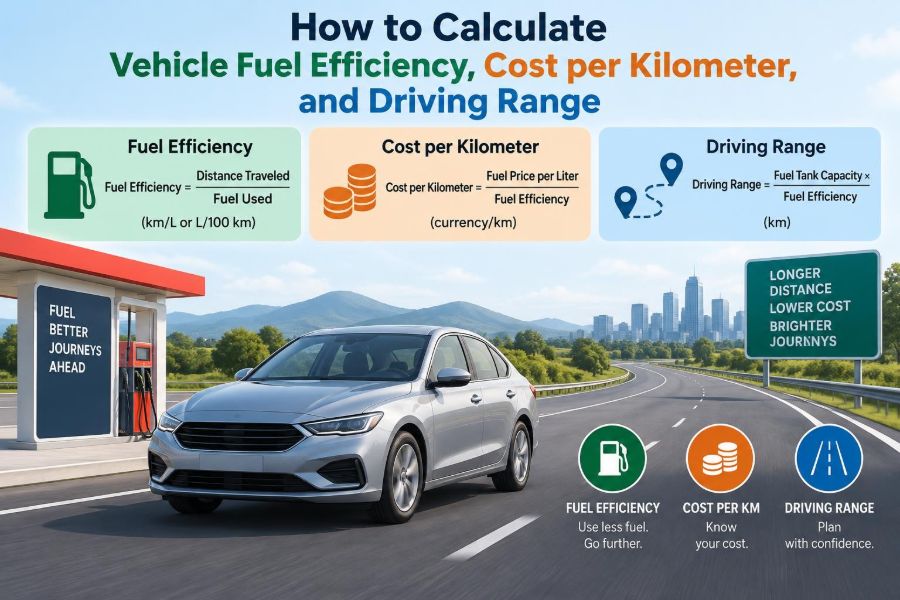
Fuel efficiency describes how much distance a vehicle travels for a given amount of fuel. It is commonly expressed as kilometers per liter (km/L), miles per gallon, or liters per 100 kilometers (L/100 km).
Cost per kilometer assigns a fuel cost to each kilometer traveled. Driving range estimates the distance available from the fuel currently in the tank or from a full usable tank. Each measure answers a different question, so they should not be treated as interchangeable.
📏 Understand distance, volume, and currency units
Use one consistent unit system throughout a calculation. In many countries, distance is measured in kilometers and fuel volume in liters, making km/L and L/100 km convenient. Cost is then entered in local currency per liter.
Mixing miles with kilometers or gallons with liters creates an incorrect result even when the arithmetic itself is correct. Record the unit beside every value, especially when comparing vehicle specifications from different markets.
🛣️ Calculate fuel efficiency in km/L
The direct formula is:
Fuel efficiency (km/L) = Distance traveled (km) ÷ Fuel used (L)Suppose a car travels 420 km and requires 35 L to refill. Its measured efficiency is 420 ÷ 35 = 12 km/L. This means that, under those particular operating conditions, each liter moved the vehicle about 12 km.
Higher km/L values are better because the vehicle travels farther on each liter.
🔄 Calculate consumption in L/100 km
Many manufacturers and fleet reports use liters per 100 km because it describes fuel consumed over a fixed distance:
Fuel consumption (L/100 km) = Fuel used (L) ÷ Distance (km) × 100Using the same example, 35 ÷ 420 × 100 = 8.33 L/100 km. In this format, lower values are better. A reduction from 9 to 8 L/100 km saves one liter every 100 km, which is often easier to interpret than a change in km/L.
🔁 Convert between km/L and L/100 km
These two expressions are reciprocals, not direct equivalents. Convert carefully:
L/100 km = 100 ÷ km/L
km/L = 100 ÷ L/100 km
A vehicle returning 10 km/L uses 10 L/100 km. One returning 20 km/L uses 5 L/100 km. This non-linear relationship matters: improving from 5 to 10 L/100 km is a much larger fuel saving than improving from 10 to 15 L/100 km.
🧮 Use the full-tank method for reliable data
The most practical real-world method is the full-to-full method. Fill the tank, reset the trip meter, drive normally, then refill at the next fuel stop. The liters added on the second visit are treated as fuel used.
- Fill the tank to a consistent stopping point.
- Record the odometer or reset the trip meter.
- Drive for a meaningful distance.
- Refill at a similar pump shut-off point.
- Record distance traveled and liters added.
- Apply the appropriate formula.
A longer test distance reduces the influence of small filling differences.
🧪 Keep refueling conditions consistent
Fuel pumps may stop at slightly different moments due to flow rate, nozzle position, and tank venting. Do not attempt to force extra fuel into the filler neck after automatic shut-off; overfilling can cause spills and may affect evaporative-emissions equipment.
For comparable records, use the same fill practice each time. A single tank result is useful, but an average of several full-to-full cycles better represents normal consumption.
🖥️ Treat dashboard economy displays as estimates
Most modern vehicles estimate fuel economy from injector operation, fuel-flow models, distance signals, and other control-module inputs. These displays are useful for observing trends and for modifying driving behavior in real time.
They are not a substitute for measured fuel added at the pump. Calibration, tire size changes, idling calculation, and sensor assumptions can create a difference between the displayed value and actual full-to-full consumption.
💰 Find the fuel cost per kilometer
Cost per kilometer can be calculated from total trip spending:
Fuel cost per km = Fuel cost for trip ÷ Distance traveledAlternatively, if fuel efficiency and pump price are known:
Fuel cost per km = Fuel price per liter ÷ Fuel efficiency in km/LFor a hypothetical fuel price of 1.80 currency units per liter and an efficiency of 12 km/L, the result is 1.80 ÷ 12 = 0.15 currency units per km.
🧾 Use L/100 km for another cost formula
When consumption is recorded in L/100 km, use this form:
Fuel cost per km = (L/100 km × Fuel price per liter) ÷ 100If a vehicle consumes 8.33 L/100 km and fuel costs 1.80 per liter, its fuel cost is approximately 0.15 per km. Both methods should agree when the underlying fuel-use data are the same.
This figure covers fuel only. It does not include maintenance, depreciation, finance charges, insurance, parking, tolls, or tires.
📊 Compare vehicles on the same basis
Comparisons become meaningful only when the units and conditions match. Convert every candidate vehicle to L/100 km or cost per km using the same local fuel price.
| Vehicle | Consumption | Fuel price | Fuel cost per km |
|---|---|---|---|
| A | 6 L/100 km | 1.80/L | 0.108 |
| B | 9 L/100 km | 1.80/L | 0.162 |
These hypothetical values show that Vehicle B costs 0.054 more per kilometer for fuel. Multiply that difference by expected annual distance to understand its budget effect.
🧭 Calculate range from usable fuel
Driving range is estimated by multiplying available fuel by measured efficiency:
Range (km) = Available fuel (L) × Fuel efficiency (km/L)If 42 L are available and the vehicle returns 12 km/L, estimated range is 504 km. With L/100 km data, the equivalent formula is:
Range (km) = Available fuel (L) ÷ L/100 km × 100Range is an estimate, not a promise. Conditions may change before the tank is empty.
🛢️ Distinguish tank capacity from usable capacity
A published tank capacity is not necessarily the amount a driver should plan to consume. Some fuel remains below the pickup point, and manufacturers may reserve fuel after a low-fuel warning to reduce the chance of immediate fuel starvation.
For trip planning, use a conservative usable amount rather than treating the nominal tank volume as fully available. The exact reserve is vehicle-specific and should not be assumed from another model.
⚠️ Leave a practical fuel reserve
Planning to arrive with an almost empty tank is risky because traffic, diversions, steep grades, weather, and unavailable stations can increase actual fuel use. Fuel also helps cool and lubricate components in some fuel-system designs.
A sensible approach is to choose a personal refueling threshold, such as refilling well before the predicted range reaches zero. This is operational planning, not a universal percentage rule.
🏙️ Separate city, highway, and mixed driving
One average can hide major differences. Urban traffic involves acceleration, braking, low average speed, and idling. Open-road driving often improves economy until aerodynamic drag becomes dominant at higher speeds.
Record operating conditions alongside each tank: mostly city, mostly highway, mixed use, heavy traffic, mountain roads, or towing. A vehicle has no single permanently fixed fuel-efficiency value; it has a range of results under different duty cycles.
🌬️ Understand aerodynamic drag at speed
Air resistance rises rapidly as speed increases. The engine must deliver more power to push air aside, so fuel consumption often climbs noticeably during sustained high-speed travel.
Roof boxes, open windows at speed, external accessories, and a loaded roof rack can increase drag. Their effect depends on shape, speed, and vehicle design, but the practical lesson is consistent: smooth airflow and moderate speed generally help range.
🚦 Recognize the cost of acceleration and idling
Every acceleration adds kinetic energy to the vehicle. Braking dissipates much of that energy as heat in conventional vehicles, although hybrids and electric vehicles can recover some through regenerative braking.
Idling consumes fuel while distance remains zero, so it worsens km/L and raises L/100 km. Avoiding unnecessary idling and anticipating traffic flow can reduce waste without unsafe driving or abrupt behavior.
🛞 Check tires, alignment, and rolling resistance
Underinflated tires deform more as they roll, increasing rolling resistance and heat. Incorrect wheel alignment can make tires scrub against the road rather than roll freely, while also accelerating tire wear.
Check tire pressure when tires are cold and use the vehicle manufacturer’s specified pressure for the actual load condition. Do not inflate beyond recommended values merely to chase economy; handling, ride, and tire wear also matter.
🔧 Account for maintenance and mechanical condition
A clogged air filter, dragging brake, poor engine tune, incorrect lubricant, damaged sensor, or transmission issue may affect fuel consumption. Not every change indicates a fault, but a persistent unexplained increase deserves investigation.
Fuel records are valuable here. If comparable routes and driving conditions suddenly require more fuel, inspect simple causes first: tire pressure, brake drag, load, warning lights, and service intervals. A qualified technician should diagnose faults rather than replacing parts by guesswork.
🎒 Include payload, passengers, and towing
Extra mass requires more energy during acceleration and hill climbing. Towing also adds rolling resistance and, often more significantly, aerodynamic drag from the trailer.
The effect is route-dependent. A heavy load has less influence during steady travel on level roads than during stop-start operation or repeated climbs. Use a separate fuel log category for towing or heavily loaded work trips instead of mixing them into normal commuting data.
⛰️ Plan for gradients, weather, and traffic
Climbing consumes energy; descending may return little or some of it, depending on the vehicle and driving conditions. Headwinds can have an effect similar to driving faster because they increase air speed relative to the vehicle.
Cold starts, dense traffic, wet roads, air-conditioning demand, and low ambient temperatures can also alter consumption. Do not conclude that a vehicle has developed a fault from one unusual tank alone.
🧠 Build driving habits that reduce consumption
Efficient driving is mainly about smoothness and anticipation. Maintain safe following distance, accelerate progressively, select an appropriate gear or drive mode, and avoid carrying unnecessary cargo.
- Use navigation or route knowledge to avoid avoidable detours.
- Maintain steady speed where traffic and law allow.
- Close windows and remove unused roof accessories on fast journeys.
- Combine short errands when practical, particularly when the engine would otherwise stay cold.
Fuel saving should never override speed limits, safe gaps, road conditions, or considerate driving.
🧾 Keep a useful fuel log
A simple notebook, spreadsheet, or application can turn occasional calculations into a trend record. Record date, odometer reading, liters added, price per liter, total cost, route type, and notable conditions.
From consecutive entries, calculate distance, efficiency, cost per km, and cost per 100 km. A log also helps separate a genuine consumption trend from normal tank-to-tank variation.
📈 Use rolling averages instead of chasing one tank
A rolling average combines several recent fill-ups and updates each time new data are added. It smooths errors caused by slight differences in filling level, one unusually congested trip, or a temporary change in weather.
For example, calculate total distance over four fill-ups and divide it by total liters over the same period. This weighted method is more accurate than simply averaging four individual km/L figures, because each tank may cover a different distance.
🧩 Avoid common calculation mistakes
Several errors appear repeatedly in fuel-cost calculations:
- Dividing liters by distance and labeling the result km/L.
- Comparing km/L directly with L/100 km without conversion.
- Using the fuel gauge needle as an exact volume measurement.
- Including a partial fill in a full-to-full calculation.
- Calling fuel cost per km the vehicle’s total ownership cost.
- Planning a trip around the advertised test-cycle range alone.
Checking the units before pressing the calculator button prevents most of these problems.
🔌 Adapt the method for hybrids and plug-in hybrids
Conventional hybrids use fuel and may show excellent city economy because regenerative braking recovers some energy. Their fuel calculations follow the same pump-based method, but results vary with temperature, battery state, and traffic pattern.
Plug-in hybrids require extra care. A trip can use electricity, fuel, or both. Track fuel liters and charging energy separately; otherwise, a low fuel figure may conceal a significant amount of grid electricity used for charging.
⚡ Compare electric-vehicle energy cost carefully
Electric vehicles do not consume liters, but the cost logic is similar. Energy efficiency is usually expressed in kWh/100 km, and energy cost per kilometer can be calculated as:
Electricity cost per km = (kWh/100 km × Electricity price per kWh) ÷ 100Charging losses, tariffs that vary by time, and public-charger pricing can change the result. For a fair comparison, state whether the energy figure is measured from the vehicle display or from the charging meter.
🗺️ Plan a long trip with conservative range
Start with route distance, expected terrain, speed, load, weather, and fuel availability. Use your measured economy from similar journeys where possible, then add a margin for uncertainty rather than assuming ideal conditions.
On remote routes, identify fuel stations before departure and verify operating availability when practical. The best plan does not maximize every kilometer from a tank; it preserves options when plans change.
🧮 Work through one complete trip example
Consider a hypothetical sedan filled to a consistent automatic shut-off point. Its trip meter shows 516 km at the next refill, and the pump delivers 43.0 L at 1.70 currency units per liter.
- Efficiency: 516 ÷ 43.0 = 12 km/L.
- Consumption: 43.0 ÷ 516 × 100 = 8.33 L/100 km.
- Fuel cost: 43.0 × 1.70 = 73.10 currency units.
- Cost per km: 73.10 ÷ 516 = about 0.142 per km.
- Estimated full-tank range with 48 usable L: 48 × 12 = 576 km.
The range should be reduced for a faster, hillier, heavily loaded, or colder future trip.
🧱 Know the limits of these estimates
Calculated figures describe past operation and support planning; they do not predict every future journey exactly. Fuel quality, traffic delay, driver behavior, wind, warm-up time, and measurement variation all influence results.
Manufacturer economy ratings remain useful for standardized comparison, but they are obtained under specified test procedures. Your own measured data is usually more relevant for your route, vehicle condition, load, and driving pattern.
✅ Bring the numbers together
The core workflow is straightforward: measure distance accurately, measure fuel through consistent full-to-full refills, calculate efficiency, apply the current fuel price, and estimate range conservatively. Repeat the process over several tanks instead of placing too much confidence in one result.
Use km/L or L/100 km to understand consumption, cost per km to build a travel budget, and available fuel multiplied by realistic efficiency to plan stops. The numbers become most valuable when paired with notes about traffic, speed, load, and maintenance condition.
Reliable fuel decisions come from consistent measurement, correct units, and conservative planning—not from a single dashboard number or an optimistic range estimate. With a basic log and a few formulas, every driver can turn refueling data into clearer operating decisions. 🚗⛽📍