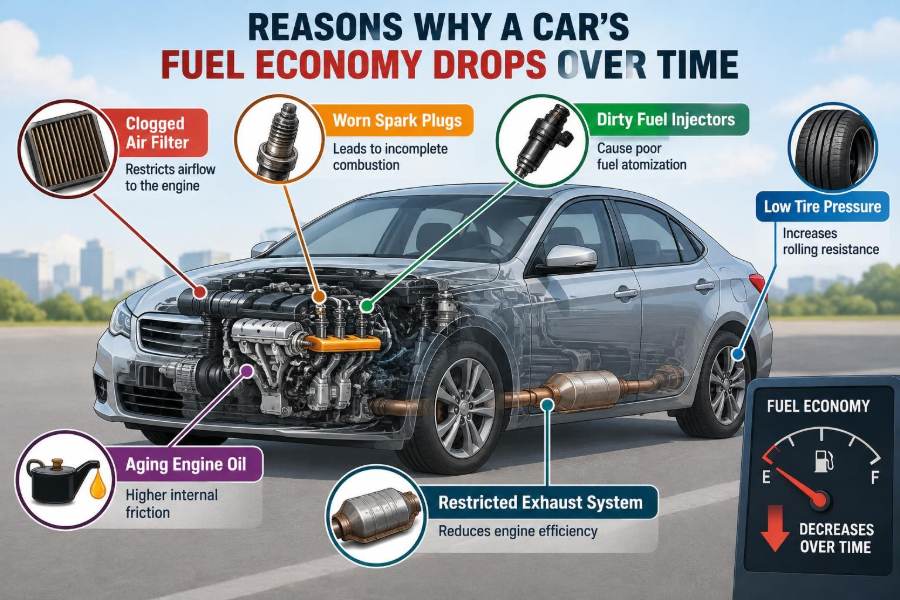

A car that once travelled comfortably through the week on one tank can gradually start asking for fuel sooner. The change is often subtle: an extra stop at the fuel station, a trip computer showing a lower average, or a familiar commute costing more than it used to.
It is tempting to blame the engine immediately. In reality, fuel economy is the result of many systems working together: combustion, air intake, tyre rolling resistance, wheel alignment, transmission operation, electrical loads, and even the way the vehicle is driven.
Some reduction can come from changed traffic, weather, or trip patterns rather than a mechanical fault. But a continuing decline under similar conditions is worth investigating, because it can reveal neglected maintenance, a developing fault, or avoidable energy loss.
Understanding where the fuel goes helps drivers make sensible decisions. It also gives engineering students a useful real-world view of how small losses across a vehicle can combine into a noticeable change at the pump.
🧭 Start by Confirming That Economy Has Actually Fallen
Fuel economy should be compared over similar journeys and measured consistently. A single poor tank may reflect congestion, a strong headwind, unusually cold weather, heavy cargo, or a short series of trips rather than a vehicle problem.
The most reliable simple method is to record the distance travelled between fills and the fuel added at the next fill. Use several full tanks, preferably from the same filling routine, then compare the trend rather than relying on one reading from the dashboard display.
For a litre-based calculation, divide distance travelled by litres used. For a gallon-based calculation, divide distance travelled by gallons used. Neither method eliminates every variation, but repeated records reveal whether there is a real downward trend.
⚙️ Fuel Economy Is an Energy-Balance Problem
Fuel contains chemical energy, but only part of it becomes useful motion at the wheels. The engine loses energy through exhaust heat, coolant heat, friction, pumping work, and accessory loads. The rest of the vehicle must then overcome rolling resistance, aerodynamic drag, gradients, and acceleration demands.
Fuel economy drops whenever the car needs more energy for the same journey or converts fuel energy less efficiently. A partially dragging brake, for example, raises the force needed at the wheels. A poor air-fuel control signal can make combustion less efficient.
This is why there is rarely one universal answer. The useful question is: what has changed in the energy path from fuel tank to road?
🛞 Incorrect Tyre Pressure Raises Rolling Resistance
A tyre deforms as it rolls, and that deformation consumes energy as heat. Low inflation pressure increases the size and flexing of the contact patch, increasing rolling resistance and making the engine work harder to maintain speed.
Pressure can fall gradually through normal air loss, seasonal temperature changes, or a slow puncture. The vehicle may still look normal, so visual inspection alone is not enough. Check pressures when tyres are cold and use the vehicle manufacturer’s specified values, usually found on a door-frame label or in the handbook.
Overinflating tyres is not a sensible economy fix. It can reduce ride comfort, alter grip and wear patterns, and may exceed the intended operating condition. Correct pressure, not maximum pressure, is the target.
📏 Wheel Alignment Can Make the Car Fight the Road
Wheel alignment describes angles such as toe, camber, and caster. Of these, incorrect toe often has a direct effect on fuel consumption because the tyres are slightly steered against one another instead of rolling freely in the intended direction.
A hard kerb strike, pothole impact, worn suspension component, or collision repair can alter alignment. Clues include a steering wheel that is off-centre, drifting on a level road, or uneven tyre wear, especially feathering across the tread.
An alignment check is valuable because it protects both fuel economy and tyres. However, alignment should not be adjusted blindly; worn or loose steering and suspension parts must be identified first, otherwise the setting may not remain stable.
🧱 Tyre Type, Tread Wear, and Wheel Condition Matter
Not all tyres have the same rolling resistance. A robust all-terrain tyre, for instance, may trade some efficiency for durability and off-road traction. Winter tyres can also behave differently from summer tyres, particularly when road and ambient temperatures change.
Unevenly worn tyres may indicate alignment, balance, suspension, or inflation issues. A damaged wheel can create vibration and affect how consistently the tyre contacts the road. These conditions do not always cause a dramatic fuel penalty alone, but they add resistance and often point to a larger maintenance issue.
When replacing tyres, choose an approved size and load rating. A change in overall diameter can also affect speedometer and odometer readings, making a calculated economy change appear larger or smaller than it really is.
🛑 Binding Brakes Waste Energy as Heat
Brake pads should retract slightly after braking so that the wheel rotates with minimal contact. A sticking caliper piston, seized slide pin, restricted flexible hose, or parking-brake fault can leave a pad or shoe dragging continuously.
The driver may notice a hot wheel, a burning smell, reduced coasting distance, steering pull, or one wheel producing much more brake dust than the others. In severe cases, the vehicle may feel sluggish despite normal engine operation.
This is not merely an economy concern. Excess heat can damage discs, pads, wheel bearings, brake fluid, and nearby components. A suspected binding brake needs prompt inspection by a competent technician.
🧰 Wheel Bearings and Driveline Drag Add Hidden Losses
Wheel bearings, constant-velocity joints, differentials, and driveshafts all transmit motion with some friction. As parts wear or lubrication degrades, the losses can rise. A failing wheel bearing may produce a growl that changes with road speed or cornering, although sound alone is not a diagnosis.
Incorrect differential or transfer-case lubricant, where applicable, can also increase drag or reduce component protection. Fluid specifications matter because viscosity and additive packages are selected for a particular design.
These problems are less common than low tyre pressure or poor maintenance, but they illustrate an important principle: fuel use rises when rotating parts no longer move freely.
🫧 A Dirty Air Filter Can Restrict Intake Air
An engine needs air to burn fuel. A heavily contaminated air filter increases intake restriction, especially when the engine demands high airflow during acceleration or at higher speed. Modern fuel-injected engines can often compensate within limits, so a mildly dirty filter does not automatically explain a large economy loss.
Still, a filter that is visibly clogged, wet, damaged, or contaminated by oil should be replaced. The airbox and intake ducting should also be checked for collapsed sections, loose clips, or objects blocking the path.
Replacing filters at the service interval, or earlier in dusty conditions, is sensible. Installing an unapproved “high-flow” filter is not automatically beneficial; poor filtration can increase engine wear, and altered airflow readings may create other problems.
🌬️ Intake Leaks Disturb Engine Air Measurement
Most modern engines estimate incoming air using a mass airflow sensor, a manifold pressure sensor, or both. If unmetered air enters through a cracked hose, failed gasket, or loose intake connection, the control system may calculate the wrong fuel quantity.
The engine control unit can correct modest errors using oxygen-sensor feedback, but large or persistent leaks may cause rough idle, hesitation, fault codes, or a warning light. Turbocharged engines can also lose efficiency when boost pipes leak, because the compressor works without delivering the expected air to the cylinders.
Smoke testing and live diagnostic data are often more reliable than guessing. Replacing sensors before checking hoses and connections is a common, expensive mistake.
🔥 Spark Plugs and Ignition Misfires Consume Fuel Poorly
A spark-ignition engine depends on a timely, strong spark to ignite the air-fuel mixture. Worn spark plugs, damaged coils, poor electrical connections, or incorrect plug gaps can cause incomplete combustion or intermittent misfires.
A severe misfire is usually noticeable as vibration, lack of power, or a flashing engine warning light. Continuing to drive in that condition can send unburned fuel into the catalytic converter, overheating and damaging it.
Even before a dramatic failure, plugs beyond their intended service life may reduce combustion consistency. Use the correct plug type and gap specification; a plug that physically fits is not necessarily suitable for the engine.
🧪 Fuel Injectors Can Lose Their Intended Spray Pattern
Fuel injectors meter fuel in very short pulses and atomise it into fine droplets. Deposits, internal wear, or electrical faults can alter flow or spray pattern. Uneven delivery between cylinders may reduce smoothness, power, and economy.
Injector problems should be diagnosed carefully because similar symptoms can come from ignition faults, vacuum leaks, compression loss, or sensor errors. A workshop may use fuel-trim data, balance testing, pressure checks, or inspection methods appropriate to the fuel system.
Pour-in cleaners are not a universal repair. They may help with mild deposits in some circumstances, but they cannot correct a failed injector coil, a damaged nozzle, or a mechanical fuel-system fault.
🧠 Oxygen Sensors Influence the Air-Fuel Mixture
Oxygen sensors monitor oxygen remaining in the exhaust. The engine control unit uses this information during closed-loop operation to adjust fuel delivery toward the intended mixture. A slow, contaminated, or faulty sensor can lead to excessive fuel use, though the control system may store a fault before the driver notices a major change.
Short-term and long-term fuel trims are diagnostic values that show how much the control unit is adding or subtracting fuel from its base calculation. They can point toward a mixture problem, but they must be interpreted with other data rather than treated as a direct instruction to replace a sensor.
Oil burning, coolant leakage, exhaust leaks, and unsuitable additives can contaminate sensors. Fixing the underlying cause matters as much as replacing the affected component.
🌡️ Engine Temperature Control Affects Efficiency
An engine is generally designed to operate within a controlled temperature range. If a thermostat sticks open, coolant may circulate through the radiator too early and the engine can take too long to warm up. The control system may maintain a richer mixture for longer, while oil remains more viscous and friction stays higher.
A faulty coolant-temperature sensor can create a similar control problem by reporting an implausible temperature. On the other hand, overheating is not an economy strategy in reverse; it is a serious condition that can damage the engine.
Weak cabin heat, unusually slow warm-up, or a temperature gauge that remains lower than its normal position can justify investigation. Gauge behaviour varies by vehicle, so scan-tool data may be needed for confirmation.
🛢️ Engine Oil Choice and Oil Condition Influence Friction
Engine oil separates moving surfaces and carries heat and contaminants away from critical areas. Oil that is badly degraded, too thick for the design, or filled beyond the recommended level can increase pumping and friction losses.
Using the manufacturer-specified viscosity and performance standard is the sensible baseline. A thinner oil is not always better: if it does not meet the engine’s required specification, protection under temperature and load may be inadequate.
Short trips can be particularly hard on oil because moisture and fuel contamination may not evaporate fully. Following the appropriate time-and-distance service interval is more useful than relying on appearance alone.
🧱 Carbon Deposits Can Change Combustion Behaviour
Deposits can form in combustion chambers, on intake valves in some engines, and around piston rings or injector tips. Their effect depends heavily on engine design, fuel quality, operating pattern, and maintenance history.
In some cases, deposits disturb airflow or fuel atomisation. In others, they can contribute to knock tendency, causing the engine control unit to retard ignition timing. Retarded timing protects the engine but can reduce efficiency and performance.
There is no universal cleaning procedure for every deposit problem. The right approach depends on evidence from diagnostics and the specific engine. Aggressive cleaning methods should not be used casually because detached material or unsuitable chemicals can cause damage.
🧯 Exhaust Restrictions Increase Pumping Work
The engine must push exhaust gases out of the cylinders. A restricted catalytic converter, crushed exhaust pipe, damaged muffler, or blocked particulate filter can increase backpressure and reduce the engine’s ability to breathe.
Symptoms may include reduced power at higher load, poor acceleration, unusual exhaust smell, warning lights, or excessive heat. A restriction may be the result of another fault, such as repeated misfires or oil consumption, so simply replacing the blocked component may not solve the root cause.
Diesel particulate filters require particular care. Their regeneration process depends on correct driving conditions and a healthy engine; repeated interrupted regeneration can contribute to fuel dilution in oil and rising fuel use.
🔌 Electrical Loads Make the Engine Work Harder
The alternator converts mechanical energy from the engine into electrical energy. Headlamps, rear demisters, blower motors, heated seats, battery charging, and other accessories increase alternator load, which ultimately requires more fuel.
Air conditioning also consumes energy because its compressor must be driven mechanically or electrically. The effect varies with ambient temperature, cabin setting, vehicle design, and compressor type. In hot weather, an economy comparison without considering air-conditioning use is incomplete.
These loads are normal and often necessary for comfort or visibility. The practical lesson is to avoid leaving high-demand functions on unnecessarily, not to compromise safety by switching off essential equipment.
❄️ Cold Weather and Short Trips Are a Difficult Combination
Cold starts use more fuel because the engine and catalytic converter need to warm up. Tyres, gear oil, engine oil, and wheel-bearing grease are also more resistant to motion when cold. Cabin heating, window demisting, and battery recovery add further demand.
On a very short trip, the car may reach its destination before the engine reaches its most efficient operating state. This explains why a vehicle can show poor average economy in winter urban use yet perform normally on a long motorway journey.
Excessive idling to “warm up” the engine usually wastes fuel. Following the handbook guidance, driving gently after starting, and ensuring clear windows before moving are generally more practical.
🏙️ Traffic, Idling, and Repeated Acceleration Change the Result
A car travelling steadily needs energy mainly to overcome drag and rolling resistance. In stop-start traffic, it must repeatedly accelerate its mass, then discard much of that kinetic energy as heat in the brakes unless the vehicle has regenerative braking.
Idling is especially revealing: fuel is being used while distance travelled is zero, so calculated fuel economy falls rapidly. Congestion can therefore create a large difference even when the vehicle is mechanically sound.
Route changes matter. A new commute with more junctions, hills, school-zone traffic, or lower average speed can look exactly like a mechanical decline until driving conditions are compared.
🏎️ Driving Style Changes Fuel Consumption Quickly
Hard acceleration, late braking, high cruising speed, and abrupt throttle movements raise energy demand. Aerodynamic drag increases rapidly as speed rises, so a modest speed increase on an open road can require noticeably more power.
Smooth anticipation is more effective than trying to drive unusually slowly. Leave space, maintain momentum where safe and legal, and avoid accelerating toward a situation that immediately requires braking.
For manual transmissions, use an appropriate gear without labouring the engine. For automatics, avoid treating every acceleration as a full-throttle event. Modern transmissions are designed to shift efficiently when the driver’s inputs are progressive.
🧳 Extra Mass Has the Greatest Effect in Stop-Start Use
Extra vehicle mass increases the energy required for every acceleration and uphill climb. A boot full of tools, sports equipment, unused cargo, or a permanently fitted heavy accessory may have little effect during a steady cruise but becomes more relevant in urban driving.
Remove unnecessary weight, but keep safety equipment, emergency tools, and required items. The goal is not to make a car impractical; it is to avoid carrying loads that serve no purpose on most journeys.
Passengers and cargo are normal parts of vehicle use. Their impact is simply one reason why one driver’s real-world result may differ from an official test figure or another owner’s experience.
🧰 Roof Racks and Open Windows Increase Aerodynamic Drag
At higher speeds, air resistance becomes a major demand on engine power. Roof bars, roof boxes, bicycle carriers, and poorly positioned external accessories disturb airflow and raise drag. An empty roof rack can still impose a penalty on a regular motorway journey.
Open windows also alter airflow, especially at speed. In warm conditions, the trade-off between open windows and air conditioning is not identical for every car or speed; both can raise fuel use in different ways.
Remove external carriers when they are not needed. This is one of the few economy improvements that can be immediate, requires no mechanical repair, and does not change the vehicle’s safety systems.
⛰️ Terrain, Wind, and Road Surface Can Mislead Drivers
Climbing consumes energy because the vehicle gains gravitational potential energy. Descending may return little of that energy in a conventional petrol or diesel vehicle, especially when braking is required. Hybrid and electric vehicles can recover some through regenerative braking, but not all.
Headwinds raise the effective air speed over the vehicle, increasing aerodynamic drag. Rough, wet, loose, or snow-covered surfaces can raise rolling resistance as well. A route that feels familiar may produce different fuel use when weather changes.
These conditions are not defects to repair. They are reminders to compare economy records over enough distance and varied conditions before concluding that a component has failed.
🔧 Transmission Problems Can Keep the Engine Out of Its Efficient Range
A transmission allows the engine to operate across a range of vehicle speeds. If it slips, delays shifts, fails to lock up a torque converter, or selects unsuitable ratios, engine speed may remain higher than expected and fuel economy can fall.
Signs can include engine revs rising without matching acceleration, harsh or erratic shifts, transmission warnings, or delayed engagement. Transmission fluid condition and level may be relevant, but service procedures vary greatly and some units require specific temperature-controlled checks.
Do not add generic fluid or additives without confirming the exact specification. Transmission faults can be complex, and early diagnosis is generally preferable to continuing until a minor control issue becomes a major repair.
🧩 Hybrid-System Faults Have Their Own Economy Clues
Hybrid vehicles depend on a battery, electric motor, power electronics, engine, and control software working as a system. Their economy can change with outside temperature, cabin heating demand, battery state of charge, trip length, and traffic pattern.
A weak hybrid battery, cooling-system issue, or fault that prevents normal regenerative braking can reduce efficiency. However, a lower displayed economy in winter or on repeated short trips is not automatically evidence of battery failure.
Hybrid diagnostics require suitable equipment and safety procedures because high-voltage components are involved. Owners should not attempt work on orange high-voltage cables or battery assemblies unless properly trained and equipped.
💻 Warning Lights and Diagnostic Codes Need Interpretation
An engine warning light can be associated with an economy problem, but a diagnostic trouble code identifies a detected condition, not always the failed part. For example, a code relating to mixture control can originate from an air leak, fuel-pressure issue, exhaust leak, sensor wiring fault, or sensor failure.
A good diagnostic process combines codes with live data, visual inspection, service history, and targeted tests. Clearing the code without resolving the fault may make the warning disappear briefly while fuel use and emissions remain affected.
Affordable scan tools can be useful for reading information, but they do not replace system knowledge. Treat a code as a starting point for investigation rather than a shopping list.
📋 A Practical Order for Investigating Poor Economy
Start with simple, low-cost checks before assuming an internal engine problem. This reduces wasted parts replacement and often finds the cause early.
- Confirm the trend over multiple fill-ups and similar journeys.
- Check tyre pressures, tyre condition, visible leaks, cargo, and roof accessories.
- Note warning lights, unusual smells, noises, vibration, braking drag, and warm-up behaviour.
- Review the maintenance schedule for oil, filters, spark plugs, and specified fluids.
- Have fault codes and live data assessed if symptoms persist.
- Arrange professional inspection promptly for brake drag, overheating, misfires, fuel leaks, or major power loss.
Keeping a small log of fuel, distance, weather, route type, and maintenance makes this process much more objective.
🚫 Common “Fixes” That Can Waste Money
Many products promise large savings with little explanation of the mechanism. Be cautious with fuel-line magnets, unsupported intake modifications, oversized claims for additives, and parts replaced solely because an online symptom list mentions them.
Similarly, disconnecting a battery or clearing codes may reset adaptive values but does not repair a fault. It can also erase useful diagnostic information. Removing emissions-control components is not a legitimate economy solution and can create legal, environmental, and drivability problems.
The best repairs are evidence-based: identify the abnormal resistance, inaccurate measurement, combustion issue, or operating condition, then correct it with the appropriate part or procedure.
🗓️ Preventive Maintenance Protects More Than Fuel Use
Routine servicing keeps small problems from accumulating. Correct fluids reduce friction, fresh filters protect airflow and fuel delivery, specified spark plugs support reliable ignition, and inspections can reveal leaks, worn belts, tyre damage, and brake issues before they become costly.
Maintenance does not guarantee factory-new fuel economy forever. Age-related wear, driving environment, and changes in use still matter. But it gives the vehicle its best chance of operating as its engineers intended.
Use the manufacturer’s service schedule as the foundation, then adapt it for severe conditions such as dusty roads, towing, repeated short journeys, extreme temperatures, or frequent stop-start operation where the handbook permits.
✅ The Core Principle: Find the Added Loss or Reduced Efficiency
A car’s declining fuel economy is usually not mysterious. It comes from more resistance at the wheels, more drag through the air, extra load on the engine, inefficient combustion, inaccurate sensor feedback, or a journey pattern that prevents efficient operation.
The most useful approach is systematic. First separate normal variation from a genuine trend. Then inspect the accessible factors, respect warning signs, and use proper diagnostics for faults that are not visible. This method protects money, reliability, emissions performance, and safety at the same time.
Good fuel economy is not achieved by one magic adjustment; it is the result of a well-maintained vehicle operating efficiently in the conditions it actually faces.
Track the trend, correct the real cause, and let sound maintenance do the work. 🚗🛠️⛽