
You turn the key or press the start button, and the car does something unfamiliar: perhaps the dashboard flickers, the engine clicks once, or it starts but a warning light remains on. These symptoms can feel similar from the driver’s seat, yet they can come from three very different parts of the starting and charging system.
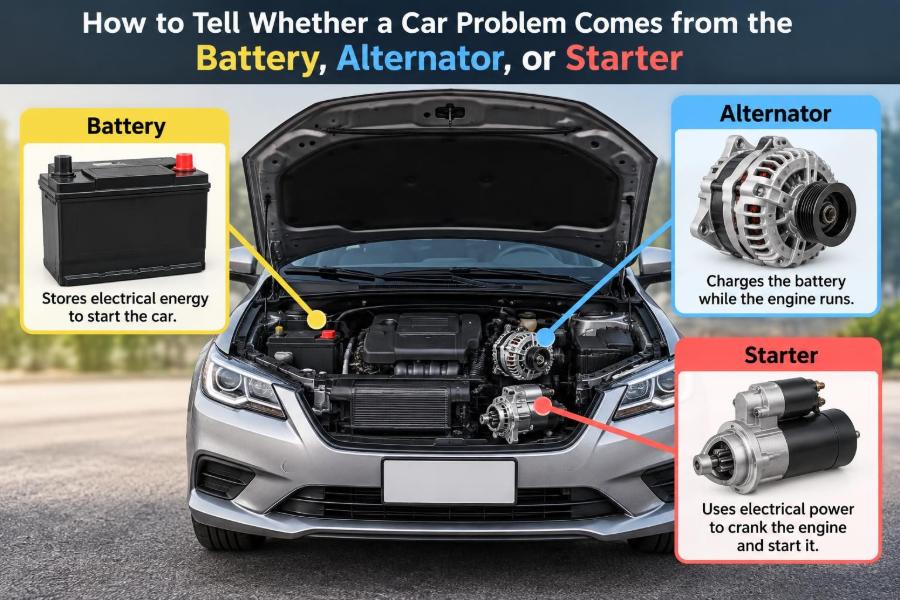
The battery stores electrical energy, the alternator replenishes that energy while the engine runs, and the starter uses a large burst of battery power to turn the engine over. A problem in any one of them can leave a vehicle unable to start.
Guessing can lead to an unnecessary battery purchase, a stranded vehicle, or a missed charging-system fault that ruins a new battery. A few careful observations, combined with safe basic tests, can narrow the cause considerably.
The goal is not to replace professional diagnosis. It is to understand the sequence of events well enough to recognize likely battery, alternator, and starter faults—and to know when testing equipment or a technician is needed.
🔌 Start With the Electrical Chain
A conventional 12-volt vehicle starting system works as a chain. The battery supplies stored electrical energy. The starter draws very high current briefly to crank the engine. Once the engine runs, the alternator generates electricity and recharges the battery.
This sequence explains why the timing of a symptom matters. Trouble before the engine starts often points toward battery condition, cable connections, or the starter circuit. Trouble after the engine is running more strongly suggests the alternator or its drive belt, wiring, and control system.
🔋 What the Battery Actually Does
The battery is not merely a container of voltage. It must deliver substantial current while keeping its voltage high enough for the starter, fuel system, ignition, and electronic control units to operate.
An aging battery may show a reasonable voltage with no load, then collapse when the starter demands current. Cold weather exposes this weakness because chemical reactions inside a lead-acid battery slow down, while the engine requires more effort to turn.
⚙️ What the Alternator Does While Driving
The alternator converts mechanical energy from the running engine into electrical power. It supplies current to vehicle loads—such as lights, blowers, heated glass, and engine electronics—while restoring energy removed from the battery during starting.
Its output is regulated to avoid undercharging and overcharging. On many newer vehicles, the charging voltage can vary with temperature, battery state, and energy-management strategy. Therefore, one voltage reading is useful evidence, not always a complete diagnosis.
🌀 What the Starter Does in Seconds
The starter motor engages the engine’s flywheel or flexplate and rotates the crankshaft fast enough for combustion to begin. It is designed for short bursts, not continuous use.
A starter system includes the motor, a solenoid or relay function, control wiring, heavy battery cables, and the engine ground path. A fault in any of these can imitate a failed starter motor, which is why replacing the starter immediately is not always the right answer.
👀 Observe the Exact Starting Symptom
Before testing anything, notice what happens in a normal start attempt. Do interior lights dim dramatically? Is there rapid clicking, one solid click, a slow crank, or no sound at all? Does the engine crank normally but fail to fire?
Cranking means the starter is rotating the engine. An engine that cranks at normal speed but does not start commonly has a fuel, ignition, immobilizer, sensor, or engine-management issue rather than a battery, alternator, or starter fault.
📋 Use This Symptom Comparison Carefully
| Observed symptom | More likely causes | Why it happens |
|---|---|---|
| Slow, laboured crank; lights dim | Weak battery, poor connections | Voltage falls under high starter load |
| Rapid repeated clicking | Low battery charge, loose terminals | Starter solenoid cannot stay engaged |
| Single click, no crank | Starter circuit, starter, cables | Control circuit operates, but motor does not turn |
| Starts with a jump but later dies or warning lamp appears | Alternator or charging circuit | Battery is not being replenished |
| Normal crank, engine will not run | Usually another system | Starter has performed its main job |
These are patterns, not verdicts. For example, a seized engine, poor engine ground, or corroded positive cable can also produce a single click.
💡 Read the Dashboard and Headlights
Dim headlights, slow power windows, a weak horn, or a clock that resets after a start attempt suggest low system voltage. They do not prove that the battery itself is defective, because discharged batteries can result from alternator faults, parasitic drains, or lights left on.
If lights stay bright and the dashboard behaves normally but the starter gives one click or remains silent, the battery may still be adequate. That shifts attention toward the starter control circuit, cable resistance, transmission safety switch, clutch switch, or starter assembly.
🔊 Interpret Clicking Without Overdiagnosing
Rapid clicking is commonly caused by insufficient voltage at the starter solenoid. The solenoid engages, voltage drops, it releases, voltage recovers slightly, and the cycle repeats. A low battery charge or high-resistance connection is often responsible.
One heavy click can mean the solenoid has engaged but the starter motor cannot rotate. However, it can also occur when battery current cannot pass through a corroded cable or weak ground. The sound alone cannot separate these faults.
🌡️ Consider Temperature and Recent Use
A vehicle that cranks slowly only on very cold mornings may have a marginal battery, thicker engine oil, or both. Heat creates a different pattern: a starter with worn internal components may fail after a hot drive, then work again after cooling.
Recent short trips matter too. Starting consumes energy, and repeated short journeys may not give the alternator enough time to restore it, especially when defrosters, lights, seat heaters, and blower motors are operating.
🧪 Check Battery Voltage at Rest
A digital multimeter offers a useful first check. With the engine off and the vehicle allowed to rest, a healthy fully charged conventional 12-volt lead-acid battery is often near 12.6 volts. A lower reading indicates a lower state of charge, though it does not by itself establish battery health.
Surface charge after driving can make a battery appear temporarily higher, while a battery that has just supplied accessories may read lower. Treat the measurement as a starting point, not a pass-or-fail certificate.
📉 Watch Voltage During Cranking
The more revealing test is voltage under load. Connect the meter safely across the battery terminals and observe the reading while an assistant attempts to start the vehicle. A sharp voltage drop can indicate a weak battery, excessive starter current draw, or severe cable resistance.
Exact acceptable limits vary by vehicle, temperature, battery type, and test method. If voltage falls dramatically and the engine barely turns, the battery and its connections deserve attention first. Professional load or conductance testing gives a more dependable battery assessment.
🔧 Inspect Battery Terminals and Cables
Battery terminals should be clean, tight, and free of heavy corrosion. White, blue, or green deposits can interfere with current flow, especially during the high demand of cranking. Inspect both the positive cable and the negative cable—not only the visible battery clamps.
Follow the negative cable to its body and engine ground points where accessible. A loose or corroded ground can create symptoms that resemble a weak battery or failed starter. Do not bridge terminals with tools, and remove metal jewellery before working near a battery.
🧼 Clean Connections Before Buying Parts
With the ignition off and the manufacturer’s procedure followed, disconnecting and cleaning heavily corroded terminals may restore a no-start condition. Disconnect the negative terminal first and reconnect it last to reduce the risk of an accidental short circuit.
Cleaning is not a cure for a battery with damaged internal plates or an alternator that is not charging. It simply removes a common source of resistance so later tests are meaningful.
⚡ Test Charging Voltage With the Engine Running
After the engine starts, measure voltage at the battery terminals. Many traditional charging systems show a reading above resting battery voltage, often roughly in the mid-13 to mid-14 volt range. Modern smart-charging systems may intentionally vary output, so consult reliable vehicle-specific information when available.
A reading that remains close to a resting battery voltage while the engine runs can indicate that charging is absent. But verify the meter connection, battery condition, warning messages, and belt operation before concluding that the alternator has failed.
💡 Understand the Battery Warning Light
The battery-shaped warning lamp generally signals a charging-system problem, not necessarily a bad battery. It may illuminate because alternator output is low, the drive belt is slipping or broken, wiring is damaged, or a control fault has been detected.
If this lamp comes on while driving, reduce unnecessary electrical loads and arrange a safe stop as soon as practical. The vehicle may continue only until stored battery energy is depleted; steering assistance and other functions can also be affected depending on the vehicle.
🪢 Inspect the Alternator Belt
Most alternators are driven by a serpentine belt. A broken, loose, contaminated, or slipping belt can prevent adequate alternator speed and may also affect other accessories, such as the water pump on some engines.
Never place hands near a moving belt. With the engine off, look for cracking, fraying, glazing, missing ribs, or an obviously misplaced belt. A belt problem is not always visible, because a weak tensioner or pulley can allow slip under load.
🔌 Account for Electrical Load
Turn on major loads—headlamps, cabin blower, rear defroster, and heated seats where fitted—and observe whether charging voltage and lighting remain stable. A healthy system should support normal designed loads, although idle speed and smart-charge strategy influence what a meter shows.
Lights that brighten noticeably when the engine is revved, repeated warning messages, or a burning electrical smell require prompt attention. Avoid prolonged testing if a belt is noisy, smoke is present, or wiring appears damaged.
🚙 Why a Jump-Start Is Evidence, Not Proof
If a vehicle starts with jumper cables or a jump pack, it had insufficient available power at that moment. That often means a discharged or weak battery, but it does not explain why the battery was low.
A battery may have been discharged by an alternator fault, an interior light left on, a module that failed to sleep, a loose connection, or frequent short trips. A successful jump-start should be followed by charging-system and battery testing rather than an automatic battery replacement.
⛔ Do Not Disconnect the Battery While Running
An old shortcut suggests removing a battery cable while the engine runs to see whether the alternator keeps the engine alive. Do not use this method on modern vehicles. The battery helps stabilize system voltage, and disconnecting it can create damaging voltage spikes or disrupt electronics.
A multimeter, a charging-system tester, or professional diagnostic equipment is a safer and more informative alternative.
🧭 Separate a Starter Fault From a Control Fault
Before the starter can operate, the vehicle must recognize Park or Neutral in an automatic transmission, or a depressed clutch in many manual vehicles. The immobilizer system, start button, ignition switch, starter relay, and fuses may also be part of the authorization path.
A no-crank condition with a good battery can therefore arise from a failed neutral-safety switch, clutch switch, relay, fuse, ignition switch, or wiring fault. Trying Neutral instead of Park, while keeping the brake applied and following safe procedures, can sometimes reveal a range-switch issue.
🧲 Recognize Common Starter Patterns
A starter that occasionally produces a single click, especially with known-good battery voltage and clean cable connections, may have worn brushes, contacts, a faulty solenoid, or a mechanical problem in the starter drive. Intermittent operation is particularly frustrating because the car may start normally later.
A starter can also draw excessive current because of internal damage. This may cause pronounced voltage drop and hot cables. Proper diagnosis uses voltage-drop and current-draw tests; these distinguish a high-resistance cable from a motor that is demanding too much current.
📏 Why Voltage-Drop Testing Matters
Voltage-drop testing measures the voltage lost across a cable or connection while current is flowing. It is more useful than merely looking at a cable because corrosion can exist inside a terminal, under insulation, or at a hidden ground point.
For example, a battery can test well, yet the starter receives too little voltage through a corroded positive cable. A technician places meter leads across individual parts of the circuit during cranking to locate where the unwanted resistance occurs.
🛠️ Use Professional Tests When Symptoms Overlap
Parts stores and workshops may offer battery testing, but the quality and scope of testing vary. A complete diagnosis may include battery state-of-health testing, alternator output and ripple checks, starter current draw, cable voltage drops, scan-tool fault-code review, and parasitic-draw testing.
This is especially valuable when a battery repeatedly goes flat. Replacing the battery may restore starting temporarily while leaving the actual drain or charging fault unresolved.
🌙 Consider Parasitic Battery Drain
A parasitic draw is electrical current consumed after the vehicle is shut down. Some draw is normal because security systems, clocks, and control modules retain memory. The concern is an abnormal drain that discharges the battery during hours or days of parking.
Glovebox lamps, aftermarket accessories, damaged wiring, or a module that does not enter sleep mode can be causes. Testing requires care: opening a door or waking a module can change the reading, so this diagnosis is often best left to someone familiar with the vehicle.
🔄 Distinguish a Bad Battery From a Discharged One
A discharged battery has low state of charge; it may recover after correct charging if it is otherwise healthy. A bad battery has lost useful capacity or cannot deliver adequate current even after charging. Age alone is a clue, not a diagnosis.
Repeated deep discharge can shorten battery life. A proper recharge followed by a load or conductance test is more informative than judging condition solely by whether the vehicle starts once.
🚨 Know When to Stop Driving
Stop and seek assistance if you smell burning insulation, see smoke, notice a severely swollen battery case, hear belt failure noises, or receive charging warnings accompanied by fading lights and multiple electrical malfunctions. These symptoms can develop into loss of engine operation or electrical damage.
Do not attempt to charge a visibly damaged, leaking, or frozen battery. Batteries can release flammable gas and contain corrosive electrolyte. Follow the vehicle manual and charger instructions, and use appropriate eye protection when handling conventional batteries.
🧰 A Practical Diagnostic Order
- Identify whether the engine cranks, cranks slowly, clicks, or cranks normally without starting.
- Check for obvious battery-terminal corrosion, loose cables, warning lights, and belt damage.
- Measure resting battery voltage and, where safe, observe voltage during cranking.
- If the engine starts, assess charging-system behavior with the engine running.
- Have the battery tested after it is properly charged.
- If battery and charging results are satisfactory, test starter control, cable voltage drops, and starter current draw.
This order prevents a common mistake: condemning the most visible component before confirming that power can reach it.
🧠 Avoid the Most Common Misdiagnoses
- “It started with a jump, so the battery is bad.” The underlying issue may be alternator failure or parasitic drain.
- “The battery light means replace the battery.” It usually directs attention to the charging system.
- “One click means the starter is definitely bad.” Cable resistance and poor grounds can cause the same result.
- “A voltage reading proves the battery is healthy.” A battery must also perform under load.
- “No start means no crank.” Normal cranking with no firing points elsewhere.
🧾 Keep a Pattern Record
Intermittent faults are easier to diagnose when the driver records conditions. Note whether the problem occurs after overnight parking, only when hot, only in cold weather, after rain, with accessories on, or immediately after a long drive.
Also note warning messages, unusual sounds, and whether a jump-start worked. This information helps a technician test the correct system instead of waiting for an intermittent failure to reappear.
✅ The Core Principle: Diagnose by Sequence
The clearest way to separate these three components is to follow the vehicle’s operating sequence. Before starting, ask whether the battery can provide power. During cranking, ask whether current can reach and operate the starter. After starting, ask whether the alternator is restoring electrical energy.
Battery, alternator, and starter symptoms overlap because they share cables, grounds, relays, and electronic controls. A measured test and the timing of the symptom are more reliable than replacing the part that seems most likely.
When a car will not start, begin with what it does—not what you assume has failed. Careful observation, safe electrical checks, and targeted professional testing turn a confusing no-start into a manageable diagnosis. 🚗🔋⚙️