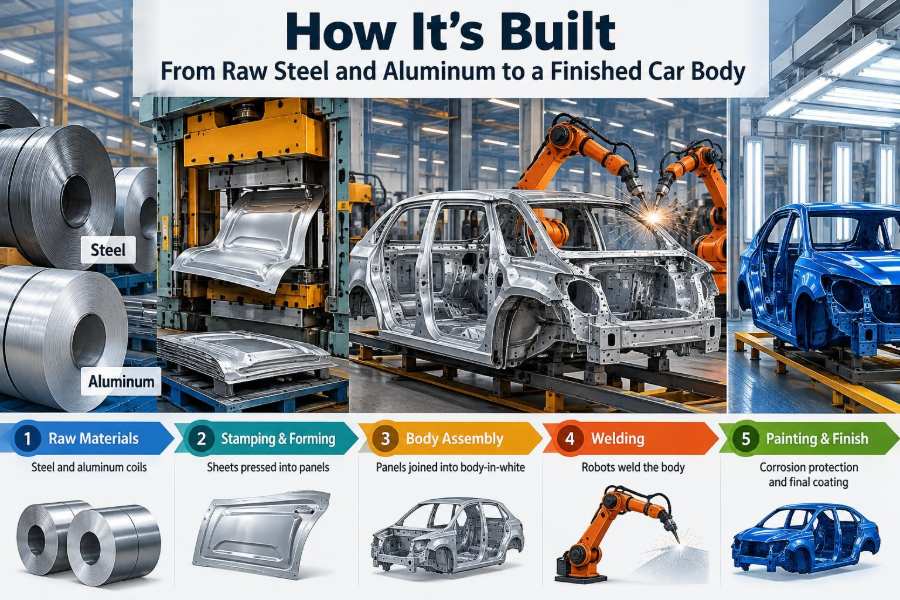

Most people see a car body as a painted shell: doors that close with a reassuring thud, a bonnet with a smooth curve, and a roof strong enough to support the cabin. In a factory, though, that familiar shape begins as tightly controlled coils of metal and a long chain of decisions about strength, weight, cost, corrosion, and repair.
Consider a minor parking dent. Whether the panel springs back, creases permanently, or can be repaired cleanly depends partly on the metal grade, thickness, geometry, and forming process chosen long before the car reached a dealership.
For engineering students, body construction connects materials science, manufacturing, design, automation, and vehicle safety. For working professionals, it explains why a seemingly simple panel change can affect tooling, crash performance, paint quality, and assembly timing.
The journey from raw steel and aluminum to a body-in-white is not one dramatic operation. It is a carefully sequenced manufacturing system in which every stage prepares the next.
🏗️ What “Car Body” Actually Means
A vehicle body is a structural assembly, not merely its visible exterior. It includes floor sections, pillars, roof rails, cross-members, wheel housings, bulkheads, and outer panels such as doors, fenders, and the roof skin.
Before paint, trim, glass, wiring, seats, and powertrain are installed, the welded structure is called the body-in-white, often abbreviated BIW. The name refers to the bare, unpainted metal assembly rather than its final colour.
In most passenger vehicles, the body is a major load-carrying part of the vehicle. It must preserve passenger space in a severe collision while also providing accurate mounting points for suspension, doors, instrument panels, and countless smaller components.
🧱 The Unibody Principle
Most modern cars use unibody, or monocoque-derived, construction. Instead of placing a complete passenger body on a separate heavy frame, the stamped and joined body structure carries much of the vehicle’s bending and torsional loads.
A ladder-frame truck is a useful contrast. Its frame bears the primary loads, while the body can be more separate. A unibody car spreads structural responsibility through its floor, sills, pillars, roof rails, and cross-members.
This approach can reduce mass and create efficient crash-load paths, but it makes body engineering highly interconnected. Changing the shape or material of one reinforcement can influence stiffness, joining methods, corrosion protection, and nearby tooling.
🎯 Starting With Design Targets
Manufacturing starts long before metal enters a press. Engineers establish targets for crashworthiness, body stiffness, noise and vibration behaviour, aerodynamic shape, vehicle mass, package space, durability, repairability, and cost.
There are unavoidable trade-offs. A thicker panel may improve dent resistance but adds mass. A very strong steel can improve intrusion resistance, yet may be more difficult to form or repair. Aluminum can reduce weight in certain applications, but it requires different joining and corrosion-management strategies.
Computer-aided design defines the intended geometry, while simulation helps engineers predict forming, structural response, and assembly access. Physical prototypes remain valuable because real materials, tools, and joints can reveal behaviours that models simplify.
🧪 Choosing Steel, Aluminum, and Other Materials
Steel remains widely used because it combines strength, formability, availability, familiar processing, and competitive cost. Automotive steel is not one material; body structures may contain several grades selected for very different jobs.
Aluminum alloys are common in closures, such as bonnets and doors, and in some complete body structures. Their lower density can support mass reduction, but their forming behaviour, springback, joining requirements, and material cost differ from steel.
Plastics, magnesium, composites, adhesives, and foams also appear in vehicles, but a steel-and-aluminum body shop remains central to high-volume vehicle production.
🔩 Understanding Automotive Steel Grades
Mild steels are relatively easy to form and can suit less demanding panels. Higher-strength steels allow engineers to use thinner gauges or create stronger reinforcements, although that does not mean every part should use the strongest grade available.
Advanced high-strength steels are designed to provide useful combinations of strength and ductility. Ductility is the ability to deform without cracking, a critical property when making deep shapes or managing crash deformation.
Ultra-high-strength grades are often used strategically in pillars, roof rails, bumper reinforcements, and other safety-critical areas. Their value comes from placing the right material in the right load path, not from treating strength as the only design objective.
🪶 Why Aluminum Behaves Differently
Aluminum is much less dense than steel, which makes it attractive where reducing body mass is worthwhile. It also forms a natural oxide layer, though this does not eliminate the need for carefully engineered corrosion protection.
Its lower elastic modulus means aluminum panels can require different section shapes or thicknesses to achieve comparable stiffness. Aluminum also tends to show more springback: after forming, a panel partially returns toward its original shape when the tool load is removed.
These characteristics affect die design, joining, handling, and quality inspection. Aluminum is therefore not a simple drop-in replacement for steel; it changes the manufacturing system around the part.
📦 From Metalworks to Coil Supply
Steel and aluminum commonly arrive at a vehicle plant as coils: long strips of sheet metal wound tightly for efficient transport and storage. Suppliers provide material to specified chemistry, thickness, coating, surface quality, and mechanical-property requirements.
Many steel sheets for exposed panels are supplied with metallic coatings, often zinc-based, to improve corrosion resistance. The coating must survive forming and later paint processes without causing surface defects.
Incoming material control matters. Variation in thickness, lubrication, surface condition, or mechanical properties can alter press behaviour and lead to wrinkles, splits, dimensional variation, or visible marks after painting.
✂️ Blanking: Cutting the Starting Shape
Before a door outer or floor pan can be shaped, the coil is unwound, flattened, lubricated where required, and cut into a flat piece called a blank. The blank is deliberately shaped to give the press enough material in areas that will stretch or draw deeply.
Blank shape affects material flow. Too little material near a deep corner can cause a split; too much can contribute to wrinkling. Nesting blanks efficiently on the sheet also matters because scrap has both financial and environmental consequences.
Some components use tailored blanks, where sheets of different thicknesses or grades are joined before stamping. This lets strength be placed where it is needed without making the entire component unnecessarily heavy.
🛠️ The Stamping Press Line
In a press shop, automated equipment feeds blanks into large presses fitted with matched tools called dies. A press line may perform several operations in sequence, transferring the part from one die set to the next.
The dies do not simply “stamp” a final shape in one hit. They guide, hold, draw, trim, pierce, bend, and restrike the panel until it meets its required geometry. The scale is substantial, but precision is equally important: tiny dimensional errors can later create uneven door gaps.
Automation improves repeatability and protects people from hazardous manual handling near heavy moving tooling. It does not remove the need for skilled die maintenance, process setup, and fault diagnosis.
🌀 Drawing: Creating Three-Dimensional Form
Deep drawing is a key forming operation for large panels such as bonnets, roofs, and door outers. A punch pushes the sheet into a die cavity while a blank holder controls how metal flows inward.
The process resembles pulling a sheet smoothly over a shaped form, except the metal must stretch and flow in controlled ways. Excessive restraint may tear the sheet; insufficient restraint may create wrinkles.
Lubrication, tool radii, blank-holder force, sheet properties, and press settings all influence the result. Forming simulation helps engineers identify high-risk areas before expensive production dies are finalized.
📐 Trimming, Piercing, and Flanging
After the main draw, the part usually needs additional operations. Trimming removes excess edge material, piercing creates holes, and flanging bends edges to support joining or create a finished boundary.
A door inner panel, for example, needs accurately positioned holes for hinges, latch hardware, window mechanisms, speakers, and trim clips. These features turn a broad shaped sheet into a functional assembly component.
Edges must be controlled carefully. Burrs, inaccurate holes, or distorted flanges may create assembly problems, water-leak paths, or poor fit even when the main panel surface looks correct.
🧭 Springback and Dimensional Control
Metal behaves elastically as well as plastically. Once a press releases a formed panel, stored elastic strain can make it spring back slightly. With high-strength steel and aluminum, this effect can be significant enough to affect assembly dimensions.
Engineers compensate through die geometry, restrike operations, draw-bead design, process settings, and material selection. A panel may be intentionally formed beyond its final target shape so that springback brings it closer to the intended geometry.
Dimensional control is not vanity. A body shell with poor geometric consistency can cause wind noise, difficult door closing, inconsistent seal compression, and problems mounting later components.
👁️ Protecting Class-A Exterior Surfaces
Visible exterior panels are often described as Class-A surfaces. Their requirements are demanding because small distortions can become obvious under sunlight, showroom lighting, or a glossy paint finish.
Tool marks, waviness, handling dents, and contamination may be almost invisible on bare metal yet highly noticeable after paint. Press shops therefore control lubrication, die cleanliness, part transfer, stacking, and surface inspection.
This is one reason an outer door skin and a hidden reinforcement are not engineered in the same way. Both must function, but appearance panels have an additional optical-quality requirement.
🧩 Building Subassemblies First
The body shop normally does not begin by joining every panel into one complete shell. It first makes subassemblies: underbodies, front structures, rear floors, side frames, roof assemblies, doors, bonnets, and liftgates.
Fixtures hold parts in their specified positions while joining occurs. Good fixture design locates the part on stable datum features rather than on flexible edges that vary from stamping to stamping.
This modular sequence makes the build manageable and allows inspection at useful points. It also lets different areas of the body shop operate in parallel before major assemblies meet.
🤖 Spot Welding and Its Role
Resistance spot welding is a familiar body-shop process, especially for steel structures. Electrodes clamp overlapping sheets, electrical current generates heat at the interface, and a small fused region forms as the material cools.
A finished body may contain many spot welds distributed according to structural, access, and manufacturing needs. Weld placement is not arbitrary: spacing, sheet stack-up, electrode access, and expected crash loads all influence the plan.
Robots are well suited to repetitive welding because they can position heavy welding guns consistently. However, electrode wear, coating condition, weld current, force, and panel fit must still be monitored to maintain weld quality.
🧷 Adhesives Add More Than Glue
Structural adhesives are widely used alongside mechanical fasteners and welds. When applied between panels before assembly, they can distribute load over a larger area than a concentrated spot weld and can contribute to stiffness and fatigue performance.
Many body adhesives cure during later heating stages in the paint shop. Their performance depends on correct bead placement, surface preparation, joint gap, cure cycle, and compatibility with surrounding materials.
Adhesive is not a universal substitute for welding. It must be designed as part of a complete joint system, with consideration for crash behaviour, production time, inspection, service repair, and environmental exposure.
🔗 Joining Aluminum and Mixed Materials
Aluminum bodies and mixed-material structures often use methods beyond conventional resistance spot welding. Depending on the design, manufacturers may use self-piercing rivets, clinching, flow-drill screws, laser welding, bonding, or combinations of these methods.
Self-piercing rivets, for example, join stacked sheets without making a fully punched hole first. The rivet flares within the lower sheet to create a mechanical interlock, often with adhesive added to the joint.
Different materials can create galvanic corrosion risk when electrically connected in the presence of an electrolyte such as saltwater. Coatings, sealants, isolation layers, and thoughtful joint design help limit that risk.
🧱 Load Paths: Designing for a Crash
A safe body is not simply a rigid box. It must manage crash energy through planned deformation while maintaining a survivable passenger compartment. Engineers create load paths that route forces through rails, pillars, cross-members, and floor structures.
Front and rear structures are generally designed to absorb energy progressively. The central occupant cell is designed to resist intrusion, using geometry and carefully placed reinforcements to preserve space around passengers.
Actual crash performance depends on the full vehicle system: body structure, restraint systems, seats, steering components, battery protection where applicable, and impact conditions. Material strength alone cannot describe safety.
🏠 Stiffness, Noise, and Driving Feel
Body stiffness affects more than crash response. A torsionally stiff structure can provide a stable foundation for suspension tuning, helping the vehicle respond more consistently when it encounters uneven roads or cornering loads.
The body also transmits vibration and noise. Engineers consider natural frequencies, panel resonance, joint stiffness, and sealing because an apparently small vibration can become an irritating boom or rattle in the cabin.
Adding mass can sometimes reduce a noise issue, but it is not always the best solution. Changing a panel’s shape, reinforcement placement, damping treatment, or attachment method may address the root cause more efficiently.
🚪 Doors, Closures, and Their Hidden Complexity
Doors, bonnets, tailgates, and liftgates are called closures because they open and close an aperture in the body. They must be light enough to operate conveniently, strong enough for their function, and accurate enough to seal against wind and water.
A typical door has an outer skin, an inner structural panel, reinforcements, hinge mounts, a side-impact beam or equivalent structural features, and hemmed edges. Hemming folds the outer panel edge around the inner panel to create a clean, secure perimeter.
Door quality is immediately noticeable to users. Flushness, gap consistency, latch effort, window alignment, and the sound of closing all reflect the interaction between design tolerances and manufacturing control.
📏 Measurement: Checking What the Eye Cannot
Quality teams inspect critical dimensions using gauges, coordinate measuring machines, optical systems, and in-line sensors. A coordinate measuring machine can probe or scan points in three-dimensional space and compare them with the design model.
Some checks focus on individual stamped panels; others assess subassemblies or the completed body-in-white. Engineers monitor trends because a gradual shift can indicate die wear, fixture movement, electrode issues, or material variation before it becomes a larger problem.
Human visual inspection remains useful, particularly for exposed surfaces, but it works best alongside objective measurement rather than as the only control method.
🔍 Common Body-Shop Defects and Their Causes
Defects usually arise from interactions, not a single obvious mistake. A wrinkle may relate to blank-holder force, lubrication, blank shape, tool condition, or changes in incoming sheet properties. A poor gap may originate in stamping, fixturing, joining distortion, or locator wear.
| Issue | Typical underlying cause | Why it matters |
|---|---|---|
| Split panel | Excessive stretching or restricted material flow | Part may fail structurally or cosmetically |
| Wrinkle | Insufficient control of compressive material flow | Visible defect or assembly interference |
| Weld inconsistency | Electrode wear, poor fit-up, or process variation | Joint strength and durability can be affected |
| Uneven gap | Dimensional stack-up across parts and fixtures | Can affect appearance, seals, and closure operation |
Effective problem-solving traces the defect back through the process rather than adjusting the final symptom alone. Corrective action may involve tooling, settings, maintenance, material controls, or part design.
🧼 Cleaning Before the Paint Shop
Once the body-in-white is complete, it must be cleaned thoroughly. Press oils, shop dust, metallic particles, and residues can interfere with coatings and create corrosion or appearance problems later.
Cleaning and pretreatment processes prepare the metal surfaces for paint adhesion and corrosion resistance. Exact chemistries and sequences vary by plant and coating system, but consistency in surface preparation is fundamental.
The body is also sealed at selected seams and joints. Sealers help limit water entry, road-noise paths, and trapped moisture, especially in complex cavities where corrosion would be difficult to detect or repair.
🎨 E-Coat: Corrosion Protection in Hidden Cavities
A key coating stage is electrocoating, often called e-coat. The body is immersed in a coating bath, and electrical charge helps deposit a protective primer layer over accessible conductive surfaces.
The process is particularly valuable because it can reach many internal areas that would be difficult to coat uniformly with a spray gun. Those hidden spaces include seams, cavities, and boxed structural sections.
Coverage still depends on sound body design and process control. Drain holes, access paths, seam sealing, pretreatment quality, and coating cure all influence long-term corrosion performance.
🔥 Seam Sealer, Underbody Protection, and Oven Curing
After e-coat, automated or manual systems may apply seam sealers, underbody coatings, and sound-deadening materials. These materials help defend vulnerable joints from water, stones, salt, and vibration.
Ovens cure coatings and many adhesives by heating the body through controlled cycles. Thermal expansion must be considered, particularly where different materials are joined, because steel and aluminum expand by different amounts when heated.
Paint-shop heat is therefore part of body engineering, not merely a finishing detail. A joint that works at room temperature must also tolerate production curing and the vehicle’s expected service environment.
🌈 Paint Brings the Surface to Life
Primer, colour coat, and clear coat systems create the final visible finish while adding further environmental protection. The exact layer sequence varies, but the objective is consistent: a durable, attractive surface with controlled colour, gloss, texture, and film thickness.
Paint reveals body quality mercilessly. A small dent, dirt particle, sharp edge, or surface wave can become much more visible after a reflective finish is applied. This is why surface discipline begins in stamping and continues through every handling stage.
After paint, the shell is no longer just a structural assembly. It becomes the carefully finished foundation for final vehicle assembly.
🔧 From Painted Shell to Finished Vehicle
In general assembly, the painted body receives wiring harnesses, glazing, insulation, instrument panels, seats, doors, lighting, trim, wheels, and many other systems. The powertrain, front and rear suspension assemblies, and exhaust may be installed in a coordinated “marriage” operation beneath the body.
Body accuracy matters throughout this stage. If mounting holes, apertures, or reference points drift, workers and robots may struggle to install components, and the final vehicle may show alignment, sealing, or noise issues.
The body is therefore both a product and a platform. Every later subsystem depends on it being structurally sound, dimensionally accurate, clean, and properly protected.
♻️ Scrap, Recycling, and Material Efficiency
Stamping generates offcuts, but these are valuable material streams rather than ordinary waste. Scrap is commonly segregated and returned for recycling, where it can re-enter metal production under controlled material-management systems.
Reducing scrap begins with design and nesting efficiency, but manufacturers must balance material yield against part quality and robust forming. An aggressively optimized blank that causes frequent splits is not truly efficient.
Material choice also involves lifecycle questions. Recyclability, energy required for primary material production, repair implications, vehicle mass, and durability all matter. No single material automatically produces the lowest overall environmental impact in every vehicle application.
🧰 Repairability and the Aftermarket Reality
A body design that works well in a factory may still be difficult to repair after a collision. High-strength steels can lose intended properties if heated improperly, while aluminum often requires dedicated tools and strict contamination control to avoid cross-material issues.
Repair procedures specify where panels may be sectioned, how joints should be recreated, which adhesives or fasteners are approved, and what corrosion protection must be restored. Ignoring these procedures can compromise durability or structural performance.
For technicians and engineers alike, the lesson is clear: manufacturing joins and repair joins are related but not automatically interchangeable. The approved repair method must match the structure and materials involved.
⚖️ Why Mixed-Material Bodies Demand Systems Thinking
Combining steel, aluminum, plastics, and composites can place each material where its properties are most useful. It can also create a more complicated system involving additional joining methods, inspection needs, thermal behaviour, recycling routes, and repair requirements.
The best choice depends on the vehicle’s purpose and production scale. A high-volume family car, a battery-electric vehicle, a commercial van, and a low-volume performance model may reach different sensible solutions.
Engineers should resist material stereotypes. Steel is not automatically outdated, aluminum is not automatically superior, and a multi-material body is not automatically optimized. Performance comes from the complete design and production strategy.
🧠 Skills Behind a Successful Body Program
Body engineering brings together specialists in materials, stamping, tooling, robotics, welding, adhesives, simulation, metrology, corrosion, paint, manufacturing quality, and service repair. Their work overlaps constantly.
A design engineer who understands press forming can avoid impractical radii and draw depths. A manufacturing engineer who understands crash load paths can recognize why a particular reinforcement or joint location cannot be casually changed.
Clear communication is as valuable as technical depth. The body shop is a place where a small local change can travel through the entire vehicle program.
✅ The Core Principle: Build the Whole System, Not Just Panels
A finished car body is the result of controlled material selection, precise sheet forming, reliable joining, dimensional verification, corrosion protection, and carefully managed finishing. Each stage protects the value created by the stage before it.
The central engineering lesson is that body manufacturing is a systems problem. A beautiful exterior panel is not enough if it cannot be formed consistently; a strong joint is not enough if it creates corrosion risk; a light structure is not enough if it cannot meet crash, assembly, durability, and repair requirements.
When these requirements are considered together, raw coil becomes a structure that can carry loads, protect occupants, accept paint, support every vehicle system, and remain serviceable over its working life.
A car body is built successfully when materials, geometry, processes, and quality controls are engineered as one connected system—not as separate factory steps. 🚗🔩🏭