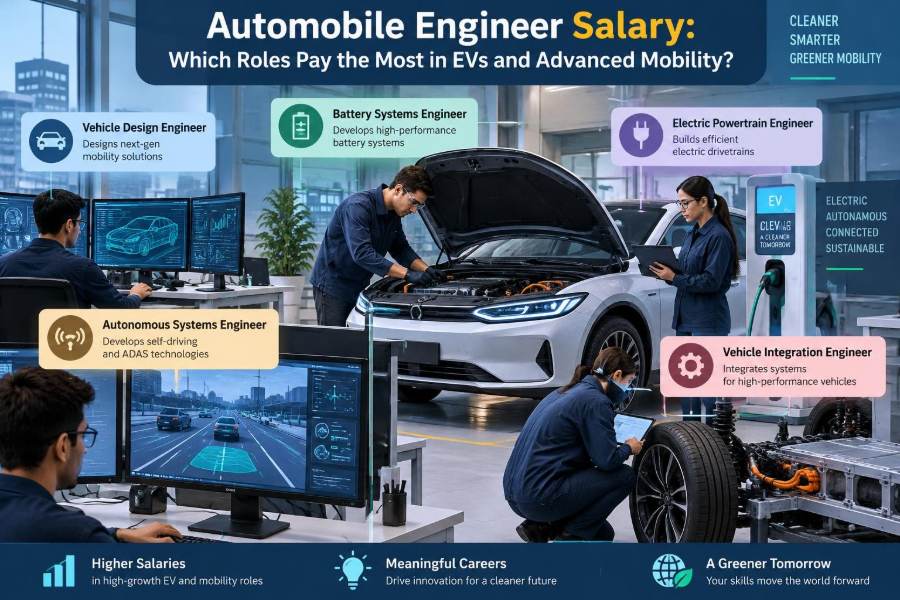

A mechanical engineering student compares two job descriptions: one is for a conventional vehicle design role, the other for battery systems in an electric vehicle program. Both ask for engineering fundamentals. Yet the second mentions high-voltage safety, embedded software, thermal management, and data analysis—and may sit in a very different salary band.
For a working automobile engineer, the question often arrives later. Should you stay in component design, move into validation, learn controls, or target a systems role? The answer is not simply “EV jobs pay more.” Some EV roles are highly paid because they carry scarce technical responsibility, while others remain close to traditional automotive pay.
Salary also reflects much more than a job title. Location, company type, production scale, safety accountability, software depth, and the difficulty of hiring for a skill all matter. A specialist at a supplier may earn differently from a generalist at an automaker, even when both work on the same vehicle.
The useful question, then, is not which title sounds futuristic. It is which engineering problems are difficult, commercially valuable, and hard to solve reliably at scale. That is where advanced-mobility careers tend to create stronger earning potential.
🧭 Start With the Meaning of “Salary”
An automobile engineer’s pay can include fixed salary, performance bonus, overtime or shift allowances, stock-based compensation, travel support, and retirement benefits. Comparing only the headline annual figure can therefore be misleading.
It is also useful to separate entry pay, median career pay, and top-end pay. A field can offer excellent compensation for experienced specialists without being the highest-paying path for a fresh graduate. Ask which stage of career you are evaluating.
📍 Geography Changes the Answer Dramatically
Automotive engineering salaries are strongly shaped by local labor markets, living costs, tax structures, manufacturing concentration, and the maturity of the EV industry. A battery engineer’s nominal pay in one country cannot be directly compared with another country’s without considering purchasing power and benefits.
Within one country, roles near vehicle engineering centers, battery plants, electronics clusters, or autonomous-driving hubs may command a premium. That premium can be offset by housing and commuting costs, so evaluate the full practical picture.
🏭 Why Advanced Mobility Creates Pay Gaps
Traditional vehicle development has mature methods, established suppliers, and large pools of experienced engineers. Advanced mobility adds problems that many organizations are still learning to solve: high-voltage safety, battery aging, real-time software, vehicle connectivity, and automated operation.
When a technical failure can delay production, trigger a recall, reduce range, or create a safety risk, companies place high value on engineers who can prevent it. Compensation rises most clearly when expertise reduces a costly uncertainty.
🔋 Battery Systems Engineering Often Sits Near the Top
Battery engineering is commonly among the stronger-paying EV specializations, particularly when it combines cell behavior, pack architecture, testing, and manufacturing knowledge. The battery is expensive, safety-critical, and central to range, charging performance, and warranty risk.
A battery systems engineer may define pack requirements, coordinate cell suppliers, review degradation data, and work with thermal, mechanical, and software teams. This breadth makes experienced engineers valuable because decisions in one area affect many others.
🌡️ Thermal Management Is a High-Value Specialty
EV thermal engineering is no longer limited to keeping an engine cool. Engineers must manage battery temperature, electric motor and inverter heat, cabin comfort, heat-pump operation, charging conditions, and energy use across weather conditions.
Poor thermal control can reduce charging speed, affect battery life, limit power, or hurt real-world range. Engineers who can model heat transfer, design coolant circuits, run simulations, and validate systems in harsh conditions are solving a direct product-performance problem.
⚡ Power Electronics Engineers Command Scarcity Value
Inverters, DC-DC converters, onboard chargers, and high-voltage distribution systems convert and control electrical energy. Their design requires knowledge spanning circuit behavior, switching devices, electromagnetic compatibility, thermal limits, insulation, and control software.
This intersection of electrical, electronic, and vehicle engineering is difficult to fill with a single narrow skill set. Engineers who can take a power-electronics subsystem from requirements through validation and production troubleshooting often have strong bargaining power.
🧠 Controls and Embedded Software Raise the Ceiling
Modern EVs depend on embedded software: code running within electronic control units to monitor sensors, make decisions, and command hardware. Motor control, charging logic, regenerative braking, thermal control, and battery management all depend on it.
Pay is often higher when an engineer can connect control theory with production-quality software. Writing a prototype algorithm is different from building software that remains stable across temperatures, component variation, diagnostic events, and millions of operating cycles.
🛡️ Functional Safety Brings Responsibility—and Reward
Functional safety concerns hazards caused by electrical or electronic system malfunctions. In automotive work, engineers may analyze failures, define safety goals, trace requirements, and verify that systems respond safely when faults occur.
Safety engineering can pay well because it requires disciplined judgment, documentation, systems thinking, and familiarity with rigorous development processes. It is not glamorous in the way a concept vehicle may be, but it is essential where steering, braking, propulsion, or high voltage is involved.
🔐 Cybersecurity Is Becoming a Core Vehicle Discipline
Connected vehicles exchange data with phones, chargers, cloud services, workshops, and fleet systems. Each connection can create a possible attack path if it is poorly designed or maintained.
Automotive cybersecurity engineers work on threat analysis, secure communication, software update protection, access control, and incident response planning. The role becomes especially valuable when the engineer understands both security principles and vehicle electronic architectures.
📡 Connected Vehicle and Telematics Roles Reward Systems Thinking
Telematics covers the collection and transmission of vehicle data, often for diagnostics, fleet management, navigation, usage-based services, or remote features. These roles blend vehicle networks, cloud platforms, mobile connectivity, data governance, and customer experience.
Compensation can be strong for engineers who bridge these domains, especially where uptime and data quality affect a commercial fleet. However, pure dashboard reporting roles may not command the same premium as architecture or platform-engineering positions.
🤖 Automated Driving Pays Well but Has Uneven Demand
Advanced driver-assistance systems and automated-driving development use sensors, perception software, controls, simulation, mapping, and safety validation. Highly specialized roles in these areas can be among the best paid in mobility engineering.
There is an important caution: hiring in this field can be cyclical. Programs change direction, regulations evolve, and companies may narrow ambitious autonomy plans. A durable career strategy combines automation expertise with transferable skills such as software engineering, estimation, controls, or systems safety.
👁️ Perception, Sensor Fusion, and Robotics Expertise
Perception engineers help a vehicle interpret camera, radar, lidar, ultrasonic, or other sensor data. Sensor fusion combines multiple inputs so that the system can form a more reliable estimate of objects, lanes, motion, and uncertainty.
These roles often reward advanced mathematics, machine learning, signal processing, and robust software practices. The highest-paying positions usually demand more than model training; they require performance evaluation, edge-case analysis, compute optimization, and integration into a safety-conscious vehicle platform.
🧩 Systems Engineering Connects the Expensive Problems
Systems engineers translate customer and vehicle-level needs into coordinated requirements for hardware, software, mechanical design, and validation. In an EV, they may balance range, acceleration, charging time, mass, cost, safety, and thermal constraints.
Strong systems engineers are valuable because they prevent local optimization. For example, a larger battery may improve range but add mass, change cooling needs, increase cost, and affect crash packaging. Seeing those trade-offs early can save major redesign work.
🧪 Validation and Test Engineering Can Be Highly Paid
Testing is sometimes wrongly viewed as less prestigious than design. In reality, an engineer who can design meaningful tests, isolate root causes, interpret data, and make a system ready for production is protecting the company from expensive failures.
High-voltage testing, battery abuse testing, electromagnetic compatibility, durability, software-in-the-loop, hardware-in-the-loop, and vehicle-level validation are particularly technical areas. Salary potential rises with ownership of complex test strategy rather than simple routine execution.
🏗️ Manufacturing Engineering Gains Value at Scale
A brilliant battery pack design has limited value if it cannot be assembled safely, consistently, and economically. Manufacturing engineers turn designs into repeatable production processes, addressing tooling, joining methods, quality checks, ergonomics, automation, and cycle time.
Roles tied to battery module assembly, cell manufacturing, e-axle production, and end-of-line testing can pay very well when they directly improve yield or reduce downtime. Yield means the share of output that meets requirements; small improvements can matter greatly at large volume.
📊 Quality and Reliability Engineers Protect Long-Term Costs
Quality engineers prevent defects from reaching customers, while reliability engineers assess whether products will perform over time under expected conditions. In EVs, this can involve battery degradation, connector corrosion, software faults, thermal cycling, and vibration.
These careers reward engineers who use structured problem-solving rather than intuition alone. A good failure analysis may connect field data, laboratory evidence, supplier process variation, and vehicle operating conditions to a practical corrective action.
🧱 Conventional Mechanical Roles Still Matter
EVs still need structures, closures, suspension, steering, braking, crash protection, sealing, interiors, and manufacturable components. Mechanical design engineers remain fundamental, and experienced specialists in lightweight structures, crashworthiness, or complex mechanisms can earn very well.
The difference is that generic CAD capability alone is less likely to create a premium. Higher pay usually follows deeper ownership: design for manufacture, material selection, tolerance analysis, simulation, supplier coordination, and responsibility for real vehicle performance.
🚚 Commercial Vehicles and Fleet Electrification Offer Strong Niches
Electrifying buses, delivery vans, trucks, and industrial fleets introduces demanding use cases: heavy payloads, predictable routes, depot charging, long operating hours, and strict downtime expectations. The engineering economics are often more visible than in private-car ownership.
Engineers who understand vehicle energy use, charging infrastructure, fleet data, and total cost of operation can be especially useful. A design decision that keeps a delivery vehicle on the road can matter more than a small feature improvement in a passenger car.
🔌 Charging Infrastructure Is More Than Installing Chargers
Charging work can include connector and communication standards, grid interaction, load management, power quality, payment systems, thermal limits, installation constraints, and reliability monitoring. It sits at the boundary between automotive and electrical infrastructure.
The best-paid opportunities tend to involve architecture, power systems, product engineering, or large-scale deployment rather than basic site installation alone. This path suits engineers who enjoy solving both vehicle-side and grid-side constraints.
🪜 Leadership Usually Raises Pay, but Not Automatically
Technical leadership and people management often create a higher salary ceiling because the role influences budgets, schedules, product risk, and team output. A chief engineer or engineering manager must make trade-offs under incomplete information, not simply review technical work.
However, management is not the only route. Many organizations need senior individual contributors who own a difficult technical domain. Choose leadership because you enjoy prioritizing and developing people, not merely because the title appears more lucrative.
🧾 Supplier, Automaker, Startup, and Consulting Pay Differently
| Employer type | Typical attraction | Potential trade-off |
|---|---|---|
| Vehicle manufacturer | Vehicle-level ownership and mature processes | Large structures can narrow individual scope |
| Tier supplier | Deep expertise in a component or subsystem | Less influence over whole-vehicle decisions |
| Startup | Broad responsibility and rapid learning | Higher business and workload uncertainty |
| Engineering consultancy | Varied projects and accelerated exposure | Work can depend on client demand |
No employer type is universally better paid. Startups may offer upside tied to company performance, while established firms may offer steadier compensation and benefits. Evaluate the actual role, financial stability, learning environment, and terms of the offer.
🎓 Degrees Open Doors, but Evidence of Skill Sets Pay
A degree in automobile, mechanical, electrical, electronics, computer, or mechatronics engineering can lead into EV work. For advanced roles, employers often look beyond the degree title to evidence that you can work with relevant tools, data, systems, and constraints.
A master’s degree can help in research-heavy fields such as battery science, machine learning, or advanced controls. It is not a universal salary shortcut; meaningful projects, internships, and demonstrated problem-solving may matter just as much for many product-development roles.
🧰 Build a Skill Stack, Not a Random Certificate Collection
The strongest candidates combine a core discipline with adjacent knowledge. A mechanical engineer working on battery packs, for example, benefits from thermal analysis, high-voltage safety awareness, data handling, and manufacturing understanding.
- Core depth: such as power electronics, structures, controls, testing, or battery design.
- Digital fluency: simulation, programming, data analysis, version control, or automated testing.
- Vehicle context: requirements, diagnostics, networks, safety, and production constraints.
- Communication: clear test reports, design reviews, and cross-functional decision-making.
Certificates are useful when they support applied competence. They are weak substitutes for a project where you can explain your assumptions, failures, test results, and design choices.
🧑💻 Portfolio Projects Can Change an Entry-Level Conversation
Students may not have access to a vehicle program, but they can still demonstrate relevant thinking. A small battery thermal model, a motor-control simulation, a CAN-data analysis exercise, or a test fixture design can make skills concrete.
Document the work professionally: define the problem, show the method, state limitations, and describe what you would test next. Never present a classroom prototype as proof that it is road-ready; engineering credibility depends on honest boundaries.
🗣️ Negotiate With Scope, Not Just a Salary Number
When discussing compensation, connect your request to the role’s scope. High-voltage certification, ownership of a validation plan, ability to automate test data processing, or prior production-launch experience are clearer value signals than a generic claim that you work hard.
Consider asking about salary progression, review cycles, training support, relocation, bonus criteria, and the team’s technical roadmap. A slightly lower starting offer can sometimes be worthwhile when the role provides uncommon experience that strengthens your next move.
⚠️ Common Career Mistakes in the EV Salary Chase
The most common mistake is following buzzwords without understanding the work. “AI,” “autonomy,” or “battery” on a job listing can describe anything from serious engineering ownership to a narrow support task with limited growth.
- Choosing a field only because it appears highly paid.
- Ignoring whether the role builds transferable technical depth.
- Underestimating software, documentation, and safety requirements.
- Comparing offers without considering location, benefits, and working hours.
- Assuming a startup title equals a senior level of responsibility or pay.
A better approach is to identify the problems you can become unusually good at solving.
📈 A Practical Route for Students
Start by choosing one technical anchor: vehicle dynamics, embedded systems, electrical machines, battery technology, thermal engineering, manufacturing, or data-driven testing. Then add one complementary skill that makes you more useful in a team.
- Learn the engineering fundamentals thoroughly.
- Complete one project with measurable requirements and test evidence.
- Seek internships, lab work, competitions, or supplier exposure.
- Learn to read drawings, requirements, logs, and test reports.
- Apply for roles where you can own a subsystem or analysis task.
This route may look slower than chasing every trend, but it builds the credibility that supports both salary growth and better technical judgment.
🔄 A Smart Transition Plan for Experienced Engineers
Professionals from internal-combustion, manufacturing, quality, or conventional electronics backgrounds should not assume they must start again at entry level. Many existing skills transfer directly: durability testing, root-cause analysis, thermal design, production quality, control calibration, and supplier management.
Map your current work to an EV subsystem, then close only the most relevant gaps. An engine thermal engineer, for example, can focus on battery thermal behavior and electric-drive cooling rather than attempting to become an expert in every part of electrification at once.
💰 Which Roles Usually Have the Highest Ceiling?
There is no universal ranking, but senior compensation often rises fastest in roles that combine scarce technical depth with high product risk or broad system influence. Battery systems, power electronics, embedded controls, functional safety, cybersecurity, autonomy-related software, and technical leadership commonly fit that pattern.
At the top end, the distinction is often not the discipline but the level of ownership. An engineer responsible for architecture, safety decisions, production readiness, or a critical program outcome generally has a higher ceiling than someone performing a tightly defined task in the same domain.
🎯 The Core Principle: Solve Critical Problems Reliably
Advanced mobility rewards engineers who can make complicated systems safe, efficient, manufacturable, testable, and dependable. EVs do not eliminate traditional automobile engineering; they increase the need to connect mechanical, electrical, software, and production decisions.
Choose a path where your curiosity matches a real engineering constraint. Build depth, prove it through practical work, and gradually take responsibility for larger decisions. That combination is more durable than chasing any single fashionable title.
The best-paying automobile engineering careers are usually built by becoming trusted at solving high-consequence problems—not by simply attaching “EV” to a job title. Develop useful depth, retain broad vehicle awareness, and let responsibility grow with your capability. 🚗⚡🛠️