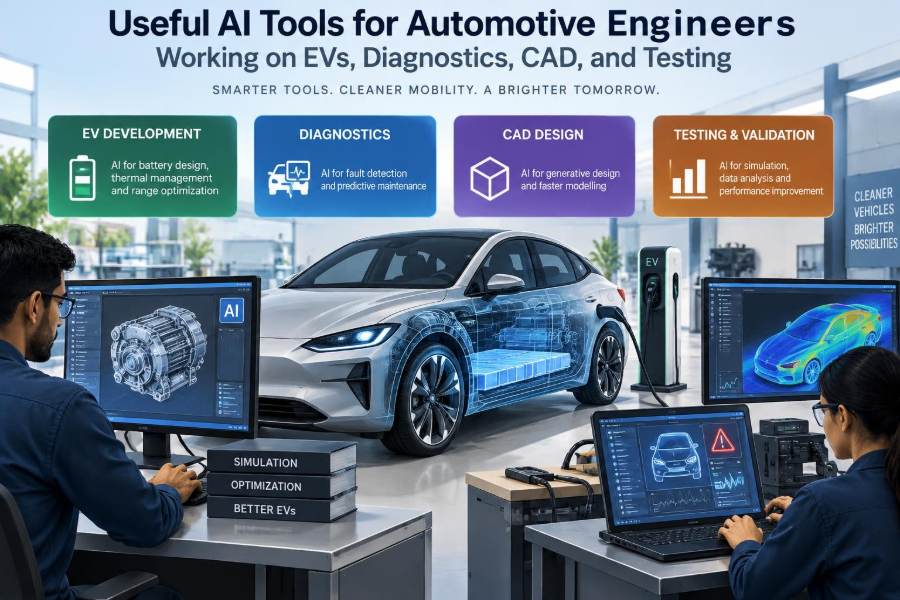

An EV prototype arrives in the workshop with an intermittent warning lamp, a customer complaint, and a test schedule that has already slipped. One engineer is searching CAN logs, another is checking a thermal model, and a third is revising a bracket in CAD after a packaging change.
None of these jobs can be handed safely to a chatbot. Yet each contains repetitive searching, pattern finding, document handling, or drafting work that can consume valuable engineering time.
That is where AI tools are becoming practical for automotive engineers. Used well, they can shorten the path from raw information to a useful engineering question, while leaving design authority, safety judgement, and validation with the engineer.
The useful question is not whether AI will replace automotive engineering. It is which tools genuinely improve work on EVs, diagnostics, CAD, and testing—and where their limits make human review non-negotiable.
🧭 Start with the engineering problem, not the AI tool
A tool should be selected because it improves a defined task: classifying fault logs, extracting requirements from a specification, generating test cases, or finding geometry conflicts. Starting with a fashionable tool often produces impressive demonstrations but little operational value.
Write the task in measurable terms before evaluating software. For example: “reduce the time needed to locate recurring inverter faults in labelled log files” is clearer than “use AI for diagnostics.” It identifies the input, expected output, responsible reviewer, and a way to judge whether the result is useful.
🧠 Understand the main categories of automotive AI
“AI” covers several different methods. A language model works with text and code; machine learning models detect patterns in numerical or sensor data; computer vision interprets images; and optimisation algorithms search for a better design within stated constraints.
These categories have different strengths. A language model can summarize an engineering change request, but it cannot establish that a battery pack is safe. A trained anomaly detector may flag an unusual current trace, but it does not automatically identify the physical root cause.
| Tool category | Typical automotive input | Useful output | Human check required |
|---|---|---|---|
| Language AI | Reports, specifications, code | Drafts, summaries, search answers | Technical accuracy and confidentiality |
| Machine learning | Signals, fault labels, fleet data | Classification or anomaly scores | Data quality and failure modes |
| Computer vision | Images and video | Defect or object detection | Lighting, coverage, false decisions |
| Generative design | Loads, space, materials, constraints | Candidate geometry | Manufacturability and validation |
🔒 Protect vehicle data before experimenting
Vehicle logs, calibration files, source code, supplier drawings, and incident reports may contain confidential information. Uploading them to an unapproved public service can create contractual, cybersecurity, or intellectual-property problems.
Use the organisation’s approved environment and data classification rules. If no approved tool exists, begin with synthetic, anonymised, or publicly available data. Removing obvious vehicle identification is not always enough: timestamps, locations, configuration identifiers, and free-text notes can also reveal sensitive information.
- Know where prompts, files, and generated outputs are stored.
- Check whether submitted data may be used to train a provider model.
- Control access to models, project folders, and application programming interfaces.
- Keep a record of the data version used for important engineering work.
📚 Use language AI as a technical reading assistant
Automotive programmes generate large quantities of text: interface control documents, requirements, change notices, test procedures, and supplier reports. A language tool can turn a long document into a structured first pass, listing interfaces, assumptions, unresolved questions, and acceptance criteria.
This is particularly useful when joining a project or comparing revisions. Ask the tool to quote the exact source clause beside each summary point where the approved environment supports document retrieval. The engineer should still open the source and verify every requirement that affects safety, compliance, cost, or release decisions.
📝 Draft requirements without confusing drafts for requirements
AI can propose a requirements template from a subsystem description. For a battery cooling controller, it might suggest inputs, operating modes, diagnostic behaviour, and measurable performance statements. This reduces blank-page work.
However, generated requirements often sound precise while hiding ambiguity. Phrases such as “rapidly,” “appropriate,” or “when necessary” are not testable. Convert them into verifiable statements with a condition, behaviour, and acceptance criterion. Also check traceability to vehicle-level needs, hazard analyses, and interface definitions.
💻 Accelerate scripts for data processing and automation
Many engineers use Python, MATLAB, or similar environments to parse measurement files, plot signals, convert formats, and automate reports. A coding assistant can explain unfamiliar library calls, suggest a parser structure, create repetitive plotting functions, or help write unit tests.
It is most valuable when the engineer gives a narrow prompt: file format, expected signals, units, sample data, and error conditions. Treat generated code as code from an inexperienced colleague: read it, test it with known cases, and inspect edge cases such as missing channels, changed delimiters, and time-base mismatches.
🔋 Find EV battery patterns in test data
Battery development produces many linked signals: cell voltage, current, temperature, state of charge, insulation status, coolant flow, and contactor state. Pattern-recognition tools can help cluster similar drive cycles, identify cells behaving differently from their neighbours, or detect recurring thermal responses.
For example, an algorithm may highlight a module whose temperature rise differs during fast charging. That is a prompt for investigation, not evidence of a defective cell. Sensor placement, cooling-path variation, balancing behaviour, and data synchronisation must be considered before a physical conclusion is made.
🌡️ Support thermal management work with surrogate models
High-fidelity computational fluid dynamics and thermal simulations can be expensive to run repeatedly. A surrogate model is a faster approximation trained on a set of simulation or test results. It can explore how geometry, flow rate, ambient temperature, or control settings influence an output.
Surrogates are useful for early trade studies and optimisation. Their weakness is extrapolation: a model trained within one operating range may give unreliable answers outside it. Keep its domain of validity visible, and confirm promising results with the underlying physics-based model or physical test.
⚡ Improve BMS calibration analysis, not BMS accountability
A battery-management system, or BMS, estimates quantities such as state of charge and may limit power to protect cells. AI can help compare calibration versions, scan logs for events near threshold changes, and identify conditions where estimation error appears to grow.
It should not be allowed to silently change safety-relevant calibration values. Calibration is tied to cell characterisation, system behaviour, diagnostics, and validation evidence. Use AI to organise the evidence and surface questions; use the established engineering process to approve any parameter change.
📡 Make CAN and automotive Ethernet logs searchable
Communication logs often become difficult because a fault can involve thousands of messages across several controllers. Tools can index decoded signals, align logs with test events, and answer structured questions such as, “Which messages changed state before torque was inhibited?”
Good results depend on good signal dictionaries, consistent timestamps, and known software versions. A missing message may indicate a bus issue, a gateway filter, an incorrect decoder, or simply that the capture started too late. AI can narrow the search, but network diagnosis still requires architecture knowledge.
🩺 Use anomaly detection for earlier diagnostic leads
Anomaly detection learns what normal behaviour looks like and flags observations that differ. It can be useful where engineers do not have exhaustive fault labels, such as unusual inverter switching signatures, unexpected vibration spectra, or atypical charging sessions.
The major practical challenge is setting the threshold. A sensitive model catches more unusual events but produces more false alarms; a conservative model creates fewer alerts but may miss weak early signals. Evaluate it against representative normal and faulty cases, including seasonal conditions and different vehicle variants.
🧩 Separate fault detection, isolation, and root cause
These three activities are frequently confused. Fault detection asks whether something is abnormal. Fault isolation asks which subsystem is likely involved. Root-cause analysis asks why the failure occurred.
AI is often strongest at the first task and sometimes helpful at the second. Root cause usually needs engineering evidence: inspection, reproduction, measurements, material analysis, software review, or supplier investigation. A model that associates low insulation resistance with a certain connector does not prove that connector caused the event.
🧪 Generate test ideas from requirements and risks
Language tools can transform a structured requirement into candidate nominal, boundary, invalid-input, and recovery test cases. This is a useful way to expose omitted conditions. A requirement about charge-port locking, for instance, should lead to questions about low voltage, interrupted communication, manual release, and conflicting user commands.
Generated test ideas must be reviewed against the actual architecture and safety concept. They may miss vehicle-specific operating states or suggest impossible stimulus combinations. Test engineers remain responsible for coverage, instrumentation, pass criteria, and safe execution.
🔁 Build smarter regression test selection
Running every automated test after every change may be slow, while running too few can allow defects to escape. Historical relationships between changed components, requirements, previous failures, and test results can help rank tests likely to be affected.
This is a prioritisation aid, not permission to delete validation. New architecture, limited historical data, or safety-critical changes call for conservative coverage. Record why a test was selected or deferred so the decision can be reviewed later.
🧷 Improve traceability across requirements, tests, and defects
Traceability connects a vehicle need to a system requirement, software or hardware implementation, verification method, result, and defect record. AI-assisted search can identify likely links in fragmented project repositories and highlight requirements that appear to lack tests.
Suggested links need ownership and approval because similar wording can refer to different functions. Strong traceability is not a collection of hyperlinks; it is evidence that intended behaviour has been implemented and verified at the right level.
📐 Use generative design inside real engineering constraints
Generative design software can produce many candidate shapes after receiving a design space, loads, supports, material choices, and objectives such as mass reduction. It can reveal non-obvious load paths for brackets, housings, or structural supports.
The organic-looking output is only a starting point. Ask whether it can be cast, stamped, machined, moulded, or additively manufactured at the required volume. Include joining features, tool access, inspection needs, fatigue loading, corrosion protection, crash behaviour, and service access before treating a lightweight shape as a viable component.
🧱 Combine AI-generated geometry with CAD discipline
CAD assistants can speed repetitive modelling, feature recognition, drawing annotations, part-number searches, and simple configuration work. Natural-language commands may also make some operations easier for occasional users.
But a clean-looking model can still have broken references, unsuitable tolerances, inaccessible fasteners, or missing datum strategy. Maintain ordinary CAD discipline: stable references, meaningful parameters, version control, design reviews, and checks against the packaging envelope. The tool should reduce clicks, not remove engineering intent.
🔍 Apply computer vision to inspection carefully
Camera-based systems can detect visible assembly issues, surface defects, incorrect labels, missing clips, or connector positions. They are especially attractive for repetitive inspection where a consistent camera angle and illumination can be engineered.
Vision performance depends heavily on the physical setup. Reflections from glossy paint, shadows, dirt, part variation, camera vibration, and changing daylight can alter an image more than expected. Validate the complete station rather than only the model on curated images, and provide a defined response for uncertain results.
🏭 Bring manufacturing knowledge into the model
A design tool may optimise mass while ignoring assembly sequence, fixture location, weld access, sealant application, or battery-module handling. Manufacturing engineers should be involved early enough to place these constraints in the model or review criteria.
For example, a pack tray feature that improves stiffness may complicate extrusion, add difficult-to-inspect joints, or block a robot path. AI becomes more useful when it is fed practical constraints from production rather than asked to optimise an abstract shape.
🛠️ Use AI for maintenance triage, not automatic repair decisions
In service operations, AI can summarize diagnostic trouble-code histories, compare symptom descriptions with repair records, and suggest checks in a logical order. This can help technicians avoid repeatedly testing the same likely-good component.
A suggested repair must never override safe workshop procedure, official service information, isolation requirements, or technician judgement. EV work adds high-voltage hazards, and a plausible text answer is not a substitute for proving a circuit is safe before work begins.
🧯 Keep functional safety and cybersecurity reviews independent
Safety-related functions and connected-vehicle systems require disciplined engineering arguments, evidence, and review. AI can help organise artefacts, find inconsistent terminology, or draft checklists, but it cannot provide a safety case merely by producing polished prose.
Likewise, generated code and automated integrations can create cybersecurity exposure through insecure defaults, exposed credentials, or uncontrolled data flows. Subject outputs to the same review, testing, change control, and threat analysis expected from any other engineering work product.
⚖️ Watch for bias, drift, and incomplete data
A fleet-data model trained mostly on one climate, road type, driving pattern, or vehicle configuration may perform poorly elsewhere. Data drift occurs when real-world inputs change over time—for example, after a software update, sensor replacement, or new battery chemistry.
Document the data population, labels, exclusions, and known gaps. Monitor deployed models for performance changes, and define a fallback when confidence is low. A simple rule-based check can be safer than a complex model in a condition where evidence is sparse.
📏 Validate AI tools with engineering acceptance criteria
Do not judge a tool by one successful demonstration. Define acceptance criteria that match its intended role. For a defect detector, that may include missed-defect rate, false-alert burden, response time, and performance across production conditions. For a document assistant, it may include accuracy of extracted requirements and traceable source references.
Use an independent evaluation set where possible, rather than only the examples used to configure the tool. Test awkward but realistic cases: incomplete logs, corrupted files, unexpected units, new variants, and contradictory documentation.
👥 Make AI outputs reviewable by the whole team
An answer that cannot be traced, reproduced, or explained is difficult to use in a regulated engineering workflow. Preserve inputs, model or tool version, key settings, generated output, reviewer comments, and final decision when an AI result affects a deliverable.
This does not require documenting every casual brainstorming prompt. It does require proportionate records for decisions that influence designs, calibrations, test coverage, releases, or investigations. Reviewability turns a private shortcut into a team asset.
🎓 Build skills beyond prompt writing
Effective users understand the subsystem, the data, and the limitations of the tool. Prompt writing helps, but signal processing, statistics, software fundamentals, requirements engineering, and domain knowledge remain more durable skills.
Students can practise with small, safe projects: clean a public vehicle dataset, write a script to identify missing samples, create a test-case matrix for a hypothetical controller, or compare a physics calculation with a simple regression model. The goal is to learn where outputs come from and when they should be doubted.
🧰 Create a practical workflow for everyday use
A reliable workflow prevents AI from becoming an uncontrolled shortcut. Start with a bounded task, approved data, and a clear reviewer. Then compare the output with known truth before expanding use.
- Define the engineering question and intended decision.
- Choose approved tools and prepare suitable data.
- Ask for a structured, inspectable output.
- Check against source documents, calculations, tests, or known cases.
- Record decisions and improve the prompt, model, or dataset.
This cycle is less dramatic than fully automated engineering, but it is far more likely to produce dependable gains.
🚧 Avoid the most common implementation mistakes
The first mistake is treating confident language as verified fact. The second is applying a model to data unlike the data it learned from. The third is automating a poorly understood manual process and making its errors faster.
- Do not expose restricted engineering data in unapproved tools.
- Do not accept generated calculations, code, or requirements without review.
- Do not use accuracy alone when false negatives and false positives have different consequences.
- Do not overlook process owners, technicians, manufacturing teams, and service users.
- Do not claim a tool is validated for a purpose it has not been tested to support.
🏁 Choose augmentation over automation as the core principle
The best automotive AI tools remove friction around information, repetition, and pattern discovery. They help an engineer spend more time interpreting evidence, resolving trade-offs, and making decisions with real accountability.
EV engineering, diagnostics, CAD, and testing all involve physical systems operating under constraints that software cannot fully infer from a prompt or dataset. The engineering method remains familiar: define the problem, understand the assumptions, validate the result, and document the decision.
Use AI to make engineering work clearer and faster, but keep evidence, verification, and responsible human judgement at the centre of every vehicle decision. 🚗🔋🧪