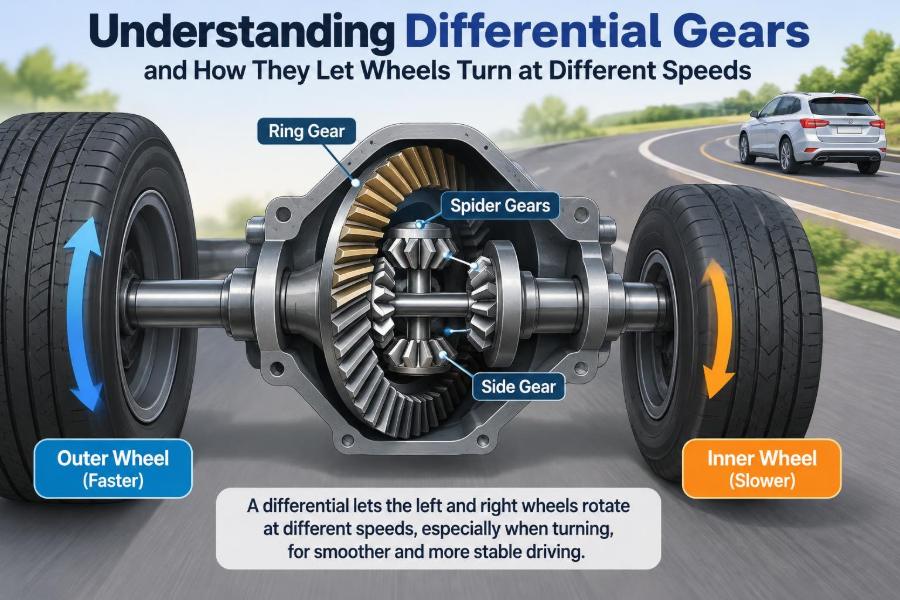

Picture a car turning into a parking space. The inside tyre traces a tight circle, while the outside tyre follows a much wider path. Even at low speed, those two tyres cannot travel the same distance through the turn.
If both driven wheels were forced to rotate at exactly the same speed, one would have to slip across the road surface. The result would be tyre scrub, steering resistance, noise, and extra load on the drivetrain.
The component that solves this problem is the differential. It is a compact gear mechanism that allows two output shafts to rotate at different speeds while still transmitting engine torque to both wheels.
Differentials are often hidden inside an axle housing or transaxle, so they receive little attention until a vehicle loses traction, makes a whining noise, or leaves uneven tyre marks. Understanding their operation explains much of a vehicle’s cornering behaviour.
🧭 The Wheel-Speed Problem in Every Corner
During a turn, the inside and outside wheels rotate about the same instantaneous centre of the corner, but they travel on circles with different radii. The outside wheel covers a longer arc in the same time, so it must rotate faster.
This is true for cars, trucks, racing vehicles, and most other wheeled machines. The difference becomes greater as the turn gets tighter and as the spacing between the wheels increases.
For a simple example, imagine two people walking side by side around a circular track. The person on the outside must either take longer steps or walk faster. A vehicle’s wheels face the same geometric requirement.
📐 Why Equal Wheel Speeds Would Cause Scrub
Without a differential, a solid axle would make both axle shafts turn together. On a perfectly straight road, this is not a problem because both wheels normally cover equal distances.
In a corner, equal wheel speed conflicts with the different distances each wheel needs to cover. Since tyres are flexible and the road contact patch is not perfectly rigid, the mismatch is relieved by slip and deformation.
This effect is called tyre scrub. It increases rolling resistance and can make a vehicle feel reluctant to turn. On high-grip surfaces, it can also place substantial stress on shafts, joints, gears, and suspension components.
⚙️ What a Differential Actually Does
A differential is not simply a gear reduction unit. Its defining function is to split drive between two outputs while permitting a difference in their rotational speeds.
In a conventional vehicle, torque arrives from the propeller shaft or transmission and enters the differential case. The case drives internal gears connected to the left and right axle shafts.
When the vehicle moves straight, both outputs can turn at the same speed. When it turns, the internal gears accommodate the speed difference instead of forcing a tyre to slide.
🔩 The Main Parts Inside an Open Differential
The most familiar design is the open differential. Its major parts work together as a small planetary gear system.
- Ring gear: A large gear driven by the final-drive pinion.
- Differential case or carrier: The housing that rotates with the ring gear.
- Side gears: Gears splined to the left and right axle shafts.
- Spider gears: Small bevel gears between the side gears, also called differential pinions.
- Cross pin or pinion shaft: Supports the spider gears within the case.
The exact arrangement varies, but the principle remains the same: the carrier supplies rotation, and the side gears deliver it to the axle shafts.
🦷 Bevel Gears and Their Useful Geometry
Most conventional axle differentials use bevel gears because they can transmit rotation between shafts arranged at an angle. The side gears face each other, while the spider gears mesh with both of them.
When viewed conceptually, the spider gears behave like small gears rolling between two larger gears. Their ability to rotate on their own shafts is what enables one side gear to speed up while the other slows down.
Some modern units use different internal layouts, including helical gears or electronically controlled clutch packs. Yet they all address the same problem of managing left-to-right wheel speed and torque.
➡️ Straight-Line Driving: No Relative Gear Motion Needed
When a vehicle travels straight and both driven tyres have the same effective rolling radius, the side gears rotate at the same speed. The spider gears revolve with the carrier but do not spin around their own pinion shafts.
In this condition, the differential behaves much like a solid connection between the axle shafts. Both wheels receive drive, and neither wheel needs to overrun the other.
This detail corrects a common misunderstanding: a differential is not constantly making one wheel rotate faster than the other. It only permits a difference when operating conditions demand one.
↪️ What Changes When the Vehicle Turns
As the vehicle enters a corner, the outside wheel needs a higher rotational speed. The resistance at the tyres causes the spider gears to begin rotating on the cross pin.
That internal motion allows the outside side gear to speed up and the inside side gear to slow down relative to the carrier. The carrier’s speed becomes the average of the two axle-shaft speeds in a standard open differential.
If the outside wheel increases speed by a certain amount relative to that average, the inside wheel decreases by an equivalent amount. This relationship lets the axle follow the corner without driveline wind-up.
🧮 A Simple Speed Relationship
For an open differential with equal side gears, the carrier speed is the average of the two wheel speeds. In simplified form:
carrier speed = (left wheel speed + right wheel speed) / 2Suppose the carrier corresponds to 100 rpm. If one wheel turns at 120 rpm through a corner, the other turns at 80 rpm. The average remains 100 rpm.
This is a kinematic relationship, meaning it describes motion rather than available grip. It does not mean the faster wheel automatically receives more useful driving force.
🔄 Why Reversing One Wheel Makes the Other Turn Opposite
When a vehicle is raised so both driven wheels are off the ground, turning one wheel by hand often causes the other to rotate in the opposite direction. This is a normal feature of many open differentials.
With the carrier held still, the average speed of the two side gears must be zero. Therefore, one side gear turning forward requires the other to turn backward at an equal speed.
This workshop observation is useful, but it is not a complete traction test. Brake drag, clutch packs, electronic controls, and the type of differential can change what is observed.
🛞 Torque Is Not the Same as Wheel Speed
Wheel speed describes how fast a wheel rotates. Torque is twisting force, which is what produces tractive force at the tyre contact patch. These concepts are related in vehicle motion but are not interchangeable.
An open differential can permit a large speed difference while transmitting roughly equal torque to both axle shafts. The practical limitation appears when one tyre reaches a very low-grip surface.
A spinning wheel may rotate rapidly, but that does not mean it is propelling the vehicle effectively. Traction depends on the interaction between tyre, normal load, road surface, and applied torque.
🧊 The Open Differential’s Low-Traction Limitation
Imagine one driven wheel on ice and the other on dry pavement. The ice-side tyre can support very little tractive force before it slips. In a conventional open differential, the torque available at the high-grip wheel is constrained by the low torque the slipping wheel can support.
The low-grip wheel then spins, while the wheel on dry pavement may receive too little torque to move the vehicle. This is why a two-wheel-drive vehicle can become stuck even though one driven tyre still has excellent grip.
The differential has not failed; it is doing exactly what its open-gear design allows. The limitation is a trade-off between smooth, uncomplicated cornering and traction in uneven conditions.
⚖️ Why “Power Goes to the Wheel With Least Resistance” Is Incomplete
The popular phrase is useful as a quick warning, but it is technically imprecise. An open differential does not simply send all power to the wheel with the least resistance.
It tends to apply similar axle torque to each side, while the wheel with less available traction reaches its limit first and spins. Once it spins, most of the vehicle’s useful propulsion is lost because the other wheel cannot receive substantially more torque through the open mechanism.
Power also depends on torque and rotational speed. A rapidly spinning low-grip wheel can absorb considerable power even when the torque on both shafts remains similar.
🚙 Open Differentials in Everyday Vehicles
Open differentials remain common because they are compact, durable, smooth in turns, and economical to manufacture. They are well suited to ordinary paved-road driving, where left-to-right traction is usually similar.
They are found in many front-wheel-drive transaxles, rear-wheel-drive axles, and all-wheel-drive systems. Their presence is not an indication that a vehicle is poorly engineered; it reflects the expected operating environment.
For routine commuting, the tyre choice, vehicle stability systems, and driver inputs often matter more to safety and control than the differential type alone.
🔒 Locking Differentials and Their Purpose
A locking differential can mechanically or electronically connect its two outputs so both wheels rotate at the same speed. This prevents the low-traction side from limiting the torque available to the high-traction side in the same way as an open differential.
Locks are valuable in deep mud, loose rocks, snow, and certain work-vehicle conditions. When engaged, both driven wheels are compelled to share rotational speed, improving the chance that at least one tyre can produce useful traction.
However, a locked axle should not generally be used on dry, high-grip pavement during normal turns. The required difference in wheel speed is removed, so tyres and driveline components must absorb the mismatch.
🧲 Limited-Slip Differentials: Controlled Bias
A limited-slip differential, often shortened to LSD, sits between an open differential and a full lock. It still permits speed differences, but it resists excessive differences and transfers more torque toward the wheel with better traction.
Different LSD designs achieve this with clutch packs, cone clutches, gears, or fluid-based couplings. Their response, maintenance needs, and locking characteristics differ considerably.
Rather than asking whether an LSD is “better,” consider the use case. It can improve acceleration out of corners or on mixed-grip roads, but it may add cost, complexity, and particular lubricant requirements.
🌀 Helical Gear Differentials
Helical gear limited-slip differentials use angled gears rather than friction clutches to create torque bias when there is resistance at both wheels. They are valued for smooth, progressive operation and can be effective in performance road cars.
They generally need some resistance from both outputs to develop their biasing action. If one wheel is completely unloaded, such as when lifted off the ground, their effectiveness can be reduced unless braking or electronic control provides resistance.
This is an example of why a differential’s label alone does not reveal its entire behaviour. Internal geometry and vehicle control systems matter.
💧 Viscous Couplings and Their Characteristics
Some systems use a viscous coupling containing closely spaced plates in a silicone-based fluid. A speed difference between the plates shears the fluid, generating resistance that can couple the outputs.
These units can operate smoothly with few external controls, but their response depends on temperature and sustained speed differences. Their behaviour is generally less direct than a mechanically locked system.
Viscous couplings have been used in centre-differential and axle applications. They should not be confused with every electronically managed all-wheel-drive system, many of which use actively controlled clutch packs instead.
🖥️ Electronic Differentials and Brake-Based Traction Control
Many modern vehicles improve traction without a mechanical limited-slip unit. Wheel-speed sensors detect slip, and the stability-control system briefly applies the brake to the spinning wheel.
Braking that wheel creates resistance in the open differential, allowing more torque to reach the wheel with grip. The engine controller may also reduce power when necessary.
This approach is flexible and works with existing brake hardware, but repeated intervention can generate heat and may feel less immediate than a purpose-designed mechanical LSD in sustained demanding use.
🌐 Centre Differentials in Four-Wheel-Drive Systems
Vehicles with permanent four-wheel drive or all-wheel drive may need a centre differential between the front and rear axles. It serves the same fundamental purpose as an axle differential: allowing two driven outputs to rotate at different speeds.
Front and rear axles follow different paths in a turn, particularly in tight manoeuvres. Without a centre differential or a controlled clutch that can slip, a full-time system may experience driveline wind-up on grippy surfaces.
Some off-road vehicles can lock the centre differential for loose terrain. This is distinct from locking the front or rear axle differential, though all three functions affect traction.
🏎️ Differential Behaviour in Performance Driving
During acceleration out of a corner, a performance car often transfers load toward the outside rear tyre. An open differential may allow the lightly loaded inside tyre to spin before the outside tyre receives all the torque it could use.
A limited-slip or electronically controlled differential can help distribute torque more effectively, improving exit acceleration and making the vehicle’s response more predictable. It can also influence understeer or oversteer balance.
There is no universal setup. Excessive locking can make a vehicle resist turning or become harder to manage at the limit, while too little locking may waste available traction.
🚚 Heavy Vehicles, Tight Turns, and Axle Stress
Heavy trucks and equipment face the same wheel-path problem, but high axle loads and long wheelbases make its consequences more pronounced. Multi-axle vehicles may use inter-axle differentials as well as wheel differentials.
Locking functions improve mobility on soft ground, but operators must understand when to disengage them. Using axle locks on firm surfaces while turning can accelerate tyre wear and increase mechanical stresses.
Some truck axles use systems intended to reduce tyre scrub in tight turns. Their design reflects a practical balance among manoeuvrability, load capacity, durability, and traction.
🛢️ Differential Lubrication Is a Design Requirement
Differential gears operate under high contact loads, especially at the ring-and-pinion interface. Correct gear lubricant forms a protective film, carries away heat, and helps prevent scuffing and wear.
Oil specifications are not interchangeable by default. A clutch-type limited-slip differential may require a lubricant with a suitable friction modifier, while another unit may require a specific manufacturer-approved fluid.
Using an unsuitable lubricant can cause chatter during turns, poor clutch operation, noise, or reduced component life. The vehicle service information is the proper reference for grade, specification, and interval.
🔊 Whines, Clunks, and Other Warning Signs
A differential can produce different sounds depending on the fault. A whine that changes with vehicle speed may be associated with gear mesh, bearings, or lubricant condition, while a clunk during load changes can come from excessive backlash or related driveline joints.
Other warning signs include fluid leaks at seals, vibration, metal particles found during service, or a limited-slip unit that chatters sharply in slow turns. None of these symptoms identifies one fault with certainty.
Because wheel bearings, universal joints, CV joints, tyres, and transmissions can create similar symptoms, diagnosis should be systematic. Replacing parts based only on a noise description is expensive and unreliable.
🔧 Practical Checks for Drivers and Technicians
A driver can watch for new noises, leaks beneath the axle or transaxle, unusual tyre wear, and changes in traction behaviour. Any sudden grinding, strong burning smell, or major fluid loss deserves prompt professional attention.
Technicians should verify the complaint under safe conditions, inspect fluid level and condition, check for leaks, assess axle and bearing play, and follow the manufacturer’s diagnostic procedure. Electronic differential systems also require scan-tool data and fault-code evaluation.
- Use the specified lubricant and fill procedure.
- Confirm tyre sizes and rolling circumferences are appropriately matched, especially on all-wheel-drive vehicles.
- Do not assume a spinning wheel proves a differential is defective.
- Check service guidance before adding friction modifiers or aftermarket additives.
🧯 Mismatched Tyres Can Create Driveline Trouble
Tyres with significantly different rolling circumferences rotate at different speeds even while driving straight. On an open axle differential, this creates continuous internal differential action.
In vehicles with locked, limited-slip, or tightly coupled all-wheel-drive systems, mismatches can create unwanted heat and stress elsewhere in the driveline. Differences may result from tyre size, uneven wear, inflation pressure, or mixing tyre models.
Follow the vehicle manufacturer’s guidance when replacing tyres. Some all-wheel-drive vehicles are particularly sensitive to circumference differences between axles.
🧪 A Safe Thought Experiment for Understanding
Imagine a rear axle with a conventional open differential. On a straight road, both wheels rotate at 100 rpm. In a left turn, suppose the left wheel slows to 80 rpm because it follows the inside path.
The right wheel can rotate at 120 rpm, preserving the 100 rpm average carrier speed. No tyre needs to scrub merely because the wheels have different speeds.
Now place the left wheel on a slippery surface. It may spin much faster, but the right wheel does not automatically gain unlimited torque. That contrast separates the differential’s speed-accommodation function from its traction-management function.
⚠️ Common Misunderstandings to Avoid
Several myths make differential diagnosis and vehicle operation more confusing than necessary.
- “A differential divides power equally.” It primarily manages relative speed; torque behaviour depends on the design and available traction.
- “All four-wheel-drive vehicles have locking differentials.” Many use open differentials, clutches, brake-based control, or combinations of these.
- “A locked differential always improves handling.” It may improve traction in some conditions but can make turning less natural on high-grip surfaces.
- “Any gear oil will work.” Fluid specification can be critical, particularly with limited-slip clutches and integrated transaxles.
🧩 Choosing the Right Differential for the Job
For normal road use, an open differential combined with modern traction control is often an effective solution. It offers smooth cornering and low complexity.
A mechanical or electronic limited-slip differential suits vehicles that frequently encounter uneven grip or require repeatable performance under acceleration. A selectable locker is especially useful where severe low-speed off-road traction is the priority.
The best arrangement depends on vehicle layout, tyre grip, operating surface, duty cycle, driver skill, and cost. A component that is excellent on a rocky trail may be undesirable in a city car, and vice versa.
🎯 The Core Principle to Remember
Differential gears exist because left and right wheels take different paths in a turn. By allowing different rotational speeds, they reduce tyre scrub, avoid unnecessary drivetrain stress, and help the vehicle corner smoothly.
An open differential solves the speed problem elegantly but has a traction limitation when one wheel loses grip. Limited-slip units, locks, clutches, and brake-based controls are different strategies for managing that limitation.
Understanding the distinction between wheel speed, torque, and traction makes the entire system easier to interpret—from a simple parking-lot turn to the behaviour of an all-wheel-drive vehicle on a slippery road.
A differential lets a vehicle turn naturally by allowing its driven wheels to rotate at the speeds their different paths require. Once that principle is clear, the strengths and limits of every differential design become much easier to understand. 🚗⚙️🛞