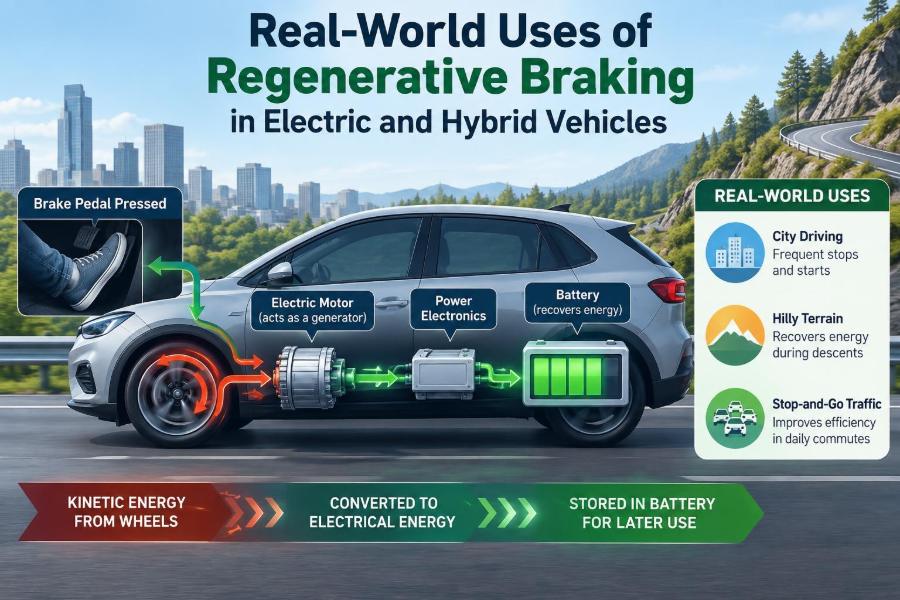

Picture a familiar drive: traffic compresses near a red light, the vehicle ahead slows, and the driver lifts off the accelerator. In a conventional car, much of the vehicle’s motion is converted into heat at the brake discs and pads.
In an electric vehicle or many hybrids, that same slowdown can do another job. The traction motor reverses its role, becoming a generator that sends some of the vehicle’s kinetic energy back to the battery.
This is regenerative braking, often called regen. It is easy to notice as a driver, but its real-world value reaches far beyond a dashboard energy screen: it affects range, brake wear, driving technique, downhill control, commercial fleet operation, and vehicle design.
Understanding where regenerative braking works well—and where it cannot replace friction brakes—helps students connect electrical-machine theory with the decisions engineers and drivers make every day.
⚡ Regenerative Braking in Plain Terms
Regenerative braking is energy recovery during deceleration. Instead of using only friction to slow the wheels, the vehicle commands its electric traction motor to resist wheel rotation.
That resistance produces braking torque. Because the rotating motor is now driven by the wheels, it generates electrical power, which the power electronics route mainly into the high-voltage battery.
The recovery is partial, not magical. Energy is lost in tyres, gears, inverters, motor windings, battery charging, and aerodynamic drag. Still, recovering a useful part of energy that would otherwise become brake heat can improve overall efficiency.
🔄 The Motor Becomes a Generator
In propulsion mode, battery electricity creates motor torque and turns the wheels. In regenerative mode, wheel motion applies torque to the motor shaft; the motor develops an opposing electromagnetic torque while generating electricity.
The inverter is central to this change. It controls current and voltage so that the machine produces the requested deceleration while the battery receives power within safe operating limits.
This reversal explains why an EV can slow immediately when the accelerator is released. The control system may request regeneration even before the driver touches the brake pedal.
🧠 Kinetic Energy Is the Starting Point
A moving vehicle contains kinetic energy, expressed simply as ½mv². This relationship means speed matters greatly: doubling speed increases kinetic energy by four times for the same vehicle mass.
Therefore, slowing from highway speed can make more recoverable energy available than a gentle reduction at low speed. Yet high-speed energy is also heavily affected by aerodynamic drag, which cannot be recovered once it has heated the surrounding air.
Vehicle mass matters too. A loaded bus descending from a stop or a delivery van making repeated urban stops has substantial motion energy available for recovery.
🚦 Stop-and-Go City Driving
Urban traffic is one of the clearest real-world uses of regenerative braking. Frequent accelerations and decelerations create repeated opportunities to capture energy, rather than wasting all of it as heat at the wheels.
Consider a hypothetical commuter route with junctions, queues, and pedestrian crossings. A driver who anticipates traffic and lifts off early can allow moderate regeneration over a longer distance, instead of accelerating until late and demanding a hard friction-brake stop.
This does not make congestion desirable. It simply means an electric or hybrid vehicle can reduce the energy penalty of unavoidable slowing better than a vehicle that relies entirely on friction brakes.
🏙️ One-Pedal Driving in Daily Use
Many battery-electric vehicles offer one-pedal driving, where lifting the accelerator produces strong regenerative deceleration. The driver uses the accelerator to regulate both propulsion and much of normal speed reduction.
It is especially useful in dense traffic, car parks, and urban corridors because it can reduce switching between pedals. The vehicle usually still requires the brake pedal for urgent stops, precise low-speed control, or stronger deceleration than regeneration can provide.
Driving feel varies. Some systems preserve a small amount of creep at standstill, while others hold the vehicle once stopped. Engineers tune these behaviours around comfort, predictability, and local driver expectations.
🛣️ Highway Deceleration and Exit Ramps
Regeneration also works on highways, although opportunities are less frequent during steady cruising. It becomes useful when approaching an exit ramp, lowering speed for a work zone, or responding to slower traffic.
A long, smooth deceleration is generally more favourable than a last-moment stop because the vehicle can stay within its regenerative power and battery-charge limits. Sudden heavy braking may exceed what the motor-generator system can absorb.
The practical lesson is not to coast carelessly. Drivers should maintain safe following distance and use normal braking when needed; regenerative recovery is a benefit of good anticipation, not a reason to delay braking.
⛰️ Long Descents and Grade Control
On a descent, gravity continuously adds energy to the vehicle. Regenerative braking can convert part of that incoming energy into battery charge while maintaining a controlled speed.
This is valuable on mountain roads, where repeated friction braking can heat pads and discs. Regeneration reduces the friction-brake workload, although the system may need friction assistance if the descent is steep, the battery cannot accept charge, or greater braking torque is needed.
For drivers, the experience resembles engine braking in a conventional vehicle, but the recovered energy has a useful electrical destination.
🔋 Why Battery State of Charge Matters
A battery near full charge may have little room to accept regenerative energy. To protect the cells, the battery-management system limits charging current, which reduces available regeneration.
This is why an EV can feel different just after a full charge, particularly on a downhill route. The vehicle may rely more heavily on friction brakes until energy has been used and the battery has charging headroom.
Temperature also matters. Cold cells commonly accept charge less readily, while very hot cells may be protected by reduced charging power. The dashboard’s indicated regeneration limit is therefore a real operating constraint, not merely a display preference.
❄️ Cold Weather and Regeneration Limits
At low battery temperatures, lithium-ion cells can face restrictions on rapid charging. Since regeneration is a form of charging, the control system may initially limit it after a cold soak.
This can modestly change deceleration feel and reduce winter energy recovery. Cabin heating, denser air, snow tyres, wet roads, and slower warm-up conditions can also affect overall energy use at the same time.
Some vehicles prepare the battery thermally before fast charging or driving, but the exact strategy differs by design. Drivers should never assume the usual lift-off deceleration will be available in every temperature condition.
🧲 Blended Braking Explains the Brake Pedal
Most electrified vehicles use blended braking. When the driver presses the brake pedal, software divides the requested braking force between regeneration and conventional friction brakes.
At moderate deceleration, the system may favour regeneration. At higher demand, or when battery acceptance is limited, hydraulic or electro-mechanical friction braking supplies the additional force.
The goal is a consistent pedal response. A well-calibrated system should not make the car feel as if braking suddenly weakens when regeneration reduces; it should quietly increase friction braking to meet the driver’s request.
🛞 Stability Control Always Takes Priority
Braking torque must remain within tyre-road grip. On a slippery surface, excessive regenerative torque at driven wheels can contribute to wheel slip, just as excessive engine braking can.
Anti-lock braking, traction control, and electronic stability control monitor wheel speeds and vehicle motion. They can reduce regeneration quickly and apply friction braking in a controlled way to preserve directional stability.
This is why drivers should not treat strong regeneration as a substitute for careful speed selection in rain, snow, gravel, or ice. The vehicle can manage torque rapidly, but it cannot create grip where little exists.
🚘 Front, Rear, and All-Wheel-Drive Differences
Regenerative braking is available primarily at wheels connected to an electric machine. A front-motor vehicle may recover mainly through the front axle, while a rear-motor vehicle does so through the rear.
Dual-motor all-wheel-drive EVs can often distribute regenerative torque across both axles. That may expand recovery potential and support stable deceleration, but the final allocation depends on traction, motor speed, thermal limits, and handling calibration.
Hybrids add another variation: their electric machine may be integrated with the transmission or mounted on one axle, so their regenerative capability can differ substantially from that of a full EV.
🚖 Hybrid Vehicles Use Regen Differently
In a hybrid, regenerative braking helps recharge a comparatively smaller battery that supports electric launch, low-speed driving, torque assistance, and engine-off operation. It is one reason hybrids can perform efficiently in urban use.
A conventional full hybrid generally cannot be plugged in; it gains battery energy from regeneration and, when necessary, the internal-combustion engine. A plug-in hybrid can also begin a journey with externally supplied electrical energy.
The central principle remains the same in both: recover energy during braking when practical, then use that energy later to reduce fuel use or provide electric propulsion.
🚌 Buses Benefit from Repeated Stops
City buses repeatedly accelerate a large mass and stop at closely spaced stops. That operating pattern makes regenerative braking particularly relevant, especially on routes with predictable urban stop cycles.
Recovered energy can assist the next pull-away, while reduced friction braking can lower wear in a duty cycle that would otherwise be demanding for pads and discs. Passenger comfort still matters, so braking control must avoid abrupt transitions.
Actual benefit depends on passenger load, road gradient, traffic flow, weather, battery temperature, and how aggressively the route is driven. Regeneration helps most when a vehicle has frequent, controlled deceleration events.
🚚 Delivery Fleets and Urban Logistics
Electric delivery vans spend much of their time in lower-speed streets, making frequent stops for collections, drop-offs, junctions, and traffic. Regeneration can recapture energy across this repeated deceleration pattern.
Fleet operators also value the possibility of reduced brake-service demand. Fewer friction-brake applications may mean slower pad wear, but inspection intervals and safety checks remain necessary because brakes can corrode or seize when used less often.
Route planning still matters. A heavily loaded van climbing and descending urban grades behaves differently from an empty van on a flat route, so real energy use should be assessed from operating data rather than assumptions.
🚆 Rail Vehicles Offer a Larger-Scale Example
Regenerative braking is not limited to road vehicles. Electric trains commonly use traction motors as generators during braking, sending energy back into an electrified supply system when that system can accept it.
The railway example makes the concept easier to see: a large moving mass slows, electrical energy flows away from the motors, and another train or the network may use that energy. If the network cannot receive it, other methods such as resistive braking may be needed.
Road EVs store most recovered energy locally in their batteries, but the underlying motor-generator physics is closely related.
🏗️ Construction and Off-Highway Machines
Electrified construction equipment, mining trucks, and other off-highway machines may use regeneration where their work involves repeated deceleration or downhill travel. A haul truck descending with a heavy load is an intuitive case because gravity supplies considerable energy.
However, machine duty cycles are highly specific. Low-speed hydraulic work, loose surfaces, and changing payloads may limit opportunities compared with road travel.
Engineers must consider battery acceptance, cooling, traction, and reliability in dusty or high-load environments. The presence of an electric motor alone does not guarantee large regenerative gains.
🏎️ Performance Driving and Track Use
High-performance hybrid and electric vehicles can use regeneration to capture energy under braking and then redeploy it for acceleration. This approach is especially relevant when repeated braking zones occur.
Track operation also exposes limits. Battery temperature can rise, braking events can be severe, and the battery may reach a charge limit on certain layouts. Friction brakes remain essential because they provide dependable high braking power when regenerative capacity is capped.
For road drivers, performance-oriented regen settings should not be confused with a safety feature. Their purpose is energy management and driving response, while stopping distance still depends primarily on tyres, surface, and total braking capability.
🌧️ Wet Roads Require Predictable Calibration
Low-grip conditions place a premium on smooth torque changes. Strong lift-off regeneration can shift vehicle load forward and alter deceleration more noticeably than a driver expects, particularly if road friction changes suddenly.
Modern controls can reduce motor braking based on wheel-slip signals, but the driver should still use gentle inputs and leave greater space. Regeneration at the driven axle must coexist with tyre grip needed for steering and stability.
Vehicle manufacturers also calibrate brake lights to illuminate under sufficiently strong regenerative deceleration, helping following drivers interpret the vehicle’s speed reduction.
🛑 Why Friction Brakes Are Still Essential
Regeneration cannot bring every vehicle to a complete stop in every condition, and it cannot always provide emergency-level deceleration. Motor speed falls near zero, battery charge acceptance varies, and mechanical braking remains necessary for fail-safe stopping.
Friction brakes also hold practical advantages: they work regardless of a full battery, can provide very high braking torque, and are required for parking and emergency functions in conventional vehicle architectures.
The correct view is complementary rather than competitive. Regen handles recoverable energy when conditions allow; friction brakes cover the rest of the braking envelope.
🔧 Brake Wear Falls, but Maintenance Does Not Disappear
Because regeneration can reduce routine friction braking, pads and discs may last longer than in a comparable conventional vehicle. This is a genuine operational advantage, especially in stop-start service.
But lightly used friction brakes can develop corrosion, uneven disc surfaces, sticky caliper slides, or poor movement. In regions using road salt, these concerns deserve particular attention.
Owners should follow the manufacturer’s maintenance schedule and have braking components inspected. Longer pad life is not permission to ignore a safety-critical system.
📉 Energy Recovery Is Not the Same as Efficiency
A dashboard may show energy flowing back to the battery while braking, but this does not mean braking is inherently efficient. The most efficient energy is often the energy never spent accelerating unnecessarily.
For example, repeatedly accelerating hard toward a red light and recovering part of the energy later still wastes more than maintaining a steady, appropriate speed and reducing unnecessary stops where safely possible.
Regeneration reduces losses; it does not erase them. This distinction is important when interpreting driving data or comparing driving styles.
🧭 Anticipation Improves Real-World Recovery
Good regenerative driving begins with looking ahead. Notice traffic signals, queues, bends, speed-limit changes, gradients, and vehicles turning across the route.
- Lift off earlier when a slowdown is clearly developing.
- Use a smooth deceleration that stays within available regenerative capability.
- Press the brake pedal normally when more braking is needed; do not compromise safety to maximise a display reading.
- Leave space so that small speed changes do not become repeated harsh braking events.
These habits support smoother driving even in vehicles without regenerative braking.
🎛️ Choosing Regen Settings Sensibly
Many vehicles offer selectable regeneration levels, from near-coasting to strong one-pedal deceleration. No single setting is best for every journey.
Stronger settings can suit congested urban driving and hilly routes. Lower settings can feel more natural on open roads, on long gentle gradients, or when a driver wants to preserve momentum.
The best choice is the setting that allows controlled, predictable driving. Switching repeatedly to chase tiny energy differences can distract from traffic conditions and rarely matters as much as smooth speed management.
📊 A Quick Comparison of Operating Situations
| Situation | Regeneration opportunity | Main limitation |
|---|---|---|
| Urban traffic | High, due to repeated slowing | Short, irregular braking events |
| Steady motorway cruising | Low until a slowdown occurs | Few deceleration events |
| Long downhill | Potentially high and sustained | Battery may become full or warm |
| Cold battery after parking | Often reduced initially | Limited charge acceptance |
| Slippery road | Controlled but potentially limited | Tyre grip and stability demands |
| Heavy fleet vehicle in town | Often valuable across many stops | Payload and route variation |
⚠️ Common Misunderstandings
One mistake is assuming regenerative braking always works at its maximum level. In reality, the system responds to battery state of charge, temperature, speed, traction, motor limits, and driver demand.
Another is thinking that lifting off the accelerator means brake lights will always operate in exactly the same way as pedal braking. Vehicle strategies differ, although they are designed to communicate meaningful deceleration to following traffic.
A third is treating regeneration as free energy. It is recovered energy with conversion losses, not newly created energy.
🧪 What Engineers Must Balance
Designing regenerative braking requires trade-offs among energy recovery, pedal feel, stability, thermal management, battery life, noise, and customer expectations. Maximising one factor can complicate another.
For instance, strong regeneration may improve urban recovery but feel abrupt to some drivers. Aggressive battery charging can capture more energy in a moment, but cell-protection limits must take priority.
Calibration is therefore a system-level task. The motor, inverter, battery, hydraulic brakes, tyres, suspension load transfer, and control software must act as one coordinated vehicle.
🔮 Future Uses and Smarter Control
Future systems can use route information, navigation data, traffic conditions, and gradient estimates to plan energy use more intelligently. A vehicle that knows a long descent is ahead may avoid filling the battery unnecessarily before reaching it.
Connected and predictive features must still handle uncertain traffic, changing weather, and driver choices. Their purpose is to assist energy management, not to remove the driver’s responsibility for safe control.
Advances in batteries, power electronics, and software may widen the conditions in which regeneration is available, while friction braking will remain a fundamental part of vehicle safety.
✅ The Core Principle Behind Real-World Regen
Regenerative braking is most useful whenever a vehicle must slow and its battery can safely accept energy. It turns part of an unavoidable loss into electricity that can later move the vehicle again.
Its strongest everyday roles are in urban traffic, on gradients, in stop-start public transport, and in delivery work. Its limits—full or cold batteries, low grip, high braking demand, and near-zero speed—explain why conventional brakes remain indispensable.
For engineers, regen is a clear example of integrated vehicle design. For drivers, it is a tool that rewards anticipation, smoothness, and an understanding that efficient driving begins before the brake event.
Regenerative braking does not eliminate the need to slow down; it makes necessary slowing more useful by recovering part of the energy that would otherwise be lost. 🚗⚡🔋