
A driver buys a new car, pairs a phone, and expects the navigation, music, parking camera, and driver-assistance features to work together without much thought. A few months later, the car may receive an update that improves its route planning, changes the screen layout, or fixes a battery-management issue while parked in the driveway.
That experience feels familiar because phones and computers have worked this way for years. In a vehicle, however, the consequences are more serious: software can influence braking support, steering assistance, charging behavior, visibility, security, and whether a vehicle is ready to drive.
This shift is changing automobile engineering. The modern vehicle is no longer only a mechanical machine with electronic add-ons; it is becoming a tightly integrated system of mechanical hardware, electrical architecture, sensors, networks, and software.
Understanding software-defined vehicles helps students see where vehicle design is heading and helps working professionals recognize why traditional engineering boundaries are becoming less rigid.
🚘 What Is a Software-Defined Vehicle?
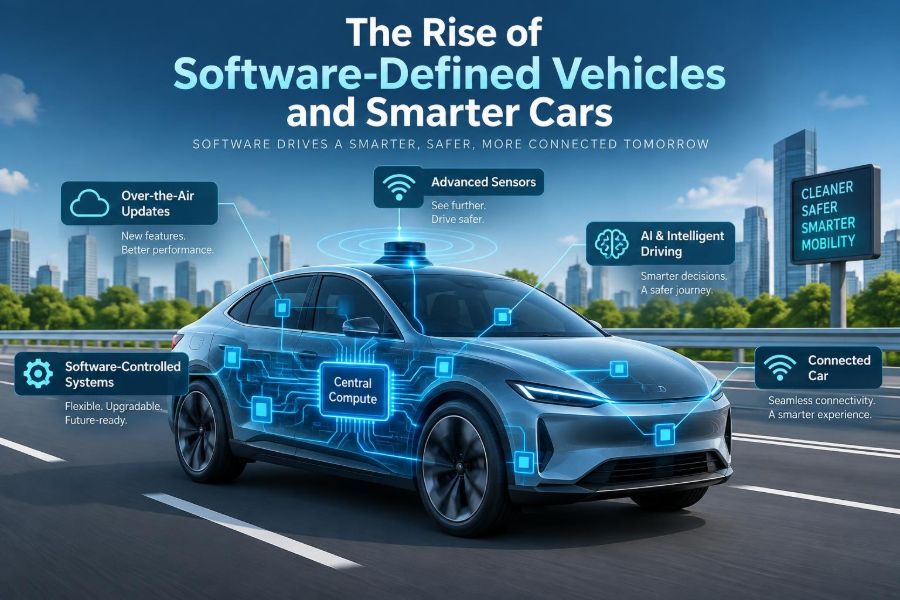
A software-defined vehicle, often shortened to SDV, is a vehicle whose functions and user experience can be substantially created, changed, improved, or managed through software over its operating life.
Software has existed in cars for decades. Engine control units have regulated fuel injection, ignition timing, and emissions systems for years. The SDV difference is scale: software increasingly coordinates many vehicle domains through more centralized computing and can be updated after sale.
It does not mean that software replaces mechanical engineering. Tires still generate grip, structures still absorb crash energy, and motors still produce torque. Software decides how intelligently, safely, and efficiently many of those physical components are controlled.
🧩 Why the Vehicle Architecture Is Changing
Older electronic architectures commonly used many separate electronic control units, or ECUs. One module might govern windows, another the transmission, another airbags, another climate control, and another infotainment.
This distributed arrangement grew gradually as manufacturers added features. It works, but it can create large wiring harnesses, duplicated computing power, complicated calibration, and difficult communication between modules from different suppliers.
SDV development moves toward fewer, more capable computers. These computers can host several software functions while specialized controllers remain close to sensors, actuators, and safety-critical hardware where fast local response is needed.
🧠 From ECUs to Vehicle Computers
A high-performance vehicle computer resembles a powerful embedded computer designed for automotive conditions. It can process camera data, run the digital cockpit, coordinate connectivity, and execute selected vehicle-control applications.
Consolidation can reduce hardware duplication, but it is not simply a matter of putting every function in one box. Braking, steering, restraint systems, and powertrain controls have different timing, safety, and availability needs.
Engineers therefore divide tasks carefully. A central computer may make a high-level decision, while a local controller handles a rapid actuator loop. This layered approach helps preserve predictable behavior when network traffic or other software loads increase.
🗺️ Zonal Architecture and Shorter Wiring Paths
One important design approach is zonal architecture. Instead of grouping electronics mainly by function, the vehicle is divided into physical zones such as front left, front right, cabin, or rear.
A zonal controller in each area connects nearby lights, switches, sensors, and actuators. It then communicates with central computers through a high-speed backbone. The arrangement can shorten local wiring runs and make assembly more organized.
The exact benefits depend on the vehicle platform and implementation. A zonal design still needs reliable connectors, power distribution, electromagnetic compatibility, and a service strategy. It is an architectural tool, not an automatic solution to every electrical problem.
🔌 Networks That Let Systems Cooperate
A vehicle needs several networks because not every message has the same urgency. A warning light update can tolerate more delay than a message needed to coordinate braking or steering support.
| Network approach | Typical strength | Common use |
|---|---|---|
| CAN and CAN FD | Robust control communication | Body, chassis, and powertrain messages |
| LIN | Low-cost local communication | Seats, mirrors, switches, and simple actuators |
| Automotive Ethernet | High data capacity | Cameras, central computing, diagnostics, and software updates |
Network design includes more than data speed. Engineers must consider latency, message priority, fault containment, connector choices, and what should happen if a communication path is interrupted.
📡 Sensors Turn Physical Conditions into Data
Smarter vehicles depend on sensors that observe both the vehicle and its surroundings. Wheel-speed sensors, temperature sensors, pressure sensors, cameras, radar, ultrasonic sensors, inertial measurement units, and battery monitors each provide a partial view.
No sensor is perfect. A camera can be affected by glare or dirt, radar interpretation can be complex in dense traffic, and a temperature sensor only represents conditions at its location. Software must account for uncertainty rather than treating every input as unquestionable truth.
For example, a tire-pressure warning system can alert a driver to a developing issue, but it does not replace a visual inspection for cuts, embedded objects, or uneven wear.
👁️ Sensor Fusion Builds a Better Picture
Sensor fusion combines inputs from multiple sensors to estimate what is happening around the vehicle. A camera may classify a lane marking, radar may estimate an object’s distance and relative speed, and vehicle motion data may help stabilize the interpretation.
Combining sources can improve robustness because one sensor may compensate for another’s weakness. It also creates engineering challenges: timestamps must align, sensor locations must be calibrated, and conflicting measurements need sensible handling.
A fusion system should be designed to recognize uncertainty. If weather, contamination, or a sensor fault reduces confidence, a driver-assistance function may need to limit performance, request driver control, or deactivate safely.
🛞 Software Controls Real Physical Systems
Software commands eventually become physical actions. A request for regenerative braking may be shared between the electric motor and friction brakes. A stability-control system may reduce torque and apply braking at selected wheels to help the driver maintain control.
This is why automotive software cannot be judged only by whether its screen looks polished. It must meet timing requirements, operate across temperature and voltage ranges, and respond appropriately to sensor faults and component failures.
The best control strategy also respects physical limits. No algorithm can create tire-road friction on ice, eliminate braking distance, or make an overloaded vehicle handle like an unloaded one.
⚙️ Powertrain Software Is Becoming More Strategic
In internal-combustion vehicles, software coordinates air, fuel, ignition, exhaust after-treatment, transmission shifts, and thermal management. Calibration strongly affects drivability, emissions compliance, fuel consumption, and component durability.
In electric vehicles, control software manages torque delivery, regenerative braking, inverter operation, battery temperature, charging behavior, and energy use by heating and cooling systems. These decisions influence range and performance, especially in demanding weather.
Engineers must balance competing goals. Strong regeneration can recover energy, but the available level depends on battery state, temperature, traction, and the requested deceleration. A consistent brake-pedal feel requires careful blending with hydraulic braking.
🔋 Battery Management Is a Software-Intensive Task
The battery-management system, or BMS, estimates battery state of charge, monitors temperatures and voltages, manages contactors, and helps keep cells within safe operating limits. Its estimates are derived from measurements and models, not from a single simple gauge.
Battery state of health is also an estimate. It can depend on use history, temperature exposure, charging patterns, cell variation, and how the manufacturer defines usable capacity.
Software updates may refine estimation or thermal-control logic, but they cannot reverse physical aging. Clear communication matters: an improved range display is useful only if it remains honest about changing driving conditions.
🖥️ The Cabin Is Becoming a Digital Platform
Displays, voice interfaces, phone integration, profiles, maps, and connected services shape how drivers experience a vehicle every day. A well-designed interface can reduce friction by putting useful information where it is needed.
Yet a large screen is not automatically a better interface. Essential controls such as defrosting, hazard lights, demisting, and frequently adjusted climate settings need to be quick to find and usable without excessive visual attention.
Human-machine interface design should consider reach, glare, typography, audio feedback, haptic feedback, and cognitive workload. The engineering question is not merely what can be placed on a display, but what a driver can use safely in motion.
🧭 Driver Assistance Is Not Autonomous Driving
Advanced driver-assistance systems, or ADAS, can support tasks such as emergency braking, lane keeping, adaptive cruise control, blind-spot alerts, and parking assistance. Their capabilities vary widely among vehicles and operating conditions.
Driver assistance does not automatically mean self-driving. Many systems require a licensed, attentive driver who remains responsible for supervising the road and taking over when the system reaches a limit.
Names and marketing language can create misunderstandings. Engineers and users should focus on the vehicle documentation: what the feature detects, its operating conditions, its warnings, and the driver’s required role.
🧪 Operational Design Domains Set Boundaries
An operational design domain, or ODD, describes the conditions in which an automated function is intended to operate. It may specify road type, speed range, weather limits, lighting conditions, map coverage, and other constraints.
For instance, a hypothetical automated parking function may be designed for marked parking spaces at low speed, not for navigating a crowded construction zone. Its limitation is part of the design, not a failure of engineering ambition.
Clear boundaries make validation more realistic. The broader the intended operating domain, the more varied edge cases the system must recognize and handle safely.
🛡️ Functional Safety Requires Planned Failure Behavior
Functional safety asks what happens when an electrical or electronic system fails. A fault might involve a stuck sensor value, a damaged wire, corrupted communication, a processor malfunction, or an actuator that does not respond as commanded.
Engineers identify hazards, assess risk, and design safety mechanisms such as plausibility checks, watchdog timers, redundant sensing, diagnostic coverage, and controlled fallback states. The appropriate measure depends on the function and its potential consequences.
Good safety design does not assume faults are impossible. It aims to detect dangerous conditions quickly and move the vehicle or system toward a safer state when normal operation cannot be assured.
🧯 Redundancy Is More Than Duplicating Parts
Redundancy may include two sensors measuring a critical quantity, independent power paths, separate computing channels, or a mechanical fallback. But two identical components can share the same weakness if they rely on the same power supply, location, software error, or environmental condition.
Engineers therefore examine common-cause failures. Two cameras placed close together may both be blinded by the same low sun; two processors running the same flawed logic may reach the same flawed conclusion.
Diversity, separation, monitoring, and graceful degradation can be as valuable as duplication. The goal is not maximum complexity, but credible resilience for the hazard being controlled.
🔐 Cybersecurity Now Reaches the Road
Connected vehicles have interfaces that earlier vehicles often lacked: cellular links, Bluetooth, Wi-Fi, diagnostic ports, phone apps, cloud services, and update mechanisms. Each interface can become a potential entry point if it is poorly protected.
Cybersecurity engineering uses practices such as authentication, access control, encryption where appropriate, secure boot, signed software, network segmentation, logging, and vulnerability management. Security must be considered during design, production, operation, and service.
A secure system also needs a realistic recovery plan. If suspicious behavior is detected, engineers must decide which functions can be isolated, how the driver is informed, and how service personnel restore trusted software.
☁️ Connectivity Enables Services but Adds Dependencies
Vehicle connectivity can support emergency assistance, remote status checks, navigation updates, fleet management, charging features, and diagnostic insight. For commercial fleets, connected data can help schedule maintenance around actual usage rather than only calendar intervals.
However, driving-critical functions should not depend unnecessarily on a continuous cloud connection. Cellular coverage varies, subscriptions change, services can be discontinued, and remote servers may be unavailable.
A sensible design distinguishes between local vehicle control and cloud-enhanced convenience. The vehicle should retain essential safe operation when connectivity is absent.
🔄 Over-the-Air Updates Change the Ownership Model
Over-the-air updates, often called OTA updates, allow approved software packages to be delivered remotely. They can correct defects, update maps, improve interfaces, refine energy management, or add supported functions without a workshop visit.
Because an update can affect a complex system, it needs safeguards: package signing, compatibility checks, adequate battery charge, reliable storage, rollback or recovery strategies, and clear information for the owner.
Not every update should be treated alike. Updating a media application has a different risk profile from updating software that affects propulsion, braking coordination, or driver assistance.
✅ Validation Must Cover Software and the Vehicle Together
Traditional vehicle validation already involves durability, vibration, temperature, corrosion, crash performance, and road testing. Software-defined features add simulation, code review, automated testing, hardware-in-the-loop testing, cybersecurity assessment, and data analysis.
Hardware-in-the-loop testing connects real controllers to simulated sensors and vehicle behavior. It lets engineers test rare or hazardous cases repeatedly before using a physical test vehicle.
Simulation is powerful but not complete. Models make assumptions, so final confidence requires multiple forms of evidence, including controlled physical testing and disciplined assessment of scenarios that are difficult to recreate.
📋 Regulations, Standards, and Compliance Still Matter
Vehicle software operates within a framework of type approval requirements, safety expectations, cybersecurity obligations, emissions rules where applicable, and regional regulations. Requirements vary across markets and evolve over time.
Engineering teams need traceability: a way to connect requirements, design decisions, code changes, tests, calibrations, and released versions. Without it, proving what a particular vehicle configuration does becomes difficult.
Standards can guide methods, but compliance paperwork alone does not create a safe product. The engineering culture must encourage careful reviews, truthful reporting of limitations, and action when field issues appear.
🔧 Diagnostics Are Moving Beyond Fault Codes
Diagnostic trouble codes remain valuable, but complex vehicles need richer context. A code without time, environmental conditions, software version, sensor history, or communication status may not reveal the real cause.
Modern diagnostics can include event logs, network traces, software configuration records, and guided service procedures. This information can help technicians separate a failed component from a wiring problem, calibration issue, or software interaction.
Access must be managed responsibly. Independent repair and service workflows need practical diagnostic capability, while security controls must prevent unauthorized changes to safety-relevant systems.
🧰 Service Technicians Need New Skills
Mechanical competence remains essential, but technicians increasingly need confidence with high-voltage safety, network diagnostics, scan tools, software versions, sensor calibration, and structured troubleshooting.
Replacing a camera, radar unit, steering component, or battery-related part may require calibration or configuration afterward. A physically correct installation can still produce poor performance if the electronic setup is incomplete.
A productive workflow starts with symptoms and evidence rather than assumptions. Checking service information, power supply quality, connector condition, relevant codes, and recent software changes can prevent unnecessary parts replacement.
👨🔧 What This Means for Automobile Engineering Students
Students do not need to become experts in every programming language or every automotive subsystem. They do need a systems mindset: understanding how mechanical behavior, electronics, control logic, safety, and user behavior interact.
- Build strong foundations in vehicle dynamics, powertrains, electrical basics, and thermodynamics.
- Learn introductory programming, data handling, and control-system concepts.
- Practice reading signals from sensors and interpreting simple network messages.
- Study failure modes, diagnostics, and the difference between verification and validation.
A small project can be highly instructive: for example, use a microcontroller and sensors to control a model vehicle, then document what happens when a sensor value is noisy, missing, or delayed.
🏭 Manufacturing Must Manage Software Configuration
In a software-defined vehicle, a production line must install not only correct hardware but also the correct software, calibration, security credentials, and regional configuration. A vehicle may have similar physical components but different approved features depending on its market.
Configuration control prevents mismatches between modules. It also supports later service, recalls, quality investigations, and lawful updates because the manufacturer can identify what version was installed on a particular vehicle.
Production quality therefore includes digital traceability. A robust end-of-line check may verify communication, software integrity, sensor status, and function readiness alongside traditional mechanical inspection.
♻️ Software Can Support Efficiency, Not Defy Physics
Software can reduce energy waste by optimizing thermal systems, planning charging, smoothing torque delivery, managing regenerative braking, and providing drivers with useful efficiency feedback. Fleet software can also reduce idle time and identify maintenance needs early.
But efficiency claims should be interpreted carefully. Real energy use still depends on speed, payload, terrain, ambient temperature, tires, traffic, driving style, and accessory loads.
The strongest solutions combine good hardware and good controls: aerodynamic design, efficient motors, low-loss power electronics, sensible thermal systems, and software that coordinates them under real operating conditions.
⚖️ Data Ownership and Privacy Need Deliberate Choices
Connected vehicles can generate information about location, charging, driving events, component condition, and account settings. Some data is useful for safety, diagnostics, insurance products, navigation, or fleet operations, but usefulness does not remove privacy concerns.
Drivers and fleet operators should understand what data is collected, why it is collected, who can access it, how long it is retained, and whether sharing is optional. These questions can differ by market and service agreement.
Privacy-aware engineering favors data minimization, transparent consent, access controls, and separation between personally identifiable information and technical records where practical.
⚠️ Common Misconceptions About Smarter Cars
One misconception is that a vehicle update is always harmless. Updates can be beneficial, but their impact depends on which system changes and how thoroughly it has been tested for the installed hardware configuration.
Another is that more sensors always create more safety. Additional sensors can improve awareness, yet they also add calibration needs, failure modes, data-processing demands, and cost.
A third is that a connected car is automatically future-proof. Hardware performance, sensor capability, network support, regulations, storage capacity, and manufacturer support policies all set practical limits on what future software can deliver.
🛠️ Practical Questions for Buyers and Fleet Managers
When evaluating a smart vehicle, look beyond a feature list. Ask how the vehicle behaves when a function is unavailable, what maintenance and calibration it needs, and which features require a subscription or data connection.
- What driver-assistance functions are available, and when do they operate?
- How are software updates delivered and communicated?
- What happens if connectivity is lost?
- What training and equipment will service staff need?
- What data-sharing controls are available?
For fleets, compatibility with existing diagnostic tools, charging infrastructure, dispatch systems, and driver training can matter as much as the sophistication of the vehicle itself.
🌍 The Road Ahead Is Evolution, Not a Single Switch
Software-defined vehicles will not make every vehicle identical, fully autonomous, or permanently upgradeable. Different segments will adopt different levels of central computing, connectivity, automation, and electrification according to cost, regulations, customer expectations, and operating needs.
Some functions will remain intentionally simple because simplicity can support affordability, repairability, and reliability. Other functions will gain from powerful computing, especially where coordination across systems provides a clear safety, efficiency, or usability benefit.
The most durable designs will treat software as part of the vehicle engineering process from the first concept stage, rather than as a layer added after mechanical design is complete.
🏁 The Core Principle: Integrated Engineering Creates Smarter Cars
The rise of the software-defined vehicle is fundamentally a story of integration. Mechanical design sets the physical capability; electronics sense and actuate; networks carry information; software interprets conditions and coordinates decisions.
Success depends on disciplined trade-offs. Better features must be balanced with safety, cybersecurity, serviceability, privacy, cost, and honest communication about limits. A clever function is only valuable when it behaves predictably in normal use and fails responsibly when conditions are outside its design envelope.
For automobile engineers, the key skill is no longer mastering one isolated subsystem. It is learning to connect disciplines while respecting the real-world constraints of vehicles, roads, people, and physics.
Smarter cars will be defined not by how much software they contain, but by how safely and usefully software works with sound automotive engineering. 🚗💻🛠️