
You roll away from a traffic light in near silence, then notice the petrol engine join in as speed rises. A few minutes later, while slowing for the next junction, the engine may switch off again even though the car is still moving.
That apparently simple behaviour is the result of constant calculation. A hybrid vehicle is not merely choosing between two power sources; it is managing energy, heat, emissions, battery condition, driver demand, road load, and component protection—often several times each second.
For drivers, this explains why a hybrid can feel smooth and economical in town but less dramatically different on a fast motorway run. For engineering students and technicians, it provides a useful case study in controls, electrical machines, thermodynamics, and mechanical power transmission working as one system.
Under the hood, the main question is rarely “engine or motor?” Instead, the control system asks: what combination of energy paths meets the driver’s request with the least fuel use, emissions, wear, and battery stress?
🔋 A Hybrid Is an Energy-Management System
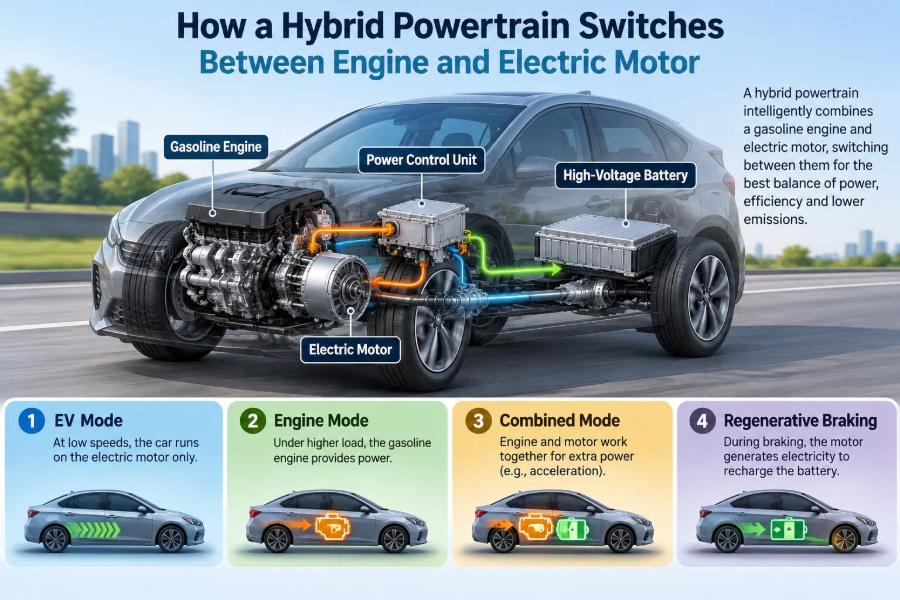
A hybrid powertrain combines an internal-combustion engine with one or more electric machines, an energy-storage battery, power electronics, and a supervisory controller. The engine converts fuel chemical energy into shaft power; the electric machine can convert electrical energy into shaft power or reverse that conversion during braking.
The key advantage is flexibility. The engine can avoid some of its least efficient operating conditions, while the motor supplies quick low-speed torque and recovers energy that an ordinary friction-brake system would turn into heat.
🧭 The Driver Requests Torque, Not a Power Source
Pressing the accelerator does not directly command the engine throttle in many modern hybrids. It communicates a requested wheel torque through sensors and vehicle control modules.
The hybrid control unit then decides how to deliver that torque. It considers pedal position and rate of movement, vehicle speed, gradient estimates, battery state, temperatures, traction limits, and the chosen drive mode. A rapid pedal movement usually signals that the driver wants immediate response, even if the engine must start.
🧩 The Core Components Working Together
Hardware layouts vary, but most hybrids contain the same functional building blocks:
- Engine: usually optimized for efficient steady operation rather than peak low-speed response.
- Traction motor: drives the wheels, assists the engine, or regenerates electricity.
- Generator: starts the engine and/or produces electricity in some architectures.
- High-voltage battery: stores and releases electrical energy over short and medium time scales.
- Inverter: converts battery DC into controlled AC for the motor and converts generated AC back to DC.
- Transmission or power-split device: matches power sources to wheel speed.
A conventional 12-volt battery still exists for low-voltage electronics, but it is not the main source for traction.
⚡ Why the Battery Is Not Just a Larger Starter Battery
The traction battery is designed for repeated charge and discharge, high power flow, and thermal control. Its management system monitors voltage, current, temperature, insulation condition, and the state of charge, often abbreviated as SOC.
Hybrid batteries are generally not operated from completely full to completely empty. Keeping a buffer at both ends protects cell life and preserves room to absorb regenerative braking energy. This is why a dashboard battery display can show “full” while the pack still has reserved capacity.
📊 State of Charge Sets the Boundaries
Battery SOC strongly influences engine switching. If charge is low, the controller may run the engine more often or use it to generate electricity. If charge is high, it may favor electric propulsion briefly or limit regeneration on a long descent because there is little space left to store energy.
SOC is not the only limit. A cold battery, a very hot battery, or a battery at an unsuitable voltage can accept or supply less power even when its indicated charge level appears normal.
🔌 The Inverter Makes Motor Control Possible
The battery provides direct current, while common traction motors require carefully controlled alternating current. The inverter uses high-speed semiconductor switches to create AC with the frequency and waveform needed for the desired motor speed and torque.
During regeneration, the direction of energy flow reverses. The motor becomes a generator, the inverter rectifies and controls the electrical output, and the battery receives charging current. This bidirectional role makes the inverter one of the most important—and thermally demanding—parts of the system.
🌀 Electric Motors Deliver Torque Differently
An electric traction motor can provide substantial torque from zero speed. That is why a hybrid can move away briskly without needing the engine to idle at high speed or a conventional transmission to hunt for a low gear.
Motor torque is also precisely controllable. The system can blend motor torque with engine torque almost imperceptibly, provided the controller, clutches, inverter, and transmission are well coordinated.
🔥 Engines Prefer Some Operating Points Over Others
A petrol engine loses considerable efficiency at light load because it still experiences pumping, friction, and heat losses. It may also operate inefficiently when asked for sudden low-speed torque.
A hybrid can sometimes turn the engine off at low demand, or run it at a more favorable load while using excess output to charge the battery. The battery can later return that energy during acceleration. Energy is not created by this cycle—each conversion has losses—but it can move engine operation away from especially wasteful conditions.
🏙️ Electric Launch in Urban Driving
At a gentle pull-away, the traction motor may propel the vehicle alone. This is especially useful in slow traffic, parking maneuvers, and stop-start conditions, where an engine would otherwise spend time idling or running lightly loaded.
Electric-only operation depends on available battery power, temperature, vehicle speed, and requested torque. It is not a promise that the engine will remain off whenever the battery icon looks charged.
🚦 What Makes the Engine Start
The engine may start for reasons that are not obvious from the driver’s seat. Common triggers include stronger acceleration, sustained higher speed, low battery charge, steep gradients, heating demand, emissions-system requirements, or the need to warm the engine and catalyst.
In a full hybrid, an electric machine usually spins the engine to speed before fuel is introduced. This produces a smoother start than a traditional starter motor engaging a stationary engine, though some vibration can still be felt.
🛣️ Why the Engine Usually Dominates at Cruise
At steady road speed, the vehicle needs continuous power to overcome aerodynamic drag, rolling resistance, drivetrain losses, and gradients. As speed rises, aerodynamic drag becomes increasingly significant, so sustained electric-only driving would drain a modest hybrid battery quickly.
The engine can therefore become the primary source at motorway speeds. The motor may still assist during passing or absorb surplus energy, but a non-plug-in hybrid is not intended to behave like a long-range battery-electric vehicle.
⛰️ Climbing Hills Requires a Different Strategy
A steep or extended climb demands high wheel torque for a long period. The controller may combine engine and motor output, using stored electrical energy to fill short peaks in demand.
If the climb continues, battery SOC may fall toward its target lower boundary. The system then reduces electric assistance and relies more heavily on the engine. This is normal energy management, not necessarily a fault.
🛑 Regenerative Braking Captures Kinetic Energy
When a moving vehicle slows, it has kinetic energy. In regeneration, the wheels drive the motor, and the motor resists rotation while generating electricity. That resistance creates braking torque.
Regeneration is most valuable where frequent slowing occurs: urban traffic, rolling roads, and descents. It cannot recover all kinetic energy because conversion losses exist, tire grip limits apply, and the battery may be unable to accept the full available power.
🦶 Brake Blending Keeps Stopping Predictable
Drivers expect a consistent brake-pedal response, but regenerative braking changes with speed, battery condition, and traction. Hybrid brake systems blend regenerative torque with hydraulic friction braking to achieve the requested deceleration.
At very low speed, regenerative capability normally fades because motor generation becomes less effective. Friction brakes then complete the stop. Hydraulic brakes also intervene whenever stronger braking is needed than the motor and battery can safely provide.
🌧️ Grip and Stability Take Priority
On a slippery surface, excessive regenerative braking at the driven wheels can contribute to wheel slip. Anti-lock braking and stability-control systems therefore coordinate with the hybrid controller.
If wheel-speed sensors detect instability, regenerative torque can be reduced quickly and conventional brake pressure adjusted. Energy recovery is always secondary to maintaining control of the vehicle.
🔀 Series Hybrids: Electricity Is the Main Route
In a series hybrid, the engine does not normally drive the wheels mechanically. It drives a generator, which supplies electricity to the traction motor and battery system. Wheel propulsion is electric.
This layout can simplify mechanical coupling and let the engine operate in a narrower speed range. However, converting engine power to electricity and back to mechanical wheel power introduces losses, so the best result depends on the duty cycle and design.
⚙️ Parallel Hybrids: Engine and Motor Share the Driveline
A parallel hybrid connects both engine and motor to the wheels through a transmission or clutch arrangement. Either source may propel the vehicle, or they may work together.
Because engine power can reach the wheels through a mechanical path, a parallel system can be efficient during steady cruising. The clutch arrangement is crucial: it determines whether the engine can be disconnected for electric driving and how smoothly torque transfers occur.
🪐 Power-Split Hybrids Combine Mechanical and Electrical Paths
A power-split hybrid uses a planetary gearset or comparable mechanism to divide engine power between a mechanical path to the wheels and an electrical path through motor-generators. It is often described as an electronically controlled continuously variable transmission, or e-CVT.
The term can be confusing. Unlike a belt-type CVT, this system may use planetary gears and electric machines to vary the relationship between engine speed and wheel speed. It gives the controller broad freedom to select efficient engine operation.
🧱 Mild Hybrids Have More Limited Electric Authority
A mild hybrid commonly uses a smaller motor-generator and battery, often to provide stop-start operation, regeneration, torque assistance, and smoother engine restarts. Many cannot drive the car solely on electric power in ordinary conditions.
This distinction matters when comparing specifications. “Hybrid” describes a family of architectures, not one fixed capability. Full hybrids and plug-in hybrids generally have greater electric propulsion ability than mild hybrids.
🔋 Plug-In Hybrids Begin With a Larger Energy Reserve
A plug-in hybrid electric vehicle, or PHEV, has a battery designed to be charged from an external supply as well as by the engine and regeneration. It can often cover a meaningful portion of daily travel electrically when charged and driven within its electric capability.
Once that usable charge is depleted, it continues as a hybrid rather than stopping. Real fuel use depends heavily on charging access, trip length, ambient conditions, speed, and whether the driver regularly plugs in.
🌡️ Temperature Changes the Switching Logic
Cold starts increase engine friction and slow catalyst warm-up. Cabin heating can also require engine heat in many vehicles, even when propulsion demand is low. As a result, the engine may run in cold weather when an observer expects electric mode.
High temperatures create another constraint. Batteries, inverters, and motors have thermal limits, so the system may reduce electric power, regeneration, or repeated hard acceleration to protect components.
🧪 Emissions Control Can Override Fuel-Saving Instincts
The catalyst works best within a suitable temperature range. After a cold start, an engine may run partly to warm the emissions-control system, not simply to charge the battery or make power.
This is a useful reminder that fuel economy is only one objective. Modern calibration must also meet drivability, emissions, durability, noise, and safety requirements.
🔇 Why Engine Speed May Not Match Vehicle Speed
In some hybrids, particularly power-split designs, engine speed can rise and settle independently of road speed during strong acceleration. This can sound unfamiliar to drivers used to stepped automatic gear changes.
The sound is not automatically evidence of slipping. The controller may be holding the engine near a power-producing region while the electric path and gearset manage the difference between engine and wheel speeds.
🧠 The Supervisory Controller Is the Decision Maker
No single sensor decides when the engine starts. The supervisory control system combines information from the engine controller, battery-management system, inverter, transmission controller, brake controller, and stability systems.
Its strategy is typically predictive as well as reactive. For example, it may preserve battery charge before a likely climb or accept more regeneration before a stop, based on navigation data in vehicles equipped to use it. Exact strategies differ by manufacturer and model.
📈 A Simple Journey Through the Operating Modes
Consider a hypothetical commute. Leaving a parking space, the car uses the motor at low speed. A firmer merge onto a main road starts the engine and adds motor torque. At a steady cruise, the engine provides most of the energy, perhaps charging or lightly assisting the battery system as needed.
Approaching a roundabout, lifting off the accelerator begins regeneration. Pressing the brake increases regenerative torque until hydraulic brakes supplement it. At the next stop, the engine can shut down if battery charge, temperature, and cabin demands allow.
🧰 Drive Modes Change Priorities, Not Physics
Eco, Normal, Sport, EV, and charge-hold modes alter pedal mapping and energy-management priorities. Eco may request gentler torque for a given pedal movement, while Sport may preserve more battery power for immediate assistance.
EV mode may request electric-only operation, but the controller can still start the engine if power demand, speed, battery condition, heating needs, or protection limits require it. A mode button is a preference, not an unconditional command.
🚫 Common Misunderstandings About Hybrid Operation
- “The engine starting means something is wrong.” Often it is responding normally to load, temperature, emissions, or battery needs.
- “Regeneration makes braking free.” It recovers part of energy that would otherwise be lost, but cannot eliminate losses.
- “A full battery guarantees EV driving.” Temperature, power demand, and system protection still govern operation.
- “The engine always charges the battery efficiently.” It may be necessary, but external charging is generally a more direct energy source for a PHEV.
🛠️ Driving Habits That Help the System Work Well
Smooth anticipation is more useful than trying to force electric mode. Ease off early before a known stop, use moderate acceleration when time permits, and avoid carrying unnecessary speed into a queue where it must immediately be removed by braking.
For a PHEV, regular charging is central to realizing its electric-driving capability. For any hybrid, follow the manufacturer’s maintenance schedule, use the specified fluids, and investigate warning messages rather than assuming every change in engine operation is routine.
⚠️ Service and High-Voltage Safety
Hybrid systems contain high-voltage circuits that require trained procedures, insulated equipment, and correct isolation methods. Orange cables commonly identify high-voltage wiring, but color alone is never a safe diagnostic method.
After a collision, flooding event, damaged underbody, or warning related to the hybrid system, professional assessment is appropriate. Technicians must follow the vehicle-specific service information because battery placement, disconnect methods, and residual-energy precautions vary.
🔮 Where Hybrid Control Is Heading
Hybrid systems continue to improve through more capable power electronics, refined thermal management, faster control algorithms, and better integration with navigation and driver-assistance data. The engineering direction is not simply to maximize electric operation at every moment.
The stronger goal is to use each energy source where it is most suitable while keeping transitions unobtrusive. That includes smoother engine starts, more natural brake blending, and smarter protection of battery life.
✅ The Core Principle Behind Every Transition
A modern hybrid switches between engine and motor because its controller is balancing competing demands in real time. Vehicle speed and accelerator input matter, but so do battery power limits, temperature, road conditions, emissions control, and the available paths through the driveline.
The most successful systems feel uncomplicated from the driver’s seat precisely because the complexity is managed in the background. Whether the vehicle is a mild hybrid, full hybrid, power-split design, or PHEV, the same engineering principle remains: deploy mechanical and electrical energy where each does the most useful work.
A hybrid powertrain is best understood not as two separate propulsion systems taking turns, but as one coordinated system continuously routing energy to the wheels, battery, and brakes. 🚗⚡🔧