
Imagine leaving work on a cold, wet evening with 80 km shown on the dashboard and 55 km to home. The route includes fast traffic, a hill, and perhaps a charger that may already be occupied. Even if the car can probably make it, the uncertainty changes how the journey feels.
This is range anxiety: concern that an electric vehicle will not have enough usable energy to complete a trip or reach a charging point. It is not simply fear of a low number on a display. It is a practical response to weather, driving conditions, charger reliability, unfamiliar routes, and the time needed to recharge.
For students of automobile engineering, range anxiety is a useful systems problem. It cannot be solved by increasing battery capacity alone. The vehicle, battery, thermal system, charging network, route-planning software, and driver all influence the result.
Modern EVs are improving on several fronts at once. Understanding how these improvements work makes it easier to judge real-world range claims, charging promises, and the engineering trade-offs behind them.
🧭 What Range Anxiety Actually Means
Range anxiety is often described as worry about battery depletion, but it has two parts: energy uncertainty and access uncertainty. A driver may be unsure whether the remaining charge is sufficient, or whether a charger will be available and functioning when needed.
A petrol or diesel driver can usually refuel quickly at many locations. EV drivers are adapting to a different model: charging is often done where the car already parks, while longer trips depend on planned charging stops. Confidence rises when this system becomes predictable.
📏 Rated Range and Real-World Range
Rated range is measured using standardized test cycles. It allows comparison between vehicles, but it cannot reproduce every real journey. Speed, temperature, wind, elevation, passengers, tyres, and air-conditioning all affect energy consumption.
A useful relationship is simple: usable battery energy divided by energy consumption gives approximate range. If consumption rises sharply at highway speed or in cold weather, range falls even though the battery has not changed.
Drivers need an estimate they can trust more than an optimistic maximum figure. This is why modern range prediction is becoming as important as nominal battery size.
🔋 Usable Capacity Matters More Than the Headline Figure
A battery pack may have a total, or gross, energy capacity and a smaller usable capacity. Manufacturers normally reserve some energy at the upper and lower ends of the state-of-charge window to protect cell life and provide operating margin.
This buffer helps prevent damaging overcharge and excessive discharge. It also gives the battery management system room to estimate charge accurately, especially as the pack ages.
When comparing EVs, a larger gross kWh figure does not automatically mean more practical driving range. Vehicle efficiency, usable capacity, and charging performance all matter.
⚗️ Battery Chemistry Is Evolving for Different Jobs
Lithium-ion is a family of battery chemistries rather than one single technology. Some cell types emphasize energy density, which supports longer range for a given mass. Others prioritize cycle life, cost, thermal stability, or reduced use of certain raw materials.
Lithium iron phosphate, commonly called LFP, is widely used in many EV applications because it can offer durability and stable behavior. Nickel-rich chemistries can provide high energy density, but require careful thermal and charge management.
There is no universally best chemistry. A city car, a long-distance sedan, a delivery van, and a high-performance EV may reasonably use different cell designs.
📦 Cell-to-Pack Engineering Reduces Dead Weight
An EV battery is more than cells. It includes modules or structural assemblies, busbars, sensors, cooling hardware, fire protection, enclosure materials, and high-voltage connections. Every non-cell component occupies volume and adds mass.
Cell-to-pack and structural-pack approaches aim to use the pack space more effectively. By reducing unnecessary layers and integrating cells more directly into the structure, engineers can improve energy stored per kilogram or per litre.
The trade-off is repairability and manufacturing complexity. A highly integrated pack may be efficient, but damage assessment and component replacement can become more difficult.
🌡️ Temperature Is a Major Range Variable
Battery cells perform best within a moderate temperature range. In cold conditions, electrochemical reactions slow and internal resistance increases. The vehicle may use energy to warm the pack before driving or charging.
Hot weather creates a different challenge. High temperatures can accelerate degradation if not controlled, so the thermal system may consume energy to cool the battery and cabin.
Temperature effects are not a flaw unique to EVs; all energy systems respond to conditions. However, EV drivers notice them directly because available energy and charging power are displayed continuously.
❄️ Heat Pumps Preserve Winter Driving Energy
Cabin heating can have a noticeable effect on EV range because an internal-combustion vehicle has abundant waste heat from its engine, while an EV is much more efficient and produces less spare heat.
A heat pump moves heat rather than creating all heat through electrical resistance. It can draw energy from the outside air, drivetrain components, or other available sources and transfer it into the cabin.
Its benefit depends on conditions and system design. In severe cold, supplemental heating may still be needed, but a well-designed heat pump can reduce the energy burden of winter comfort.
🧊 Battery Preconditioning Enables Faster Charging
Fast charging works best when cells are within a preferred temperature range. Battery preconditioning warms or cools the pack before arrival at a high-power charger.
If navigation knows that a charging stop is planned, the vehicle can begin conditioning during the drive. This uses some energy, but may reduce time spent at the charger enough to make the overall trip faster.
Preconditioning illustrates an important EV principle: the best outcome is not always the lowest instantaneous energy use. It can be the shortest, most reliable total journey time.
⚡ Understanding Charging Power and Charging Curves
Charging power is measured in kilowatts, while battery energy is measured in kilowatt-hours. A 100 kW charger can theoretically supply 100 kWh in one hour, but an EV does not normally accept its maximum power from empty to full.
The charging curve describes how accepted power changes with state of charge. Many EVs charge strongly at lower charge levels and then reduce power as the battery approaches a high state of charge.
That taper protects cells and controls heat. For road trips, charging from a low or moderate state of charge to a practical departure level is often quicker than waiting for a near-full battery.
🔌 AC Charging Solves Most Daily Driving Needs
Alternating-current charging is commonly used at home, workplaces, apartment buildings, and destinations where cars remain parked for hours. The vehicle’s onboard charger converts AC electricity into the DC electricity required by the battery.
For many drivers, overnight or daytime destination charging means starting ordinary journeys with a high state of charge. This removes much of the anxiety associated with searching for public chargers.
Its limitation is access. Residents without private parking, renters, and drivers in dense urban areas may not have convenient regular AC charging, so public infrastructure remains essential.
🚀 DC Fast Charging Changes Long-Distance Travel
DC fast chargers supply direct current to the battery pack, bypassing much of the vehicle’s onboard AC conversion equipment. They are designed for shorter stops during intercity travel.
The charger rating alone is not enough. The car must be able to accept high power, the battery must be warm enough, the charger must deliver its advertised capability, and the site must not impose limits through shared power.
A vehicle with a modestly smaller battery but a stable, fast charging curve may be easier to travel long distances in than one with a larger pack that charges slowly.
🛣️ Charging Networks Need Reliability, Not Just Quantity
Counting charging connectors gives only part of the picture. A useful network also needs clear location information, working payment systems, adequate lighting, physical accessibility, maintenance, and confidence that a charger will be available.
Charger uptime is especially important on routes with few alternatives. A broken unit at a highway site creates more anxiety than a lack of chargers in an area where several nearby options exist.
Network operators, automakers, utilities, and site owners all affect the user experience. The EV driver sees one stop; behind it is a chain of equipment, software, electricity supply, and service operations.
🧩 Interoperability Reduces Friction
Charging should ideally be straightforward even when a driver uses a different network or travels across regions. Interoperability concerns connector compatibility, authentication, payment, data sharing, and communication between charger and vehicle.
Multiple apps, cards, accounts, and pricing systems create cognitive load. They do not change the battery’s physical range, but they can make an EV feel less dependable.
Plug-and-charge systems and better roaming arrangements can reduce these steps. Their success depends on secure communication and broad implementation, not just a convenient interface.
🗺️ Route Planning Turns Range into a Manageable Plan
Modern EV route planners combine map data, elevation, traffic conditions, charger locations, battery state, and predicted consumption. Instead of asking, “Can I drive 400 km?” the driver gets a plan: where to stop, how long to charge, and the expected arrival charge.
This is more realistic because long trips are not completed in one continuous discharge. They are a sequence of driving and charging decisions.
A good planner also proposes alternatives. If a primary site is busy or unavailable, knowing the next viable charger can be more reassuring than having a very large battery reserve.
📡 Better Consumption Prediction Builds Trust
Early EV range displays sometimes relied heavily on recent consumption, so the estimate could jump after a steep hill, fast highway segment, or strong use of climate control. A changing estimate is not necessarily wrong, but it can feel unreliable.
Improved software uses route context. It can account for road gradient, expected speed, outside temperature, wind where data is available, driving history, and planned cabin settings.
The goal is not perfect prediction. Conditions change. The goal is a range estimate with uncertainty handled honestly enough that a driver can make sound decisions.
🎛️ The Battery Management System Is the Pack’s Safety Manager
The battery management system, or BMS, monitors cell voltages, temperatures, current, insulation status, and state of charge. It limits charging or discharge when conditions could harm cells or compromise safety.
It also balances cells. Small differences between cells can grow over time; balancing helps keep the pack operating within safe and useful limits.
Because the BMS estimates internal battery state rather than measuring every property directly, its accuracy depends on sensors, calibration, models, and operating history. This is one reason the displayed percentage is an informed estimate, not a simple fuel gauge.
🧠 Software Updates Can Improve the Vehicle After Sale
Some EV improvements do not require new hardware. Software updates can refine thermal control, charging behavior, energy predictions, route planning, and driver displays.
For example, revised battery conditioning logic may prepare the pack more effectively before a fast-charging stop. Changes must be validated carefully, because battery control affects durability, safety, and customer expectations.
Software cannot override physical limits. It cannot make a small battery large, repair a weak charging network, or eliminate cold-weather losses. But it can help the vehicle use its existing energy more intelligently.
🔄 Regenerative Braking Recovers Some Energy
During deceleration, an EV motor can operate as a generator and return energy to the battery. This is regenerative braking. It is especially useful in urban driving with frequent slowing and stopping.
Regeneration does not create free energy; it recovers part of the vehicle’s kinetic energy that would otherwise become heat in friction brakes. Recovery is limited by tyre grip, battery temperature, state of charge, and the motor-generator system.
On a long downhill route, a nearly full battery may accept less regenerative energy. The vehicle must then manage speed with a combination of regeneration and conventional braking as conditions require.
🌬️ Aerodynamics Matters Most at Higher Speeds
At highway speed, air resistance becomes a large part of the force the vehicle must overcome. Aerodynamic drag rises rapidly with speed, which is why a modest speed increase can noticeably raise energy consumption.
Vehicle shape, frontal area, underbody design, wheel design, mirrors, roof accessories, and open windows can all influence drag. A roof box may be practical, but it can reduce highway range.
This explains why two similarly sized EVs with similar battery capacities can deliver very different long-distance efficiency.
🛞 Tyres, Mass, and Rolling Resistance
Tyres must balance rolling resistance, wet grip, braking, noise, wear, load capacity, and cost. Low rolling resistance can help efficiency, but it cannot come at the expense of safe traction.
Underinflated tyres increase rolling resistance and can reduce range. They may also wear unevenly and affect handling. Checking pressures according to the vehicle manufacturer’s guidance is a simple, practical range habit.
Vehicle mass matters most during acceleration and climbing. Regeneration can recover part of acceleration energy during braking, but not all of it, so efficient driving still matters.
🏔️ Terrain and Towing Change the Energy Equation
Climbing converts battery energy into gravitational potential energy. Descending can return some of that energy through regeneration, but recovery is incomplete and may be limited by the battery’s ability to accept charge.
Towing adds mass and frequently worsens aerodynamics. A trailer can substantially alter consumption, especially at speed or in strong wind.
Drivers towing caravans, boats, or work equipment should plan shorter legs and identify sites with suitable space to enter, park, and charge. A charger that is electrically available may still be physically impractical with a trailer attached.
🏙️ City, Highway, and Mixed Driving Behave Differently
| Driving pattern | Typical EV energy behavior | Practical implication |
|---|---|---|
| Urban stop-start travel | Regeneration can recover energy during deceleration; average speeds are lower. | Range may be favorable, though heating or cooling still uses energy. |
| Steady highway travel | Aerodynamic drag becomes dominant at higher speeds. | Plan charging intervals conservatively, particularly in wind or cold weather. |
| Hilly or loaded driving | Climbing, payload, and towing increase energy demand. | Use route-aware estimates rather than relying on a generic rated range. |
The lesson is that “range” is not one fixed property of a vehicle. It is an outcome of vehicle design, operating conditions, and driving task.
🏠 Home and Workplace Charging Change Driver Behavior
Drivers who can charge at home or work often stop thinking in terms of refuelling trips. The car replenishes energy while it is already parked, and the driver begins many days with enough charge for routine travel.
This convenience is one of the strongest practical advantages of EV ownership. Yet it should not be treated as universal. Charging policy and infrastructure must account for people living in multi-unit housing or relying on street parking.
Equitable EV adoption depends on making routine charging practical beyond detached homes with private driveways.
⏱️ Charging Time Is Also Time Used
Drivers often compare an EV charging stop directly with the few minutes needed to fill a fuel tank. That comparison is relevant for some journeys, especially high-mileage commercial use, but it misses context.
A charging stop can coincide with a meal, rest break, shopping visit, or overnight stay. For long trips, a planned pause may fit naturally into the journey; for drivers under strict time pressure, it may remain a meaningful constraint.
Engineering and infrastructure should address both realities rather than assuming one travel pattern represents everyone.
🚚 Commercial Fleets Have a Different Range Problem
Fleet operators usually know routes, payloads, dwell times, and depot locations more precisely than private drivers. This can make electrification easier for predictable operations such as local delivery, municipal service, or fixed shuttle routes.
However, fleet charging may require major electrical upgrades. Several vehicles charging together can create a high site load, and missed charging windows can disrupt operations.
Fleet software helps schedule charging, avoid unnecessary demand peaks, and ensure vehicles receive sufficient energy before dispatch. For commercial vehicles, reliability and operational planning can matter as much as maximum range.
🔌 Grid Capacity Must Grow with Charging Demand
More EVs mean more electricity demand, but the challenge is often the timing and location of charging rather than total annual energy alone. A cluster of high-power chargers near a highway or logistics depot can require substantial local grid capacity.
Smart charging can shift flexible charging to periods when electricity supply and local network capacity are more favorable. This may reduce system stress while still meeting driver needs.
Grid upgrades, storage, renewable generation, and load management are complementary tools. No single measure solves every local constraint.
🔋 Vehicle-to-Load and Bidirectional Charging
Some EVs can supply electricity to external equipment through vehicle-to-load functions. This can be useful for tools, camping equipment, or limited backup uses where appropriate equipment and safety procedures are followed.
Bidirectional charging goes further by allowing energy to move between a vehicle and a building or grid under controlled conditions. It has potential value, but compatibility, installation requirements, battery warranty considerations, local rules, and utility arrangements vary.
It should be viewed as an emerging energy-management capability, not as a replacement for reliable charging infrastructure.
🧪 Battery Ageing Is Real but Manageable
All rechargeable batteries lose some capacity and power capability over time. Ageing is influenced by temperature, time spent at high state of charge, high charging and discharge rates, and the number and depth of cycles.
Manufacturers manage these factors through chemistry choice, thermal control, buffers, and BMS limits. Owners can support battery health by following vehicle guidance and avoiding unnecessary exposure to extreme heat or prolonged high charge when the vehicle will sit unused.
There is no need for most drivers to treat every charge as a laboratory experiment. Practical use should come first, while routine habits can reduce avoidable stress.
⚠️ Common Range-Planning Mistakes
- Using rated range as a guaranteed trip distance: leave margin for weather, speed, detours, and charger availability.
- Arriving at every charger nearly empty: a small reserve creates options if the planned charger is unavailable.
- Charging to a high state of charge at every stop: charging often slows substantially near the top of the battery window.
- Ignoring route elevation and wind: both can materially change consumption on longer journeys.
- Assuming every charger is suitable for towing or accessibility needs: check site layout as well as connector availability.
These are planning errors, not reasons to avoid EVs. Better vehicle software and clearer infrastructure information are steadily reducing their impact.
🧑🔧 Practical Habits That Build Confidence
New EV drivers benefit from learning their vehicle’s patterns before relying on it for an unfamiliar long trip. Observe consumption during city and highway use, in warm and cold conditions, and with climate control operating.
- Set up charging access and payment methods before a journey.
- Use built-in or reputable route planning to identify primary and backup stops.
- Navigate to a fast charger early enough for battery preconditioning to work.
- Maintain sensible charge reserve rather than treating 0% as a target.
- Check tyre pressures, especially before carrying heavy loads or travelling at speed.
Confidence comes from repeated predictable outcomes. The first few road trips may require more attention; later trips often become routine.
🏗️ What Engineers Must Optimize Together
Range anxiety is a systems-engineering challenge. Increasing battery capacity can help, but adds cost, mass, material demand, charging time in some cases, and packaging constraints.
Engineers therefore optimize several connected targets:
- Energy density and battery durability
- Thermal performance in hot and cold climates
- Vehicle efficiency and aerodynamics
- Fast-charging speed without excessive cell stress
- Accurate range prediction and intuitive human-machine interfaces
- Reliable, accessible charging ecosystems
The most successful solution is not necessarily the EV with the largest advertised range. It is the one that delivers dependable mobility for its intended use.
🔮 The Next Improvements Will Be Incremental and Connected
Future progress may include improved cell materials, lower-cost pack designs, faster and more durable charging, better thermal systems, and more capable battery diagnostics. Solid-state batteries are frequently discussed, but widespread deployment depends on solving manufacturing, cost, durability, and scale challenges.
Nearer-term progress is likely to come from many incremental improvements working together: efficient vehicles, clearer charging information, dependable stations, better route forecasts, and charging access where people live and work.
This is less dramatic than a single breakthrough, but it is how real transportation systems become trustworthy.
✅ The Core Principle: Predictability Solves More Than Capacity
A larger battery reduces some range anxiety, but it does not fully solve uncertainty. A driver still needs accurate predictions, charging access, dependable equipment, and a vehicle that manages temperature and energy intelligently.
Conversely, a moderately sized battery can support confident travel when the vehicle is efficient, charging stops are reliable, and software creates a realistic plan. The right balance varies by driver, climate, route, and vehicle role.
For automobile engineers, the key lesson is clear: range is not merely stored energy. It is the quality of the entire mobility experience, from the cell chemistry to the charger cable and the information on the dashboard.
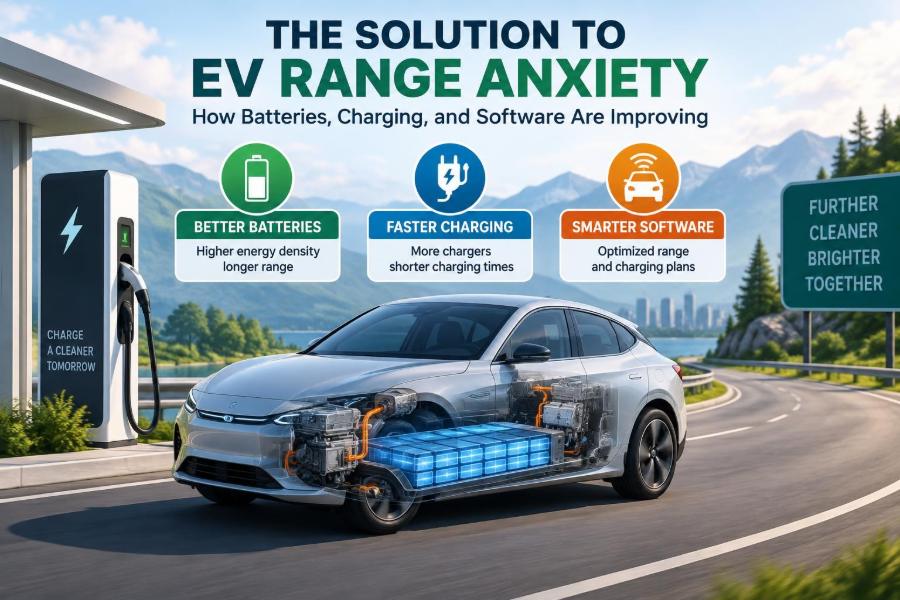
EV range anxiety will fade most effectively when batteries, charging infrastructure, vehicle efficiency, and software become reliable as one connected system. 🚗🔋⚡