
A new car may feel effortless during a short test drive. The doors close with a solid sound, the engine starts instantly, and the cabin is quiet. What is much harder to see is the enormous amount of testing behind those ordinary moments.
A vehicle must work through hot summers, freezing mornings, potholes, traffic jams, wet roads, rough parking surfaces, repeated braking, and years of vibration. It must also protect occupants when something goes wrong, often in a fraction of a second.
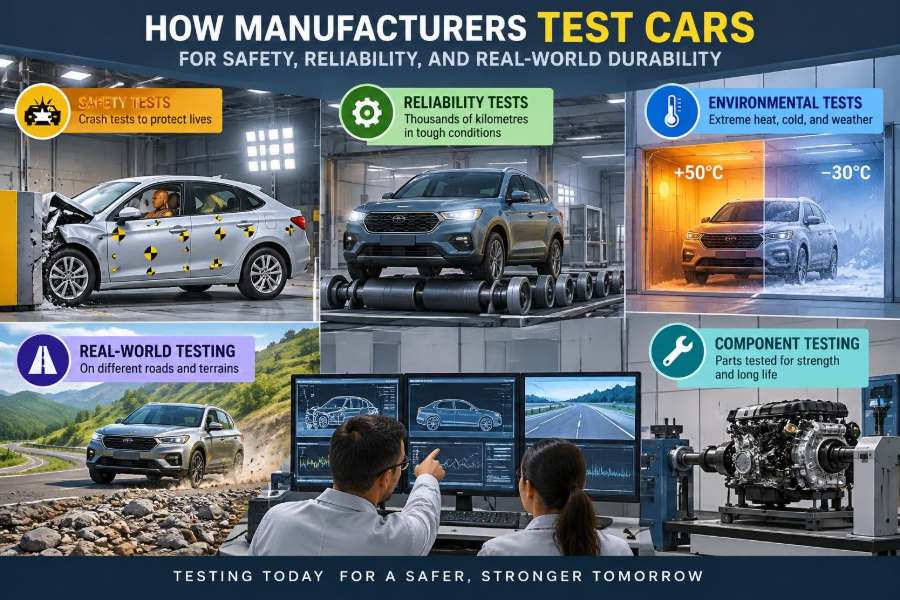
For manufacturers, testing is not a single crash in a laboratory or a long drive around a proving ground. It is a layered engineering process that begins before a physical prototype exists and continues after production starts.
Understanding that process helps students connect classroom subjects such as materials, vehicle dynamics, electronics, thermodynamics, and manufacturing with the real decisions that shape a dependable automobile.
🧭 Testing Is a System, Not One Event
Vehicle development uses many test types because a car is a system of systems. A strong body structure alone is not enough if braking control, restraint systems, tyres, software, wiring, cooling, and manufacturing quality do not work together.
Engineers usually move from computer analysis to component tests, subsystem tests, complete-vehicle tests, and production monitoring. Each stage answers a different question and exposes problems at a different cost.
Finding a weak bracket in a digital model is relatively simple. Finding it after thousands of vehicles have been built may require redesigned parts, service campaigns, and difficult communication with customers.
🎯 Defining Requirements Before Building Prototypes
Testing starts with requirements. These are measurable targets for safety, performance, durability, comfort, emissions compliance, electrical operation, and customer use.
A requirement might specify that a door must continue to latch after a particular structural event, that a cooling system must maintain acceptable temperatures under demanding use, or that a control function must respond within a defined time.
Good requirements are traceable: engineers should be able to connect a customer need, a design feature, a test method, and the evidence showing whether the target was met. Vague statements such as “make it durable” are not test plans.
💻 Virtual Engineering and CAE Models
Before metal is cut, teams use computer-aided engineering, often shortened to CAE, to predict behaviour. Finite element analysis divides a structure into many small elements so software can estimate stress, deformation, vibration, and energy absorption.
Computational fluid dynamics helps examine airflow through radiators, around body panels, and beneath the vehicle. Multibody simulations can model suspension movement, steering geometry, and load transfer during braking or cornering.
Simulation reduces the number of physical iterations, but it does not replace them. A model is only as useful as its assumptions about materials, joints, boundary conditions, loads, and real-world variation.
🧪 Material Coupons Reveal Basic Behaviour
Long before a full door beam or suspension arm is tested, engineers test small material samples called coupons. Tensile testing measures how a sample stretches and eventually fractures under a pulling load.
Other tests may evaluate hardness, impact response, fatigue resistance, corrosion behaviour, coating adhesion, or behaviour at high and low temperatures. These results help engineers select steel grades, aluminium alloys, polymers, adhesives, and composites.
Material data cannot predict every component failure by itself. A part’s geometry, welds, fasteners, surface finish, and manufacturing process can create local weaknesses that a simple coupon does not represent.
🔩 Component-Level Durability Testing
Component testing isolates a part and applies controlled loads repeatedly. A seat track may be moved through many cycles, a window regulator may be operated again and again, and a suspension bushing may be twisted under representative loads.
This approach makes failures easier to diagnose. If a bracket cracks, engineers can inspect the crack origin, compare it with stress predictions, and determine whether the solution is a thicker section, a different radius, stronger material, or a revised load path.
Repeated loading matters because many automotive failures are caused by fatigue: progressive damage from cycles that may individually be well below the load needed to break a new part in one pull.
🏗️ Body Structure and Load Paths
The body-in-white is the welded or bonded structural shell before trim, glass, and many mechanical parts are installed. Engineers examine its stiffness, mass, joint quality, and ability to direct crash loads through intended paths.
In a collision, some regions are designed to deform in a controlled way and absorb energy. Other regions, particularly around the passenger compartment, must preserve survival space as far as practical.
Load paths are not simply “stronger is safer.” An extremely rigid front structure can transmit high deceleration to occupants, while an uncontrolled weak structure may collapse too quickly. Safety design is a managed balance of deformation, force, and occupied space.
💥 Crash Testing and Energy Management
Physical crash tests validate the interaction of structure, restraints, seats, steering systems, and sensors. The exact configurations depend on the markets in which a vehicle will be sold and the safety goals set by the manufacturer.
Crash test dummies contain instruments that record motions and forces at selected body regions. High-speed cameras, load cells, and post-test measurements help engineers understand not only whether damage occurred, but when and how it developed.
A crash result is never explained by one feature. Belt load limiters, airbags, seat structure, pedal movement, steering-column behaviour, and body deformation must act as a coordinated system.
🧍 Occupant Restraints Must Work Together
Seat belts are the primary restraint system in normal driving and many collisions. Pretensioners can remove belt slack early in a crash, while load limiters can manage belt force as the occupant moves forward.
Airbags supplement belts; they are not substitutes for properly wearing them. Their deployment timing and inflation characteristics depend on sensor information, occupant position strategies, crash severity, and vehicle architecture.
Engineers also assess seats, head restraints, child-restraint attachment points, and interior contact surfaces. A restraint system that performs well for one body size or seating position must be considered across a broader range of expected occupants and conditions.
🚶 Protecting People Outside the Vehicle
Vehicle safety work also considers vulnerable road users, including pedestrians and cyclists. Exterior geometry, bonnet space, bumper design, active safety systems, and sensor performance can all affect outcomes in a potential impact.
Some vehicles use deployable mechanisms or active bonnets intended to create additional space between the outer panel and hard components below it. Whether such systems are used depends on vehicle design and applicable requirements.
Prevention remains especially valuable. Automatic emergency braking and pedestrian detection may reduce impact speed or avoid some collisions, but their performance can be limited by visibility, weather, sensor obstruction, road geometry, and system operating conditions.
🛑 Brake Testing Beyond Stopping Distance
Brake development examines more than the shortest possible stop on dry pavement. Engineers evaluate stability, pedal feel, fade resistance, parking-brake holding ability, wet performance, noise, wear, and electronic brake-control behaviour.
Brake fade occurs when repeated high-energy stops raise component temperatures enough to reduce braking effectiveness or change pedal response. A mountain descent, towing duty, or repeated track-like braking can stress the system differently from one emergency stop.
Anti-lock braking systems help maintain tyre rotation during severe braking, allowing the driver to retain more steering control than with locked wheels. They cannot overcome the available grip of a wet, icy, loose, or worn surface.
🌀 Handling, Stability, and Vehicle Dynamics
Vehicle dynamics engineers study how a car responds to steering, braking, acceleration, wind, surface changes, and load transfers. Their aim is not merely high cornering capability; it is predictable behaviour that a typical driver can understand.
Tests may include lane changes, split-friction braking, steady cornering, obstacle avoidance, and evaluation on low-grip surfaces. Instrumented measurements are combined with trained-driver feedback because numbers alone may not capture confidence or controllability.
Electronic stability control can selectively brake wheels and reduce propulsion torque when it detects a developing skid. Its effectiveness depends on correct sensors, tyres, brakes, calibration, and the physical limits of the road surface.
🛞 Tyres Are Part of Every Safety Test
Tyres are the vehicle’s only intended contact patches with the road. Their compound, tread pattern, construction, pressure, temperature, and wear condition influence braking, cornering, aquaplaning resistance, ride, noise, and efficiency.
A vehicle tuned with one tyre specification can feel substantially different with another approved size or construction. This is why manufacturers test tyres as part of the vehicle rather than treating them as interchangeable accessories.
For owners, correct inflation and timely replacement are practical safety measures. Even advanced driver-assistance systems can only use the grip that the tyres and surface provide.
🌧️ Weather, Water, Dust, and Corrosion
Environmental testing exposes vehicles and components to heat, cold, humidity, water spray, mud, dust, salt, sunlight, and rapid temperature changes. The goal is to reveal effects that may take years to appear in ordinary use.
Corrosion testing is particularly relevant where roads are treated with salt or where humid coastal air is common. Engineers inspect seams, fasteners, underbody coatings, electrical connectors, drainage paths, and areas where moisture can remain trapped.
A laboratory salt exposure is an accelerated comparison tool, not a perfect copy of every owner’s environment. Real corrosion also depends on driving patterns, washing habits, damage to coatings, local climate, and design details.
❄️ Hot and Cold Climate Validation
Extreme temperatures challenge batteries, lubricants, seals, plastics, cooling systems, heating systems, displays, and electronic modules. A cold start can reveal slow cranking, stiff seals, weak HVAC performance, and reduced battery capability.
High ambient temperatures increase thermal loads on engines, motors, power electronics, transmissions, batteries, and air-conditioning systems. Engineers test difficult combinations, such as climbing under load with occupants and cooling demand.
Temperature cycling is valuable because different materials expand and contract at different rates. Over time, this can loosen joints, stress solder connections, create leaks, or cause cosmetic gaps.
📳 Vibration, Noise, and Harshness
NVH means noise, vibration, and harshness. It covers everything from engine boom and tyre roar to steering-wheel shake, wind noise, rattles, and the sharpness felt over a road joint.
Engineers use accelerometers, microphones, vibration rigs, and subjective evaluations to trace a noise path from source to cabin. A rattle may originate from a small clip, but the vehicle body can amplify or transmit it.
NVH is not only a comfort concern. Persistent vibration can fatigue brackets, loosen connections, obscure warning sounds, and make a driver less willing to notice important changes in vehicle behaviour.
🛣️ Proving Grounds Reproduce Difficult Roads
Proving grounds provide repeatable roads and obstacles that would be unsafe, inconvenient, or impossible to use consistently on public highways. Surfaces may imitate potholes, broken pavement, cobblestones, washboard tracks, steep grades, and banked turns.
Repeatability is a major advantage. If a dashboard rattle occurs at a particular speed on a particular rough surface, engineers can return to the same condition after each design change.
Test tracks do not eliminate public-road development. They complement it by providing controlled severity, secure instrumentation, and a safe place to investigate vehicle limits.
🧳 Real-World Load Cases Matter
A vehicle’s behaviour changes with passengers, luggage, roof loads, trailers, and uneven cargo distribution. Suspension travel, headlamp aim, braking balance, cooling demand, and acceleration performance can all be affected.
Manufacturers test defined loading conditions based on the vehicle’s intended use. A family SUV, delivery van, pickup, and performance coupe need different representative cases.
Owners should not assume that an advertised payload permits any loading arrangement. Axle limits, tyre ratings, towing limits, cargo securement, and stability requirements still apply.
🔌 Electrical Systems Face Hidden Stresses
Modern cars contain extensive wiring, connectors, control modules, sensors, motors, and communication networks. Electrical validation examines voltage variation, current loads, water intrusion, vibration, electromagnetic interference, and connection durability.
A connector that works on a clean laboratory bench may fail after heat, road spray, vibration, and repeated mating cycles. Sealed connectors, routing clips, strain relief, and grounding design are therefore critical details.
Electromagnetic compatibility testing checks whether a vehicle’s electronic equipment can operate without causing unacceptable interference with other systems. This is increasingly important as vehicles add wireless functions, radar, cameras, and high-voltage power electronics.
🧠 Software Verification Is Vehicle Verification
Software now controls or influences powertrain operation, battery management, braking functions, displays, connectivity, driver assistance, and diagnostics. A mechanical design can be sound while an incorrect software state creates poor or unsafe behaviour.
Development teams use reviews, simulations, bench testing, hardware-in-the-loop rigs, and vehicle tests. In hardware-in-the-loop testing, a real controller is connected to equipment that imitates sensors, actuators, and vehicle conditions.
Software testing must include unusual inputs and fault conditions, not just ideal operation. For example, engineers may examine sensor disagreement, low voltage, interrupted communication, implausible signals, and restart behaviour.
📡 Validating Driver-Assistance Features
Camera, radar, ultrasonic, and other sensing systems require careful validation. Engineers assess object detection, tracking, warnings, braking requests, lane interpretation, false alerts, and how the system behaves when its confidence is low.
Real roads are complex: faded markings, glare, rain, shadows, roadworks, unusual vehicles, and partially obscured objects can challenge perception systems. This is why system limitations in the owner information matter.
Driver assistance is best understood as assistance. The driver remains responsible for attentive driving unless a vehicle is specifically designed, approved, and operated under conditions that assign responsibility differently.
🔋 Testing Electrified Powertrains
Hybrid and electric vehicles add high-voltage batteries, electric machines, inverters, charging systems, thermal management, and isolation monitoring. These systems are tested for performance, durability, electrical protection, thermal behaviour, and fault response.
Battery evaluation can include charge-discharge cycling, temperature exposure, vibration, mechanical protection, and monitoring of cell and pack behaviour. Engineers must account for the fact that battery performance and ageing vary with temperature and use.
High-voltage safety depends on multiple layers: physical protection, insulation, monitoring, contactors, interlocks, warning labels, and procedures for service personnel. No single feature should be treated as the entire safety strategy.
⛽ Powertrain Endurance and Emissions Development
For combustion vehicles, engines and transmissions are tested through varied speed, load, temperature, and start-stop conditions. Engineers watch lubrication, combustion, cooling, shifting, driveline vibration, fuel delivery, and long-term wear.
Emissions-control systems must operate over a wide range of conditions, including warm-up periods and changing ambient temperatures. Calibration involves trade-offs among drivability, fuel use, component protection, emissions performance, and customer expectations.
Laboratory cycles are useful for repeatability, while road testing exposes additional variation. Neither method alone represents every driver, route, climate, maintenance condition, or traffic pattern.
🏭 Manufacturing Validation Prevents Variation
A design that works in a prototype workshop may behave differently on a high-volume production line. Production validation checks tooling, weld quality, adhesive application, torque processes, panel fit, software installation, and inspection methods.
Manufacturers use process controls to detect variation before it reaches customers. For example, torque tools can record whether a fastener was tightened within its specified window, while vision systems may check the presence or position of a component.
Quality is not achieved solely through final inspection. It is built into repeatable processes, clear work instructions, supplier controls, training, measurement systems, and feedback from detected defects.
🔍 End-of-Line Checks Catch Immediate Issues
After assembly, vehicles commonly undergo checks for functions such as lights, warning indicators, brakes, alignment-related measurements, fluid levels, diagnostic faults, and water leaks. The exact procedures vary by plant and vehicle.
Some checks are automated; others require trained inspectors or short vehicle drives. Their purpose is to catch assembly-related issues, not to repeat every development test performed during years of engineering.
A passed end-of-line check does not mean a vehicle has experienced every possible condition. It means it met the defined production checks at that point in time.
📊 Reliability Growth Comes From Failure Analysis
Reliability work treats failures as information. When a part fails, engineers ask what happened, under what conditions, how often it could occur, which vehicles may be affected, and whether the cause is design, material, process, service, or use.
Useful investigations distinguish the visible symptom from the root cause. A blown fuse, for example, may be the final protective event rather than the original defect.
Teams often use structured tools such as fault trees, cause-and-effect diagrams, design reviews, and failure mode and effects analysis. The aim is to reduce the chance of recurrence, not merely replace the failed part.
🗂️ FMEA Helps Engineers Think Ahead
Failure mode and effects analysis, or FMEA, is a structured way to ask how a component or process could fail, what the consequences would be, how the issue might be detected, and what prevention is appropriate.
For a cooling pump, potential modes might include loss of flow, leakage, electrical failure, or abnormal noise. The analysis encourages engineers to consider effects on temperature control, warning strategies, component damage, and customer experience.
FMEA is most valuable when it changes decisions early. Treating it as paperwork completed after the design is fixed misses its preventive purpose.
🚦 Field Data Extends Testing After Launch
Development testing cannot reproduce every road, driver, climate, maintenance history, and supplier variation. Once vehicles are in service, warranty reports, repair information, customer feedback, and returned-part analysis provide another source of learning.
A field trend does not automatically prove a design defect. Engineers must account for mileage, operating conditions, maintenance, modification, accident damage, and the number of vehicles exposed to a condition.
When evidence indicates a safety concern, manufacturers may issue service actions or recalls according to applicable regulations and their assessment of the risk. The response depends on the issue and jurisdiction.
⚖️ Regulations Set Floors, Not the Whole Goal
Vehicle regulations define mandatory requirements in many areas, but compliance is not the same as perfection. Manufacturers may set internal targets above a minimum requirement, especially where customer expectations, brand positioning, or foreseeable use justify it.
Requirements also differ by market. A car sold internationally may need to satisfy several sets of rules, climate conditions, fuel specifications, road environments, and consumer expectations.
Engineering choices therefore involve constraints. More reinforcement may improve one crash response while adding mass; added sensors may support a feature while increasing cost, complexity, and validation effort.
⚠️ Why “Tested” Does Not Mean Indestructible
A tested vehicle still has limits. It can be damaged by impacts beyond its design conditions, overloaded, poorly maintained, modified incorrectly, driven on unsuitable terrain, or operated with worn tyres and ignored warning lights.
Testing uses representative and deliberately severe conditions, but no finite programme can cover every possible event. Engineering confidence comes from evidence across many methods, not from a promise that failure is impossible.
This distinction is useful for professionals and owners alike: safety margins are valuable, but they are not permission to disregard operating limits or maintenance needs.
🛠️ What Owners Can Learn From Development Testing
The habits that protect a vehicle in ordinary life are closely connected to the conditions engineers evaluate. Follow the specified service schedule, use approved fluids and tyre sizes, respond to warning messages, and secure cargo correctly.
- Maintain tyre pressures using the vehicle manufacturer’s recommended values for the load condition.
- Do not ignore new vibrations, brake pull, fluid leaks, repeated warning lamps, or unusual electrical behaviour.
- Be cautious with suspension lifts, lighting changes, wheel modifications, wiring additions, and software changes that may alter tested behaviour.
- Use child restraints, towing equipment, and roof carriers exactly as intended for the vehicle.
These steps do not make a car new forever, but they help preserve the systems that were developed and validated as a package.
🎓 Skills Behind a Modern Test Programme
Vehicle testing is deeply interdisciplinary. Mechanical engineers work on structures, mechanisms, thermal systems, and fatigue; electrical engineers work on power distribution and sensors; software engineers develop and verify control logic.
Test engineers must also understand instrumentation, data acquisition, uncertainty, safe operating procedures, and clear reporting. A test is only useful when the setup represents the question being asked and the data can be interpreted correctly.
Communication matters as much as technical skill. A test report must explain conditions, methods, results, limitations, anomalies, and recommended next actions so that design teams can make sound decisions.
🔗 The Core Principle: Validate the Whole Vehicle
The central lesson is that cars are not validated through one dramatic test. They are developed through connected evidence: simulations guide designs, components reveal local weaknesses, full vehicles expose interactions, production checks control variation, and field feedback improves future decisions.
The best test strategy matches the method to the risk. A computer model may be ideal for comparing structural concepts, a bench rig for cycling a motor, a climate chamber for thermal exposure, and road testing for the combined effects of real use.
Safety, reliability, and durability are therefore not isolated departments or final checkpoints. They are engineering qualities built into requirements, designs, materials, software, manufacturing processes, and responsible ownership.
A vehicle earns trust not because it survives one test, but because its many systems have been challenged, measured, improved, and validated together. 🚗🔧🛣️