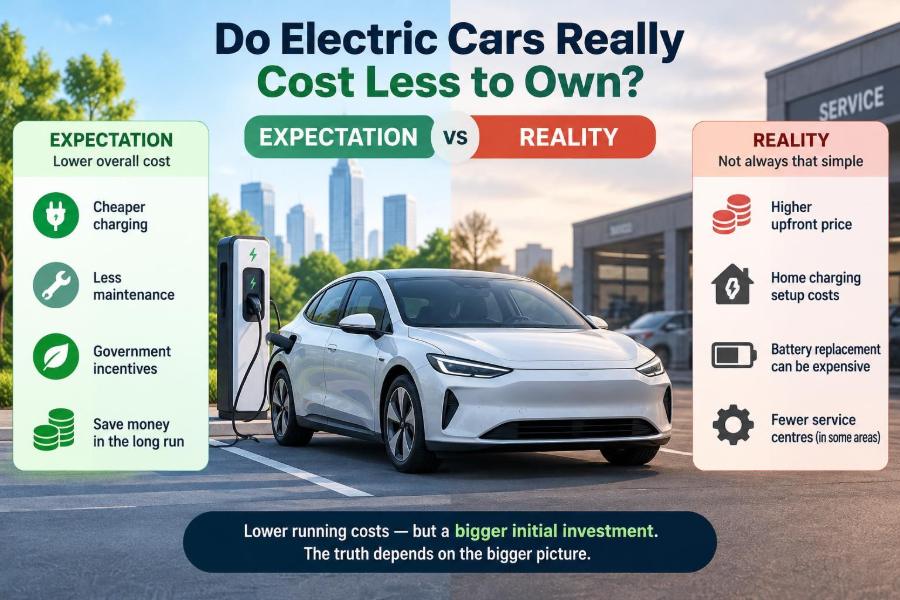

Picture two neighbours buying similarly sized new cars. One chooses a battery-electric vehicle, while the other buys a conventional petrol model. A few months later, the electric-car owner proudly mentions charging overnight for less than a typical fuel stop.
That sounds like a simple win. But then there is the higher purchase price, a home charger to consider, insurance quotes, tyre wear, public-charging prices, and the possibility that resale values will move in unexpected ways.
For students learning vehicle systems and professionals advising customers, this question is more useful than a debate about which powertrain is “better.” It is a question of total cost of ownership: every major cost of having, using, maintaining, and eventually selling a vehicle.
Electric cars can cost less to own, often substantially in the right conditions. But the saving is not automatic. It depends on where and how the vehicle is charged, how far it travels, its purchase arrangement, and the local market around it.
🔍 Start With Total Cost of Ownership
Total cost of ownership, often shortened to TCO, is the broadest useful way to compare cars. It includes costs that occur before driving, during daily use, and when the car is sold or returned.
A realistic comparison considers purchase price or finance payments, energy, servicing, repairs, insurance, taxes and fees, tyres, depreciation, and charging equipment. Focusing only on electricity versus petrol is like comparing two houses only by their monthly utility bill.
💰 The Upfront Price Still Matters
An electric vehicle may carry a higher list price than an equivalent internal-combustion-engine vehicle, although the gap varies sharply by market, model size, and equipment. A higher initial price can outweigh lower running costs for a low-mileage owner.
However, list price is not always the amount paid. Dealer discounts, manufacturer incentives, fleet arrangements, and used-vehicle availability can change the comparison. Compare the actual transaction price, not the most visible number on an advertisement.
📉 Depreciation Is Usually the Largest Hidden Cost
Depreciation is the value a car loses over time. It is often one of the biggest ownership costs, even though it does not appear as a monthly bill.
Electric-vehicle resale values can be affected by changing new-car prices, rapid product updates, battery-range expectations, charging standards, and local demand. Petrol and diesel cars also depreciate, of course; the important point is that neither powertrain has a fixed, guaranteed resale outcome.
🧾 Purchase, Lease, or Salary Arrangement?
The cheapest ownership route is not always the lowest cash price. A buyer who keeps a vehicle for many years experiences depreciation differently from a lessee who returns it after a fixed term.
Leasing can make costs predictable but may include mileage limits and condition charges. In some workplaces, salary-sacrifice or company-car arrangements alter the personal tax treatment. These rules are location-specific, so they should be checked rather than assumed.
⚡ Electricity Is Not One Universal Price
“Electricity costs less than petrol” is broadly true in many home-charging situations, but electricity is sold at very different prices. A home overnight tariff, a workplace charger, a motorway rapid charger, and a destination charger can produce very different cost-per-kilometre results.
The relevant calculation is simple: vehicle energy use in kilowatt-hours per 100 km multiplied by the electricity price per kilowatt-hour. A car that uses 18 kWh/100 km costs far less on a low home tariff than on premium public rapid charging.
🏠 Home Charging Changes the Equation
Reliable home charging is often the strongest economic advantage of owning an EV. The vehicle can charge while parked, and the driver can choose lower-priced time periods where such tariffs exist.
It also reduces time spent visiting fuel stations or public chargers. That convenience has value, even if it is difficult to put into a spreadsheet. Apartment residents and people without dedicated parking may not receive this advantage as easily.
🔌 The Cost of Installing a Charger
A dedicated home charge point may require an electrician, cabling, protective devices, and sometimes upgrades to the property’s electrical installation. Installation difficulty depends on the distance from the electrical panel, parking layout, and local regulations.
This is a one-time cost, not a cost per trip. It should be included in the first-year or multi-year comparison, particularly for a household buying its first EV. In some cases, safe use of an existing socket may be possible only at a lower charging rate; professional advice is sensible.
🛣️ Public Rapid Charging Can Reduce Savings
Rapid and ultra-rapid chargers are valuable for long journeys and drivers without home charging. They provide speed and flexibility, but the electricity price may be much higher than domestic electricity.
A driver who relies almost entirely on premium public charging may still enjoy lower energy costs than a fuel vehicle, but the margin can narrow considerably. The comparison must use the driver’s actual charging mix, not an idealised overnight tariff.
⛽ Compare Energy Costs Fairly
Fuel consumption is commonly expressed in litres per 100 km, while EV efficiency is expressed in kWh per 100 km. Both units describe how much energy the car needs to travel a distance, but their prices and real-world variability differ.
| Comparison item | Electric vehicle | Petrol or diesel vehicle |
|---|---|---|
| Energy-use measure | kWh per 100 km | Litres per 100 km |
| Best-cost refuelling route | Often home or workplace charging | Lower-price fuel retailer |
| Long-trip cost risk | High-priced rapid charging | Fuel-price variation by region |
| Efficiency in urban driving | Often favourable through regeneration | Often reduced by idling and stop-start use |
Use comparable routes, annual distance, and local prices. A headline claim based on one unusually cheap tariff or one unusually expensive fuel station is not a useful ownership forecast.
🌡️ Weather Changes Real-World Consumption
Cold weather can reduce EV range because the battery and cabin need energy for heating, while battery chemistry operates less efficiently at low temperatures. High speeds, heavy rain, strong winds, steep gradients, and towing also increase consumption.
Combustion cars are affected by weather too, particularly during short cold journeys. The difference is that an EV owner notices changing consumption directly as a reduction in displayed range. Plan winter costs using realistic seasonal energy use rather than the most favourable test figure.
🏙️ City Driving Often Favours Electric Power
Electric motors are efficient at low speeds and do not consume energy while idling in the same way as a running combustion engine. They can also recover some kinetic energy during deceleration through regenerative braking.
This makes urban commuting and stop-start delivery work potentially favourable use cases, especially when charging is available at a depot or home. Regeneration does not create free energy; it recovers part of energy that would otherwise be lost as heat at the brakes.
🛤️ Motorway Use Narrows the Gap
At sustained high speed, aerodynamic drag rises quickly and all vehicles use more energy. EVs remain efficient machines, but their range falls more noticeably than many drivers expect when speed, cold weather, and cabin heating combine.
For a frequent long-distance driver, charging stops and rapid-charging prices deserve serious weight in the ownership calculation. A larger-battery EV may reduce charging stops, but it can cost more to buy and may weigh more.
🔧 Fewer Service Items, Not Zero Maintenance
An EV has no engine oil, oil filter, exhaust after-treatment system, spark plugs, or conventional multi-ratio gearbox in the usual sense. This removes several routine service operations.
But EVs still need inspections and maintenance. Brake fluid, coolant circuits where fitted, cabin filters, suspension components, wheel alignment, air-conditioning systems, wiper blades, and tyres do not disappear when the engine is removed.
🛑 Regenerative Braking Helps, but Brakes Need Care
Because regeneration handles much everyday deceleration, friction brake pads and discs may last longer. That can lower replacement frequency, especially in city use.
Less frequent friction-brake use can also allow corrosion or sticking mechanisms to develop in wet or salty environments. Regular inspection and appropriate use of the brakes remain necessary. Longer pad life is a benefit, not permission to ignore the brake system.
🛞 Tyres Are a Genuine Running Cost
Tyres carry the same responsibilities in every car: grip, braking, steering response, load capacity, and ride comfort. EVs can be heavier than similar combustion cars because of the battery, and electric motors deliver torque immediately.
Aggressive acceleration, poor alignment, underinflation, and heavy vehicle mass can increase tyre wear. Some EV-specific tyres are designed for load, noise, and rolling resistance, but the right choice depends on the vehicle manufacturer’s specifications and the driver’s conditions.
🔋 What Battery Degradation Really Means
Battery degradation is the gradual loss of usable energy capacity over time and use. It normally appears as reduced range, not as a sudden inability to drive.
Rate of degradation depends on battery chemistry, temperature exposure, charging habits, vehicle thermal management, mileage, and calendar age. It is not possible to predict an individual battery’s future condition from a single rule such as “never fast charge.”
🛡️ Battery Warranties Reduce, Not Remove, Risk
Many EVs include a separate traction-battery warranty with conditions related to time, distance, and sometimes retained capacity. The exact coverage differs by manufacturer and country.
A warranty is valuable protection, but buyers should read what triggers a remedy and what exclusions apply. It does not mean every small range change is repaired, nor does it make the battery’s long-term market value certain.
🏥 Major Repairs Are Less Frequent but Can Be Costly
Electric drivetrains have fewer moving mechanical parts than combustion powertrains, which can reduce routine failure points. Yet an EV contains high-voltage electronics, charging hardware, cooling systems, sensors, and complex software.
A serious battery-pack, inverter, or collision repair can be expensive, particularly outside warranty. Repairability, parts availability, technician training, and insurer-approved repair networks can therefore matter as much as the vehicle’s advertised efficiency.
🧰 Software Is Part of Ownership
Modern EVs often receive software updates that can improve charging behaviour, energy management, infotainment, or driver-assistance functions. This is a practical advantage when updates are well supported.
It also means ownership depends partly on software quality and manufacturer support. Before buying, check how updates are delivered, whether features require subscriptions, and how the vehicle behaves if a connected service expires.
🛡️ Insurance Depends on More Than Powertrain
Insurance premiums are set by many factors: driver profile, location, repair costs, theft risk, vehicle value, safety systems, claims history, and insurer experience with the model. EV insurance is not automatically cheaper or more expensive.
Some models may attract higher premiums because a damaged battery area requires specialist assessment or because parts take longer to obtain. Obtain real quotes for the exact vehicle before treating a low running-cost estimate as final.
🏛️ Taxes, Fees, and Policy Benefits Can Move
Registration charges, annual taxes, congestion-zone rules, parking discounts, and workplace-charging support differ between jurisdictions. They can make a major difference to a fleet operator or city commuter.
Policy is changeable. A benefit available when a vehicle is purchased may be reduced, capped, or removed later. Treat incentives as a current input to the calculation, not a permanent property of electric motoring.
🏢 Fleet Use Can Favour EVs Strongly
Fleets with predictable routes, overnight depot parking, and high annual mileage can use EVs very effectively. Centralised charging makes energy spending easier to manage, and high utilisation allows fuel and service savings to accumulate quickly.
That does not make every commercial route suitable. Emergency response, remote work sites, irregular towing, and long shifts with limited dwell time may require careful charging design or a different powertrain choice.
🏘️ Apartment Living Needs a Different Calculation
Drivers in flats or shared housing may depend on public infrastructure, landlord approval, or communal chargers. Access can be more important than a vehicle’s official range.
Questions to ask include who pays for electricity, whether bays are reliably available, how billing is managed, and whether the charging equipment can expand as more residents buy EVs. A convenient public charger near home can work well, but it is not identical to charging on one’s own driveway.
🧭 Range Anxiety and Cost Anxiety Are Related
Range anxiety is often described as fear of running out of charge. In practice, many experienced EV drivers plan around charging stops successfully, especially on familiar routes.
There is also cost anxiety: uncertainty about whether a charger will work, how payment is handled, or what the final session price will be. Clear charging information and a backup plan are practical ownership tools, not signs that the technology has failed.
🧮 Build a Personal Five-Year Estimate
A useful estimate does not need false precision. Set out likely costs over a period such as three or five years, then test the result against less favourable energy prices and resale values.
- Start with the actual purchase price, deposit, finance interest, or lease payments.
- Estimate annual kilometres from your own travel pattern, not national averages.
- Use realistic energy consumption for your climate and driving mix.
- Separate home, workplace, and public-charging electricity prices.
- Add insurance quotes, servicing, tyres, taxes, parking, and charger installation.
- Use a cautious resale-value assumption rather than the best advertised trade-in figure.
This approach turns a broad argument into a decision based on your constraints.
📊 A Hypothetical Comparison
Imagine two similarly practical cars driven 15,000 km each year. The EV is charged mostly at home, with a small share of public rapid charging; the petrol car is fuelled at typical local pump prices. In this situation, the EV may build a meaningful energy-cost advantage over several years.
Now change only one condition: the EV owner has no home charging and buys most energy from expensive rapid chargers. The advantage may become much smaller, while the higher purchase price and depreciation remain. These are hypothetical scenarios, not predictions for every model or country.
🚫 Common Comparison Mistakes
The most common error is comparing the EV’s best-case electricity price with the combustion car’s worst-case fuel price. Another is forgetting that a cheap used petrol car may be financially hard to beat, even if an EV has lower daily operating costs.
- Comparing different vehicle sizes, performance levels, or equipment.
- Ignoring finance interest and focusing only on sticker price.
- Assuming official range equals winter motorway range.
- Leaving charger installation and insurance out of the first-year budget.
- Treating tax incentives or resale values as guaranteed for years ahead.
🧑🔧 Questions to Ask Before Buying
Ask where the car will charge on ordinary weekdays, not just on holidays. Then ask how often you make journeys beyond its comfortable real-world range, whether you can charge at work, and how long you expect to keep the vehicle.
Also investigate battery warranty terms, service intervals, local repair support, tyre specifications, public-charging reliability on regular routes, and insurance. A good EV ownership decision is largely a planning decision.
⚖️ When an EV Is Likely to Cost Less
An EV is often well placed financially when the owner can charge cheaply at home or work, drives enough kilometres for lower energy and maintenance costs to accumulate, and chooses a vehicle that genuinely suits their daily range needs.
Urban drivers, multi-car households, predictable commuters, and fleets with depot charging often fit this pattern. The result improves when purchase price, finance terms, and expected resale value are reasonable rather than assumed to be favourable.
🚧 When the Saving May Be Small or Absent
The case is less clear for a buyer with very low annual mileage, no dependable charging, frequent costly rapid charging, or a significantly cheaper suitable combustion alternative. A short ownership period can also make the initial price and depreciation especially influential.
This does not mean an EV is a poor choice. It means reasons such as quiet driving, local emissions reduction, home-charging convenience, or workplace policy may matter more than a straightforward cash saving.
🌱 Environmental Value Is Separate From Personal Cost
Operating cost and environmental impact are connected but not identical questions. An EV has no tailpipe emissions while driving, but electricity generation, vehicle manufacturing, battery production, and end-of-life treatment all belong in a wider lifecycle discussion.
For buyers, it is clearer to evaluate both questions honestly: “What will this cost me?” and “What impacts matter to me?” Neither answer should be used as a shortcut for the other.
🎯 The Core Reality Behind the Claim
Electric cars do not automatically cost less simply because they use electricity. Their strongest financial case comes from combining efficient driving with accessible low-cost charging, sensible vehicle selection, and a realistic ownership period.
Conversely, a driver who cannot charge conveniently or who pays a substantial premium for a vehicle they barely use may not recover that premium. The powertrain is one variable in a larger engineering and financial system.
An electric car costs less to own when its charging access, mileage, purchase terms, and expected ownership period work together—not when a single headline figure says it should. Compare the full journey of the vehicle, and the expectation-versus-reality question becomes much easier to answer. 🚗⚡📈